
Before you can build an effective plastic surgery marketing strategy, you need a clear picture of who you’re actually trying to reach. “Anyone who wants a procedure” is not a target audience — it’s a recipe for wasted ad spend and generic messaging that resonates with no one.

The plastic surgery patient base is more diverse than most surgeons assume. There are four primary segments worth understanding:

  • Cosmetic surgery patients: Typically women aged 30–54 pursuing elective aesthetic procedures — breast augmentation, liposuction, facelifts, and tummy tucks are the most common. This group makes up the largest share of surgical volume and responds strongly to trust signals, surgeon credentials, and before-and-after results.
  • Reconstructive patients: Individuals recovering from trauma, cancer, or congenital conditions. These patients often arrive through physician referrals rather than digital search, making referral relationship-building a key channel.
  • Non-surgical aesthetic patients: A younger demographic — often women in their 20s and early 30s — interested in injectables, laser treatments, and preventative care. This segment is highly active on social media and responds well to educational content.
  • Male patients: A fast-growing segment — up 95% in surgical volume since 2018 — seeking rhinoplasty, gynecomastia correction, and body contouring. Men tend to research quietly and value discretion and natural-looking outcomes in your messaging.

Knowing which segments you serve — and which you want more of — shapes every downstream decision in your plastic surgery marketing plan, from which platforms you advertise on to how you write your ad copy.

Not all plastic surgery patients are looking for the same thing — and your marketing shouldn’t treat them like they are. Age, gender, income level, and geography don’t just describe your patients; they tell you where to find them, what to say, and which procedures to lead with. Ignoring these variables is one of the fastest ways to burn through an ad budget with nothing to show for it.

Here’s how the major demographic segments typically map to channels and messaging in a well-structured plastic surgery marketing strategy:

  • Women 25–35: Primarily reachable on Instagram and TikTok. Lead with non-surgical treatments, subtle enhancements, and preventative care. Visual content and short-form video perform best.
  • Women 35–54: Google Search and Facebook are your primary channels. This group is actively researching surgical procedures and weighing surgeon credentials heavily. Trust signals — board certification, patient testimonials, before-and-after galleries — drive conversions.
  • Men 30–50: Reach them on Google and YouTube. Messaging should emphasize discretion, natural-looking results, and recovery time. This segment is growing but still underserved by most practices.
  • Affluent markets: Organic search and reputation platforms like RealSelf and Healthgrades carry significant weight. Premium experience, facility quality, and surgeon pedigree are the differentiators that close the consult.

The takeaway: demographics are your channel map. When you understand who you’re trying to reach, you stop guessing and start allocating budget where it actually produces qualified leads.

Before you can optimize any single channel, you need to understand what a complete plastic surgery marketing plan actually looks like. Most practices that struggle with inconsistent lead flow aren’t failing at one thing — they’re missing several pieces of an integrated system that should work together.

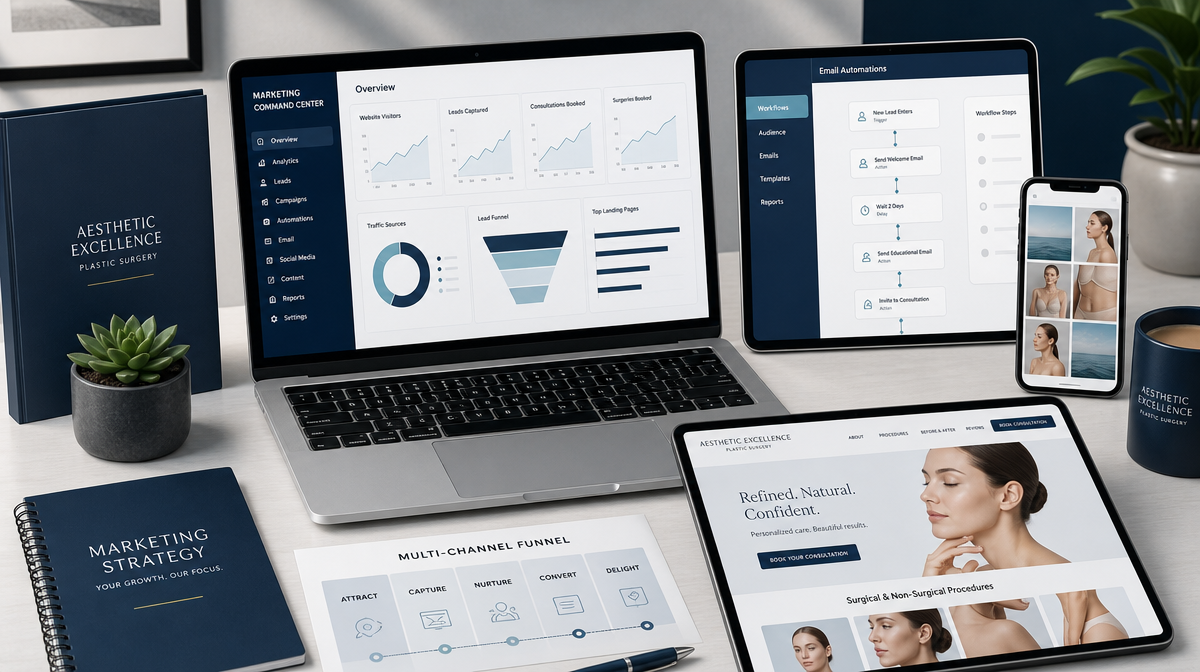
Think of your marketing mix as a flywheel. Each channel feeds the others: SEO brings in organic traffic, your website converts that traffic into consultation requests, paid ads accelerate visibility while your rankings build, and reputation management ensures that every patient who Googles your name likes what they find. Pull one piece out and the whole thing slows down.

Here are the six core channels every modern plastic surgery marketing plan should include:

  • Search Engine Optimization (SEO): The process of ranking your website in organic search results for procedure-specific and local queries — covered in depth in the next section.
  • Paid Search and Social Advertising: Pay-per-click campaigns on Google and Meta that put your practice in front of high-intent patients immediately.
  • Website Design and Conversion: Your digital front door — it must be mobile-responsive, HIPAA-compliant, and built to turn visitors into booked consultations.
  • Reputation and Reviews: Monitoring, generating, and responding to patient reviews across Google, Healthgrades, and RealSelf.
  • Email and Lead Nurture: Automated sequences that keep your practice top-of-mind for prospects who aren’t ready to book yet.
  • Social Media Content: Organic content that builds trust, showcases results, and humanizes your practice for prospective patients.

If someone in your city types “breast augmentation surgeon near me” into Google right now, are you showing up — or is your competitor? That’s the core question plastic surgery SEO answers. SEO (search engine optimization) is the process of improving your website’s visibility in organic, unpaid search results so that patients actively searching for your procedures find you first.

The beauty of SEO as a plastic surgery marketing channel is intent. These aren’t cold audiences scrolling past an ad — they’re people already looking for a surgeon. Capturing that traffic means capturing patients who are much closer to booking a consultation.

A strong plastic surgery SEO strategy covers four interconnected areas:
  • Keyword research: Identifying the exact terms patients search — procedure-specific terms like “tummy tuck [city],” intent-driven phrases like “rhinoplasty recovery time,” and comparison queries like “best facelift surgeon near me.”
  • Technical SEO: The behind-the-scenes infrastructure that helps Google crawl and index your site — page speed, mobile optimization, structured data markup, and clean site architecture.
  • Local SEO and Google Business Profile: Optimizing your Google Business Profile with accurate NAP (name, address, phone), procedure categories, photos, and consistent citations so you appear in the local map pack for “near me” searches.
  • Content authority: Publishing in-depth procedure pages, FAQs, and recovery guides that answer patient questions and signal topical expertise to Google’s ranking algorithm.

SEO compounds over time. The practices that invest consistently in all four layers build a dominant local presence that paid ads simply can’t replicate on their own.

Traffic without conversions is just an expensive hobby. You can run the best plastic surgery marketing campaigns in your market and still lose patients if your website doesn’t do its job — which is to turn curious visitors into booked consultations.

Most plastic surgery websites fail at this because they’re built to impress, not to convert. Pretty design matters, but it has to work alongside clear calls to action, fast load times, and a frictionless path to booking. Every extra click between a visitor and a consultation request is a leak in your funnel.

The highest-converting plastic surgery websites share a few non-negotiable elements:

  • Mobile-first responsive design: More than 60% of patients browse on smartphones. If your site loads slowly or displays awkwardly on mobile, they’re gone before they read a single word.
  • HIPAA-compliant contact forms: Patient inquiries must be encrypted and handled securely. SSL certificates and secure hosting aren’t optional — they’re table stakes.
  • High-quality before and after galleries: Visual proof is the single most influential factor in a prospective patient’s decision. Organize galleries by procedure and make them easy to navigate.
  • Procedure-specific landing pages: A dedicated page for breast augmentation converts better than a generic “services” page because it speaks directly to one patient with one intent.

Your website is the hub that every other channel feeds into. Get this wrong and no amount of ad spend or SEO will save your cost per lead.

SEO builds long-term visibility, but paid advertising puts your practice in front of patients right now. If you’re launching a new procedure, entering a competitive market, or simply want a predictable flow of consultation requests, paid ads are the fastest lever you can pull in plastic surgery marketing.

The two platforms that matter most are Google Ads and Meta (Facebook and Instagram). Each serves a different role in your patient acquisition funnel, and the most successful practices run both simultaneously.

  • Google Search Ads: These target patients who are actively searching for procedures — someone typing “rhinoplasty surgeon in Dallas” is ready to book. You bid on procedure-specific and location-based keywords, and your ad appears at the top of the results page. High intent, high value.
  • Meta and Instagram Ads: These work higher in the funnel. You’re reaching patients who match your ideal demographic — age, location, interests — before they’ve started searching. Visual creative and before/after imagery perform exceptionally well here, building awareness and desire.
  • Retargeting campaigns: Most prospective patients visit your website and leave without converting. Retargeting shows your ads to those visitors as they browse other sites and scroll through social feeds, keeping your practice visible during their weeks-long decision process.

One thing to watch: plastic surgery ads require careful creative and compliance review. Before/after imagery has platform-specific restrictions, and any form collecting patient information must meet HIPAA standards. Work with a team that knows these guardrails before you spend a dollar.

If you spend any time around aesthetic patients, you already know they live on social media. The question isn’t whether your practice should be there — it’s whether you’re showing up in a way that actually drives consultations. A well-executed social media strategy is one of the highest-leverage components of any plastic surgery marketing plan, because it builds trust, showcases results, and keeps your practice visible during the months-long decision journey most patients go through before booking.

Each platform serves a distinct role, and the smartest practices treat them differently:

  • Instagram: The home base for aesthetic practices. Before-and-after posts, Reels, and Stories consistently drive the highest engagement for cosmetic procedures. Research published in the Aesthetic Surgery Journal found Instagram generates the strongest ROI of any social platform for plastic surgeons — particularly among patients under 35.
  • TikTok: A discovery engine for younger demographics. Educational content, behind-the-scenes footage, and procedure explainers perform well here. The format rewards authenticity over polish, which is actually a good thing for surgeons willing to show their personality.
  • YouTube: The second-largest search engine on the planet. Patients actively search for procedure walkthroughs, recovery timelines, and surgeon Q&As. Long-form video content on YouTube builds authority and captures high-intent viewers who are close to booking.
Consistency matters more than perfection. Practices that post regularly, respond to comments, and use platform-native formats outperform those that treat social media as an afterthought.

If you spend any time talking to prospective plastic surgery patients, you’ll hear the same thing over and over: “I read every review before I booked.” That’s not an exaggeration. 84% of patients check online reviews as a critical step before choosing a surgeon, and in a field where trust is everything, your star rating is essentially your first impression.

Your online reputation directly impacts new patient volume — not as a soft metric, but as a hard driver of consult bookings. A well-executed plastic surgery marketing strategy treats reputation management as a core channel, not an afterthought.

Here’s what a complete reputation system looks like in practice:
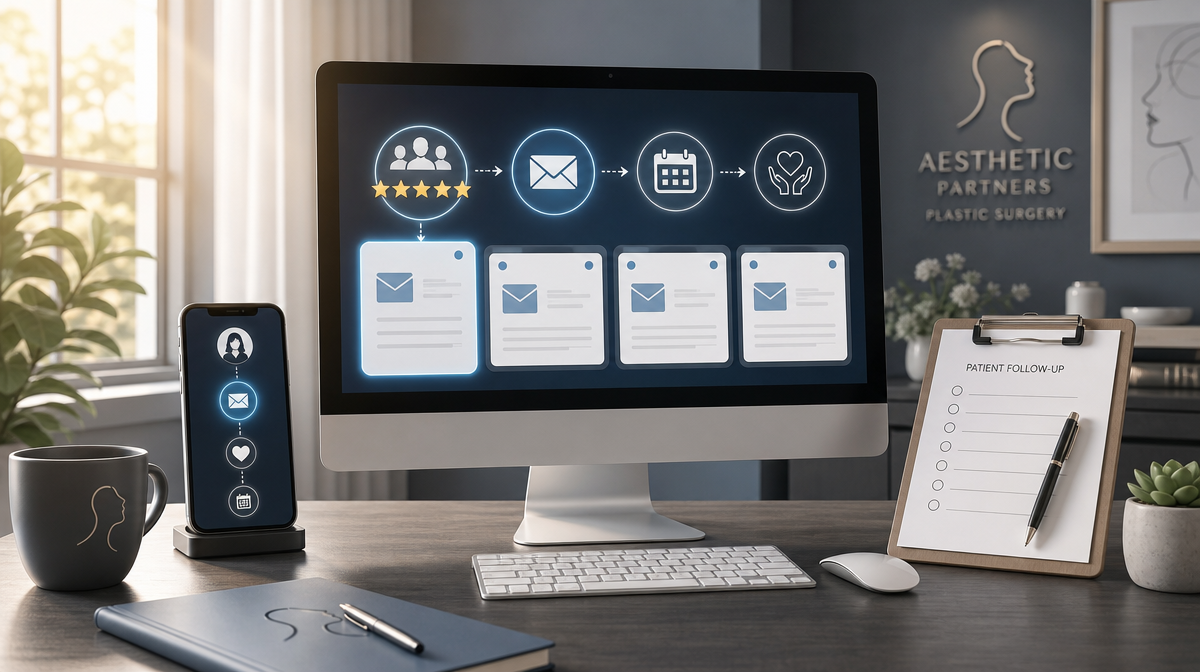
  • Automated review requests: Send email or text prompts to satisfied patients within 24–48 hours of their appointment. 74% of patients would review if asked, and timing matters — the experience is fresh, and the ask feels natural rather than transactional.
  • Multi-platform monitoring: Google gets the most attention, but patients also check Healthgrades, RealSelf, and Yelp. You need visibility and responsiveness across all of them — positive reviews acknowledged, negative ones addressed professionally and promptly.
  • Video testimonials: Written reviews build credibility, but a patient speaking directly to camera about their results is a different level of trust. Embed these on your website and repurpose them across social channels for maximum reach.

The practices winning on reputation aren’t just collecting reviews — they’re systematizing the process so it runs consistently without requiring the surgeon to chase it down manually.

Here’s a reality check: most prospective plastic surgery patients don’t book a consultation the first time they visit your website. They browse, compare, think it over, and then browse some more. The average consideration cycle for elective procedures can stretch from several weeks to several months — which means if you’re not staying in front of those leads, a competitor is.

Email nurture is how you bridge that gap. A well-structured email sequence keeps your practice top-of-mind, builds trust over time, and moves prospects closer to booking without requiring your front desk to manually chase down every inquiry. It’s one of the most underutilized tools in plastic surgery marketing, and one of the highest-ROI channels available.

A complete nurture system for a plastic surgery practice typically includes four sequence types:

  • Welcome sequences: Introduce your surgeons, your philosophy, and what patients can expect during a consultation — before they’ve even walked through the door.
  • Educational drips: Procedure-specific content covering candidacy criteria, recovery timelines, and what results realistically look like.
  • Promotional campaigns: Seasonal offers on non-surgical treatments that re-engage past patients and keep your practice revenue-generating year-round.
  • Post-consultation follow-ups: Targeted messages that address common objections — cost, downtime, fear — and gently encourage leads to commit to a surgery date.

The key is automation. Once these sequences are built, they run in the background while you focus on patients in the chair.

Artificial intelligence is no longer a buzzword for Silicon Valley — it’s actively reshaping how plastic surgery practices attract, engage, and convert patients. The practices winning the new patient race aren’t just running better ads; they’re deploying smarter systems that work around the clock without adding headcount.

Here’s where AI is making the biggest impact in plastic surgery marketing right now:

  • AI-driven SEO and generative search visibility: Google’s AI Overviews — which now appear on ~16% of all queries — summarize answers directly in search results. AI-powered content optimization ensures your practice gets cited in those summaries — not just ranked on page one. This dual-layer visibility is increasingly where high-intent patients first encounter your name.
  • AI chatbots and automated appointment booking: A prospective patient researching rhinoplasty at 11 p.m. isn’t going to wait until morning to get answers. AI chatbots handle real-time questions, qualify leads, and schedule consultations — even when your front desk is closed. That’s revenue that used to walk out the door.
  • Predictive analytics for higher conversion rates: Not every lead is equal. Predictive analytics tools analyze behavioral data — pages visited, time on site, form interactions — to identify which prospects are most likely to book. This lets your team prioritize follow-up intelligently instead of chasing cold leads.

Together, these AI capabilities compress the gap between a patient’s first search and their booked consultation — which matters enormously in a specialty where the average consideration cycle spans several months.

If you can’t measure it, you can’t manage it — and in plastic surgery marketing, unclear ROI is one of the fastest ways to waste serious budget. Every dollar you spend on ads, SEO, and content should trace back to a patient in your chair. That means tracking the right numbers, not just the ones that look good in a monthly report.

There are three core metrics every practice should monitor consistently:

  • Cost Per Lead (CPL): Divide your total marketing spend by the number of leads generated in a given period. This tells you how efficiently your campaigns are attracting prospective patients. A high CPL often signals poor targeting, weak ad creative, or a landing page that isn’t converting.
  • Lead-to-Patient Conversion Rate: The percentage of leads who actually book and complete a procedure. This metric reveals whether your follow-up process is working — and whether the quality of your leads matches your ideal patient profile.
  • Revenue Per Procedure and Practice ROI: Compare the revenue generated from marketing-sourced patients against your total marketing investment. Breaking this down by procedure type — breast augmentation, rhinoplasty, body contouring — helps you identify which services deliver the strongest return and where to concentrate future spend.

Most practices make the mistake of optimizing for traffic and impressions. Those numbers feel good but don’t pay the bills. Your marketing partner should deliver reporting tied directly to consultations booked and procedures completed — not vanity metrics dressed up in a slide deck.

Not every agency that claims to do plastic surgery marketing actually understands it. The cosmetic surgery space has a long patient decision cycle, strict compliance considerations, and a highly visual trust dynamic that generic healthcare marketers routinely get wrong. Choosing the wrong partner costs you more than wasted budget — it costs you patients.

Here’s what to look for before you sign anything:

  • Verify plastic surgery experience specifically. Ask for references from cosmetic or reconstructive surgery clients — not just “healthcare” clients. Dermatology and urgent care are not the same animal. You want an agency that understands why a facelift patient researches for six months before booking and what messaging moves them forward.
  • Demand outcome-based reporting. Traffic and impressions are vanity metrics. Your agency should report on leads generated, consultations booked, and patients acquired. If they can’t tell you your cost per consult, they’re not measuring what matters.
  • Confirm all work is done in-house. Agencies that outsource to overseas contractors lose quality control fast. Ask directly: who writes your content, who builds your campaigns, and where are they located?
  • Ask about performance guarantees. Reputable partners stand behind their work. An agency that hedges every outcome with disclaimers is telling you something about how much confidence they have in their own results.

The right agency functions as a growth partner — one that’s as invested in your new patient volume as you are. That means proactive optimization, transparent reporting, and accountability built into the relationship from day one.

These are the questions we hear most often from plastic surgeons evaluating their marketing options. Here are straight answers.

How much should a plastic surgery practice spend on marketing each month? Most established practices invest between 5% and 10% of gross revenue on marketing. A newer practice trying to build patient volume quickly may need to push closer to 15%. The right number depends on your market, your goals, and how aggressively your competitors are spending. What matters more than the budget itself is what you’re getting for it — leads, consultations, and booked procedures.

How long does it take to see results from plastic surgery SEO? SEO is a long game. Most practices start seeing meaningful ranking improvements within three to six months, with compounding results over time. If you need patients now, paid advertising can generate leads immediately while your organic visibility builds in the background. The smartest plastic surgery marketing strategies run both in parallel.

Is plastic surgery advertising HIPAA compliant? Yes — when done correctly. Patient information must be protected, and proper written consent is required before using testimonials or before-and-after images in any ad. Always work with an agency that understands healthcare privacy requirements, not just general digital marketing.

What is the best advertising platform for plastic surgeons? Google Ads captures patients actively searching for specific procedures — high intent, ready to book. Meta and Instagram ads reach patients earlier in their research journey, building awareness before they start searching. The most effective practices use both platforms together as part of an integrated strategy.
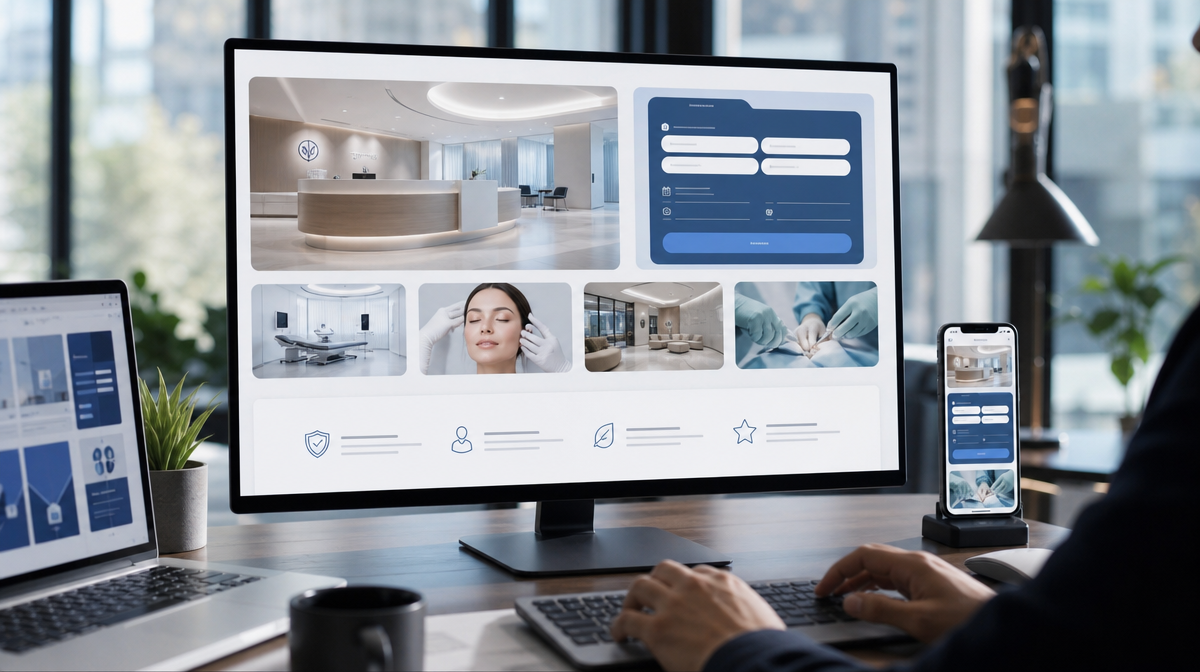
Effective plastic surgery marketing isn’t something you can half-do. It takes coordinated execution across SEO, paid advertising, website conversion, reputation management, and lead nurture — all running simultaneously, all optimized for the specific decision journey of an elective surgery patient. That’s a lot to manage when you’re also running a full surgical schedule.

The practices that consistently grow their patient volume share one thing in common: they work with a marketing partner who understands healthcare, not just digital advertising. That means someone who knows the difference between a high-intent rhinoplasty search and a casual browser, who can build HIPAA-compliant lead funnels, and who reports on consultations booked — not just impressions served.

At Target Patients MD, we specialize exclusively in patient acquisition for medical practices. Our A.L.I. 360 technology integrates AI-driven SEO, paid media, and automated lead nurture into a single system built to deliver measurable results. We’ve worked with 735+ medical practitioners and back our work with a straightforward promise: new patients, or you don’t pay.

When evaluating any plastic surgery marketing partner, look for these non-negotiables:

  • Proven experience with plastic surgery and cosmetic procedure marketing specifically
  • Outcome-based reporting tied to leads, consultations, and patients — not vanity metrics
  • In-house execution with no outsourcing to offshore teams
  • Performance guarantees that hold the agency accountable for real results

Before you can build an effective plastic surgery marketing strategy, you need a clear picture of who you’re actually trying to reach. “Everyone who wants to look better” is not a target audience — it’s a recipe for wasted ad spend and generic messaging that resonates with no one.

The plastic surgery patient base is more diverse than most surgeons assume. Understanding the distinct segments helps you tailor your channels, creative, and messaging to the people most likely to book a consultation.

  • Cosmetic surgery patients: Typically women aged 30–54 seeking elective aesthetic procedures like breast augmentation, liposuction, rhinoplasty, and facelifts. This is the largest and most active segment in terms of search volume and ad responsiveness.
  • Non-surgical aesthetic patients: A younger demographic — often women in their mid-20s to mid-30s — interested in injectables, skin resurfacing, and preventative treatments. They’re highly active on Instagram and TikTok and respond well to visual, education-first content.
  • Male patients: A fast-growing segment pursuing rhinoplasty, gynecomastia correction, and body contouring. Men tend to search privately, respond to discreet messaging, and convert well through Google Search.
  • Reconstructive patients: Individuals recovering from trauma, cancer, or congenital conditions. These patients often arrive through physician referrals rather than digital discovery, making referral network development a key acquisition channel.

Most practices serve more than one of these groups simultaneously. The practices that win at plastic surgery marketing are the ones that segment their audience deliberately — and build campaigns that speak directly to each group’s motivations, fears, and decision timeline.

Knowing who your patients are is one thing. Knowing where to reach them and what to say is where plastic surgery marketing actually gets results. Demographics — age, gender, income, and location — directly determine which channels you invest in and which messages convert browsers into booked consultations.

Younger patients in their mid-twenties to mid-thirties are spending their evenings on Instagram and TikTok, not Googling “best facelift surgeon near me.” They’re drawn to short-form video, before-and-after Reels, and relatable content that normalizes non-surgical treatments. Your messaging for this group should feel aspirational and approachable, not clinical.

Women between 35 and 54 — the core cosmetic surgery demographic — lean heavily on Google Search, Facebook, and online reviews when evaluating surgeons. They’re doing serious research. Your SEO, Google Business Profile, and reputation on platforms like RealSelf and Healthgrades carry enormous weight here. Credibility and outcome transparency win the conversion.

Male patients, a growing segment, tend to search privately and respond to messaging that emphasizes natural results and discretion. Google Search and YouTube are your strongest channels for reaching them.

Here’s a quick breakdown of how demographics map to channel and messaging strategy:

  • Women 25–35: Instagram, TikTok — non-surgical enhancements, subtle transformations
  • Women 35–54: Google Search, Facebook — surgical procedures, board-certified expertise
  • Men 30–50: Google Search, YouTube — natural results, privacy-focused messaging
  • Affluent markets: SEO, reputation sites — premium experience, credentials, outcomes

There’s no single tactic that fills a plastic surgery schedule — it’s the combination that wins. The practices growing fastest right now aren’t doing one thing well; they’re running an integrated plastic surgery marketing system where every channel reinforces the next. Here are 14 strategies that are actually moving the needle for cosmetic practices today:

  • Define your ideal patient avatar — know their age, income, goals, and fears before writing a single ad.
  • Dominate local SEO — rank in the Google map pack for procedure-specific searches in your city.
  • Run Google Search Ads — capture patients actively searching for your procedures right now.
  • Launch Meta and Instagram Ads — build awareness with visually compelling before/after creative.
  • Retarget website visitors — stay visible while prospects research their options.
  • Build a conversion-focused website — fast, mobile-first, and designed to book consultations.
  • Post consistently on Instagram — before/after results and Reels build trust at scale.
  • Create YouTube procedure videos — patients research surgeries on video before they ever call.
  • Automate review requests — satisfied patients leave five-star reviews when you make it effortless.
  • Deploy email nurture sequences — elective procedure patients decide over months, not days.
  • Publish procedure content pages — answer patient questions and build topical authority on Google.
  • Use an AI chatbot — book consultations around the clock without adding front-desk hours.
  • Track cost per lead and cost per consult — know exactly what each channel produces.
  • Offer virtual consultations — lower the barrier to entry for patients still in the consideration phase.

None of these tactics work in isolation. The real leverage comes from running them together as a coordinated system — where your ads drive traffic, your website converts it, your reviews validate the decision, and your email sequences close the gap.

Plastic surgery is one of the most competitive verticals in healthcare marketing — and one of the most rewarding when the strategy is dialed in. Patients are researching surgeons for weeks or months before they ever pick up the phone. They’re comparing before-and-after galleries, reading reviews, watching YouTube videos, and scrolling Instagram. If your practice isn’t showing up at every stage of that journey, you’re handing consultations to the surgeon down the street.

Effective plastic surgery marketing isn’t a single tactic — it’s an integrated system. You need organic search visibility to capture patients actively looking for procedures, paid ads to generate immediate lead flow, a website that converts visitors into consultation requests, and a reputation that makes the decision easy. Miss any one of these, and the whole engine underperforms.

The core channels a modern plastic surgery practice needs to compete include:

  • Search engine optimization (SEO) — ranking for procedure and location keywords when patients are actively searching
  • Paid advertising — Google Ads and Meta Ads for immediate, targeted visibility
  • Website design and conversion — turning traffic into booked consultations
  • Reputation management — generating and monitoring reviews across Google, Healthgrades, and RealSelf
  • Social media content — building trust and showcasing results on Instagram, TikTok, and YouTube
  • Email and lead nurture — staying top-of-mind through a long consideration cycle

The sections below break down each of these channels in detail — what they are, how they work for plastic surgeons specifically, and what it takes to execute them well.

Your website is where plastic surgery marketing either pays off or falls flat. You can run the best Google Ads campaign in your market and rank on page one for every procedure keyword — but if a prospective patient lands on a slow, cluttered, or untrustworthy site, they’re gone in seconds. Your website isn’t just a digital brochure. It’s your highest-leverage conversion tool.

Most patients browsing for a plastic surgeon are doing it on their phones, often during lunch or after the kids are in bed. That means your site needs to load fast, display cleanly on every screen size, and make it dead simple to request a consultation. Responsive design — where your site automatically adjusts to any device — isn’t optional anymore. It’s a baseline requirement.

Beyond speed and mobile performance, the design elements that actually move patients toward booking include:

  • Before and after galleries organized by procedure, with high-resolution images that load quickly
  • HIPAA-compliant contact forms with SSL encryption and secure hosting to protect patient data
  • Procedure-specific landing pages built around a single action — booking a consult — with minimal distractions
  • Surgeon credentials and trust signals prominently displayed, including board certifications and professional affiliations
  • Clear calls to action on every page, not buried at the bottom after three scrolls

A well-built plastic surgery website doesn’t just look impressive — it converts traffic into booked consultations at a measurably higher rate than a generic template site ever will.

If paid ads are the sprint, SEO is the marathon that wins the race. Plastic surgery SEO is the process of improving your website’s visibility in organic (unpaid) Google search results so that patients actively searching for procedures in your area find you first — not your competitor down the street.

The stakes are high. Studies show that the top three organic results capture the majority of clicks on any given search page. If your practice isn’t ranking for terms like “breast augmentation in [city]” or “best rhinoplasty surgeon near me,” you’re essentially invisible to a massive pool of high-intent patients who are ready to book a consultation.

A complete plastic surgery marketing SEO strategy covers four interconnected components:

  • Keyword research: Identifying the exact procedure and location-based terms your ideal patients type into Google, then building pages around them.
  • Technical SEO: Ensuring your site loads fast, is mobile-optimized, and uses structured data so search engines can crawl and index every page correctly.
  • Local SEO: Optimizing your Google Business Profile and maintaining consistent NAP (name, address, phone) data so you appear in map pack results and “near me” searches.
  • Content authority: Publishing in-depth procedure pages, FAQs, and educational blog posts that answer patient questions and signal topical expertise to Google.

SEO compounds over time. The practices investing in it consistently today are the ones dominating their local markets six and twelve months from now.

In plastic surgery, your reputation is your marketing. Before a prospective patient ever calls your office, they’ve already read your reviews on Google, Healthgrades, and RealSelf — and made a preliminary decision based on what they found. Practices with strong review profiles consistently outperform competitors on both conversion rate and new patient volume, regardless of how much they spend on ads.

Effective reputation management for plastic surgeons involves three distinct activities working together:

  • Generating new reviews consistently: Automated post-appointment text and email prompts make it easy for satisfied patients to leave feedback while the experience is still fresh. Timing matters — a request sent within 24 hours of a positive interaction converts dramatically better than one sent a week later.
  • Monitoring across all major platforms: Google is critical, but RealSelf and Healthgrades carry significant weight for elective procedure searches. You need visibility across all three, not just your Google Business Profile.
  • Responding professionally to every review: Responses to positive reviews reinforce trust. Thoughtful, HIPAA-compliant responses to negative reviews demonstrate professionalism to every future patient reading them.

Video testimonials add another layer of credibility that written reviews simply can’t match. When a real patient describes their rhinoplasty or breast augmentation experience on camera, it humanizes your results in a way that before-and-after photos alone cannot. Embedding these on your website and sharing across social channels extends their reach well beyond the original recording.

If SEO is the long game, paid advertising is how you get patients in the door right now. While your organic rankings are building momentum, a well-managed ad campaign can start generating consultation requests within days of launch. That’s why paid advertising is a non-negotiable component of any serious plastic surgery marketing strategy.

The two platforms that move the needle most for plastic surgeons are Google Ads and Meta (Facebook and Instagram). Each serves a different purpose in your patient acquisition funnel:

  • Google Search Ads capture patients who are already searching for specific procedures — think “rhinoplasty surgeon in Dallas” or “breast augmentation near me.” These are high-intent leads who are close to booking. You pay only when someone clicks your ad, and you can bid on procedure-specific and location-based keywords to make every dollar count.
  • Meta and Instagram Ads work higher in the funnel. You’re reaching people who fit your ideal patient profile but aren’t actively searching yet. Visual creative — including before-and-after imagery — performs exceptionally well here and builds brand recognition over time.
  • Retargeting campaigns close the gap between interest and action. Someone visited your rhinoplasty page but didn’t book? Retargeting keeps your practice visible as they continue browsing — a critical tactic given that most cosmetic patients research multiple surgeons before deciding.

The biggest mistake practices make is running ads without a clear conversion path. Traffic without a strategy to capture and follow up on leads is just wasted spend.

Effective plastic surgery marketing isn’t a set-it-and-forget-it project. It’s an ongoing system that requires expertise across SEO, paid advertising, web design, reputation management, and lead nurture — all working together. Most practices that struggle with inconsistent patient flow aren’t failing because they lack a good surgeon. They’re failing because no one is actively managing the full marketing engine.

That’s where dedicated marketing support makes the difference. Working with a team that understands the unique dynamics of elective procedures — long consideration cycles, high-ticket decisions, visual-first patient research — means your strategy is built around how cosmetic patients actually behave, not generic healthcare assumptions.

When evaluating your marketing support options, look for a partner that covers the full stack:

  • Ongoing SEO management to maintain and improve your rankings as Google’s algorithm evolves
  • Active ad campaign optimization to reduce cost per lead and improve targeting over time
  • Content production that builds topical authority and answers patient questions at every stage of the funnel
  • Reputation monitoring across Google, Healthgrades, and RealSelf to protect and grow your online standing
  • Lead follow-up systems so inquiries don’t fall through the cracks between your front desk and your CRM

The practices that consistently win new patients aren’t necessarily the best surgeons in the market — they’re the ones with the most visible and trustworthy presence across every channel their patients use to research and decide.

Here’s the honest truth about plastic surgery marketing: traffic numbers and impression counts don’t pay your staff or fill your OR schedule. What actually matters is how many qualified patients walk through your door ready to book a consultation — and how many of those consults convert into procedures.

The most effective plastic surgery marketing strategies are built around measurable outcomes, not vanity metrics. Before you invest another dollar in ads, SEO, or social media, you need to know exactly what you’re getting back. That means tracking the right numbers at every stage of the patient journey.

The KPIs that actually tell you whether your marketing is working include:

  • Cost per lead (CPL): Total ad spend divided by the number of leads generated — your baseline efficiency metric
  • Cost per consultation: Accounts for leads that actually book, filtering out low-quality traffic
  • Lead-to-patient conversion rate: The percentage of leads who become paying patients, which reveals both lead quality and follow-up effectiveness
  • Revenue per procedure: Lets you identify your most profitable services and allocate marketing budget accordingly
  • Overall marketing ROI: Revenue generated compared to total marketing investment — the number your accountant actually cares about

When you hold your marketing to these standards, the guesswork disappears. You stop wondering if your budget is being wasted and start making decisions based on data that directly connects to practice growth.

Plastic surgery marketing isn’t a one-size-fits-all game. A rhinoplasty patient in their late twenties found you on TikTok. A facelift candidate in her late forties Googled you, read your reviews on RealSelf, and checked your before-and-after gallery before ever picking up the phone. These are completely different journeys — and your marketing strategy needs to account for both.

Effective plastic surgery marketing spans multiple specialties working in concert. When any one of these channels is missing or underperforming, you’re leaving consultations on the table. Here’s what a complete, integrated approach covers:

  • Search Engine Optimization (SEO): Ranking for high-intent searches like “breast augmentation surgeon in [city]” or “best rhinoplasty near me” — the patients who are already ready to book.
  • Paid Advertising: Google Ads and Meta campaigns that put your practice in front of the right demographic immediately, without waiting months for organic results.
  • Plastic Surgery Website Design: A fast, mobile-optimized, HIPAA-compliant site that converts visitors into consultation requests.
  • Reputation Management: Monitoring and growing your reviews on Google, Healthgrades, and RealSelf — because most patients read at least five reviews before choosing a surgeon.
  • Social Media Marketing: Building trust and showcasing results on Instagram, TikTok, and YouTube.
  • Email and Lead Nurture: Staying top-of-mind with prospects who aren’t ready to book today but will be in three months.

Each channel reinforces the others. That’s what separates a real growth strategy from a scattered collection of tactics.

Plastic surgery is one of the most competitive and high-stakes niches in all of healthcare marketing. Patients are making deeply personal decisions, often researching for months before they ever pick up the phone. That means your marketing can’t just generate clicks — it has to build trust, demonstrate results, and guide prospects through a long consideration journey without losing them along the way.

Effective plastic surgery marketing isn’t a single tactic. It’s an integrated system where SEO, paid advertising, social media, reputation management, and lead nurture all work together. Pull one thread out and the whole strategy underperforms. Run them in sync and you create a compounding patient acquisition engine that fills your consultation calendar consistently.

What makes this niche uniquely challenging — and uniquely rewarding — is the revenue potential per patient. A single booked procedure can generate thousands of dollars in practice revenue. That means even a modest improvement in your marketing efficiency can produce an outsized return. The practices winning in competitive markets right now share a few common traits:

  • They show up where patients search — on Google, in the map pack, and increasingly in AI-generated search results
  • They convert traffic into consultations with websites built for trust and action, not just aesthetics
  • They nurture leads who aren’t ready to book today but will be in 60 or 90 days
  • They protect and grow their reputation across every platform patients check before choosing a surgeon

The sections below break down each of these components in detail — so you can identify exactly where your current strategy has gaps and what to do about it.

If your practice offers both surgical and non-surgical treatments, your plastic surgery marketing strategy needs to account for two very different patient mindsets — and medical spa services require their own dedicated approach.

Med spa patients are typically earlier in their aesthetic journey. They’re not ready to book a rhinoplasty, but they are absolutely ready to try Botox, filler, laser resurfacing, or body contouring. The opportunity here is significant: convert a first-time injectable patient today into a surgical consultation six months from now.

An effective med spa marketing strategy within your broader practice plan should address each stage of that patient journey. That means targeting the right channels with the right message at the right time.

  • Instagram and TikTok: Ideal for showcasing non-surgical results, treatment education, and before/after content that reaches younger demographics actively exploring aesthetic options
  • Google Search and local SEO: Capture high-intent searches like “Botox near me” or “laser skin treatment in [city]” from patients ready to book now
  • Email nurture sequences: Keep med spa patients engaged between appointments and introduce them to higher-value surgical services over time
  • Retargeting ads: Re-engage website visitors who browsed treatment pages but didn’t request a consultation

The practices that grow fastest treat their med spa and surgical offerings as a unified patient acquisition funnel — not two separate businesses running parallel campaigns with no connection between them.

CoolSculpting sits in an interesting spot within a plastic surgery marketing strategy. It’s not surgery, but it attracts patients who are actively considering body contouring — and often, those patients eventually book surgical procedures once they see what’s possible. That makes CoolSculpting marketing a genuine patient acquisition channel, not just a revenue line item.

The patients searching for CoolSculpting are typically earlier in their aesthetic journey. They want results without downtime, and they’re comparison shopping across multiple providers. To win that patient, your marketing needs to do three things well:

  • Rank locally for treatment-specific searches like “CoolSculpting near me” or “fat freezing [city]” — these are high-intent queries from patients ready to book
  • Run targeted Meta and Instagram ads featuring before-and-after visuals and clear pricing signals — this demographic responds strongly to visual proof and transparent offers
  • Nurture leads with email sequences that explain the treatment, set realistic expectations, and present a clear path to consultation

One mistake practices make is treating CoolSculpting as a standalone product rather than an entry point into a longer patient relationship. A patient who books a CoolSculpting session and has a great experience is far more likely to return for injectables, skin treatments, or eventually a surgical procedure.

Build your CoolSculpting marketing to capture the lead, convert the consult, and then keep that patient engaged — because the lifetime value of an aesthetic patient extends well beyond a single treatment.

One of the clearest illustrations of what focused plastic surgery marketing can accomplish comes from Buckhead Plastic Surgery, an Atlanta-based aesthetic practice that partnered with a specialized agency to overhaul its patient acquisition strategy.

The practice had the surgical talent. What it needed was a system that could consistently surface that talent to the right patients at the right moment. The marketing approach combined inbound content strategy, SEO, website optimization, and marketing automation into a single integrated growth engine.

The results were concrete and measurable:

  • Significant inbound marketing ROI driven by organic search and content that attracted high-intent patients actively researching procedures
  • A steady stream of new leads every month generated through optimized landing pages, procedure-specific content, and targeted digital campaigns
  • Increased website traffic from patients searching for cosmetic procedures in the Atlanta market
  • Automated lead nurture sequences that helped practice consultants close more surgical consultations without adding manual follow-up work

What made this work wasn’t any single tactic — it was the combination. SEO brought in qualified traffic. The website converted that traffic into consultation requests. Email automation kept warm leads engaged until they were ready to book. Each channel reinforced the others.

That kind of integrated execution is exactly what separates practices that grow predictably from those stuck chasing one-off wins.

Effective plastic surgery marketing isn’t theoretical — it shows up in real patient volume, booked consultations, and measurable practice growth. The practices that win consistently are the ones treating marketing as a system, not a series of one-off experiments.

Across the plastic surgery practices that have invested in integrated digital marketing strategies, a few consistent patterns emerge among the highest performers:

  • Cosmetic surgery practices in competitive metro markets that combined SEO with Google Ads saw the fastest gains in new patient inquiries, often within the first 60 to 90 days of launching paid campaigns alongside organic content.
  • Practices with optimized Google Business Profiles and active review generation systems consistently outperformed competitors in local map pack rankings, capturing patients who were ready to book.
  • Surgeons who invested in before-and-after galleries and procedure-specific landing pages reported higher consultation conversion rates — because visual proof and clear calls to action do the heavy lifting that generic websites simply can’t.
  • Practices running retargeting campaigns alongside their primary paid ads kept their name in front of high-intent patients during the research phase, shortening the average time from first click to booked consult.

The common thread isn’t budget size — it’s strategy. Practices that treat plastic surgery marketing as a coordinated, multi-channel effort consistently outpace those running disconnected tactics in isolation.

Effective plastic surgery marketing doesn’t happen by accident. It’s the result of a coordinated strategy across every channel that matters — search, paid ads, social media, reputation, and your website — all working together to move the right patients from discovery to booked consultation.

The practices that consistently win new patients aren’t necessarily the ones with the biggest budgets. They’re the ones with the tightest systems. They know their ideal patient, they show up where that patient is searching, and they have a follow-up process that doesn’t let warm leads go cold.

Here’s what separates high-growth plastic surgery practices from ones that plateau:

  • They invest in SEO before they need it — organic rankings compound over time, and waiting until your schedule slows down is already too late
  • They run paid ads with precision — targeting procedure-specific keywords and patient demographics, not broad audiences that waste budget
  • They treat their website as a conversion tool — not a digital brochure, but an active patient acquisition engine
  • They protect and build their reputation — because 90% of patients read reviews before choosing a surgeon
  • They nurture leads over time — because elective procedures have long consideration cycles and most patients don’t book on the first visit

The channel mix matters. But execution and consistency matter more. A strategy that’s partially implemented across five channels will always underperform a focused, well-managed approach built specifically for cosmetic surgery patient acquisition.

Paul

Author Paul

More posts by Paul