



Dental practice marketing is the work of turning a stranger with a toothache — or a vague intention to finally deal with their crooked teeth — into a patient sitting in your chair. It sounds simple stated that way. In practice, most practices lose people at half a dozen points along that path without ever knowing it happened.
What makes dental different from general local marketing is the decision itself. A patient choosing a dentist isn’t picking a restaurant. They’re weighing cost, anxiety, insurance, convenience, and trust simultaneously, often after a long stretch of avoidance. A general dentistry patient may book within a day of a symptom. An implant patient may research for six months. Those are different journeys requiring different messaging, and a marketing partner who treats them the same wastes budget on both. What puts either patient in front of a search box in the first place — a move, a new plan, a broken tooth — is the subject of our guide to how to attract new dental patients.
That is the real argument for specialization, and it’s worth stating plainly rather than as a sales point. An agency running campaigns for restaurants, law firms, and e-commerce brands has never had to think about why a patient abandons an intake form, how anxiety shapes ad copy, or what happens when a retargeting pixel touches health information. Those aren’t edge cases in dentistry. They’re the everyday texture of the work.
Most practice owners don’t discover their marketing is underperforming until it has already cost them months. The warning signs surface quietly, then all at once. Four are worth watching for.
Flat or declining new patient volume despite active spend is the clearest. If the appointment book hasn’t grown while budget is going out the door, the issue is almost never market saturation — competitive markets still produce thousands of new dental patients monthly, and the practices capturing them have sharper targeting and stronger conversion paths. A high cost per lead paired with low conversion is the second, and the distinction matters: cost per lead measures what you pay to generate an inquiry, but an inquiry isn’t a patient. Generating clicks and form fills that never become booked appointments means you’re paying for attention without buying outcomes.
Poor local rankings is the third. If your practice doesn’t appear in the top local results for your own area, you’re invisible to the highest-intent patients nearby — the ones searching with a specific problem and an intention to solve it this week. And fourth, a website that fails to convert: outdated design, no online booking, slow mobile load times, and missing social proof don’t just look dated, they actively push patients toward whoever loaded faster.
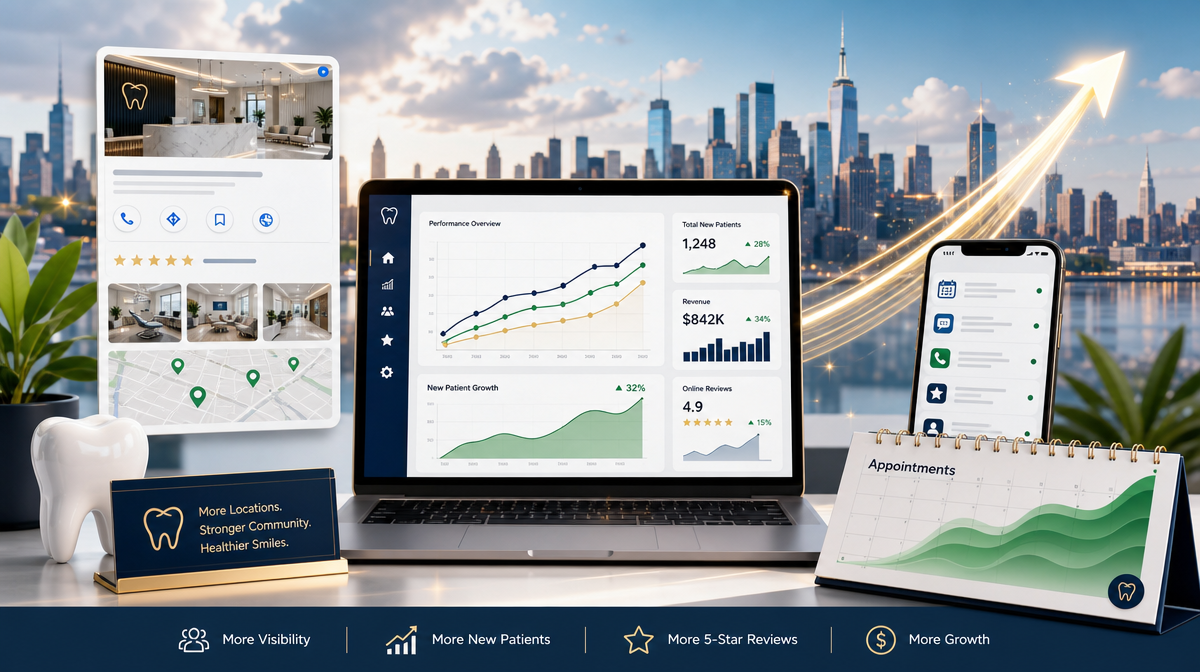
Each of those has a fix, and they’re worth walking through in the order patients actually encounter them.
Visibility comes first, because you can’t convert someone who never finds you. That means procedure-specific service pages targeting implants, clear aligners, and cosmetic dentistry rather than one page listing everything you offer — Google rewards topical relevance at the page level, and a dedicated page per procedure consistently outperforms a combined services page. It also means consistent name, address, and phone data across directories, and a fully built Google Business Profile, which is often the single most influential factor in whether patients find you before they reach your website at all. Google’s own guidance is direct about what drives placement there: relevance, distance, and prominence, with complete business information and review activity feeding two of the three.
Paid search sits alongside that rather than replacing it. It captures patients actively researching a procedure right now, which makes it the fastest lever available when the schedule needs filling — while social advertising works earlier in the decision cycle, building familiarity before someone is ready to book. Both require dental-specific audience segmentation to avoid spending on low-intent clicks, and both benefit from the disciplined campaign structure covered in our guide to Google Ads for doctors.
Then the website has to do its job. Mobile-first architecture, integrated online scheduling, fast load times, and visible trust signals aren’t optional features — they’re the difference between a site that books appointments and one that leaks qualified traffic it already paid to acquire. This is where medical website design stops being an aesthetic question and becomes a revenue one.
Reviews close the loop. Automated post-visit requests, monitoring across Google and Healthgrades, and a consistent response cadence build the social proof patients require before committing — 84% of patients check online reviews before choosing a provider, which makes reputation management a ranking input and a conversion input at the same time.
One constraint shapes all of it. Healthcare advertising carries HIPAA obligations most generalist agencies have never navigated, and a misconfigured lead form or retargeting pixel can create real regulatory exposure under HHS guidance on online tracking technologies, and no volume of new patients is worth absorbing that. A HIPAA-conscious approach means encrypted intake forms, carefully built landing pages, avoiding condition-based retargeting, and properly configured ad pixels. It doesn’t limit how often you reach patients; it shapes what those touchpoints collect and disclose.
Budget conversations make most dentists uncomfortable, and agencies that dodge the question with vague answers are usually hiding weak returns. The honest answer is that what you spend matters far less than what comes back per dollar, and that your growth objective should drive the investment tier rather than the reverse.

| Practice goal | Relative budget level | Primary channels |
|---|---|---|
| Maintain current volume | Lower | SEO, reputation management |
| Moderate growth | Moderate | SEO plus targeted paid search |
| Aggressive expansion | Higher | Full-service: SEO, paid search, social, website |
One number is worth tracking regardless of tier: cost per new patient. A partner you can measure by that metric is one whose incentives align with yours, and an agency that can’t tell you what a booked patient costs across each channel has a resource allocation problem rather than a reporting gap. That figure only means something alongside patient lifetime value, though — knowing what a patient is worth across their full relationship with the practice tells you how much you can reasonably spend acquiring one before the economics break.
Timeline expectations are where most disappointment originates, so they’re worth setting honestly. Paid advertising can produce inquiries within days of launch, because campaigns targeting high-intent procedure searches start reaching ready-to-book patients as soon as bidding stabilizes. Organic search and local optimization typically take several months before meaningful ranking movement appears, building compounding equity that paid channels never accumulate. Review volume grows steadily through consistent post-visit outreach, rewarding practices that start early.

The distinction worth holding onto: paid channels are a faucet you turn on, while organic search and reputation are infrastructure you build. Practices relying exclusively on one or the other end up either burning budget on ads that stop producing the moment spend pauses, or waiting months for organic traffic while the schedule sits half empty. The strongest programs run both in parallel — paid generating near-term appointments while organic compounds underneath.
Choosing the wrong partner doesn’t only waste money; it makes someone else’s learning curve into your lost patients. Three warning signs are worth screening for before signing anything.
Long-term contracts without performance commitments ask you to absorb all the risk — agencies confident in their work offer shorter agreements with defined benchmarks, because they expect to earn continued business rather than contractually obligate it. Vanity metric reporting is the second: if a monthly report is dense with impressions and click-through rates but never mentions how many patients actually scheduled, the agency has defined success differently than you have. And a generalist without dental or healthcare experience is the third — a firm handling software companies, hotels, and dental practices simultaneously hasn’t developed the patient psychology fluency this work requires, and will apply audience targeting logic built for e-commerce to someone weighing whether to spend thousands on implants.
That specialization runs deepest for high-ticket cases, which is why our guide to dental implant marketing covers how those campaigns differ from general dental work. And practices in dense metro markets face a further layer of complexity worth its own treatment — our guide to choosing a dental marketing agency NYC dentists can trust covers borough-level execution specifically.

Something else has shifted recently and most practices haven’t registered it yet. Patients increasingly ask an assistant a question and receive a synthesized answer rather than scrolling a page of links. If your content isn’t structured for those systems to extract and cite, you’re invisible to a growing segment of searchers, which is why practices paying attention to AI in healthcare SEO treat their whole digital footprint — reviews, content, listings, and the consistency of what their own pages claim — as one connected set of signals rather than separate campaigns.
Target Patients MD was built exclusively for medical and dental practices, not as a side offering but as the entire business. That single-focus model means every system and every optimization decision developed through direct experience with healthcare patient acquisition rather than adapted from a playbook built for retail or software. A.L.I. 360 by Target Patients MD is a proprietary AI-powered patient-acquisition system for medical and dental practices — the name stands for Attract, Learn, and Influence — and it continuously optimizes campaign performance, reallocating toward the segments actually producing booked patients.
If you want dental practice marketing you can hold accountable to chair time rather than click volume, get in touch and we’ll show you where your current program is leaking.
Here are direct answers to the questions dentists ask most often.
What does dental practice marketing actually include? At minimum: local search visibility and a complete Google Business Profile, procedure-specific pages for the treatments you want to grow, paid search for high-intent queries, a website built to convert rather than to impress, and a systematic approach to generating reviews. Those work as one system — strengthening any single piece while neglecting the others produces disappointing results.
How much should a dental practice spend on marketing? It depends on your growth objective, your market, and your procedure mix rather than on any universal percentage. The more useful figure is cost per new patient measured against what that patient is worth across their relationship with your practice, since a practice averaging high-value cases can profitably spend far more per acquisition than one built on routine hygiene.
How long before dental practice marketing produces results? Paid search can generate inquiries within days of launch. Organic search and local optimization typically require several months before meaningful movement, then compound from there. Most practices run both so there’s no gap between starting and seeing returns.
Why hire a dental-specific agency instead of a generalist? Because the constraints here are specific — HIPAA-conscious form handling, platform rules for healthcare advertising, and the patient psychology that separates a browser from a booked appointment. A generalist learns those on your budget, and the mistakes usually surface as wasted spend or compliance exposure rather than as obvious errors.
Can a dental practice handle its own marketing? Foundational work is genuinely doable in-house — claiming and maintaining a Business Profile, responding to reviews, publishing a procedure page monthly. The calculation shifts in competitive markets, with multiple locations, or when the time spent starts displacing clinical work and the administrative priorities only you can handle.