



A medical marketing agency is a specialized firm that helps healthcare practices attract new patients, build their online presence, and grow revenue through targeted digital and traditional marketing strategies. Unlike a general marketing agency, a medical marketing agency is built specifically around the healthcare industry — meaning the team already understands how patients search for providers, what motivates them to book an appointment, and what regulatory guardrails apply to healthcare advertising.
That specialization matters more than most practice owners realize. Healthcare has its own ecosystem: HIPAA governs how patient data is handled, Google and Meta enforce strict ad policies around medical content, and platforms like Healthgrades operate entirely outside the scope of a standard digital marketing playbook. A generalist agency learning those rules on your dime is a liability — a healthcare-focused agency treats them as table stakes.
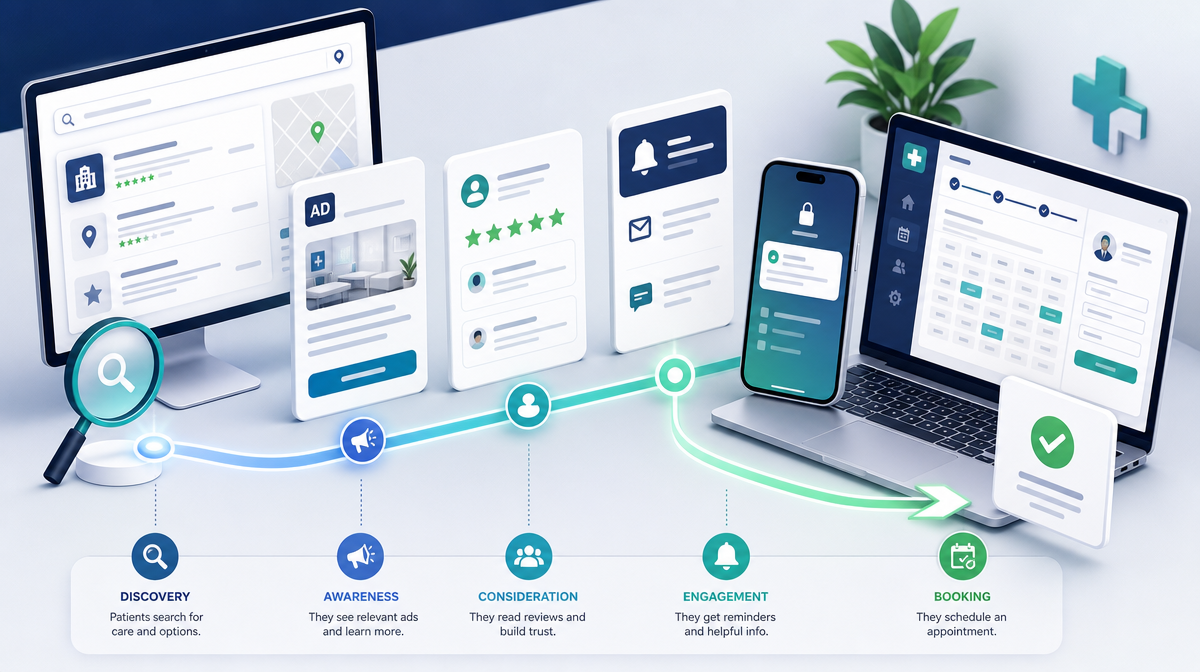
In practical terms, a medical marketing agency handles the full patient acquisition pipeline, including:
- Search visibility: Getting your practice found on Google — where 77% of patients begin their search — when they’re actively looking for your specialty
- Paid advertising: Running compliant ad campaigns that drive appointment requests quickly
- Reputation and reviews: Managing how your practice appears across healthcare-specific directories and review platforms
- Patient communication: Automating outreach that keeps your schedule full without adding administrative burden
The right agency functions as an extension of your practice — one that speaks fluent healthcare and measures success in booked appointments, not just clicks.
When a practice partners with a medical marketing agency, the measurable outcomes extend well beyond a prettier website or a few more social media followers. The real value shows up in your appointment calendar — specifically in how consistently it stays full and how predictably new patients flow in month after month.
Growth happens across four interconnected levers, each reinforcing the others:
- Patient acquisition: Bringing in net-new patients through high-intent search results, targeted paid campaigns, and physician referral networks — not just passive brand awareness
- Online visibility: Ranking prominently when prospective patients search for your specialty, procedure, or location, so your practice appears before your competitors do
- Reputation building: Systematically generating and showcasing positive patient reviews across the platforms where your next patient is already doing research — 40% of patients have avoided a provider based on what they found
- Patient retention: Re-engaging lapsed patients and keeping active ones connected through timely, personalized outreach that reduces no-shows and increases lifetime value

What separates a strong agency from a mediocre one is how these levers are coordinated. Practices that treat each channel as a standalone effort — running ads here, posting on social there — rarely see compounding returns. A well-run medical marketing agency builds an integrated system where every touchpoint moves a prospective patient closer to booking, and every existing patient has a clear reason to return.
A full-service medical marketing agency runs integrated campaigns across every digital channel your patients use — from the first Google search to the follow-up text after their appointment. The service mix is deliberately broad because patient acquisition rarely happens through a single touchpoint.
- Medical SEO services: Optimizing your website and local listings so your practice ranks for specialty-specific and location-based searches — think “LASIK surgeon near me” or “bariatric surgery [city]” — through keyword strategy, technical site improvements, and healthcare-focused content
- Medical PPC and paid advertising: Google and Bing campaigns targeting high-intent patients who are actively ready to book, built around healthcare ad policies to avoid rejections or account suspensions
- Medical website design and development: A conversion-optimized, mobile-responsive site with HIPAA-conscious intake forms, fast load speeds, and a patient experience that turns visitors into scheduled appointments
- Social media marketing for healthcare: Facebook and Instagram campaigns that build local brand awareness, promote specific procedures, and reach demographically targeted audiences in your service area
- Reputation management and patient reviews: Proactively generating reviews on Google, Healthgrades, and Yelp while monitoring and responding to feedback, because prospective patients read reviews before they ever call
- Email and SMS patient outreach: Automated sequences for appointment reminders, reactivation campaigns, and seasonal promotions that keep your schedule filled without manual follow-up
- AI-powered patient acquisition: Machine learning tools that optimize ad spend in real time, predictive analytics that identify high-value patient segments, and chatbots that qualify and capture leads around the clock. Increasingly this extends to AI in healthcare SEO, so the practice is the one cited when a patient asks an assistant instead of typing a search
The best medical marketing agencies don’t pretend to be all things to all practices. They go deep on specific healthcare verticals, which means the campaigns, messaging, and conversion strategies they deploy are already calibrated for how patients in your specialty think and decide.
- Med spa marketing: Aesthetics patients are highly visual, comparison-driven, and responsive to before/after content, seasonal promotions, and loyalty incentives — strategies that require a completely different approach than insurance-based care
- Plastic surgery marketing: Elective procedure marketing lives or dies on trust signals — surgeon credentials, before/after galleries, and review volume across multiple platforms all factor into a prospective patient’s decision timeline, which can span weeks or months. Which of those signals to build first, and where, is the subject of our guide to plastic surgery digital marketing
- Dental practice marketing: From general family dentistry to high-ticket implants and cosmetic cases, dental marketing requires segmented campaigns that speak differently to the routine-care patient versus the cosmetic-motivated one. The full service mix that supports both is laid out on our dental digital marketing page
- Ophthalmology and LASIK marketing: Vision correction patients search with strong commercial intent and respond well to procedure-specific landing pages and financing-focused messaging — making precise keyword targeting essential
- Bariatrics and medical weight loss marketing: GLP-1 programs and surgical weight loss require patient education funnels, seminar promotion, and long nurture sequences that move hesitant prospects toward consultation
- Regenerative medicine marketing: PRP, stem cell therapy, and orthobiologics are still unfamiliar to most patients — content-led campaigns that educate before they sell are the foundation of effective patient acquisition here
Specialty-specific experience shortens the learning curve significantly. A medical marketing agency that has already run hundreds of campaigns in your vertical brings proven frameworks rather than expensive trial-and-error.
Not every agency that claims healthcare expertise actually has it. When you’re vetting a medical marketing agency, four qualities separate the ones that consistently deliver from the ones that consistently overpromise.
- Healthcare specialization over generalists: Agencies built exclusively around medical practices understand the nuances that generic firms simply don’t — physician directory management, procedure-specific conversion funnels, and the difference between how a LASIK patient searches versus how a bariatric patient does. That institutional knowledge is impossible to fake and expensive to build from scratch on your account.
- Outcome-based reporting and transparency: The monthly report should lead with new patient appointments booked and cost per acquisition — not impressions, reach, or engagement rates. If an agency can’t tell you exactly how many patients their campaigns generated last month, that’s a problem worth taking seriously before you sign anything.
- HIPAA-conscious systems and workflows: Marketing touches patient data at multiple points — intake forms, email lists, retargeting pixels. A top agency operates with documented protocols across every tool in its stack, not just a checkbox on an intake form. Ask specifically how they handle pixel tracking and form submissions before assuming it’s covered.
- Defined new patient benchmarks: The strongest agencies agree to measurable patient-volume benchmarks up front and report against them, rather than offering vague promises about “best efforts.” A written benchmark forces accountability and signals that the agency expects to be judged on the number that matters to you.
Choosing the right medical marketing agency is one of the higher-stakes vendor decisions a practice owner makes — the wrong fit costs you time, budget, and patients you’ll never know you missed. Run through this checklist before committing to any partner.
- Verify healthcare industry experience: Ask how many of their active clients are medical practices, not just how many they’ve worked with historically. A portfolio heavy on restaurants and e-commerce tells you everything you need to know.
- Review patient acquisition case studies and ROI: Request documented results showing actual patient volume growth, cost per acquisition, and revenue impact from practices in your specialty or a comparable one. Aggregate “traffic up 40%” claims without appointment data don’t count.
- Confirm HIPAA-conscious practices and data security: Ask the agency to walk you through exactly which tools they use for forms, email, and ad retargeting — and how each one is configured. Vague reassurances are a red flag.
- Evaluate reporting and communication cadence: Find out how frequently you’ll receive performance reports, who your dedicated point of contact is, and whether strategic reviews are scheduled or only happen when you ask. Proactive communication is a reliable proxy for how the agency operates overall.
- Check for defined benchmarks and flexible terms: Month-to-month arrangements with defined patient acquisition benchmarks protect you far better than 12-month retainers with no accountability milestones built in. If an agency resists both, that hesitation is informative.
HIPAA in a marketing context goes well beyond keeping patient records locked in a secure EHR. The rules reach into your ad campaigns, your website, and your email list in ways that catch even experienced practice owners off guard — the Department of Health and Human Services has published specific guidance on online tracking technologies because so many practices were unknowingly exposed through their own websites.
Three areas demand particular attention when evaluating how a medical marketing agency handles compliance:
- Patient data protection: Web forms that collect names, phone numbers, or symptom information must route through encrypted, HIPAA-conscious infrastructure — standard contact form plugins on most website builders do not qualify. Any agency managing your intake forms should be able to name the specific tool they use and provide documentation.
- Testimonial and review consent: Using a patient’s name, photo, or story in marketing materials — including social media posts and before/after galleries — requires written authorization that meets HIPAA’s specific standards. Verbal permission is not sufficient, and the authorization must describe exactly how the content will be used.
- Compliant advertising practices: Meta and Google both prohibit using protected health information for ad targeting. This means retargeting pixels placed on condition-specific pages, such as a weight loss consultation page or a mental health intake form, can create serious liability if not configured correctly. A careful agency audits pixel placement before any campaign goes live.
Civil penalties scale with the degree of negligence involved, and enforcement has increasingly focused on exactly the kind of tracking and form-handling mistakes that marketing introduces — consequences that make documented protocols a non-negotiable, not a nice-to-have.

Most practices judge their medical marketing agency by the wrong scorecard. If your monthly report leads with website sessions, click-through rates, or social reach, you’re measuring activity — not growth. The only number that actually pays your overhead is new patients through the door.
A straightforward way to audit what your agency is actually delivering is to separate metrics that feel good from metrics that mean something:
- Website traffic vs. new patient appointments booked
- Social media followers vs. cost per qualified lead
- Ad impressions vs. patient acquisition cost by channel
- Email open rates vs. revenue attributable to campaigns
The left column makes dashboards look busy. The right column tells you whether your marketing spend is generating a return worth keeping.
Beyond monthly reporting, practices should track acquisition cost at the specialty or procedure level. A dental implant patient is worth many times what a routine cleaning is, and justifies a very different cost-per-lead threshold. An agency that doesn’t segment performance by procedure type is leaving significant optimization opportunities untouched.
Attribution also matters. Ask your agency to document which specific channels — organic search, paid ads, social, email — are driving booked appointments, not just form fills. Lead quality varies dramatically by source, and knowing which channels produce patients who actually show up and convert is what allows you to reinvest intelligently rather than guessing.
Target Patients MD is a healthcare-exclusive medical marketing agency — meaning every client, every campaign, and every dollar of ad spend managed by the team flows through a single industry lens. No retail accounts, no SaaS clients, no learning curve borrowed from unrelated verticals. Just practices like yours, across more than 735 practitioners throughout the U.S. and Canada.

The fully managed model means the team handles strategy, execution, and optimization without requiring you to become a marketing expert. From the initial campaign build to ongoing performance management, everything runs under one roof — including A.L.I. 360 by Target Patients MD, a proprietary AI-powered patient-acquisition system for medical and dental practices — the name stands for Attract, Learn, and Influence.
What makes the partnership different from a typical agency retainer comes down to accountability. Target Patients MD agrees to patient-growth benchmarks up front and reports against them every month, so the practice can see exactly what the work is producing. That structure only works when an agency expects to be measured on outcomes, and it removes much of the uncertainty that makes practice owners hesitant to commit to a marketing investment in the first place.
- Healthcare-only focus across med spa, plastic surgery, dental, ophthalmology, bariatrics, and regenerative medicine
- A.L.I. 360 technology for real-time campaign optimization and automated patient communications
- Defined new patient benchmarks with transparent, outcome-tied reporting
Book a practice growth session to see what a growth system built exclusively for healthcare looks like in action.
Practices shopping for a medical marketing agency tend to run into the same questions at the same point in the process. Here are direct answers to the ones that come up most often.
- How much does a medical marketing agency charge for services? Pricing structures vary widely. Some agencies bill monthly retainers that scale with service scope and practice size. Others use pay-per-lead or performance-based models where fees scale with results. The structure matters as much as the number — a higher retainer with defined patient benchmarks can outperform a cheaper arrangement with no accountability built in.
- How long does it take to see new patients from medical marketing campaigns? Paid search campaigns can begin generating consultation requests within the first week of launch. Organic search rankings, by contrast, typically require three to six months of consistent effort before meaningful patient volume materializes — which is why most competitive practices run both channels simultaneously rather than choosing one.
- What is the difference between a medical marketing agency and a general digital marketing agency? Healthcare-specific agencies arrive pre-loaded with knowledge of physician directory ecosystems, procedure-level keyword behavior, and ad platform restrictions unique to medical advertising. A generalist firm must build that understanding from scratch, usually on your timeline and your budget.
- Can a medical marketing agency replace an in-house marketing team? For most independent and group practices, a specialized agency functions as a complete outsourced marketing department at a fraction of the cost of hiring equivalent in-house expertise across SEO, paid media, design, and analytics.
- How do medical marketing agencies handle advertising restrictions on healthcare services? Experienced agencies maintain current knowledge of Google’s healthcare advertising policies and Meta’s sensitive category restrictions, structuring campaigns and landing pages to pass platform review without sacrificing conversion performance.