



A.L.I. 360 by Target Patients MD is a proprietary AI-powered patient-acquisition system for medical and dental practices. The name stands for Attract, Learn, and Influence.
It was built from the ground up for practices that want a measurable, managed system for growing patient volume — not a generic toolkit repurposed from other industries. Attract, Learn, and Influence are three interconnected disciplines that work together as a continuous loop rather than three separate campaigns you have to manage yourself.
- Attract: Gain visibility where your prospective patients are actually looking — across traditional search, local map results, and the AI-generated answers increasingly dominating Google’s interface.
- Learn: The system continuously analyzes user behavior, campaign performance, and conversion data to surface what’s actually driving appointments — not just clicks.
- Influence: Automated patient communications that feel personal and timely, meeting prospective patients at the right moment without requiring your front desk to manage every touchpoint.
What separates A.L.I. 360 from generic healthcare digital marketing tools is that it was purpose-built for the specific dynamics of medical practice growth — elective procedures, local competition, compliance requirements, and the reality that a missed lead in healthcare isn’t just lost revenue, it’s a patient who found a competitor instead.
One of the clearest signs a practice needs A.L.I. 360 is not a lack of traffic, but a breakdown in the economics of the funnel. Many clinics already know which ad channels are producing visits; what they don’t know is why those visitors hesitate, abandon forms, or never call back. A.L.I. 360 is engineered to close that gap by tying acquisition to operational outcomes.
In practical terms, the system is designed to reduce waste at the point where interest turns into intent. Instead of asking your team to interpret scattered marketing reports, it monitors which page paths, offers, and contact methods move people closest to a scheduled visit. The practices that get this right don’t just generate more leads — they lose fewer of them in the gap between first click and booked consultation, which is often where real revenue quietly leaks out.
Two details matter here for practice owners evaluating this decision:
- It’s fully managed. You’re not logging into dashboards or building campaigns. The Target Patients MD team deploys and operates A.L.I. 360 on your behalf — your job is to see the patients, not run the marketing stack.
- It’s built around appointment volume, not vanity metrics. Impressions and click-through rates don’t pay your overhead. A.L.I. 360 tracks what actually matters — how many prospective patients moved from search to scheduled visit.
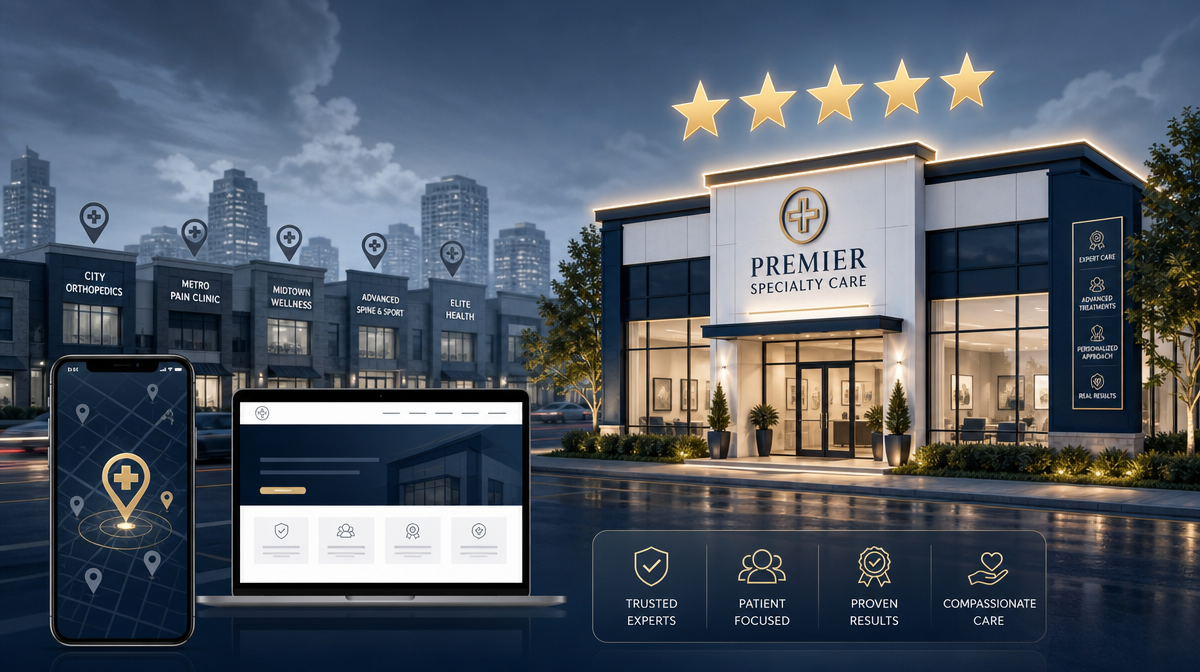
For practices in competitive markets — aesthetics, dental implants, LASIK, weight loss — that conversion gap between average and optimized is often the difference between a thriving schedule and an empty one.
A.L.I. 360 runs on six integrated components — not a collection of standalone tools stitched together, but a unified engine where each layer feeds the others. Here’s what’s actually running under the hood:
- AI-Driven SEO and Generative Engine Optimization (GEO): Standard SEO gets your practice found on Google. GEO goes further — it optimizes your content to appear inside AI-generated search summaries (Google’s AI Overviews and similar features) where a growing share of patients now get their answers without clicking at all. A.L.I. 360 covers both surfaces simultaneously.
- Smart PPC Budget Allocation: Rather than locking your ad spend to a fixed keyword list, the AI continuously redistributes budget toward the search terms and audience segments that are actively converting — adjusting in hours, not months.
- Google Business Profile and Local SEO: Citation consistency, NAP accuracy, and Google Business Profile optimization determine whether you appear in the local map pack. A.L.I. 360 manages these factors so your practice ranks when someone nearby searches for your specialty.
- High-Converting Website Development: Mobile-first, HIPAA-conscious, and built around one goal — turning visitors into appointment requests, not just impressions.
- AI Chatbots and Appointment Scheduling Automation: Prospective patients don’t only search during office hours. Automated chat engages them at 11 p.m. the same way your front desk would at 11 a.m. — without adding headcount.
- Reputation and Review Monitoring: The system tracks reviews across Google, Healthgrades, and Yelp, flagging new feedback so your team can respond before a negative review sits unanswered for two weeks — critical when 84% of patients check online reviews before choosing a provider.
A.L.I. 360 is purpose-built for specialties where patients actively choose their provider — not emergencies where they call whoever’s closest. That distinction matters enormously for how the system allocates effort and where it focuses your visibility.
- Medical Spas and Aesthetics Practices: Botox, CoolSculpting, and laser treatments are searched constantly in every major metro — and your local competitors are bidding on the same terms. A.L.I. 360 uses hyper-local targeting and AI-optimized creative — the kind of medical spa marketing that makes your practice the obvious choice before a prospective patient even compares options.
- Plastic and Cosmetic Surgery: A rhinoplasty patient might research for six months before booking a consultation. The system builds your visibility and credibility across every stage of that decision window, not just at the final search.
- Dental and Dental Implants: High-intent “dentist near me” and “implants near me” queries demand dominant local search presence. This is where Google Business Profile optimization and citation accuracy directly translate into filled chairs.
- Ophthalmology and LASIK: Patients considering LASIK are comparison-shopping aggressively. Strong review profiles and precise paid targeting separate the practices that win consultations from those that get scrolled past.
- Regenerative Medicine and Medical Weight Loss: These categories are growing fast but poorly understood by patients. AI-optimized educational content positions your practice as the authoritative local answer when patients search emerging treatment terms for the first time — a core principle behind effective regenerative medicine marketing.
Most marketing systems operate in silos — your SEO agency doesn’t talk to your PPC team, your website developer doesn’t know what’s converting in ads, and your Google Business Profile sits largely unmanaged between monthly check-ins. A.L.I. 360 breaks that pattern by treating every patient-facing channel as a single interconnected system rather than a collection of independent vendors.
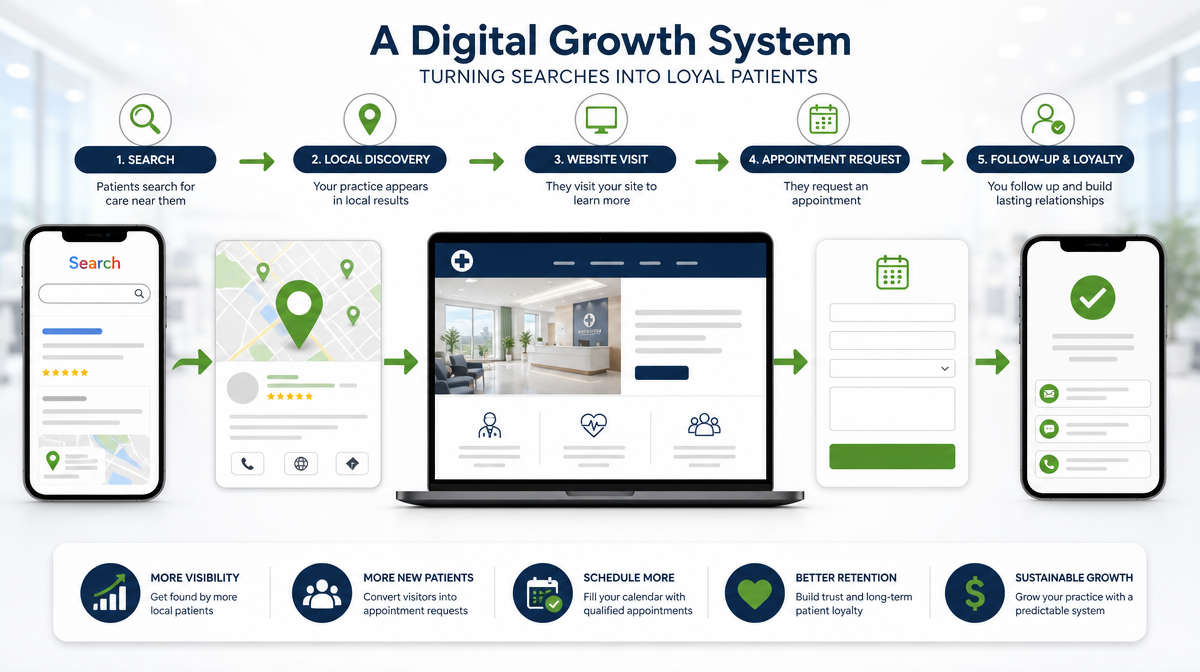
The patient journey through that system looks like this:

- Search: A prospective patient types “Botox near me” or “dental implants [city]” — the AI has already optimized your organic rankings and paid placements to appear at that exact moment, on that exact query.
- Local: Your Google Business Profile surfaces in the map pack with accurate information, strong reviews, and complete service details — not because someone remembered to update it, but because the system maintains it continuously.
- Web: The visitor lands on a page engineered to eliminate friction between interest and action — clear service information, trust signals, and a direct path to requesting an appointment.
- Follow-up: If that visitor doesn’t book immediately, automated communications re-engage them with relevant information — without your staff manually tracking a list of cold leads.
What makes this architecture valuable isn’t any single step — it’s that each stage feeds the next without gaps. A patient who searches, finds your local listing, visits your site, and hears back within minutes converts at a dramatically higher rate than one who hits a dead end at any point along that path.
The way patients find doctors has changed more in the last two years than it did in the previous decade. According to BrightEdge, an estimated 84% of queries on Google Search will be affected by generative AI — meaning a significant portion of your prospective patients are getting provider recommendations directly from Google’s AI summaries, not from a traditional list of ten blue links they scroll through and evaluate themselves.
That shift has a concrete consequence for your practice: if your digital presence isn’t optimized for how AI systems select and surface information, you’re invisible to a growing segment of people who are actively ready to book. This isn’t a future concern — it’s already affecting which practices get called today.
Voice search compounds the pressure. Patients asking their phones “who’s the best LASIK surgeon near me” or “where can I get Botox in [city]” expect a single confident answer, not a list. The practices that earn that answer share one thing in common: their entire digital footprint — reviews, content, local listings, and website authority — signals relevance in a way AI systems can recognize and reward.
If your practice isn’t optimized for these AI-driven discovery channels, you’re not just behind on a trend. You’re ceding ground to competitors who are. A.L.I. 360 was built specifically to keep your practice visible inside these emerging surfaces — not as an add-on, but as a core function of how the system operates.
Generic marketing agencies aren’t bad at what they do — they’re just not doing what your practice actually needs. When a generalist shop manages your campaigns, they’re applying the same playbook they use for a roofing company or a law firm: drive traffic, report impressions, and call it a win. Healthcare patient acquisition has entirely different dynamics, and that gap shows up in your cost per booked appointment.
Here’s where the difference becomes concrete:
| Factor | Generic Agency | A.L.I. 360 |
|---|---|---|
| Healthcare expertise | Limited or none | Built exclusively for medical practices |
| AI optimization | Manual, periodic adjustments | Continuous, real-time AI recalibration |
| Compliance awareness | Frequently overlooked | HIPAA-conscious across every touchpoint |
| Success measurement | Traffic and click volume | Booked appointments and patient conversions |
The compliance gap alone is worth pausing on. Agencies without healthcare experience routinely build retargeting audiences, run ad campaigns, and deploy contact forms in ways that create real HIPAA exposure for the practice — not for themselves. That liability lands on you, which is one reason our approach to AI-powered patient growth starts with how patient data is handled at every touchpoint.
Beyond compliance, the measurement problem is what quietly drains practice budgets. An agency reporting strong “engagement metrics” while your front desk answers fewer new patient calls isn’t failing at marketing — they’re succeeding at the wrong goal. A.L.I. 360 reporting centers on one output: prospective patients who reach a booked consultation.
Getting started with A.L.I. 360 doesn’t require months of onboarding or a marketing team on your payroll. The process is deliberately straightforward — four steps that move you from where your practice stands today to a fully operational AI patient acquisition system.
- Book Your Free Consultation: This is a working conversation, not a sales pitch. Target Patients MD evaluates whether A.L.I. 360 is actually the right fit for your specialty, your market, and your current patient volume goals — and maps out what deployment would look like specifically for your practice.
- Audit Your Current Digital Footprint: Before anything goes live, the team conducts a structured review of your existing website, ad accounts, Google Business Profile listing, and SEO baseline. This surfaces exactly where you’re losing prospective patients and establishes a clear performance starting point.
- Deploy A.L.I. 360 Across Your Campaigns: Implementation is handled entirely by the Target Patients MD team. You’re not configuring software or learning a new platform — the system goes live and begins optimizing while you focus on your patients.
- Track Patient Growth and Optimize Monthly: You receive ongoing reporting and regular strategy calls so you always know what the system is doing and what results it’s producing. The AI continues recalibrating behind the scenes between those conversations.
Paid search channels can begin driving activity quickly once campaigns go live, while SEO and local authority build progressively. The longer the system runs, the more precisely it learns your specific market and patient behaviors — compounding results over time.

A.L.I. 360 isn’t the right fit for every practice — and that’s intentional. It performs best when the practice owner is genuinely committed to growth, has a defined specialty with clear patient demand in their market, and wants clear reporting on what the system is doing and what it’s producing.
If you’re running a practice where new patient volume directly determines revenue — aesthetics, dental implants, weight loss, LASIK, regenerative medicine — the economics of AI-powered patient acquisition tend to work strongly in your favor. Those categories reward visibility at the moment a patient is comparing providers. The question is whether your practice is positioned to act on an increase in patient inquiries when they start coming in.
A few indicators that A.L.I. 360 is likely a strong match for your situation:
- You’re spending on marketing already but can’t clearly trace that spend to booked appointments
- Your local competitors are outranking you on Google despite offering comparable or inferior services
- Your website generates visitors who don’t convert into consultation requests
- You don’t have a dedicated in-house marketing team managing campaigns daily
The next step is a straightforward conversation. Target Patients MD evaluates your current digital footprint, your specialty, and your market before recommending whether A.L.I. 360 is the right deployment — and if it is, what a realistic growth plan looks like for your practice.
- Is A.L.I. 360 built with HIPAA obligations in mind?
Every component — from contact forms and chatbot interactions to ad targeting configurations — is built with HIPAA-conscious design standards. That includes avoiding audience data practices that create liability for your practice, a detail many general-purpose marketing tools simply ignore. Compliance ultimately depends on how a practice configures and operates its own systems. - Does A.L.I. 360 access my EHR or patient health records?
No. A.L.I. 360 operates at the inquiry layer and is not configured to access, receive, or store protected health information from your electronic health record or patient management system. It works with prospective patient inquiries before they become patients of record. - How quickly will my practice see new patients after launching A.L.I. 360?
It depends on your market and starting point. Paid search channels can activate quickly once live, while SEO and local authority build progressively — so activity tends to compound over time rather than arrive all at once. - Does A.L.I. 360 replace my current website or work alongside it?
Either path is available. The Target Patients MD team can optimize your existing site for conversion or build a new mobile-first, high-converting site as part of the deployment — depending on what your current digital foundation actually needs. - How are engagements with Target Patients MD structured?
Engagements are built around transparent reporting and clear accountability — you always know what the system is doing and what it’s producing.