



If you’ve been focused solely on climbing Google’s ranked results, you’re optimizing for half the picture. AI in healthcare SEO is the practice of making your medical website visible across two distinct discovery channels simultaneously: traditional search engines like Google and the AI-powered tools patients increasingly consult for health guidance — think ChatGPT, Gemini, and Google’s own AI Overviews.
This is a genuinely new discipline, not just a rebrand of what you were already doing. It combines the fundamentals of traditional search optimization with an emerging practice called Generative Engine Optimization (GEO) — which focuses specifically on getting your practice cited inside AI-generated answers, not just ranked in a list of blue links.
Here’s how the three layers break down for your practice:
- Traditional SEO: Optimizing your website to rank in Google’s standard search results, where patients click through to your pages
- AI SEO / GEO: Structuring your content and authority signals so AI tools pull from your site when generating answers to patient questions
- AI healthcare SEO: Applying both disciplines specifically to medical practice websites, with the added complexity of YMYL standards, HIPAA considerations, and clinical credibility requirements
The distinction matters because the rules for earning visibility in an AI-generated answer are meaningfully different from the rules for ranking on page one — and your competitors are only starting to figure that out.
Here’s the business reality: when a prospective patient asks ChatGPT “who is the best orthopedic surgeon near me” or tells Gemini “I need a weight loss doctor that accepts my insurance,” they are not browsing a list of results. They receive a direct recommendation — and if your practice isn’t part of what those systems have learned to trust, you simply don’t exist in that moment.
That missed opportunity compounds fast. Only a fraction of the pages that rank well in traditional results are the ones an AI Overview actually cites — meaning many practices, even ones with decent Google rankings, are invisible in the answer layer patients increasingly rely on.
For your practice specifically, the stakes break down into three concrete problems:
- Patient behavior shift: 32% of adults now use AI chatbots for health information before they ever open a directory or search results page — especially for elective procedures, specialist referrals, and second opinions
- Zero-click searches: Google AI Overviews surface synthesized answers directly on the results page, and a growing majority of searches now end without a click, so patients increasingly get what they need without ever visiting your website
- Competitive exposure: Practices already optimized for AI search are capturing inquiries from patients who would have found you six months ago through a standard Google search
The practices that treat AI visibility as optional are quietly losing new patient volume to competitors who understood the shift earlier. This isn’t a future problem — the reallocation of patient attention is already underway.

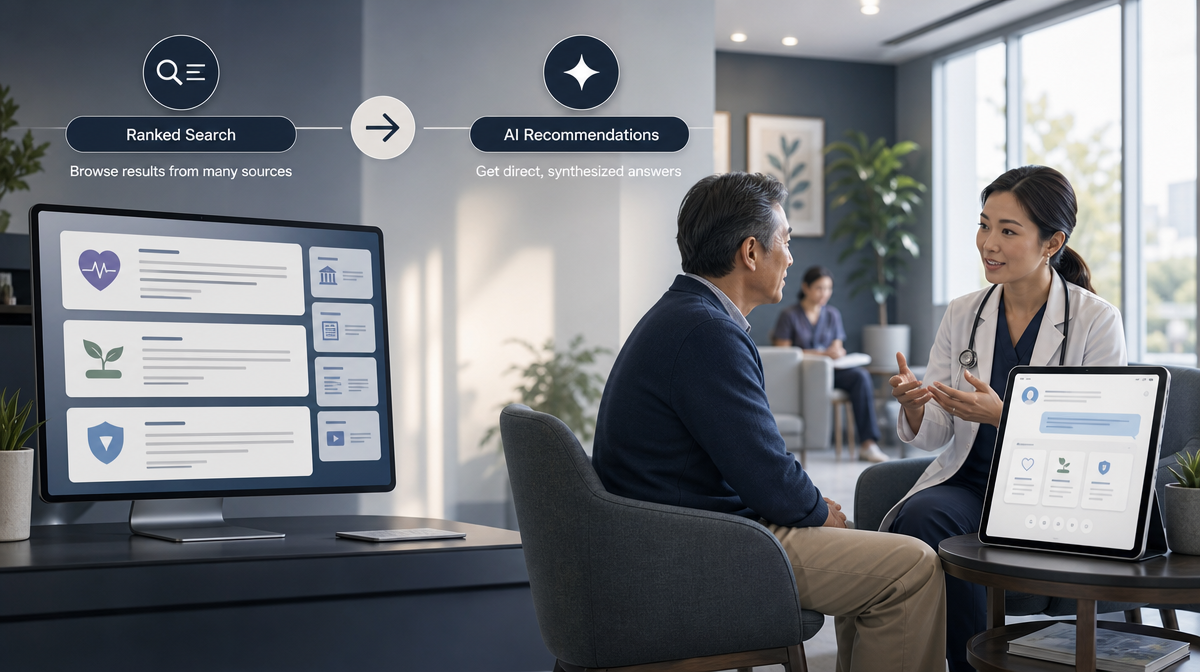
The mechanics of how patients actually search have shifted in ways that go beyond behavior — the infrastructure itself is different. Traditional search hands patients a ranked list and asks them to choose. Google AI Overviews and conversational tools like Perplexity operate more like a knowledgeable colleague: they synthesize information across multiple sources, form a direct answer, and present that answer as a conclusion rather than a starting point.
For a patient researching, say, cataract surgery options or whether a specific GLP-1 medication is right for them, that distinction has real consequences. Instead of scanning ten blue links and deciding which practice looks most credible, they receive a consolidated response — often without ever seeing which websites contributed to it.
The evaluation criteria powering these two systems are also structurally different:
- Traditional search: Rankings are driven by link authority, keyword relevance, and on-page signals — patients click through to your website to evaluate you
- AI-powered search: Citations are driven by content structure, topical authority, and trust signals — patients receive a synthesized answer that may or may not name your practice as a source
- Conversational understanding: AI tools interpret intent behind multi-step patient questions, not just isolated keyword matches, rewarding content that addresses the full clinical context
The practical implication for your practice is that a patient can now complete significant decision-making research without your website ever loading in their browser — when an AI summary appears, only a small share of searchers click through to any source — making your presence inside the AI answer layer as consequential as your position on page one. This is the heart of how AI is reshaping medical marketing — visibility now lives inside the answer, not just the results list.
Healthcare content occupies a category that most other industries simply don’t face: Google officially classifies it as Your Money or Your Life (YMYL) content, meaning any information that could directly affect a person’s health, safety, or financial wellbeing. That classification triggers a fundamentally stricter evaluation process — one that affects how both traditional search algorithms and AI tools decide whether your practice deserves to appear in front of patients.
The practical consequence for your practice is that the margin for thin, generic, or unverified content is essentially zero. A home services company can publish mediocre blog posts and still rank. A medical practice cannot. AI systems have inherited Google’s caution here — they are specifically trained to be conservative about surfacing unverified medical claims, which means low-authority healthcare content gets filtered out at a higher rate than comparable content in other verticals.
Three factors make medical SEO structurally harder in this environment:
- YMYL classification: Health content triggers elevated quality thresholds across both search algorithms and AI citation models, requiring demonstrated clinical credibility at every touchpoint
- Misinformation guardrails: AI tools apply additional skepticism to unverified medical claims, making authoritative sourcing a hard requirement rather than a nice-to-have
- Compliance complexity: HIPAA restrictions and healthcare advertising regulations constrain how you collect data, what claims you can make, and which AI-assisted workflows are permissible for your practice
Understanding this elevated standard is the starting point for building a content and optimization strategy that actually earns visibility.

Appearing in Google’s AI Overviews isn’t luck — it’s the result of specific structural and authority signals your practice either has or doesn’t. Google’s AI layer pulls from content it can parse quickly, attribute to credible sources, and match to the conversational phrasing patients actually type. That means the optimization levers are different from what moved the needle on traditional rankings.
- Optimize for conversational long-tail queries: AI Overviews consistently favor content written around the way patients phrase real questions — “what should I expect after LASIK surgery” outperforms “LASIK recovery” as a content target because it mirrors how patients speak to AI tools. Map your content to the full question, not just the keyword fragment. The same discipline carries over to voice search for medical practices, where the query is spoken as a sentence and the assistant reads one answer aloud.
- Add medical schema and structured data: Schema markup gives Google’s AI layer explicit context about your practice — who you are, what you treat, and where you’re located. Healthcare-specific types like MedicalClinic, Physician, and FAQPage schema signal to AI systems that your content is structured, credible, and safe to surface to patients making health decisions.
- Build topical authority with content clusters: A single page on knee replacement won’t carry the weight of a hub-and-spoke content model covering surgical criteria, recovery timelines, physical therapy protocols, and insurance considerations. Comprehensive topical coverage signals depth of expertise — the kind AI systems reward with citations.
- Earn citations from authoritative health sources: Backlinks and mentions from medical association websites, .edu health resources, and established health directories significantly increase the probability that Google’s AI layer treats your practice as a citable source rather than a candidate to filter out.
Google AI Overviews and ChatGPT look similar from a patient’s perspective — both deliver direct answers — but they pull from entirely different signals when deciding whose content to surface. ChatGPT, Gemini, and Perplexity are trained on broad web data and updated periodically; they develop citation habits based on which sources consistently appear authoritative across the full landscape of the internet, not just in Google’s index. That distinction changes your optimization approach considerably.
The core question these models are answering when they evaluate your practice’s content is deceptively simple: Is this source reliable enough to recommend to someone making a health decision? Meeting that bar requires a different set of actions than ranking in traditional search:
- Publish direct, factual answers to real patient questions: Conversational AI tools are trained to favor content that answers questions completely within the page itself — not content that teases information to drive clicks. A page that fully explains post-operative care for a procedure you offer is far more citable than one that summarizes and links elsewhere.
- Build brand mentions across the web: AI language models learn your practice’s credibility partly through how frequently and positively your name appears across third-party platforms — health directories, news mentions, professional association listings, and patient review aggregators all contribute.
- Structure content for machine extraction: Short paragraphs, descriptive headers, and clean list formatting help AI systems parse and quote your content accurately — dense prose gets skipped in favor of content these models can cleanly lift into a response.
Your AI in healthcare SEO strategy needs to account for these platforms separately from Google — they reward different signals and operate on different update cycles.
Executing on AI in healthcare SEO means working through five concrete operational areas — each one addresses a different gap between where your practice currently sits and where AI systems need to see you before they’ll recommend you to patients. Done well, this is what AI-driven medical SEO delivers: visibility across both the ranked results and the AI answer layer.
- 1. Claim and optimize your local listings: Your Google Business Profile, Healthgrades listing, and Vitals profile are active data inputs that AI tools query when patients ask location-based questions. Name, address, and phone number must match exactly across every directory — inconsistencies create ambiguity that causes AI systems to deprioritize your practice in proximity-based recommendations.
- 2. Publish E-E-A-T driven medical content: Every page treating a clinical topic needs a bylined author with verifiable credentials, citations to peer-reviewed sources, and clear disclosure of when content was last reviewed. Author bios with license numbers and specialty board certifications are not optional cosmetics — they are the credibility signals AI systems use to determine citation eligibility.
- 3. Strengthen technical SEO and page experience: Core Web Vitals scores, mobile rendering, and crawl accessibility form the floor that everything else sits on. AI tools preferentially cite sources that search engines can index cleanly — a slow, poorly structured website limits your AI visibility regardless of content quality.
- 4. Build reviews and reputation signals: Review volume, recency, and average rating across Google, Yelp, and Healthgrades collectively inform AI recommendations. Practices with deep, steadily growing review profiles appear in AI-generated provider suggestions more readily than comparable practices with thin or stale ones.
- 5. Use AI for keyword research and content workflows: Keyword research platforms now surface the specific questions patients type into AI assistants — use that data to identify content gaps before competitors fill them, while keeping a licensed clinician in the review loop for every published page.
Google’s quality evaluators don’t read your content the way patients do — they assess it against a specific framework designed to protect people making high-stakes decisions. For medical practices, that framework is E-E-A-T, and satisfying it isn’t about checking boxes. It’s about demonstrating, through every structural choice you make, that a real qualified professional stands behind what your website says.
Each component carries distinct weight in how both Google and AI citation models evaluate your content:
- Experience: Content should reflect direct clinical involvement — a surgeon describing what they observe during a procedure carries more weight than a general summary of what the procedure involves. First-person clinical insight is a signal, not a style choice.
- Expertise: Every page addressing a health condition or treatment needs a named, credentialed author. A board-certified physician’s byline with their specialty and license state isn’t optional decoration — it’s the credential layer AI systems verify before treating your content as citable.
- Authoritativeness: Your practice needs recognition beyond your own website. Being listed in specialty directories, referenced by medical associations, or cited in health publications signals to AI systems that your authority has been externally validated — not self-declared.
- Trustworthiness: Accurate, current information with visible review dates, HTTPS security, and transparent disclosures about the clinical basis of your content — these signals collectively tell Google’s quality systems that your practice is a reliable source, not a liability.
YMYL classification means your content is held to a standard most industries never encounter. Meeting E-E-A-T isn’t just an SEO exercise — it’s the prerequisite for any AI in healthcare SEO strategy to function.
Most SEO work is reactive — you publish content after patients start searching for something. Predictive SEO flips that model by using AI to identify what patients will search for before the query volume shows up in your keyword tools.
For your practice, this plays out in seasonal and behavioral patterns that are highly predictable once you’re looking at the right data. Allergy practices see inquiry spikes weeks before pollen counts peak. Weight loss consultations surge in November ahead of New Year resolution cycles. Elective procedure interest correlates with end-of-year insurance deductible deadlines. AI-driven analytics platforms can surface these patterns at the practice level — not just industry-wide trends — and flag content gaps before your competitors fill them.
The acquisition payoff is direct: practices publishing condition and treatment content weeks ahead of peak search windows accumulate topical authority before competitors have even identified the opportunity. That timing advantage compounds — pages that age into authority before demand peaks outperform rushed content created after the trend is already visible.
Practically, this means your content calendar should be driven by predictive signals, not intuition. A few tools worth knowing:
- Google Trends with healthcare filters: Identifies rising query patterns at the regional level before they hit mainstream keyword databases
- AI-augmented keyword platforms: The major keyword research tools now include AI-assisted forecasting that surfaces emerging patient questions your current site doesn’t address
- Practice-specific analytics modeling: Platforms built for medical practices can correlate your historical appointment data with external search trends to prioritize content that converts, not just content that ranks
Using AI tools to support your medical marketing creates a specific category of compliance risk that most practice owners don’t encounter until something goes wrong. The concern isn’t philosophical — it’s operational. When you or your staff interact with AI writing tools, the inputs you provide become part of the transaction, and any patient-identifiable information included in those prompts is potentially outside your HIPAA-conscious environment.
The practical rules for keeping your AI in healthcare SEO workflows compliant are straightforward:

- Patient data stays out of AI tools: Never paste appointment notes, case descriptions, or any detail that could identify a specific patient into ChatGPT, Gemini, or similar platforms — even to “anonymize” it yourself. The liability exposure isn’t worth the shortcut.
- Licensed professionals must review AI-generated clinical content: AI can draft a page about a procedure, but it cannot verify whether that draft reflects current clinical guidelines or makes claims your practice can substantiate. A physician or qualified clinician needs to sign off before anything goes live.
- Accuracy failures carry real consequences: Unlike a retail brand publishing slightly inaccurate product copy, a medical practice publishing AI-generated content that contains a dosing error or contraindication omission faces regulatory exposure beyond SEO penalties.
- Disclosure requirements vary by platform: Some publishing platforms and advertising networks now require disclosure when AI assists in content creation. Know the policies for each channel before you publish.
Think of AI as a capable first-draft tool that operates inside guardrails you set — not an autonomous content department. The compliance responsibility stays with your practice regardless of which tool generated the text.
Pulling all of this together — the technical infrastructure, the content credibility signals, the GEO-specific citation work, the local listings, and the compliance guardrails — is a full-time operational commitment. Most practice owners running busy clinical schedules don’t have a spare 20 hours a week to become AI search specialists. That’s the gap where the wrong choice costs you months of lost patient acquisition.
A.L.I. 360 by Target Patients MD, a proprietary AI-powered patient-acquisition system for medical and dental practices — the name stands for Attract, Learn, and Influence — was built specifically for this problem. It integrates traditional medical SEO with Generative Engine Optimization inside a single managed system — so your practice earns visibility in Google’s ranked results and gets positioned as a citable source in AI-generated answers, without you needing to manage two separate strategies with two separate vendors.
What makes it different from a general digital marketing retainer:
- Healthcare-exclusive focus: Every tactic is calibrated to YMYL standards and HIPAA-conscious workflows from day one — no retrofitting general marketing approaches to fit medical compliance requirements
- Built around patient volume: The system has been run across 735+ practitioners, and the work is measured the way patient acquisition should be — in booked appointments rather than traffic
- Integrated reputation management: Reviews are actively managed across the platforms that matter, feeding the sentiment signals AI recommendation systems weigh when surfacing providers
- Predictive content deployment: Content is timed to patient demand cycles, not published reactively after competitors have already captured the query
Book a practice growth session to see how A.L.I. 360 positions your practice for AI in healthcare SEO — before your local competitors do.
Doctors running busy practices tend to have the same handful of questions before committing to an AI in healthcare SEO strategy. Here are direct answers to what comes up most often.
- How long does AI healthcare SEO take to show results? Medical SEO services aimed at traditional organic rankings typically produce movement within three to six months of consistent optimization work. Visibility inside AI-generated answers can move faster — some citation patterns change as models update — but the underlying authority that earns those citations still accumulates over time. There is no shortcut around the credibility-building phase.
- Is AI-generated content safe to use on a medical website? AI can accelerate drafting and research, but no AI-produced clinical content should go live without review and approval from a licensed healthcare professional. YMYL classification means the consequences of publishing unverified medical information extend well beyond an SEO penalty.
- How do I measure whether ChatGPT or Gemini is recommending my practice? No standardized analytics dashboard tracks AI assistant citations yet. The current approach involves manually querying relevant service and location combinations across platforms, monitoring indirect referral traffic patterns, and using emerging GEO tracking tools as they mature.
- Will AI Overviews eventually make my practice website unnecessary? No — AI Overviews synthesize answers by citing authoritative source pages. A well-optimized practice website is what earns that citation, not a liability to minimize.
- What is the practical difference between SEO and GEO for my practice? Traditional SEO earns you a position in a ranked list patients browse. GEO earns you a mention inside the answer a patient receives before they ever see that list.