


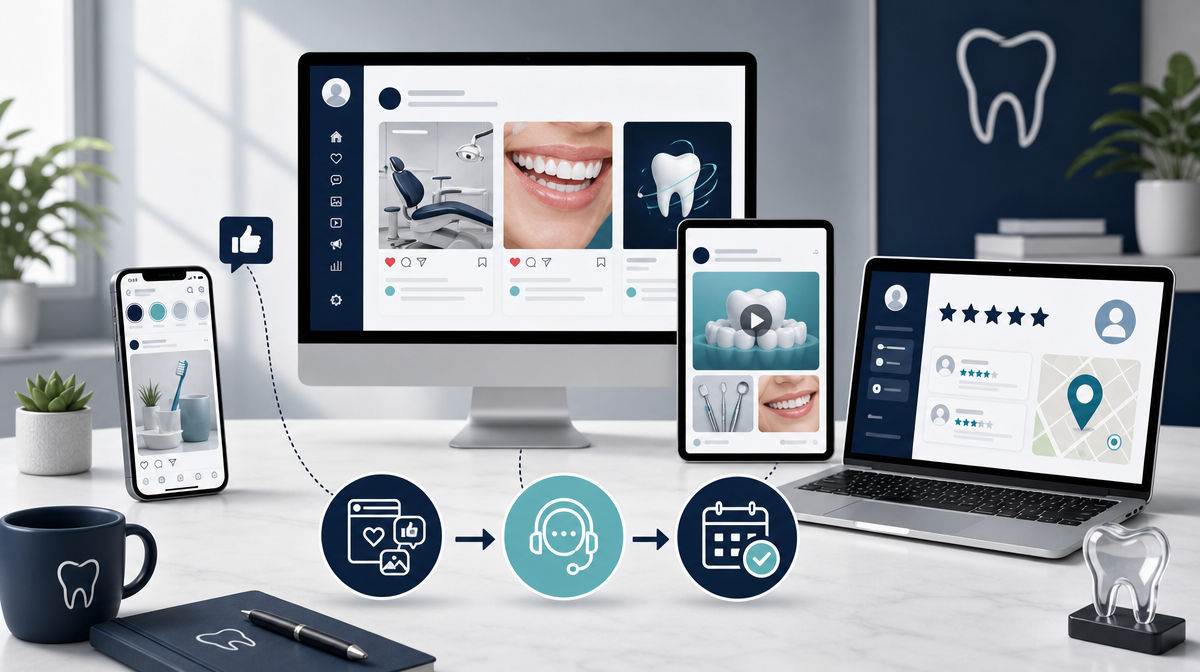
Most dental practices posting on social media are measuring the wrong things. They track likes, follower counts, and reach, and when those numbers climb they assume the strategy is working. It isn’t. Dental social media marketing only earns its keep when it puts new patients in your chair, and vanity metrics have almost no correlation with booked appointments.
The disconnect runs deeper than metrics. Most practices lose ground in four predictable ways. The first is posting without a booking path — a beautifully designed post that ends with no clear next step is a billboard nobody can act on, and if a patient can’t get from your caption to your scheduler in a tap, that impression is wasted. The second is having no attribution at all: ask most practice owners which post generated their last five new patients and you’ll get a blank stare, which means time and money are going into content nobody can connect to revenue. The third is content that blends in, because generic reminders and stock holiday graphics don’t distinguish you from the practice three miles away. And the fourth is treating organic posting as the whole strategy, which mostly reaches people who already follow you rather than the new patients you actually need.
The result is a practice that feels active on social media but sees no measurable lift in consultations or treatment starts. The fix isn’t posting more. It’s restructuring the whole approach around one outcome: booked appointments.
When dental social media marketing is built around patient acquisition rather than audience growth, the return shows up in revenue rather than on an analytics dashboard. The practices seeing the clearest gains aren’t necessarily posting more often than their competitors — they’re posting with purpose, and every piece of content has somewhere to send an interested patient.
What that produces is worth being specific about. You get more new patient inquiries at a lower cost per inquiry, because targeted social reaches people by location and life stage in a way print and direct mail never could. You get higher case acceptance on high-value treatment, since a patient who has already seen your results and heard a real patient describe the experience arrives pre-sold and needs less convincing in the chair. You get stronger retention between visits, because a consistent presence keeps your practice visible during the long stretches when patients aren’t thinking about dental care at all. You build credibility before the first call, as reviews and patient stories do third-party validation work that no ad can replicate. And over time you become the recognized option in your community rather than one of several names a patient is weighing.
Not every platform deserves equal space in your week, and spreading a small team across six channels is a faster route to burnout than bookings. The smarter move is matching each platform’s native behavior to a specific goal.

Facebook remains the workhorse for practices whose patients skew 35 and older, and its reviews sit prominently on your business page where high-intent visitors see them before they ever reach your website. Instagram is built for visual storytelling, which makes it the natural home for smile transformations, and Reels and Stories surface your content to people who don’t already follow you — which is the point, since new patient exposure matters more than engagement from existing patients. TikTok has become a genuine discovery platform for younger patients, and polished production actually works against you there; unscripted content from your team consistently outperforms anything that looks like an advertisement. YouTube is the only platform where your content also strengthens your position in Google search, so a short explainer on what implant recovery actually involves earns trust and visibility at the same time. And your Google Business Profile, which most practices ignore, directly influences whether you appear in local map results — posts, current photos, and review responses there shape booking decisions at the precise moment someone is searching for a dentist nearby.
Platform choice and posting frequency mean nothing if the content itself doesn’t move someone from scrolling to scheduling. Most practices default to whatever is easiest — motivational quotes, holiday graphics, generic oral health tips — and then wonder why appointment volume stays flat.
A handful of formats consistently generate real inquiries. Before-and-after case content is the most persuasive thing you can publish, because visual proof of clinical outcomes does more selling than any caption; a fifteen-second clip showing a transformation carries more weight than a paragraph describing one. Patient testimonial video works for the same reason — someone speaking for thirty seconds about their own experience outperforms polished copy every time, since prospective patients are evaluating trust rather than production quality. Doctor and team introductions address something specific to dentistry: dental anxiety is real and it begins with fear of the unknown, so short videos showing who your team actually is reduce that friction before anyone picks up the phone. Treatment education answers the questions patients are too embarrassed to ask out loud, and removing that uncertainty early means fewer hesitant callers and faster decisions. Financing and affordability content matters more than most practices admit, because cost is frequently the real objection behind a stalled treatment plan, and simply making payment options visible lowers the barrier to booking. Behind-the-scenes and community content earns its place too, though it should stay a modest share of what you publish — warmth supports conversion, it doesn’t replace it.
Consent is where dental social media differs from marketing any other local business, and it deserves its own attention rather than a footnote. The governing distinction is identifiability: any content that could connect a recognizable person to a treatment or clinical outcome requires written authorization before it goes anywhere near your feed. A verbal yes in the hallway is not authorization. Content with no patient information in it — educational graphics, team photos, procedure explainers — carries no such requirement and is safe to publish freely.

Two other habits keep practices out of trouble. Public comments and direct messages are not secure channels, so when a patient raises a symptom or treatment detail in a comment thread, respond professionally and move the conversation offline rather than engaging with clinical specifics in the open. And signed authorizations need a paper trail: the form should specify exactly where the content will be used and be archived alongside a record of what was published and when. Practices that build a simple consent step into their post-appointment routine find this becomes ordinary rather than paralyzing. Protecting patient privacy and running an active social presence aren’t in conflict — they just require a documented, HIPAA-conscious process. That reply layer is where most of the exposure in healthcare social media marketing actually sits, whatever the specialty — a practice controls its own posts and almost nothing underneath them.
Knowing what to post only gets you halfway. The gap between someone who likes your content and someone who books is a conversion problem, and it takes deliberate systems rather than better captions.
Start with the obvious and most-neglected fix: every caption and every profile needs a booking instruction and a working path. Your Instagram bio link and your Facebook page button should route directly to your scheduler rather than your homepage, and a caption without a next step is a dead end no matter how good the content is. Inbound messages deserve the same treatment — patients who message your practice are expressing intent, and replying quickly with a direct booking link removes the back-and-forth that lets leads go cold. Then make the traffic land somewhere that converts, because social sends people to your site and medical website design determines whether they book once they arrive; a slow page or a buried scheduling button wastes the intent your content worked to create.
Attribution is the piece almost nobody builds. Tagged booking links and call tracking numbers let you trace an inquiry back to the specific post or campaign that produced it, which is the difference between knowing your social media works and merely hoping it does. And none of it should run in isolation — social is one channel inside a broader dental digital marketing program, and it performs best when a patient who sees your content also encounters your practice in search results and in follow-up email, each touch shortening the decision.
Paid social deserves a mention here because organic reach alone has real ceilings. Advertising on Facebook and Instagram lets you reach people by neighborhood, age, and life stage who have never heard of your practice, retarget visitors who browsed your services without scheduling, and capture inquiries through forms that don’t require leaving the app. It is the fastest way to add volume when organic is compounding too slowly. The mechanics of building and managing those campaigns sit alongside the rest of your paid strategy rather than inside a social content plan, which is why it’s covered in depth as part of the broader service.
Reviews belong in this conversation too, because your patients make booking decisions before they ever call your front desk — Medical Economics reports that 84% of patients check online reviews before choosing a provider — and the reviews sitting on your Google Business Profile and Facebook page are doing more persuasion at that moment than any post you published this week. Practices that understand this treat reputation management as an acquisition asset rather than a passive byproduct of good care.
Four habits determine how much that social proof actually produces. Automated review requests sent shortly after checkout, while the visit is still fresh, consistently outperform asking manually days later. Turning strong reviews into posts puts that credibility in front of people who would never think to browse your review profile. Video testimonials collapse skepticism in a way star ratings cannot, because a face and a voice carry weight that text doesn’t. And how you respond publicly — particularly to criticism — is visible to every prospective patient reading the thread, which makes a calm, professional reply to a complaint more valuable than several more five-star reviews on the same page.
Budget conversations make practice owners uncomfortable because the honest answer isn’t a number, it’s a framework. What you should spend depends on how aggressively you need to grow, how competitive your market is, and whether you’re running organic content alone or adding paid campaigns on top.
Those paths carry different cost structures. An organic-only approach looks inexpensive until you account for staff time — someone is creating content, managing platforms, and answering comments, and those are hours not spent on patient care. It also compounds slowly, taking months to translate into measurable new patient flow. Paid campaigns require ongoing ad spend, and the tradeoff is speed for dependency: inquiries can appear within the first week, but they stop when the spending does. Full-service engagements bundle content, campaign management, reputation work, and reporting, and pricing varies widely with market size and scope.
The reframe that matters most: stop evaluating social spend against impressions or follower growth, and start evaluating it against what a new patient is worth to your practice. A single high-value case can justify a meaningful monthly investment. The real question is whether your current setup can trace a booking back to what caused it.
Most practices shopping for help make the same mistake — evaluating agencies on creative portfolios and monthly pricing before asking the questions that actually predict results. This decision deserves the rigor you’d apply to adding a new piece of equipment, because the wrong partner costs far more than the retainer.

Four things separate a real partner from a posting service. Look for healthcare-only focus with dental experience on file, because a generalist pivoting into dental has no working knowledge of case acceptance psychology or how privacy obligations shape what you can publish — and ask for performance data tied to appointment volume rather than testimonials. Insist on reporting that shows appointments rather than audience growth, with attribution down to the campaign or creative that produced each inquiry; that single requirement separates a dental marketing agency from a vendor posting on your behalf. Expect an in-house team on month-to-month terms, since long contracts and offshore execution remove the leverage you need when results plateau. And ask specifically how their system connects a booked appointment back to the touchpoint that generated it — if the answer is vague, the attribution isn’t real.
Most practices that struggle here don’t have a content problem, they have an integration problem. Individual tactics running in isolation produce individual results: a video gets views, a campaign gets clicks, a review gets a response. None of it compounds into a predictable acquisition system unless someone is connecting every channel, touchpoint, and dollar. That’s the same principle behind effective healthcare content marketing — individual pieces matter far less than whether they’re working as one system.
It’s also why discovery itself is changing. Patients increasingly ask an assistant a question and receive an answer rather than scrolling a page of links, and the practices paying attention to AI in healthcare SEO are treating their whole digital footprint — reviews, content, listings, social presence — as one connected set of signals rather than separate campaigns.
That integration problem is what Target Patients MD is built to solve. Rather than managing social as a standalone deliverable, the approach ties every campaign to your scheduling pipeline, so you can see which formats, audiences, and platforms are producing consultations and which are burning budget on engagement that never converts. A.L.I. 360 by Target Patients MD is a proprietary AI-powered patient-acquisition system for medical and dental practices — the name stands for Attract, Learn, and Influence — and it tracks inquiries from the first social touchpoint through to a booked appointment, continuously adjusting targeting based on what is actually producing patients rather than what is producing impressions.
The practices seeing the clearest return are the ones that stopped treating social as a branding exercise and started treating it as a measurable acquisition channel with real performance standards. If your current setup can’t tell you what a booked appointment from social cost you this month, you don’t have a strategy — you have a posting habit. Get in touch and we’ll show you where the gap is.
Here are answers to the questions dental practices ask most often about social media.
How long does dental social media marketing take to produce new patients? Paid social campaigns can generate inquiries within the first few days of going live, while organic strategies typically require three to six months of consistent effort before an audience converts into scheduled appointments at a meaningful rate.
Can a dental practice run social media in-house, or is an agency required? In-house management works if a dedicated team member has both the time and the marketing knowledge to execute consistently. Most dental teams lack the bandwidth to sustain content creation, campaign optimization, and performance tracking alongside patient care.
What is the difference between organic and paid dental social media marketing? Organic refers to unpaid posts that reach your existing followers through normal feed distribution, while paid uses advertising spend to place your practice in front of targeted audiences who have never encountered your brand — generating new patient exposure that organic reach alone cannot achieve.
Can dentists post patient before-and-after photos? Yes, with written authorization from the patient. Any content that could identify a specific person alongside a treatment or outcome requires documented consent specifying where it will be used. Content with no patient information in it needs no authorization.
How do dental practices track booked appointments from social media? Through a combination of call tracking numbers, tagged links on posts and campaigns, dedicated landing pages tied to specific campaigns, and scheduling or CRM integrations that record each inquiry’s original source.