


If a prospective patient types “breast augmentation Miami” or “rhinoplasty surgeon near me” into Google right now, your practice either shows up or it doesn’t. Plastic surgery SEO is the discipline that determines which outcome you get. At its core, it’s the process of optimizing every digital touchpoint your practice owns — your website, your Google listing, your directory profiles — so that search engines surface you when high-intent patients are actively looking for a surgeon.
Unlike a billboard or a magazine ad, SEO reaches people at the exact moment they’ve already decided they want a procedure. They aren’t passively scrolling; they’re hunting for a provider. That’s a fundamentally different kind of attention, and it’s why practices with strong organic rankings convert at a higher rate than those relying entirely on interruptive advertising. The discipline itself breaks into four connected parts: organic search, which covers the unpaid results patients see when searching for a procedure and a city; local search, meaning the map listings that appear above organic results; on-page work, which is how your procedure pages and site structure match what patients actually type; and off-page signals — the backlinks, reviews, and directory citations that tell Google you’re credible. Getting one right helps. Getting all four working together is what fills a surgical calendar.
Plastic surgery patients don’t choose a surgeon the way they pick a restaurant. This is a high-consideration, high-anxiety, out-of-pocket decision, and the research phase reflects that — patients routinely spend weeks comparing options before submitting a single contact form, and nearly all of that journey happens in search.
Here is what it looks like in practice. Someone notices something they want to change, opens their phone, and types a procedure name plus their city. Google returns a mix of map listings, organic results, and sometimes a directory profile. The surgeons who appear on that first page get considered; everyone else effectively doesn’t exist, since the overwhelming share of clicks goes to the top handful of results. From there the decision accelerates through a predictable sequence. Patients read reviews and star ratings across Google, RealSelf, and Healthgrades, where a thin review profile reads as risk. They look for before-and-after galleries, wanting visual evidence specific to their own concern rather than generic stock imagery. And they scan for trust signals — board certification, surgeon credentials, real photography, and an obvious way to book a consultation.

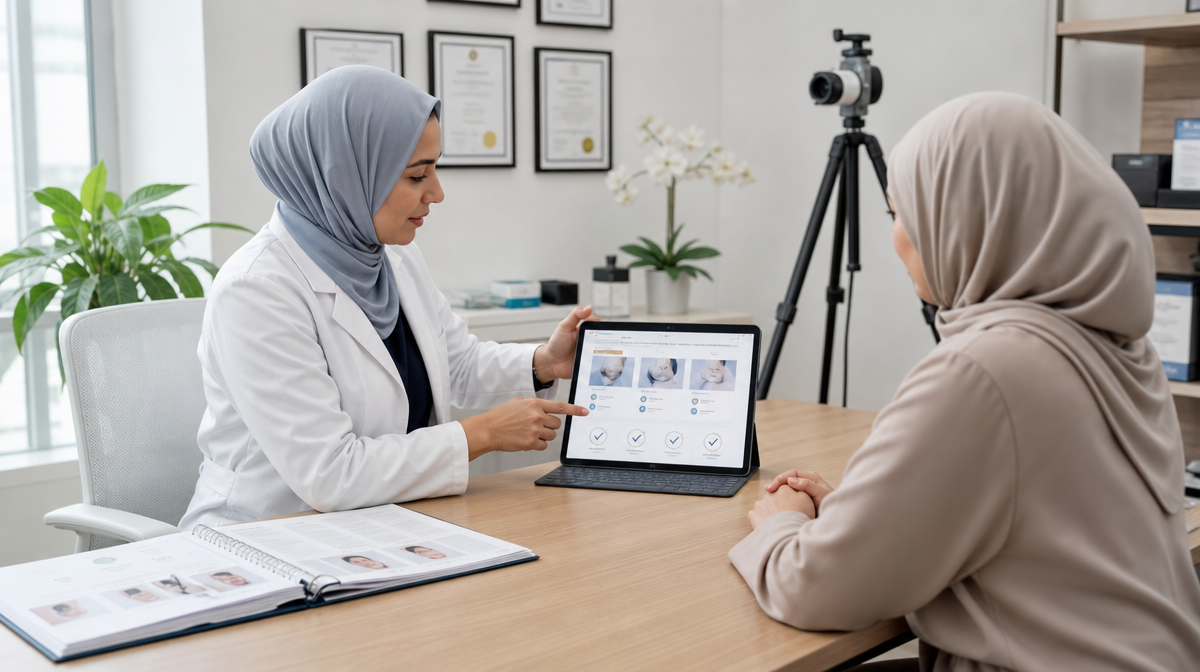
One caution worth stating plainly, because it governs everything in that gallery: any before-and-after image or patient story that could identify a specific person requires written authorization before it goes anywhere near your website or social channels. A verbal yes in the consultation room is not authorization, and the form should specify exactly where the images will be used. Handled properly, galleries are your most persuasive asset. Handled casually, they’re a liability.
The implication for your practice is direct: if patients can’t find you organically, none of the other factors get a chance to work.
Every dollar you spend on Google Ads disappears the moment you pause the campaign — rankings, visibility, and lead flow all stop together. That’s the fundamental economic problem with relying solely on paid search: you’re renting attention rather than owning it. Organic rankings work on a different model, because they compound. A well-optimized rhinoplasty page that reaches page one in month six keeps generating consultation requests in month eighteen without an incremental spend increase, and cost per lead falls over time as a fixed investment in content and technical work spreads across a growing volume of inquiries.
The economics favor organic in a second way that matters just as much: intent quality. Someone who types “board-certified facelift surgeon” plus a city and clicks an organic result has self-selected at a level no display ad or social campaign can match. They aren’t browsing, they’re evaluating surgeons, and that readiness translates into higher consultation-to-procedure conversion than cold paid traffic. The contrast sharpens in competitive metros, where procedure keywords carry some of the highest cost-per-click rates in healthcare. At those prices, generating consistent consultation volume through paid ads alone requires a budget most independent practices can’t sustain indefinitely. Organic traffic sidesteps that ceiling once rankings are established — which is why the strongest programs run both, using paid to fill the calendar now while organic compounds underneath it.
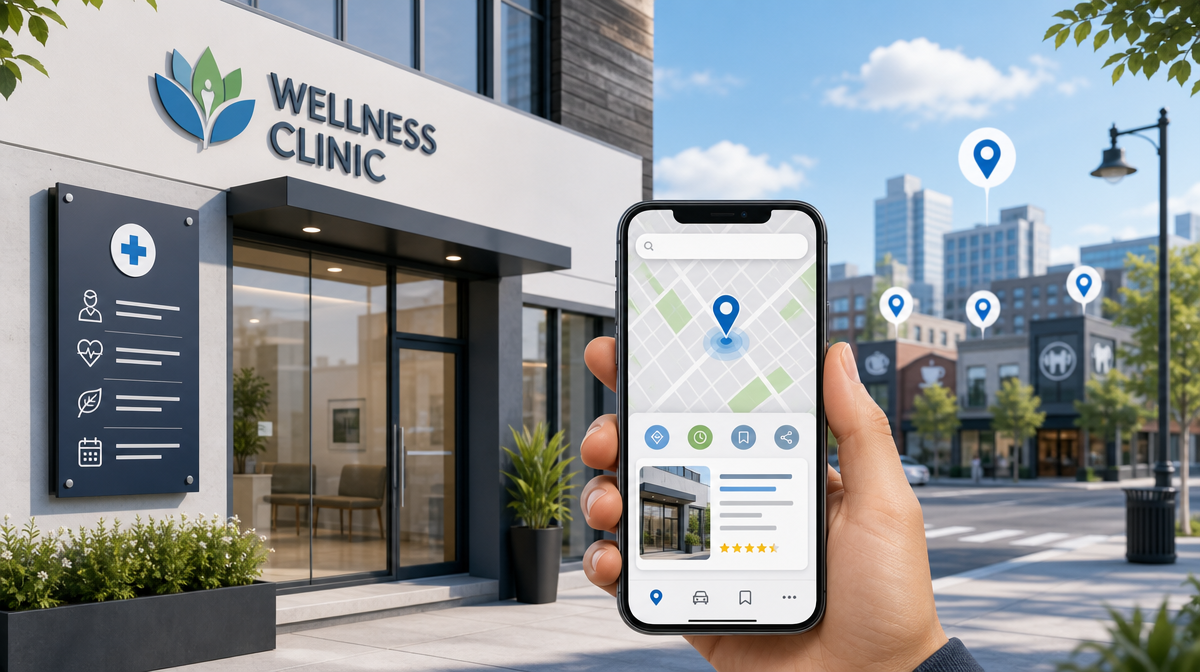
When a patient searches for a procedure in your city, the local map pack — the listings that appear above organic results — is often the first thing they see. Earning a place there is its own ranking challenge, separate from traditional plastic surgery SEO, and it starts with your Google Business Profile. Think of that profile as a second homepage Google controls: an incomplete listing signals you aren’t a serious player, while a fully built-out one feeds the local algorithm what it needs.
Four areas are where most practices leave local visibility on the table. The first is simply completing every field — name, address, phone, hours, service categories, photos, and a procedure-specific description — because partial profiles consistently rank below complete ones. The second is keeping your name, address, and phone number identical across every directory, since mismatches between your profile, website, Yelp, Healthgrades, and RealSelf create conflicting signals that suppress local rankings. The third is building a repeatable review system, because volume, recency, and your response rate all feed the local algorithm; a checkout-time text or a short follow-up sequence lifts review acquisition without adding staff time. The fourth is publishing profile posts regularly, which signals an active practice and keeps the listing fresh.
Your procedure pages are the highest-leverage asset you own, and most practices treat them like brochure pages. A single page listing every service tells Google almost nothing. What ranks is specificity: one dedicated page per procedure, built around the exact language patients use when they’re ready to book.
Keyword mapping is the foundation. Each page should own one primary term — typically a procedure paired with your city — exclusively. A rhinoplasty page targeting that procedure and a breast augmentation page targeting its own will outperform any catch-all services page every time, because Google rewards topical relevance at the page level rather than the site level. The content then has to answer what patients are actually researching before they call: candidacy, recovery timelines, what the procedure involves, and realistic expectations. Thin pages with two paragraphs of generic copy don’t rank in competitive markets; comprehensive pages that anticipate patient concerns and demonstrate clinical depth do. This is the same principle that governs medical SEO generally, just applied to a vertical where the search behavior is procedure-led rather than symptom-led.
Four on-page elements decide whether those pages get found. Title tags carry real ranking weight and appear directly in results, so the procedure and city belong in them. Meta descriptions should be written for clicks rather than keywords, since they influence click-through from the results page. Schema markup helps Google display richer results like FAQs and ratings alongside your listing. And internal links from blog posts and supporting pages should funnel authority toward your highest-value procedure pages rather than scattering it.
Google evaluates medical content through a framework it calls E-E-A-T — Experience, Expertise, Authoritativeness, and Trustworthiness — and plastic surgery sits squarely inside what Google classifies as “Your Money or Your Life” content, where bad information causes real harm. That classification means your credibility signals get scrutinized far more aggressively than a retailer’s would.
Backlinks are the currency of that system. A link from a respected health publication, a university network, or a regional news outlet reads to Google as institutional endorsement, and a handful of high-authority links from relevant medical sources will outperform hundreds from unrelated directories. Three approaches build that authority without risk. Earning links from health, news, and educational sources works best through genuine expert commentary — offering perspective to journalists covering aesthetic medicine, or contributing clinical insight to health publications. Adding surgeon authorship matters more here than in most verticals: every piece of clinical content should display the writing surgeon’s board certifications and training, with markup connecting that author to their credentials. And listing your practice in trusted medical directories delivers both a quality link and direct referral traffic from patients already comparing surgeons.
Avoid any agency offering purchased links or bulk directory submissions. Google identifies those patterns, and recovering from a manual penalty takes longer than building authority properly would have in the first place. The same logic applies to reviews: a systematic, permission-based approach to reputation management compounds, while shortcuts create exposure.
Content and local signals get you discovered. Technical work determines whether Google can read, understand, and serve what you’ve built — and a site with excellent procedure pages can still underperform if the underlying medical website design is working against it. The stakes are highest on mobile, since the majority of healthcare searches now start on a phone and Google evaluates the mobile experience first when deciding where to rank you. A procedure page that loads slowly or shifts layout while someone is trying to tap a phone number isn’t just frustrating; it’s a ranking liability.
Three technical areas produce most of the impact for surgical practices. Core Web Vitals come first — Google measures how fast your main content loads, how quickly the page responds, and whether elements shift while loading, and high-resolution before-and-after galleries are the most common culprit behind poor scores, so compress and lazy-load without sacrificing quality. Crawl and indexation hygiene comes second, because duplicate content across location pages, accidentally blocked procedure pages, and broken internal links waste crawl budget and suppress rankings; a periodic audit catches these before they compound. Structured data comes third, where physician, local business, and procedure markup tell Google precisely what each page represents and enable the richer result displays that lift click-through.
Something has shifted in how patients find surgeons, and it happened faster than most practices noticed. AI Overviews now answer procedural questions — how long recovery takes, whether someone is a candidate — directly on the results page, before a patient clicks anything. Meanwhile a growing share of prospective patients begin their search on an AI assistant rather than Google, asking conversational questions and receiving curated recommendations.
That shift introduces a discipline sometimes called generative engine optimization: structuring content so AI-powered search tools can extract, cite, and recommend your practice when generating an answer. The practical implication for surgeons is concrete, because AI systems overwhelmingly cite pages that already rank well organically. Practices whose content is organized around clear questions with authoritative, credentialed answers get cited; those with thin procedure summaries get ignored. The signals that earn those citations overlap heavily with strong plastic surgery SEO — credentialed authorship, structured question-and-answer content, genuine topical depth — but generative optimization adds a layer of specificity around how information is formatted and attributed. A.L.I. 360 by Target Patients MD is a proprietary AI-powered patient-acquisition system for medical and dental practices — the name stands for Attract, Learn, and Influence — and it’s built for exactly this convergence, optimizing content for traditional rankings and AI-generated answers at the same time.
One of the most common complaints practice owners have about SEO is that it feels like money disappearing into a black box. That’s usually a measurement problem rather than a performance problem, because organic results arrive on a predictable timeline if you track the right indicator at each stage instead of demanding page-one rankings in week three.

The progression follows four phases. In the first few months the goal is confirming Google has discovered and indexed your new and optimized pages, which shows up in Search Console as rising impressions — how often your pages appear at all, even without clicks. Through roughly months three to six, watch your target procedure-plus-city terms climb through the twenties and teens, since moving from page two to the bottom of page one is the milestone that matters most in that window. From about six to twelve months, position improvements start translating into measurable organic session growth. And on an ongoing basis, the only number that justifies the investment is consultation volume attributable to organic search — inbound requests, calls, and booked appointments traced back to that channel. If your program can’t draw a line from rankings to consultations, the measurement stack is broken even if the strategy isn’t.
Hiring the wrong partner is an expensive way to learn what good looks like. Most generalist firms will sell you on keyword rankings and traffic reports, then deliver exactly that while your consultation calendar stays half empty. The distinction between a vanity-metrics vendor and a genuine growth partner comes down to what they agree to be measured on.
Four filters separate them. The first is healthcare specialization: a firm splitting attention between surgeons, e-commerce brands, and law firms hasn’t built the procedure-specific content skill or the compliance awareness this vertical requires — which is why practices increasingly look for a healthcare-exclusive medical marketing agency rather than a generalist. The second is evidence: ask for documented outcomes showing inquiry volume and cost per lead, not screenshots of ranking changes, because rankings are inputs and booked procedures are the output. The third is transparent reporting — a clear account of what was done, what moved, and what’s planned, rather than a PDF of traffic graphs with no strategic context. The fourth is accountability to consultations rather than clicks, which means the agency ties its own performance definition to your front desk.
Target Patients MD works exclusively with medical practices and measures every engagement against patient acquisition. That focus extends across the aesthetic space — the same principles that drive plastic surgery digital marketing more broadly apply here, with search as the channel where high-intent patients are actually found. If your rankings aren’t producing consultations, working with a specialized plastic surgery marketing agency is usually the difference between activity and outcomes. Get in touch and we’ll show you where the gap is.
Here are answers to the questions practice owners ask most often about plastic surgery SEO.
How long does plastic surgery SEO take to show results? Expect meaningful keyword movement between months three and six, with sustained organic traffic and consultation growth becoming clearly measurable in the six-to-twelve-month window. Timelines run faster in less saturated markets and slower in cities where established practices have years of accumulated authority.
What’s the difference between plastic surgery SEO and general medical SEO? Medical SEO largely targets symptom and condition searches. Plastic surgery patients search by procedure name, by qualitative outcome, by surgeon evaluation, and by comparison between procedures — which means the site architecture, content, and trust signals all have to be built differently.
Do plastic surgeons need a separate page for each procedure? Yes. Google rewards topical relevance at the page level, so a dedicated page per procedure consistently outperforms a single combined services page. Each one should own its primary term and answer the candidacy, recovery, and expectation questions patients research beforehand.
How important are before-and-after photos for SEO? They matter enormously for conversion and meaningfully for rankings, since they increase engagement and demonstrate the outcomes patients are evaluating. They also require written patient authorization before publication, and because they’re image-heavy they need compression and lazy-loading so they don’t slow the page down.
Should a plastic surgery practice do SEO or paid ads first? Most practices run both. Paid search fills the schedule while organic authority is still building, and organic reduces long-term dependence on ad spend once rankings establish. The right balance depends on how quickly you need consultations versus how much you want to lower cost per patient over time.