



A dental practice decides to run paid search. It picks the obvious terms, sets a budget, and watches the cost per click come in far above what the numbers seemed to justify. The usual conclusion is that the local market is unusually competitive.
It usually isn’t. The other bidders in that auction are mostly not dentists.
That single fact reorders everything about how a practice should approach dental PPC, because the strategy that works against a competing practice down the road is not the strategy that works against a bidder with entirely different economics.
| Who is bidding | What they are buying | Why they can outbid a practice |
|---|---|---|
| A single practice | A patient they will treat | Limited by chair time and one case value |
| A dental service organization | Volume across many locations | Centralized budget, averaged across sites |
| A directory or aggregator | A lead they will resell | Sells the same click more than once |
| A national treatment brand | Category awareness | Not paying for a local patient at all |
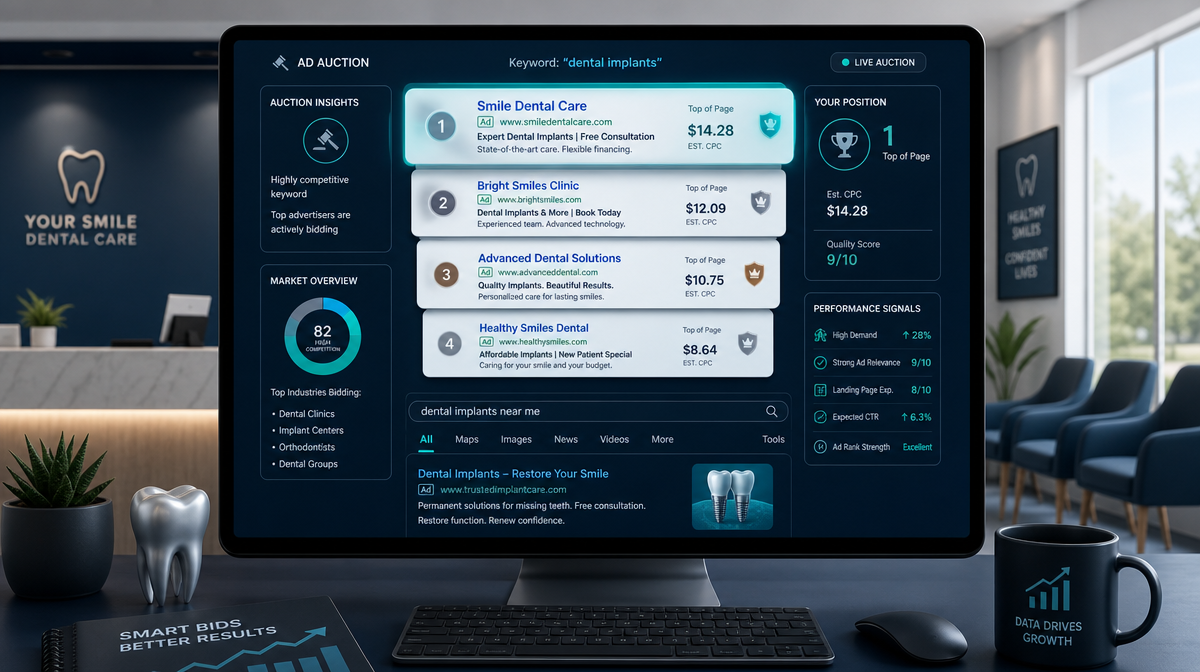
Work down that right-hand column and the pricing stops looking irrational. A practice bidding on an implant term is buying one patient it will personally treat, and the ceiling on what that click is worth is one case value divided by the odds of conversion. A corporate group bidding on the same term is buying against an averaged cost per acquisition across dozens of locations, so a click that would be reckless for one office is unremarkable for a network.
The aggregator is the one that distorts the auction most, and it is the least understood. A directory or lead marketplace that captures the enquiry and sells it onward is not constrained by a single case value at all — it can sell the same enquiry to several practices. Its economics let it bid past the point where treating the patient would make sense, because it never treats anyone.
The national brand is a different problem again. A company advertising a treatment category nationally is not trying to fill a chair in your town. It is buying awareness, and it will hold a position on a treatment term in every market simultaneously without caring which local practice eventually sees the patient.
Understanding this changes the obvious next move. The instinct when clicks are expensive is to bid harder, and against these bidders that is a losing exchange — they have more room than you do and they are not going to run out first. The workable strategy is to compete where their economics stop making sense: terms too specific, too local, or too small for a national budget to bother defending.

Which leads to the most consequential decision in a dental paid search account, and the one most practices get backwards.
The highest-volume dental keyword is not the highest-value one. A search for a dentist in a city, or a variation on finding a dentist nearby, attracts an enormous and largely undifferentiated audience — people comparing prices, people looking for a cleaning, people who will not book at all. It is the term every bidder in the table above is also competing for, which is precisely why it costs what it costs.
A procedure term behaves completely differently. Someone searching for a specific treatment has already diagnosed their own situation and is choosing a provider rather than deciding whether to seek care. The audience is smaller by an order of magnitude and the case value behind it is substantially higher, which means a practice can rationally pay more per click and still acquire the patient for less than it paid to acquire a hygiene shopper on a broad term.
The uncomfortable version of this is that the cheapest-looking click is frequently the most expensive patient. A practice measuring cost per click will conclude the broad term is efficient. A practice measuring cost per booked case will usually find the opposite, and the gap between those two views is where a great deal of dental advertising budget disappears.
Emergency and urgent terms sit in their own category and are worth separating in the account. Someone searching with a problem happening right now has essentially no consideration period — they will contact whoever appears able to see them immediately. The conversion cycle is measured in minutes, which makes availability messaging and a working click-to-call more decisive than any other element of the campaign.
What saves the most money in a dental account, though, is not what a practice bids on. It is what it excludes.
Dental terms attract an unusually wide range of searchers who cannot become patients. People looking for work in a practice. Students researching procedures for coursework. People searching to understand what a treatment involves before deciding whether to see anyone at all. People looking specifically for free or reduced-cost care. People trying to understand their insurance coverage rather than find a provider.
Without exclusions, a budget bleeds into all of it. And because these searches are numerous and cheap to serve ads against, they consume impressions and clicks at a rate that quietly distorts every performance number in the account — the click-through rate looks reasonable, the cost per click looks efficient, and almost none of it can convert.
Building that exclusion list is unglamorous and it is the highest-return hour anyone will spend in a dental account. The method is straightforward: read the actual search terms that triggered ads, not the keywords that were bid on, and exclude the categories rather than individual phrases. Reading the search term report weekly for the first month of a campaign catches most of it.
Geography deserves the same scrutiny, and it is usually configured as a setting rather than treated as a lever. A practice that draws its patients from a handful of surrounding neighbourhoods gains nothing from paying for impressions across an entire metropolitan area, and the broader the radius the more the averaged performance hides which areas actually produce patients. Narrowing the target and then reading results by area is how a practice discovers that a substantial share of its spend was going to places nobody was driving from. Proximity governs unpaid placement too — Google’s own documentation states that local results are determined primarily by relevance, distance, and prominence — and the underlying logic is covered in more depth in our guide to local SEO for doctors.
Then there is the destination, which determines what the click was actually worth. Sending paid traffic to a homepage or a general services page is the most common and most expensive mistake in dental paid search. Someone who searched for a specific procedure and lands on a page listing fifteen services has to find their own way to the relevant information, and a meaningful share of them will not.
One page per campaign, matched to the term, answering the questions that specific searcher has — candidacy, what the procedure involves, what it costs in ranges, what happens next. That page also has to load quickly on a phone and put a phone number where a thumb can reach it, because paid dental traffic is overwhelmingly mobile and frequently urgent. Thoughtful medical website design treats these pages as the conversion mechanism they are rather than as an extension of the brochure.
Procedure-specific campaigns benefit most from this discipline, because the questions differ so much between treatments. What an implant patient needs to read has almost nothing in common with what a clear-aligner patient needs to read, and the campaigns supporting each are covered separately in our pieces on dental implant marketing and orthodontic marketing.
The tracking layer that measures all of this carries obligations in dentistry that it does not carry in other categories. Conversion tracking, call tracking, and remarketing all collect information about people seeking care, and the Department of Health and Human Services has issued guidance on online tracking technologies addressing when that data falls under HIPAA and what obligations attach to sharing it with a vendor. Parts of that guidance have been contested in court and the boundary is not fully settled.

The practical posture is deliberate measurement rather than no measurement. Know what the analytics and ad platform scripts on a landing page transmit and to whom, keep that tooling inside agreements that contemplate health information, and treat form submissions the same way — a form that collects a description of a dental problem is collecting something the HIPAA Privacy Rule governs, regardless of whether the person becomes a patient. Remarketing deserves particular attention, since building an audience from people who visited a page about a specific procedure is exactly the pattern that raises questions.
Given all that, the number a practice should be managing to is cost per booked appointment, and almost nobody starts there. Cost per click is the number the platform reports most prominently and the least useful one available — it describes what the auction charged, not what the practice received. Cost per lead is better and still misleading, because a form fill and a booked case are different things and the gap between them varies enormously by campaign.
Getting to the useful number requires connecting the phone. A large share of dental enquiries arrive as calls, and in a default setup a call produces almost no signal — the visitor looks like a bounce. Distinct tracking numbers per campaign close that gap, and until they are in place any conclusion about which campaigns work is guesswork dressed as data.
Paid and organic divide the work rather than competing. Paid buys a position immediately and stops the moment the budget does. Organic accumulates and keeps producing, but it does not fill a schedule gap next month. Most practices that grow steadily run both, with paid covering near-term capacity while the organic side compounds underneath — the broader picture of how the channels fit together is in our overview of dental digital marketing, and the medical-general mechanics of campaign setup are covered in Google Ads for doctors.
One further shift is worth noting, because it changes the shape of the results page itself. An increasing share of searches now return a generated summary before any list of links, paid or organic. That summary occupies attention above everything a practice can bid on, and the sources it draws from are chosen by a process that does not work like an auction. A practice can hold the top paid position and still be the second thing a searcher reads. The emerging discipline of AI in healthcare SEO addresses that surface directly, and it is worth understanding on its own terms rather than assuming paid placement covers it.

A.L.I. 360 by Target Patients MD is a proprietary AI-powered patient-acquisition system for medical and dental practices — the name stands for Attract, Learn, and Influence — and it was built for exactly this kind of split, where paid placement, organic position, and citation in a generated answer are three separate contests running on the same page.
For a practice starting from nothing, the sequence matters more than the budget. Build the exclusion list before the first campaign runs rather than after the first invoice. Start on one procedure with a real case value behind it rather than on the broad term, because a narrow campaign produces interpretable data and a broad one produces noise. Point it at a page built for that procedure. Connect the phone before anything else, since without it there is no way to tell which of these decisions worked.
And judge the account on booked cases. A practice that optimises to cost per click will end up bidding on the cheapest traffic available, which is reliably the traffic least likely to become a patient — the exact outcome the whole exercise was meant to avoid.
- What is dental PPC?
It is paid search advertising for dental practices — buying placement on search results for terms prospective patients use, and paying when someone clicks. It differs from general paid search mainly in who else is bidding: dental auctions include corporate groups, lead aggregators, and national treatment brands alongside local practices, all with different economics. - Why is dental PPC so expensive?
Because several bidders in the auction are not buying the same thing a practice is. A directory that resells the enquiry can bid past what treating the patient would justify, since it sells the same lead more than once. A corporate group averages cost across many locations. A practice is limited by chair time and one case value, so it hits its ceiling first on broad terms. - Should a dental practice run PPC or focus on SEO?
They do different jobs. Paid buys a position immediately and stops when the budget stops; organic accumulates slowly and keeps producing. Practices filling near-term capacity generally need paid, while the organic side reduces dependence on it over time. Running both is common; choosing between them usually reflects budget rather than strategy. - What should a dental practice exclude with negative keywords?
Job and employment searches, coursework and educational queries, searches for free or reduced-cost care, insurance-coverage questions from people not seeking a provider, and any procedure the practice does not offer. The method matters more than any list — read the actual search terms triggering ads weekly during the first month, and exclude categories rather than individual phrases.