



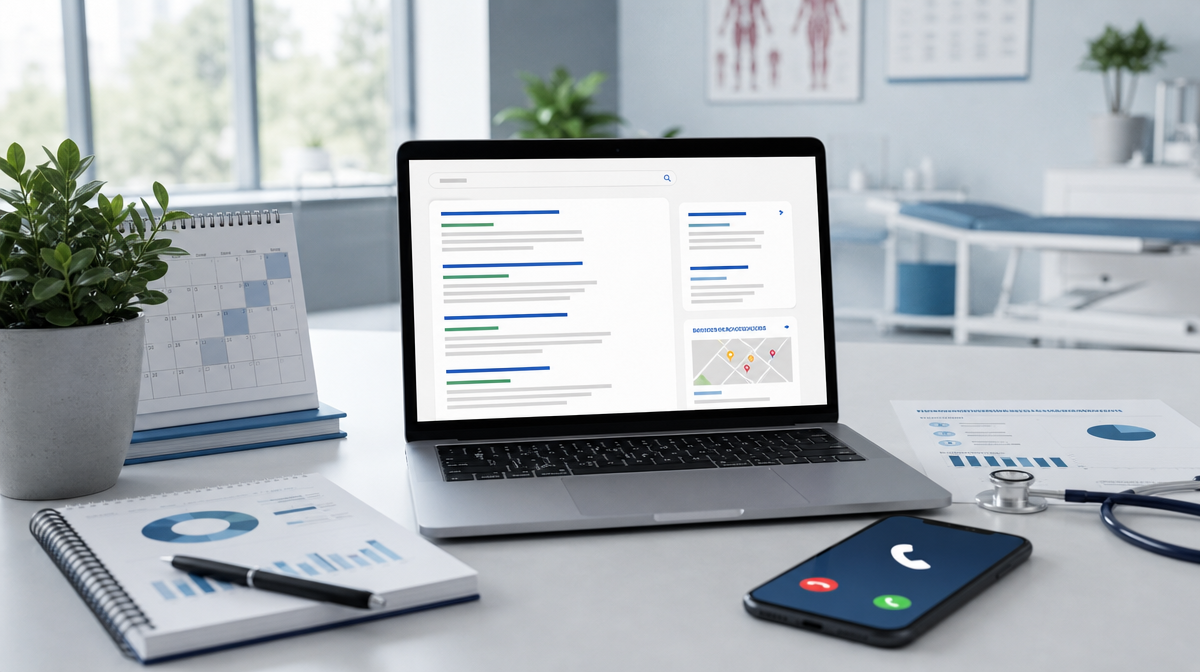
Google Ads is a pay-per-click advertising platform that lets your practice appear at the very top of search results the moment a patient searches for services you offer — think “dermatologist near me” or “pediatrician accepting new patients.” Unlike a billboard or a social post, your ad only surfaces when someone is actively typing a query related to your practice, and you pay nothing for the impression. You pay only when that person clicks.
The system runs on an auction model. Every time a relevant search happens, Google runs a real-time bidding process to determine which ads appear and in what order. Your placement depends on two things: how much you bid per click, and your Quality Score, which is Google’s internal rating of how relevant your ad and landing page are to the search term. A higher Quality Score can earn you a better position at a lower cost than a competitor who is simply outbidding you. That combination — paying only for clicks, choosing the exact terms that trigger your ads, and competing on relevance rather than budget alone — is what makes paid search distinctly valuable for medical practices. The practical result is that a patient searching for a specific procedure in your city can see your practice at the top of their results within hours of you launching a campaign, with no months-long runway required.
The speed advantage comes down to one word: intent. When someone opens Google and types “knee replacement surgeon near me” or “same-day urgent care open now,” they have already made a decision. They need a doctor, and they are ready to act. That is a fundamentally different psychological state than someone scrolling an Instagram feed who happens to see your sponsored post between vacation photos. Compare it to medical SEO, which is a long game worth playing but rarely delivers new patients quickly — you are building authority, earning links, and waiting for the algorithm to reward your consistency. Paid search skips that queue entirely.
Social media ads sit somewhere in the middle, but closer to the wrong end for most practices. Platforms like Facebook and Instagram let you reach large audiences at reasonable cost, but the people seeing those ads were not looking for a doctor. You are interrupting a scroll and hoping the timing is right, which is why healthcare conversions from social tend to require more touchpoints before anyone picks up the phone. The intent gap is why Google Ads for doctors consistently performs well on cost per booked appointment — not because the clicks are cheap, but because they are higher quality. A patient who searched for your specific service is already partway through the decision before your ad even loads.
Compliance is usually the first question an attorney raises when a practice mentions paid search, and it is a fair one. The honest answer is that Google Ads itself does not create a privacy violation — the platform runs on keyword targeting and search intent, not your patient records. The risk lives in how your practice configures and uses the platform. Google does not sign a Business Associate Agreement, which means protected health information should never pass through Google’s systems, and that single constraint shapes several decisions you need to make before your first campaign goes live.
Three areas create most of the unintentional exposure. The first is custom audience uploads: pushing your patient email list to Google for audience matching moves protected information to a vendor with no agreement covering it. The second is remarketing tied to health conditions — placing a remarketing pixel on condition-specific pages can associate a user’s device with a medical concern, which is exactly the association you want to avoid creating. The third is protected information appearing in ad copy or destination URLs, both of which are visible to Google’s systems and should never carry anything patient-identifiable. The practical workaround is straightforward: build your targeting around geography, search terms, and general site behavior rather than health status. Google’s own healthcare advertising policies add further guardrails for sensitive medical categories, and campaigns built inside those boundaries stay both effective and HIPAA-conscious.
Not every campaign type is built for the same job, and choosing the wrong one is among the fastest ways to burn a monthly budget. Search ads — the text ads that appear above organic results — are the right starting point for virtually any practice running paid search for the first time, because the targeting is precise, the intent is high, and the results are measurable. Local Services Ads sit above standard search ads, display a verification badge alongside your practice name and rating, and charge per lead rather than per click, so you are billed only when a patient actually contacts you; eligibility requires passing a background and license verification, but practices that qualify often see strong local returns. Performance Max distributes your ads automatically across Search, Display, YouTube, Gmail, and Maps from a single campaign, which suits established practices that already have conversion data and want broader reach without managing separate campaigns. Retargeting serves ads to people who visited your site without booking, and it should stay focused on general site visitors rather than anyone who landed on a condition-specific page, for the privacy reasons already covered.
What you actually spend depends heavily on your specialty and how competitive your local market is — two practices with identical budgets can see very different results based on those variables alone. Healthcare keywords sit among the most expensive in paid search, because the patient value behind each click is high and competitors know a single booked patient can be worth thousands over time. Cost per click climbs as you move from primary care toward dental PPC, then toward high-ticket elective work, where competition is fiercest — the aesthetic space is a good illustration, since med spa marketing operates in some of the most contested keyword territory in healthcare. The same dynamic applies geographically: a dermatologist in a dense metro competes against dozens of well-funded practices bidding on identical keywords and will pay substantially more per click than a dermatologist in a mid-sized market paying for the same terms.

The more useful framing is not “how little can I spend?” but “what is a new patient worth to my practice?” High-value elective procedures are the clearest illustration — the economics behind plastic surgery marketing tolerate a much higher cost per click than a routine primary care visit, because the value of a single booked case is so much greater. The same holds in ophthalmology marketing, where refractive surgery keywords sit among the most contested in healthcare precisely because a single case justifies the bid. Budget decisions get considerably cleaner once you anchor them to patient value rather than treating ad spend as an expense to minimize.
Building a campaign that works follows a rough sequence, and skipping a step early tends to cost you later in wasted spend or missing attribution. Start with high-intent keywords, targeting phrases where the searcher is ready to act — “book dermatologist appointment” or “orthodontist accepting new patients near me” — rather than educational queries like “what causes back pain,” which attract researchers rather than patients. Structure your ad groups by individual service line, because an ad group mixing dental implants and teeth whitening dilutes relevance for both, while separate campaigns keep keyword-to-ad alignment tight and lift your Quality Score. Build your negative keyword list before launch rather than after, since terms like “free,” “DIY,” “jobs,” and “school” will trigger your ads without producing a single call, and blocking them on day one protects the budget from the start.
From there, anchor your daily budget to patient value rather than to a number that simply feels comfortable, and geo-target your actual service radius — most patients travel only a short distance for non-emergency care, so tight radius targeting keeps spend concentrated on people who can realistically book. Activate call assets and sitelink extensions, which add click-to-call buttons, your address, and direct links to pages like new patient forms or online booking, giving patients a faster path to contact without navigating your whole site. Finally, connect call tracking before your first dollar goes live, because without a dedicated tracking number tied to the campaign you cannot tell which keywords produced phone calls and which produced clicks that went nowhere.
Your ad copy is doing more work than most practices realize. Before a patient reaches your landing page or picks up the phone, the characters in your headline have already made the case for why your practice deserves the click over the three competitors listed directly beneath you. Generic copy is what kills conversion here: phrases like “compassionate care” and “experienced team” appear in virtually every medical ad on Google, communicate nothing specific, and give patients no reason to choose you. The practices that win lead with information that is actually decision-making fuel — evening and weekend hours, same-day availability, a specific board certification, or simply the fact that you are accepting new patients right now. Where it is appropriate and compliant, naming a consultation offer or financing option raises click-through measurably, particularly for elective procedures where cost is a known objection. And the call to action should be explicit rather than vague, because “call for same-day availability” tells the patient exactly what happens next in a way that “contact us today” never does.
Responsive search ads let you supply multiple headline and description variations that Google tests against live traffic, and that flexibility rewards deliberate use. Write one headline around your specialty, one around your location, and one around a patient benefit, then let the data show which combination drives actual bookings rather than guessing upfront.
Getting the click is only half the equation, because that click costs you money whether the patient books or bounces — and most practices lose the majority of their ad spend on landing pages that were never built to convert. The single biggest lever is message match. If your ad promotes a specific procedure, the destination page has to open with that procedure rather than a homepage banner cycling through six different services. Every second a patient spends reorienting is a second spent reconsidering. This is where medical website design stops being an aesthetic question and becomes a budget question.

Once the page matches the search, the job is to remove doubt quickly, because patients arriving from Google are comparing you against two or three competitors open in other tabs. Board certifications and credentials belong near the top, since patients use them as a proxy for safety, especially for surgical and elective procedures. Patient reviews pulled from Google or Healthgrades carry more weight than anything you write about yourself, which is why reputation management quietly determines how well your paid traffic converts long before anyone reaches the booking form. For aesthetic and elective specialties, before-and-after imagery accelerates the decision more than any headline can. And a simple signal like years in practice communicates volume, which patients read as experience and reduced risk. Forms and booking tools deserve the same scrutiny as the design itself: a slow form, or one demanding excessive information before confirming an appointment, creates friction that quietly kills conversions. Use a HIPAA-conscious booking tool that encrypts submissions and keeps patient data off advertising infrastructure, and keep required fields to the minimum needed to hold the slot.
Quality Score is Google’s rating of how well your keyword, ad, and landing page work together, and most practices running paid search for the first time treat it as a vanity metric worth a glance. That is a mistake, because a strong score against a weak one on the same keyword can mean paying noticeably less per click for a better position than a competitor who is simply bidding higher. Google builds the score from three components, and each has a practical fix. Ad relevance measures how closely your headline and description reflect the keyword that triggered them, which means a term like “sports medicine doctor Houston” should appear in the ad copy rather than being buried under a generic line about comprehensive care. Expected click-through rate is Google’s prediction based on how similar ads have historically performed, and specific, benefit-forward headlines outperform vague ones — the same discipline that improves bookings also improves this metric. Landing page experience evaluates load speed, mobile responsiveness, and whether the page delivers on the ad’s promise, so a slow page or a mismatched destination drags it down fast. Improving all three at once lowers your cost per click while pushing your ad higher, which is how practices end up appearing above competitors who are paying more.
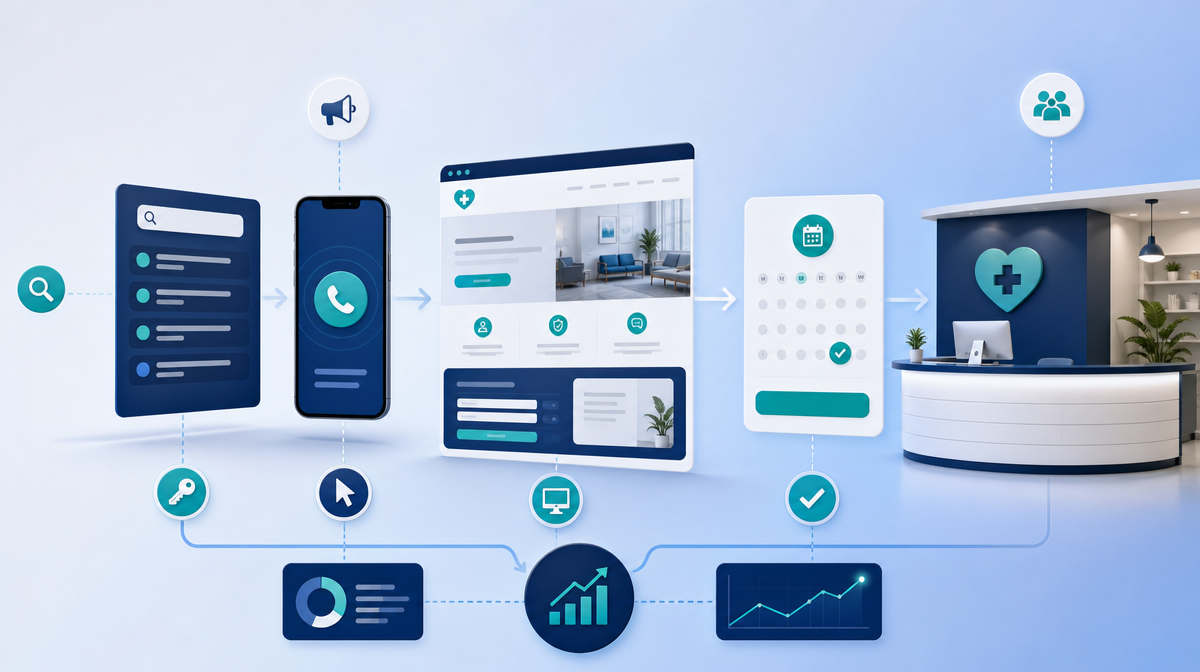
Clicks and impressions are the metrics your ad platform is happy to show you, and they say nothing about whether your waiting room is filling. The real question is how many of those clicks became patients who walked through the door, and answering it requires building tracking infrastructure before the campaign launches rather than after. Most practices discover their attribution gaps weeks in, when they realize the front desk has no idea which new patients came from paid search rather than a referral or an organic result.
Four data points give you the complete picture. Dedicated call tracking numbers tie every inbound call to a specific keyword or ad instead of leaving you with a vague sense that someone called. Form submissions tagged with UTM parameters let your analytics record exactly which campaign drove each appointment request. Booked appointments reconciled against campaign data — cross-referencing your scheduling system with your ad account on a regular cadence — is where you calculate real cost per acquired patient rather than cost per lead. And connecting that data to your patient management system lets you see whether ad-acquired patients return and refer, which turns a one-time acquisition cost into an actual return calculation. Cost per acquired patient, your total ad spend divided by new patients booked from it, is the number that tells you whether to scale the budget or restructure the campaigns.
Even well-run campaigns leak budget through predictable, fixable errors. Broad match keywords without negatives is the most common: Google interprets broad match generously, so a surgeon bidding on a procedure term can end up paying for searches about training programs or at-home alternatives, and every irrelevant click is a real dollar leaving the account. Routing all traffic to your homepage is a close second, because a homepage is built for exploration rather than conversion, and a patient who searched for one specific procedure should not have to hunt for it. Ignoring call tracking hides the majority of your results, since most new patient inquiries from paid search arrive by phone rather than by form. Skipping mobile optimization undercuts everything upstream, because healthcare searches skew heavily toward phones — often during a lunch break or after hours — and a page that loads slowly or presents a form that is awkward on a small screen quietly destroys the conversion rate. And treating campaigns as set-and-forget guarantees decay: keyword costs shift, competitors adjust bids, and search patterns evolve, so an account left untouched for two months is almost certainly paying for traffic a regular audit would have caught.
Running paid search in-house sounds appealing until you are three weeks in, half the budget is gone, and the front desk still cannot tell you whether a single new patient came from the campaign. The platform is technically accessible to anyone; running it profitably inside healthcare constraints is a different matter. A practice spending modestly each month may reasonably start in-house while learning the fundamentals, but the calculus shifts as spend grows, because the optimization gap between a trained specialist and a self-managed account eventually costs more than a management fee. The compliance dimension is where the stakes are highest — someone who has run campaigns across dental, med spa, ophthalmology, and surgical practices already knows which configurations create exposure, while an in-house team would need to discover those boundaries through trial and error.
It is also worth being clear that paid and organic are not an either/or decision. Ads fill the schedule now while search engine optimization compounds in the background, and the two reinforce each other: holding both a paid and an organic position on the same results page crowds out competitors and increases the share of patients who reach your practice rather than a rival’s. The same logic increasingly extends to AI-driven search, where AI-powered search tools summarize answers before a patient ever scrolls to traditional results, making visibility across every surface part of the same coordinated system rather than a set of separate line items.
Most agencies will happily take your budget and send back a monthly report full of impressions and click-through rates. What those reports rarely answer is whether any of those clicks became patients who scheduled, showed up, and received care — and that gap between ad activity and practice revenue is where most medical paid-search relationships break down. Target Patients MD is built around that accountability problem: every campaign we manage for doctors is structured around booked appointments rather than click volume. A.L.I. 360 by Target Patients MD is a proprietary AI-powered patient-acquisition system for medical and dental practices — the name stands for Attract, Learn, and Influence — and it continuously evaluates campaign performance and adjusts bidding, creative, and conversion signals as the data comes in, so cost per acquired patient trends downward as a campaign matures rather than plateauing after the first few weeks.
What that looks like in practice comes down to three things. Our focus is healthcare-exclusive, so every optimization decision is calibrated for patient acquisition rather than general lead generation. Compliance is built into the campaign architecture from the initial build rather than retrofitted afterward. And attribution is connected end to end — call tracking, form submissions, and booked appointments tied together so you can see exactly what your ad spend is producing. If your campaigns are generating clicks but not a visible increase in scheduled patients, get in touch and we will show you where the disconnect is.
Here are answers to the questions practices ask most often when evaluating paid search.
How long before Google Ads start bringing in new patients? A properly configured campaign can generate patient inquiries within days of going live. The first few weeks function as a data collection period while Google’s system learns which keywords and audiences produce real conversions for your practice, and cost per lead typically stabilizes and improves over the following month as that learning compounds.
Can competitors click on my Google Ads to waste my budget? Google’s invalid click detection filters suspicious click patterns and credits those amounts back to your account. Competitor clicking is rarely a meaningful budget concern in practice — a front desk that does not answer inbound calls promptly is a far more common source of wasted ad spend.
Should I run Google Ads if my practice already ranks organically? Yes. Paid and organic listings serve different patient segments, since some patients click paid results exclusively while others scroll to organic. Holding both positions on the same results page also crowds out competitors and increases the total share of patients who reach your practice.
What is a good cost per lead for a medical practice using Google Ads? There is no universal benchmark that applies across specialties. A more useful frame is comparing your cost per acquired patient against that patient’s projected value to the practice, which varies dramatically between a primary care practice and an elective surgery clinic.
Can medical practices run Google Ads without creating HIPAA exposure? Yes, when campaigns are configured correctly. That means building audiences around geography, search terms, and general site behavior rather than health status, keeping protected information out of ad copy and destination URLs, and avoiding remarketing tied to condition-specific pages. The risk comes from misconfiguration rather than from the platform itself.