



Functional medicine marketing is the specialized work of promoting root-cause, systems-based health practices to a very specific type of patient — one who has already decided that conventional care isn’t giving them answers. These aren’t casual browsers. They’re researching cortisol dysfunction at midnight, cross-referencing gut microbiome studies, and vetting practitioners the way a hiring manager screens candidates.
That distinction matters enormously for how you approach promotion. When a conventional primary care practice runs an ad, the decision cycle is short — someone needs a physical, they book it. Functional medicine works differently. Your prospective patient needs to understand why your approach exists before they’ll trust you enough to invest in it, both financially and emotionally. Three characteristics separate this work from standard medical practice promotion. The consideration windows are far longer, with patients often spending weeks or months evaluating providers before making contact, which means your marketing has to stay relevant across that entire span. The education requirement is heavier, because most prospects don’t yet understand what a root-cause model looks like in practice, so your content has to do that teaching before any sales conversation happens. And the economics are cash-pay, so without insurance reimbursement as a fallback, your marketing has to make the value of a program clear enough to overcome price sensitivity upfront.
Understanding these dynamics is what separates practices that consistently attract committed, ready-to-invest patients from those stuck chasing low-quality leads who disappear after the first inquiry.
Think about the last patient who walked into your practice having already fired two or three conventional doctors. They didn’t arrive neutral. They arrived exhausted, skeptical, and carrying a mental checklist of reasons not to trust anyone wearing a white coat. That emotional state is the starting point for nearly every functional medicine patient, and it’s why the standard “here are our services, call to book” approach fails so completely in this specialty.
Conventional medical marketing works on familiarity. People already understand what a cardiologist does or why they’d need an orthopedic surgeon. Functional medicine doesn’t have that luxury. Your prospective patient may not yet have a vocabulary for root-cause care — the systems-based model described by The Institute for Functional Medicine is still unfamiliar territory for most people searching for answers — may not know what comprehensive lab panels reveal, or may have genuine doubts about whether any provider can actually help them. They need a reason to believe before they’ll ever hand over a credit card.
This is the core tension that shapes all effective functional medicine marketing: you cannot shortcut the trust-building phase. Practices that try — running hard-sell ads before establishing credibility, or leading with pricing before explaining philosophy — consistently see higher ad costs, lower consultation show rates, and more refund requests. The ones that grow steadily do three things first. They demonstrate clinical depth through content that shows how they think rather than simply what they offer. They validate the patient’s frustration by acknowledging honestly why conventional approaches fell short. And they make the unfamiliar feel approachable before asking for any commitment. Education isn’t a preamble to your marketing here. For functional medicine, it is your marketing.
Content is the mechanism that turns a stranger with symptoms into a patient ready to book, but only when it’s built around what your prospective patients are actually searching for rather than what you want them to know about your practice. The formats that drive consistent acquisition share one trait: they answer a specific question your ideal patient is already asking before they’ve ever heard your name.
Long-form symptom and condition articles do the heaviest lifting. Pages targeting searches like “root cause of fatigue” or “why do I have brain fog after eating” capture high-intent traffic from patients mid-research, and a well-optimized piece on thyroid-related hair loss can generate qualified inquiries for months without additional spend. Short practitioner video clips do something no service page can — a two-minute explanation of how gut permeability connects to autoimmune symptoms lets a prospective patient hear how you think, and that personal connection accelerates trust faster than any written bio. Downloadable resources such as a hormone symptom quiz or a gut health starter guide exchange genuine value for an email address, converting anonymous visitors into identifiable leads your practice can nurture over time. And anonymized lab and patient-journey content, shared with appropriate privacy protections, demonstrates clinical reasoning in a way generic advertising cannot replicate — a format that is uniquely native to this specialty.

Each format serves a different stage of the patient’s decision process — awareness, consideration, and intent — which is why practices that deploy all four see compounding results rather than isolated wins.
When a patient types “why does my inflammation keep coming back” into Google, that search is a patient acquisition opportunity, but only if your practice appears in the results. Search engine optimization is the infrastructure that determines whether that opportunity lands on your website or a competitor’s. And appearing in results now means something broader than it did a few years ago, because Google’s AI Overviews, ChatGPT, and Perplexity increasingly answer health questions directly, often without the patient ever clicking through to a website. Generative engine optimization is the emerging discipline of structuring your content so that AI-powered search tools cite your practice as the authoritative answer, and practices that build for both traditional search and AI-driven discovery hold a compounding advantage over those optimizing for Google alone.
A complete search strategy covers three distinct layers. Technical site health comes first — page speed, mobile performance, proper schema markup, and clean indexing signals tell Google your site is trustworthy enough to rank and tell AI crawlers your content is structured enough to cite. Condition and symptom keyword targeting comes next, since long-tail phrases like “functional medicine for autoimmune disease” or “integrative doctor for gut health” attract patients already researching your specialty rather than merely browsing. And a generative-search content architecture ties it together, formatting answers to specific clinical questions in a way that AI tools can extract and attribute directly to your practice — structured question-and-answer sections, clearly defined terminology, and visible clinical reasoning all increase your probability of appearing in AI-generated responses. Practices that treat search as a one-time website task rather than an ongoing channel consistently lose ground to competitors who update content regularly and optimize across both surfaces.
Most functional medicine patients search with geographic intent even when they’re open to virtual care, with phrases like “functional medicine doctor in Denver” or “integrative health clinic near me” dominating local volume. If your practice doesn’t appear in the Google map pack for those queries, you are effectively invisible to the highest-converting segment of your market: people who are ready to book and just need to pick a provider.
Local visibility operates on three specific levers. Google Business Profile completeness is the highest-impact action available to you — a fully built-out profile with accurate service categories, practitioner photos, answered questions, and regular posts consistently outranks competitors who treat their listing as a one-time setup. Consistency of your name, address, and phone number across Healthgrades, Yelp, Vitals, and niche wellness directories matters more than most practices realize, because discrepancies create signals Google cannot resolve and quietly suppress your local ranking. And if your practice serves multiple metro areas or suburbs, dedicated pages targeting each location capture search traffic that a single homepage simply cannot reach. The practices that dominate local search in competitive markets aren’t necessarily the best clinicians; they’re the ones treating local optimization as an ongoing system rather than a launch task.
Getting traffic to your website without a conversion strategy is like filling a waiting room with no front desk staff — people show up, look around, and leave. For functional medicine practices specifically, the gap between someone visiting your site and someone booking a consultation is where most marketing budgets quietly disappear.

Your homepage has a few seconds to answer one question for a skeptical, research-exhausted visitor: is this practice built for someone like me? That answer doesn’t come from a list of lab tests you offer. It comes from how your practice frames its programs, who it names as its ideal patient, and what the first call to action asks the visitor to do. Three elements separate medical website design that converts from design that merely informs. Program-centered architecture is the first — presenting a gut restoration program or a hormone optimization track rather than a service menu communicates a complete solution, which is what cash-pay patients are actually buying. Mobile-first load performance is the second, because the majority of healthcare site visits happen on a phone and a page that takes several seconds to load loses most of those visitors before they read a word about your approach. Sequential trust pathways are the third: credentials, patient outcomes, and any media recognition should appear before a booking prompt rather than being buried in a footer, guiding a visitor from curiosity to confidence before you ask for a commitment. HIPAA-conscious intake forms belong in that same category — a visibly secure form tells a privacy-minded patient that your practice handles sensitive health information with the same rigor you bring to clinical care.
Organic search builds your patient base over months. Paid advertising can put you in front of high-intent patients this week. For functional medicine practices, that speed comes with a catch: your ad strategy has to account for both the platform’s compliance rules and your patient’s psychology, and most generic campaigns fail on at least one of those fronts.
Google Ads work best when you’re targeting patients who already know what they’re looking for. Bidding on terms like “functional medicine doctor near me” or “integrative health clinic” in your city captures people at the bottom of the decision funnel — they aren’t researching, they’re ready to schedule — and that intent translates into a lower cost per booked consultation than cold audience channels, assuming your landing page delivers what the ad promised. Facebook and Instagram serve a fundamentally different role. Most people scrolling a feed have never considered root-cause care; they just know they feel terrible and conventional medicine hasn’t helped. Campaigns there work by interrupting the scroll with educational content — a short video on the connection between gut health and chronic fatigue, a symptom quiz, a patient story that mirrors their experience — where the goal isn’t a direct booking but an email address and the start of a nurture sequence. Retargeting then re-engages site visitors and quiz completers with social proof and consultation offers, and those warmed audiences convert at meaningfully higher rates than cold traffic.
One point is non-negotiable: ad copy for functional medicine has to avoid prohibited health claims on both platforms. Campaigns built around conditions and education rather than promised outcomes stay live, while the alternative invites disapprovals and account suspensions that kill momentum mid-campaign.
A patient who downloads your hormone symptom quiz on a Tuesday is rarely ready to book a consultation by Wednesday. The decision to invest in a root-cause care program takes time — sometimes six weeks, sometimes six months — and without a structured system running in the background, that lead simply goes cold while a competitor stays in front of them. Email and SMS nurture campaigns exist to close that gap, and they break down into two distinct workflows.

The first is a welcome and education sequence. The moment someone completes a quiz or downloads a guide, an automated series should begin delivering relevant, condition-specific content — not promotional email, but genuinely useful information that continues answering the questions that brought them to you. A short sequence covering topics tied to their stated symptoms keeps your name associated with answers rather than sales pressure. The second is reactivation. Past inquiries who never booked, patients who completed a program months ago, and subscribers who have gone quiet all represent recoverable revenue, and a targeted message referencing a new program, a seasonal health topic, or a relevant patient story can restart conversations that would otherwise never resurface. The key distinction from generic medical email marketing is segmentation by symptom cluster or health concern rather than by demographic — a subscriber researching gut health should receive entirely different content than one who flagged fatigue and brain fog, and that specificity is what turns a long buying cycle into a scheduled consultation.
Your prospective patient has already spent hours reading about root-cause medicine before they ever land on your website. What they do next — search your name — determines whether they book or disappear. A practice with a dozen reviews and a middling average loses that moment to a competitor with dozens more and a stronger rating, regardless of which clinic actually delivers better clinical outcomes, which makes reputation management a direct patient-acquisition channel rather than a passive byproduct of good care.
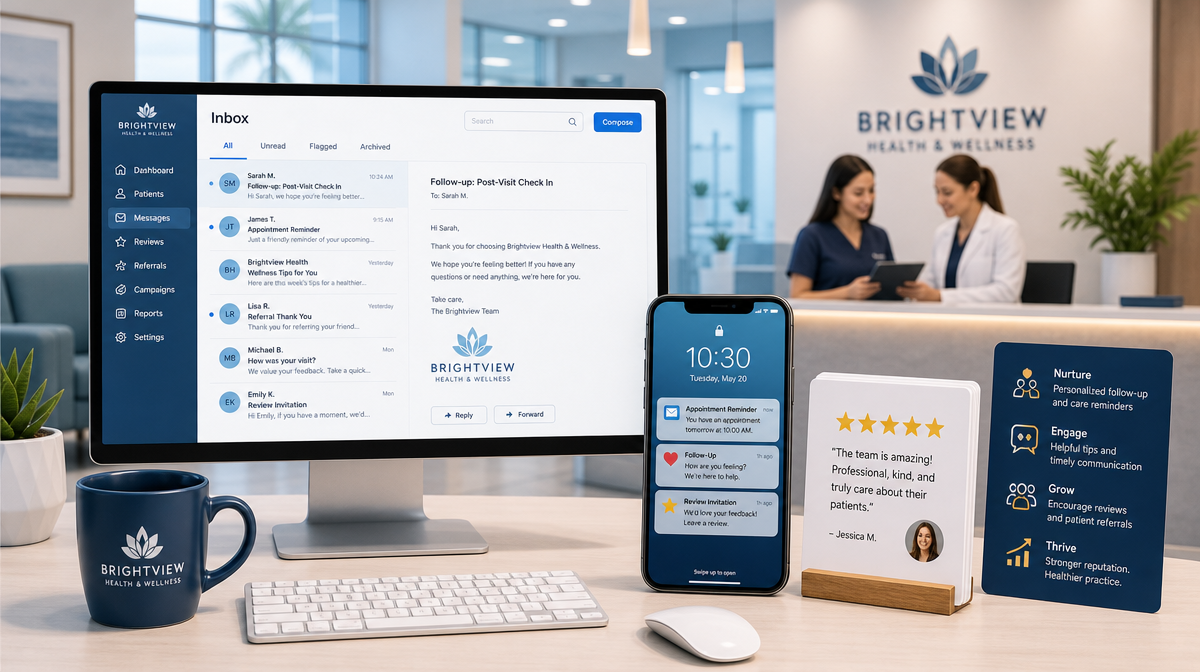
Generating reviews consistently requires a system, not a request. An automated post-visit text sent within a day of an appointment, while the experience is still fresh, produces dramatically higher response rates than asking in the moment or hoping patients remember later, and direct links to your Google Business Profile or Healthgrades listing turn leaving a review into a thirty-second task rather than a five-minute hunt. Video testimonials extend that further: a short patient story filmed on a smartphone carries more persuasive weight than a paragraph of text, and those clips belong on your homepage, inside ad campaigns, and in your email sequences — anywhere a skeptical prospect needs to see that someone like them got results. Responding to every review, positive and critical, signals that your practice is attentive and accountable, though negative responses require care: acknowledge the experience without confirming or denying any patient relationship, since privacy obligations apply in public forums exactly as they do everywhere else. Where patients invest significantly more than a standard copay, a strong review profile doesn’t just build credibility, it actively shortens the decision cycle for prospects already close to booking.
Digital channels dominate most conversations about functional medicine marketing, but the referral relationships you build offline often produce the most committed patients — ones who arrive pre-sold because someone they already trust vouched for you directly. The most productive referral partners aren’t other functional medicine doctors. They’re the providers your patients see before they find you: primary care physicians frustrated by patients they can’t help, chiropractors managing chronic inflammation cases that don’t resolve, registered dietitians working with clients whose labs look normal but who feel terrible. A brief, no-pressure meeting explaining your diagnostic methodology and the types of cases you take can open a referral stream that runs for years without ongoing ad spend.
Community workshops and live webinars serve a parallel purpose, letting prospective patients experience your clinical thinking in real time, which collapses the skepticism barrier faster than written content can. An evening session on a topic like why thyroid labs can look normal while a patient still feels exhausted attracts exactly the audience most likely to enroll in your programs. Virtual webinars extend your geographic reach without requiring travel, and the recordings become permanent lead magnets on your website. Co-hosting with a local nutritionist or functional pharmacist splits the promotional effort while doubling your exposure to compatible patient pools. Neither referral networks nor workshops require a marketing budget to launch — they require consistency and a clear explanation of who you help and how.
Most functional medicine practices track the wrong numbers. Follower counts, website impressions, and email open rates feel productive to review, but none of them pay your front desk staff or cover your lab costs. The numbers that matter are the ones connecting directly to revenue: what it cost to acquire a new patient, and what that patient generated over their relationship with your practice.
Three measurements give you the complete financial picture. Cost per lead by channel comes first — every form submission, quiz completion, and inbound call is a lead, and dividing your monthly spend on each channel by the leads it produced reveals which sources generate inquiry volume at a sustainable cost and which are quietly draining budget. Consultation booking rate and show rate come next, because a lead that never becomes a booked appointment is a sunk cost, and a high no-show rate on consultations usually signals a nurture gap rather than a lead quality problem. New patient revenue and lifetime value complete the picture: a patient who enrolls in a full program and returns for follow-up panels has a very different value than a one-visit consult, and understanding that number tells you exactly how much you can afford to spend acquiring each new patient. Tracked together, these three data points let you stop guessing about which investments are working and start making decisions with the same diagnostic precision you apply to patient care.
Functional medicine marketing works best when every channel — search, paid, email, reputation, referrals — operates as a coordinated system rather than a collection of disconnected tactics. That’s the core problem most practices run into: they’re not short on effort, they’re short on integration. One vendor handles search, another runs ads, nobody owns the full patient journey, and the result is budget spent with no clear line back to booked appointments.
Target Patients MD is a healthcare-exclusive agency built for practices where the clinical model is sophisticated and the marketing needs to match, and the patient-acquisition challenge in functional and integrative medicine is categorically different from a dermatology clinic or dental group running seasonal promotions. A.L.I. 360 by Target Patients MD sits at the center of that work — it is a proprietary AI-powered patient-acquisition system for medical and dental practices, and the name stands for Attract, Learn, and Influence, which maps closely to the three stages a functional medicine prospect moves through before committing to a program. Alongside it, the focus stays healthcare-only, so there’s no learning curve on compliance, clinical terminology, or the cash-pay psychology that defines this specialty; reporting is built around new patients and revenue rather than impressions or follower counts; and search, paid, generative optimization, email automation, and reputation run as one connected system rather than separate line items. If your practice is generating inconsistent leads or struggling to convert inquiries into enrolled patients, the gap is almost always structural rather than a budget problem — get in touch and we’ll show you where it is.
Functional medicine marketing questions tend to cluster around the same practical concerns: money, time, and whether any of it actually works for a cash-pay specialty. Here are direct answers to what practice owners ask most often.
How much should a functional medicine practice spend on marketing each month? Budget depends on your market size, growth goals, and current patient volume, and expanding practices generally allocate a meaningful share of gross revenue toward patient acquisition rather than a fixed dollar figure. A conversation with a healthcare-specific specialist will give you a defensible number tied to your actual targets rather than an arbitrary percentage.
How long does SEO take to show results for a functional medicine practice? Meaningful organic ranking improvements typically take several months to materialize, though technical fixes and local optimization often show movement sooner. Paid search can generate consultation inquiries within days, which makes it a useful complement while organic authority builds.
Can functional medicine practices run Google Ads without compliance issues? Yes, provided ad copy aligns with Google’s healthcare advertising policies and stays clear of prohibited outcome claims. Campaigns framed around conditions and education rather than promised results avoid the trial-and-error that gets general agency accounts flagged.
How is functional medicine marketing different from other wellness marketing? The patient decision cycle is substantially longer and requires far more educational content before a commitment happens. Aesthetic campaigns often close on appearance and price; functional medicine campaigns close on trust and clinical credibility.
Should separate campaigns run for gut health, hormones, and other focus areas? Segmented campaigns consistently outperform broad ones, because keyword intent, ad creative, and landing page messaging can each be tailored precisely. Smaller practices often start consolidated and segment as patient volume and budget justify the split.