



Medical weight loss marketing is the collection of strategies clinics use to attract, educate, and convert patients who are looking for physician-supervised weight management programs. Think GLP-1 treatments like Semaglutide and Tirzepatide, bariatric surgery consultations, medically monitored meal plans, and metabolic health programs — all of which require a licensed provider and, in most cases, a prescription.
That last part is what separates it from everything else in the weight loss space. A gym running Instagram ads is doing weight loss marketing. A medical weight loss clinic running those same ads without the right messaging, compliance guardrails, and clinical positioning is leaving patients confused — and leaving money on the table.
Effective medical weight loss marketing is built around three core distinctions:
- Physician supervision: Patients aren’t just downloading an app or buying a supplement — they’re entering a clinical relationship with a licensed provider.
- Prescription-based care: GLP-1 medications, appetite suppressants, and related treatments require a provider who can prescribe, monitor, and adjust dosing.
- Ongoing accountability: Medical programs include follow-up visits, lab work, and individualized adjustments that no over-the-counter product can replicate.
When your marketing reflects these distinctions clearly, it doesn’t just attract more leads — it attracts the right leads. Patients who understand the value of clinical oversight are more likely to convert, stay enrolled, and refer others.
If you spend any time around healthcare marketing right now, you already know that GLP-1 medications have completely changed the game. The GLP-1 market is projected to reach $185 billion by 2033, and Semaglutide and Tirzepatide have generated a level of patient demand that most specialties never see — and that demand is landing directly in search engines, social feeds, and your competitors’ waiting rooms.
The problem is that demand alone doesn’t fill your schedule. Effective medical weight loss marketing is what connects high-intent patients to your clinic before they end up at a telehealth platform or a compounding pharmacy down the street. And right now, the window to establish your position is narrowing fast.
Here’s why acting now matters more than ever:
- Exploding patient demand: Search volume for terms like “Semaglutide doctor near me” and “GLP-1 clinic” has surged dramatically. Patients are actively looking — the question is whether they find you or a competitor.
- New competition at every level: Direct-to-consumer telehealth brands, compounding pharmacies, and cash-pay med spas are all racing into the GLP-1 space with serious marketing budgets behind them.
- A persistent patient education gap: 30–35% of Americans are interested in GLP-1s, yet many still don’t know their local physician-supervised clinic offers these treatments. If you’re not showing up in search and on social, you simply don’t exist to them.
The clinics that invest in visibility and lead conversion now will own their local markets. The ones that wait will spend the next few years playing catch-up with brands that got there first.
In a crowded market full of gym memberships, meal-kit subscriptions, and telehealth apps, your clinic’s brand identity is what tells patients: this is different — this is medical. Getting that positioning right is one of the most overlooked levers in medical weight loss marketing.
The goal is to communicate three things at once: clinical credibility, genuine empathy, and a focus on long-term health rather than a quick number on the scale. Here’s how to build messaging that does all three:
- Emphasize “medical” at every touchpoint: Physician supervision, lab work, prescription-based care — these are things a gym simply cannot offer. Lead with your clinical credentials and make the distinction impossible to miss.
- Create a judgment-free tone: Weight loss is deeply personal. Patients have often tried and failed before they find you. Your messaging should feel like a conversation with a trusted provider, not a before-and-after ad. Empathy converts.
- Position around metabolic health, not aesthetics: “Lose weight fast” attracts bargain hunters. “Clinically supervised weight management for long-term metabolic health” attracts committed patients who are ready to invest in real outcomes.
The table below captures exactly how this shift in language separates a medical practice from the noise:
| Generic Weight Loss Marketing | Medical Weight Loss Marketing |
|---|---|
| “Lose weight fast” | “Clinically supervised weight management” |
| Aesthetic-focused | Health and lifestyle outcomes |
| One-size-fits-all | Personalized, provider-guided |
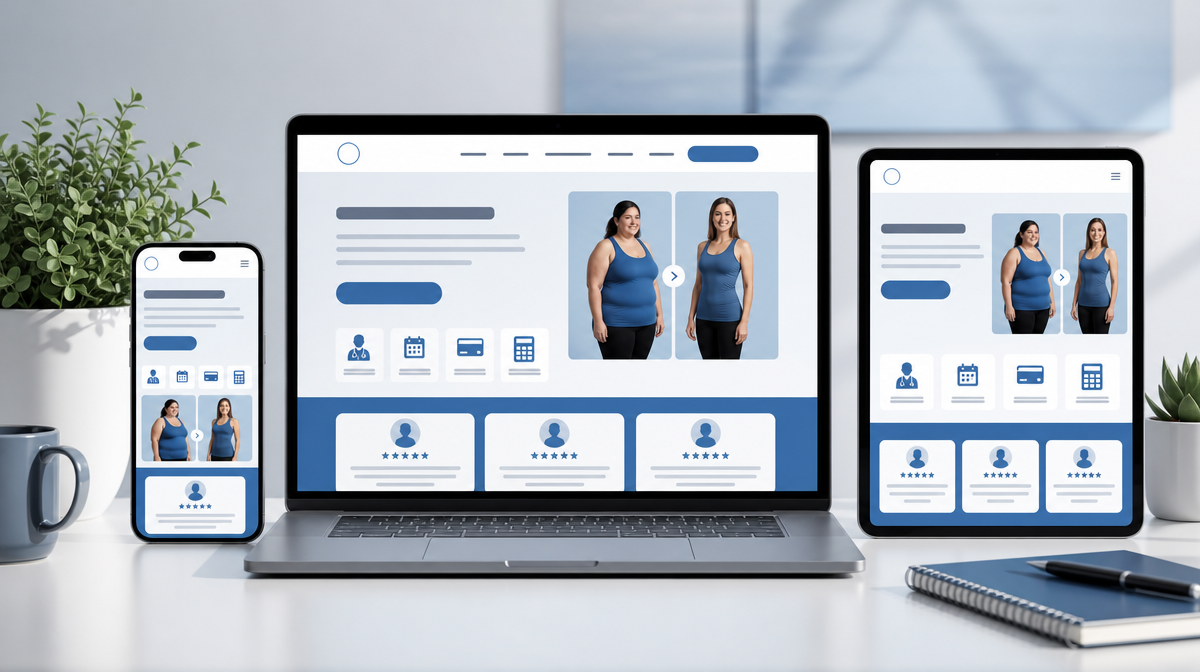
Your website is your clinic’s new front door — and in most cases, it’s the first impression a prospective weight loss patient gets before they ever speak to your staff. If that door is slow, confusing, or unconvincing, they’re gone. A high-converting medical weight loss website isn’t just about looking professional; it’s about turning curious visitors into booked consultations.

More than 70% of patients searching for weight loss solutions are doing it on their phones. Google’s mobile-first indexing means a sluggish or poorly formatted mobile site doesn’t just frustrate visitors — it actively tanks your search rankings. If your site takes more than three seconds to load, you’re losing leads before they even read a word.
Price anxiety is one of the biggest barriers to booking a weight loss consultation. When patients can see transparent pricing and get an instant financing estimate without picking up the phone, friction drops dramatically. Target Patients MD’s lead management system includes instant quote delivery paired with financing options, which directly shortens the gap between “I’m interested” and “I’m booked.”
Weight loss is deeply personal, and patients want evidence before they commit. The right social proof converts skeptics into patients. Your site should include:
- Before-and-after galleries: Visual proof of real, supervised results
- Video testimonials: Authentic patient stories that build emotional connection
- Provider credentials: Board certifications and years of clinical experience that reinforce medical authority
If paid ads are the sprint, SEO is the marathon that keeps paying dividends long after you’ve stopped running. For medical weight loss clinic marketing, search engine optimization is how you show up when a patient in your city types “medical weight loss near me” or “Semaglutide doctor” into Google at 11pm — without paying a dime per click.
SEO for weight loss clinics breaks down into three core pillars, and you need all three working together to compete:
- On-page SEO for service pages: Each treatment you offer — Semaglutide, Tirzepatide, supervised weight loss programs — deserves its own dedicated page optimized with the right title tags, H1s, meta descriptions, and body content. One generic “weight loss services” page won’t cut it in a competitive market.
- Local SEO and Google Business Profile: This is the one most clinics ignore until a competitor steals their local pack ranking. Claim and fully optimize your Google Business Profile, keep your name, address, and phone number (NAP) consistent across every directory, and actively collect patient reviews. This is what gets you into the map results where most clicks happen.
- Content marketing and blogging: Publishing educational articles on topics like GLP-1 side effects, metabolic health, or how to qualify for Semaglutide builds topical authority and answers the questions patients are already searching for — before they ever call your front desk.
Done right, SEO compounds over time. A well-optimized clinic website can generate a steady stream of high-intent leads month after month without the ongoing ad spend.
If SEO is the long game, Google Ads is how you win patients right now. Paid search puts your clinic in front of people who are actively typing things like “medical weight loss near me” or “Semaglutide clinic in [city]” — and that intent is about as high as it gets. These aren’t browsers. These are patients ready to book.
The key to effective PPC in medical weight loss marketing is precision. Broad keywords burn budget fast. Instead, build tightly themed ad groups around specific treatments and search behaviors, then write copy that leads with outcomes and credibility — not just your clinic name.
Your highest-converting search terms will include treatment-specific and location-modified keywords. Prioritize:
- “Medical weight loss near me” — the classic high-intent local query
- “Semaglutide clinic [city]” — treatment-specific with geographic modifier
- “GLP-1 injections [city]” — captures patients already educated on options
- “Tirzepatide doctor near me” — growing fast as Mounjaro awareness rises
Ad copy should lead with patient outcomes (“Lose weight with physician supervision”) and include trust signals like board-certified providers, years in practice, or financing availability. A strong call to action — “Book a free consultation today” — closes the loop.
Most visitors won’t book on their first visit. Retargeting keeps your clinic visible to people who browsed your site but left without scheduling. Display ads follow these warm prospects across the web, reinforcing your brand until they’re ready to take action. Even a modest retargeting budget can meaningfully improve your overall conversion rate without requiring new traffic.
Facebook and Instagram ads let you reach patients who aren’t actively searching yet but are absolutely the right audience — people scrolling through their feed at 10pm wondering if they should finally do something about their weight. That’s a powerful moment to show up with the right message.
The catch? Meta’s ad policies for weight loss are strict, and medical weight loss marketing on these platforms requires a more careful approach than Google. Before you launch a single campaign, you need to understand what Meta allows — and what will get your ad rejected or your account flagged.
Meta restricts before-and-after imagery in ads, limits claims that imply guaranteed results, and in many contexts restricts naming specific prescription drugs. This doesn’t mean you can’t advertise — it means you have to be smarter about how you do it. Save your before-and-after photos for your website and landing pages, where they do serious conversion work without triggering a rejection.
Compliant creative isn’t boring creative. Here’s what actually works:
- Lead with lifestyle transformation: Focus on energy, confidence, and long-term health — not pounds lost
- Use education-first angles: “Find out if you’re a candidate for our medical weight loss program” converts well and stays compliant
- Highlight your providers: Lead with physician expertise and clinical supervision, not drug names
- Target by behavior and interest: Meta’s audience tools let you reach users who follow health, wellness, and nutrition content
Paid ads get patients in the door fast, but organic social media is what builds the kind of trust that makes patients choose your clinic over the telehealth app they saw last Tuesday. Think of it as the long game — and in medical weight loss marketing, it pays off.
The platform strategy matters here. Not every channel works the same way for a weight loss practice:
- Instagram and Facebook: Post patient transformation stories (with written consent, always), provider spotlights, and before-and-after content. These platforms reward visual storytelling and community-building.
- TikTok: Short-form educational videos perform exceptionally well. Answer common questions like “Am I a candidate for GLP-1 medications?” or “What’s the difference between Semaglutide and Tirzepatide?” — your future patients are already searching for this content.
- YouTube: Use longer explainer videos to walk viewers through your program, introduce your providers, or break down how metabolic health works. YouTube is the second-largest search engine in the world, and a well-optimized video can drive organic traffic for years.
Across every platform, behind-the-scenes content humanizes your practice in a way no ad ever can. A 60-second clip of your physician explaining why they’re passionate about obesity medicine builds more credibility than a polished banner ad.
The goal is simple: by the time a patient picks up the phone to call, they should already feel like they know and trust your team.

Most weight loss leads don’t book on the first contact. Life gets in the way, they compare options, or they simply forget they filled out a form. That’s why a consistent nurture sequence — delivered via email and SMS — is one of the highest-leverage moves in medical weight loss marketing.
Email works best for education and trust-building. A simple drip sequence might look like this:
- Day 1 – Welcome email: Introduce your clinic, your providers, and what makes your program different from a telehealth app or a gym membership.
- Day 3 – Educational content: Explain how GLP-1 medications work, what to expect from a supervised program, or how you personalize treatment plans.
- Day 5 – Social proof: Share a patient success story or video testimonial that helps the lead picture their own outcome.
- Day 7 – Consultation offer: Give them a low-friction next step — a free discovery call, an instant quote, or an easy online booking link.
SMS runs parallel to email and often outperforms it. Text messages carry open rates north of 90%, compared to roughly 20–25% for email. Use texts for appointment reminders, limited-time promotional blasts, and quick two-way conversations that move a hesitant lead toward a booked slot.
The key is automation. Manually chasing every inquiry is a losing battle when you’re also running a clinical practice. A purpose-built system — like the automated SMS follow-up built into Target Patients MD’s lead management platform — keeps every lead warm without adding to your front desk’s workload.
In medical weight loss marketing, your online reputation is often the deciding factor between a patient choosing your clinic or clicking over to a competitor. Studies consistently show that 84% of patients check online reviews before booking a health appointment — and weight loss patients, who are already emotionally vulnerable about their journey, are especially likely to do their homework.
The good news: reputation management is a system, not a stroke of luck. Here’s what a solid reputation strategy looks like for a weight loss clinic:
- Requesting reviews automatically: Don’t rely on happy patients to volunteer feedback. Automated email and SMS campaigns sent after appointments consistently generate 3–5x more reviews than manual requests. Target Google, Healthgrades, and Yelp as your primary platforms.
- Responding to every review: Thank positive reviewers by name and address negative ones professionally and promptly. A thoughtful response to a one-star review often impresses prospective patients more than the complaint itself damages you.
- Displaying reviews on your website: Pull your best testimonials onto your service pages and homepage. Social proof at the point of decision reduces hesitation and increases consultation bookings.
- Aggregating reviews into one dashboard: Managing Google, Facebook, Yelp, and Healthgrades separately is a time drain. A centralized reputation dashboard lets you monitor, respond, and report from a single view — so nothing slips through the cracks.
A consistent review volume signals credibility to both patients and search engines. Clinics with 50+ recent Google reviews and a rating above 4.5 stars routinely outperform competitors in local pack rankings — making reputation management one of the highest-ROI activities in your entire marketing mix.
Generating leads is only half the battle. If your front desk takes 48 hours to call back a new inquiry, that patient has already booked with a telehealth brand. A purpose-built CRM and lead management system is what closes the gap between interest and appointment — and it’s one of the most overlooked levers in medical weight loss marketing.
The numbers are stark: leads contacted within five minutes are 21 times more likely to convert than those reached after 30 minutes. Most clinics, juggling patient care and admin, simply can’t hit that window manually. That’s where automation earns its keep.
Here’s what a weight loss-specific lead management system should do for your practice:
- Speed-to-lead automation: Instantly send a personalized text or email the moment a form is submitted — even at 11 PM on a Sunday.
- Multi-touch drip sequences: Most leads need five to eight touchpoints before they book. Automated SMS and email follow-ups keep you top of mind without burning out your staff.
- Instant financing quotes: Reduce price objections before they happen by delivering a financing estimate in the first response.
- Call recording: Review intake calls to coach your team and identify where leads are dropping off in the conversation.
- One-click intake forms: Simplified digital intake reduces friction and gets patients into your pipeline faster.
Target Patients MD’s lead management system includes all of these features, built specifically for weight loss and GLP-1 clinics — so no lead quietly goes cold while you’re focused on patient care.
You can’t improve what you don’t measure — and in medical weight loss marketing, flying blind is an expensive habit. Before you scale a single campaign, make sure you’re tracking the metrics that actually tell you whether your marketing dollars are working.

Here are the KPIs every weight loss practice owner should have on their dashboard:
- Cost per lead (CPL): What you’re paying for each new inquiry, whether it comes from Google Ads, Facebook, or organic search. A rising CPL is your early warning system that something in the funnel needs attention.
- Cost per acquisition (CPA): What you actually pay per booked patient — not just a lead. This is the number that ties marketing spend directly to revenue.
- Lead-to-patient conversion rate: The percentage of inquiries that turn into paying patients. If this number is low, the problem usually isn’t your ads — it’s your follow-up speed or intake process.
- Return on ad spend (ROAS): Revenue generated for every dollar spent on paid campaigns. Most well-run GLP-1 and weight loss programs should be targeting a 3x–5x ROAS minimum.
- Review volume and average rating: Your reputation score across Google, Healthgrades, and Yelp directly influences how many patients click through to your site in the first place.
Tracking these metrics consistently gives you a clear picture of where your medical weight loss marketing is performing and where it’s quietly leaking revenue.
If you spend any time around digital marketing in 2026, you’ve probably heard the phrase “AI is changing everything.” In medical weight loss marketing, that’s not hyperbole — it’s your new competitive reality. Google’s Search Generative Experience (SGE) and AI-powered answer engines like Perplexity are increasingly serving patients direct answers instead of a list of blue links. If your content isn’t structured for AI to read, cite, and surface, you’re invisible to a growing segment of high-intent searchers.
This emerging discipline is called Generative Engine Optimization (GEO), and it requires a different approach than traditional SEO. Your service pages and blog content need clear, structured answers — think concise definitions, bulleted explanations, and authoritative sourcing — so AI systems can confidently pull from your site when a patient asks “What’s the best GLP-1 clinic near me?” Search Engine Land’s SGE coverage is a solid starting point if you want to understand how these systems work.
Beyond visibility, artificial intelligence is reshaping how clinics acquire and convert patients at every stage. Here’s where it’s making the biggest impact:
- Predictive audience targeting: AI tools analyze behavioral signals to identify patients most likely to convert before they even search.
- Real-time campaign optimization: Machine learning adjusts bids, creative, and targeting automatically to maximize your ad spend.
- Automated patient engagement: Platforms like A.L.I. 360 use AI to manage follow-up sequences, lead scoring, and personalized outreach — so no inquiry goes cold.
Clinics that adopt AI-driven systems now will have a measurable head start over competitors still relying on manual processes and generic marketing playbooks.
Effective medical weight loss marketing isn’t a single tactic — it’s a system. SEO brings patients to your door. Paid ads fill your pipeline fast. Reputation management builds the trust that converts browsers into booked consultations. And a purpose-built lead management system makes sure none of that effort goes to waste. Getting all of those pieces working together, compliantly and consistently, is where most practices struggle.
That’s exactly what Target Patients MD is built to solve. We specialize exclusively in patient acquisition for medical weight loss and GLP-1 clinics, which means we understand your market, your compliance constraints, and what actually moves patients from search to consultation.
Here’s what you get when you work with us:
- Done-for-you marketing: SEO, paid ads, social, reputation management — fully managed for your clinic
- Proprietary lead management system: Instant quotes, automated SMS and email follow-up, call recording, and one-click intake forms
- AI-powered patient acquisition: Our A.L.I. 360 technology optimizes campaigns and targets high-intent patients in real time
- No long-term contracts: We earn your business month after month on results, not paperwork
You’ve built a practice worth growing. Let us handle the marketing engine that fills it. Learn more about Target Patients MD and see how we help weight loss clinics scale predictably.
Got questions about medical weight loss marketing before you commit to a strategy? You’re not alone. Here are the answers practice owners ask us most.
- How much does medical weight loss marketing cost? Most clinics invest anywhere from a few thousand dollars to five figures per month, depending on market size and growth goals. A typical starting mix includes paid ads, local SEO, and reputation management.
- How long does it take to see results? Google Ads can generate leads within days of launch. SEO typically takes three to six months to build meaningful momentum. Most clinics see a measurable uptick in inquiries within the first four to eight weeks of a well-structured campaign.
- Can you advertise GLP-1 medications like Ozempic or Wegovy on Google and Facebook? Yes, with conditions. Google allows healthcare ads with proper certification. Meta restricts before-and-after imagery and certain drug-specific claims, so compliant messaging is non-negotiable.
- What is the 3-3-3 rule in marketing? You have three seconds to grab attention, three minutes to hold interest, and three days to follow up before a lead goes cold. For weight loss clinics, speed-to-lead is everything.
- How do local clinics compete with telehealth GLP-1 brands? Emphasize what telehealth cannot offer: in-person physician supervision, metabolic monitoring, and a personalized care relationship that goes beyond a monthly medication shipment.
- Do I need a long-term contract to work with a weight loss marketing agency? Not always. Agencies like Target Patients MD offer flexible, no-contract engagements so you can evaluate performance without being locked in.