

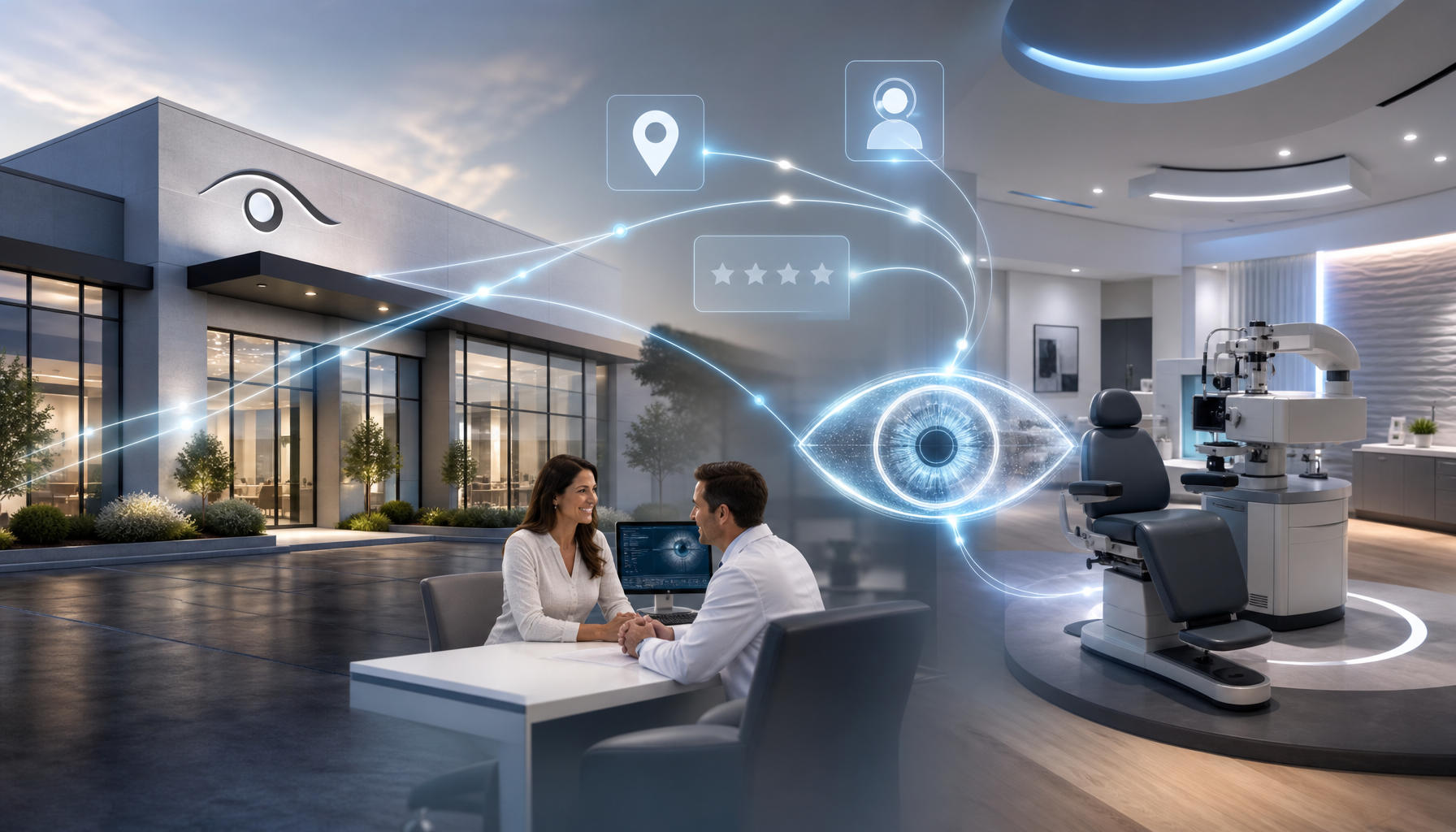
LASIK marketing refers to the specialized patient acquisition strategies ophthalmology practices use to attract candidates for laser vision correction — covering everything from paid search campaigns and local SEO to reputation systems and automated lead nurturing. It sits in its own category within healthcare marketing, and the distinction matters when you’re deciding where to spend your budget.
What separates LASIK marketing from general medical marketing comes down to three realities specific to elective refractive surgery:
- It’s a discretionary purchase. Patients aren’t referred by a primary care physician — they self-select, which means your marketing has to do the heavy lifting of creating demand and building confidence before anyone picks up the phone.
- The research phase is unusually long. Most LASIK candidates spend weeks or months comparing surgeons, reading reviews, watching procedure videos, and price-shopping before booking a consultation. Your marketing needs to stay visible throughout that entire window.
- Local competition is intense. In most metro markets, you’re competing against discount LASIK chains with large ad budgets, multi-location groups, and well-established review profiles. A generic digital presence won’t move the needle.
The result is a marketing discipline that demands both precision and persistence — reaching the right candidate at the right moment in their decision journey, then keeping your practice front-of-mind until they’re ready to commit. Getting that system right is what separates practices that consistently fill their surgical schedule from those guessing at their next patient source.
Before you spend a dollar on LASIK marketing, you need a clear picture of who you’re actually trying to reach. Broad targeting wastes budget. Precision targeting fills surgical schedules.
The sweet spot for LASIK candidates shares a few consistent traits that should directly shape your messaging, channel selection, and offer strategy:
- Age and prescription stability: Most viable candidates fall between 25 and 40. Younger patients often have prescriptions that are still changing; older patients may be approaching presbyopia territory. This age window represents your highest-conversion demographic.
- Lifestyle motivators: Think active professionals, frequent travelers, competitive athletes, and anyone whose daily routine is complicated by glasses or contacts. These patients aren’t just curious about LASIK — they have a concrete, recurring reason to want it. That motivation makes them far easier to convert once they find you.
- Contact lens fatigue: This is one of the most underutilized targeting signals in LASIK marketing. Patients who’ve worn contacts for a decade or more are primed for the “what if you never had to deal with this again” message. They already understand the problem; your job is to present the solution.
- High-intent research behavior: Your ideal patient is actively comparing surgeons, reading outcome data, and searching for cost information — often over several months. They respond to educational content, transparent pricing, and strong review profiles.
Knowing this audience determines which platforms you prioritize, what creative resonates, and how you frame your value proposition against discount competitors.
No single channel wins the LASIK patient acquisition game on its own. The practices consistently booking 30, 40, or 50+ surgeries per month aren’t betting everything on Google Ads or hoping their website does the work — they’re running an integrated playbook where every channel reinforces the others. Here’s what that playbook looks like in practice:
- Local SEO and Google Business Profile: When someone searches “LASIK surgeon near me,” the map pack is often the first thing they see. Ranking there requires a fully optimized Google Business Profile and location-specific content strategy — covered in depth below.
- Paid search and Meta advertising: Google and Bing PPC put your practice in front of high-intent searchers immediately. Meta platforms layer in demographic targeting to build awareness among contacts and glasses wearers who haven’t started searching yet.
- High-converting website: Your site is where research-phase candidates decide to book or disappear. Design and conversion architecture matter more than aesthetics — more on this shortly.
- Content and video marketing: Educational blog posts, procedure explainers, and patient testimonial videos build trust during the long consideration window between first search and booked consult.
- Reputation and review management: For an elective procedure at this price point — within a market valued at $884 million in 2025 — reviews function like word-of-mouth at scale. A weak review profile hands patients to your competitors.
- Email and SMS nurture sequences: Most LASIK leads won’t book on first contact. Automated follow-up keeps your practice top-of-mind across the weeks or months it takes them to commit.
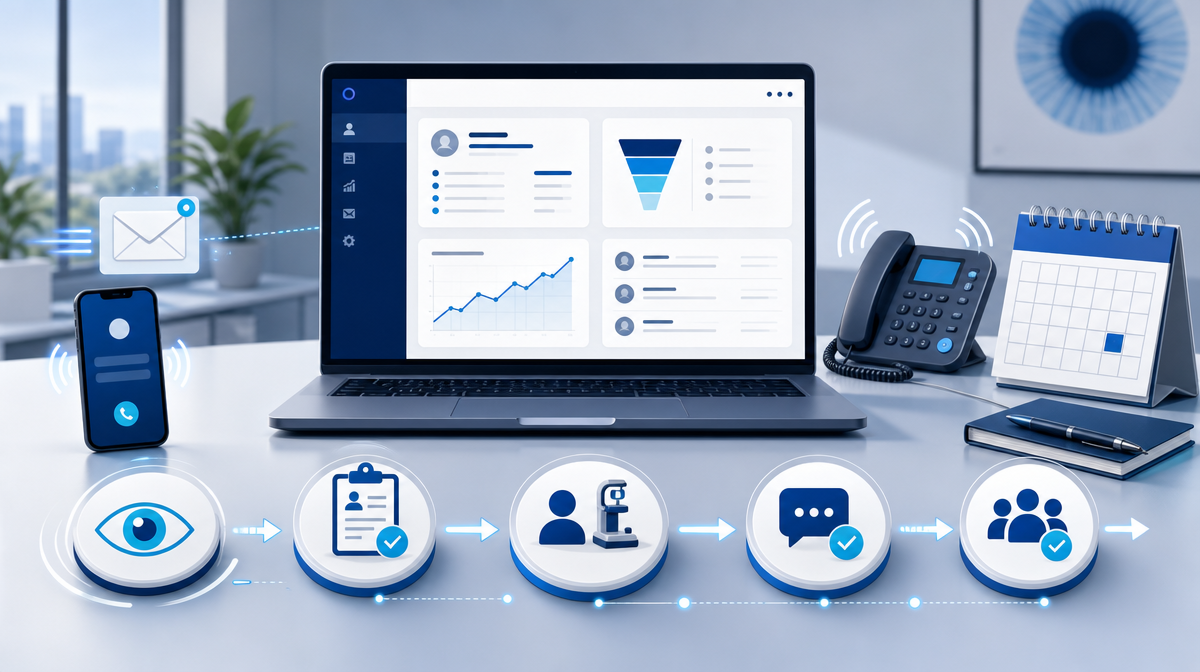
Think of your website less as a digital brochure and more as your highest-volume consultation room — one that’s open at midnight when a 32-year-old is comparing you against the discount LASIK chain across town. The structural decisions you make about that site directly determine whether that visitor books a consult or clicks away.
Four elements separate LASIK websites that convert from ones that just exist:
- Mobile-first architecture: The majority of patients researching refractive surgery are doing it on their phones, often during commutes or lunch breaks. A site that loads slowly or renders poorly on mobile isn’t just inconvenient — it’s a direct handoff to a competitor whose site works.
- Dedicated procedure pages: A single catch-all “services” page doesn’t cut it for LASIK candidates comparing LASIK, PRK, and SMILE. Each procedure deserves its own page with candidacy criteria, recovery timelines, and FAQ content that answers the questions patients are already Googling.
- Friction-free consultation paths: Every page on your site should offer a visible, immediate way to take the next step — click-to-call, online booking, or a live chat option. Burying your contact form three clicks deep costs you appointments.
- HIPAA-compliant infrastructure: SSL certificates, encrypted contact forms, and compliant email handling aren’t optional checkboxes — they protect patient data and signal to prospective patients that your practice operates with the same precision in digital spaces as you do in the operating room.
A conversion-focused LASIK website doesn’t just look professional — it actively moves patients toward a booked consultation.
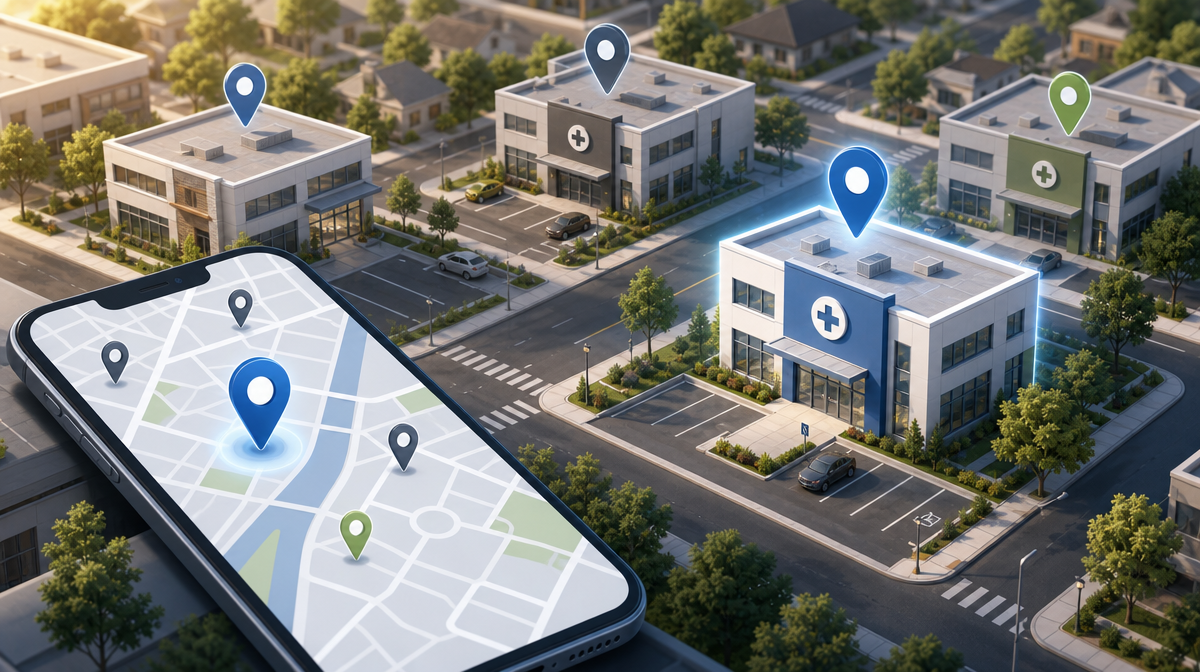
Most LASIK patients don’t start their search on your website — they start on Google Maps. When someone types “LASIK surgeon in [city]” or pulls up the local map pack, the three practices displayed there capture a disproportionate share of clicks before any paid ad or organic result gets a look. That real estate is earned through disciplined local SEO, not ad spend.
Here’s what actually moves the needle for LASIK practices competing in local search:
- Complete your Google Business Profile fully: Practices with verified, fully populated profiles — including procedure-specific photos, updated hours, Q&A responses, and service categories — consistently outrank incomplete ones in the map pack. Treat your profile as a living asset, not a one-time setup task.
- Build location-specific page content: City-plus-procedure keyword combinations like “LASIK surgeon in Austin” or “bladeless LASIK Dallas” need to appear in page titles, meta descriptions, and body copy — not stuffed in awkwardly, but woven into genuinely useful content about your practice.
- Establish consistent citations: Your practice name, address, and phone number must match exactly across every directory — Healthgrades, Zocdoc, Yelp, and dozens of others. Inconsistent listings create ranking confusion and erode the trust signals Google uses to rank local results.
- Partner locally for backlinks: Links from regional news outlets, local optometry practices, and community health organizations carry real weight. A single relevant local backlink often outperforms dozens of generic directory submissions.
- Systematize post-procedure review requests: Google reviews directly influence local pack rankings. Practices that automate review asks via SMS within 48 hours of a procedure generate review volume at a pace that manual outreach never matches.
When a prospective patient types “LASIK cost near me” into Google at 7pm on a Tuesday, they’re not browsing — they’re deciding. Pay-per-click advertising on Google and Bing puts your practice directly in front of that intent at exactly the right moment, bypassing the months it takes organic rankings to build. For LASIK surgeons competing against well-funded chains, that immediacy is the core value proposition of paid search.
Running PPC profitably for a refractive surgery practice requires more than turning on campaigns and setting a budget. Four variables determine whether your ad spend generates surgical volume or just burns cash:
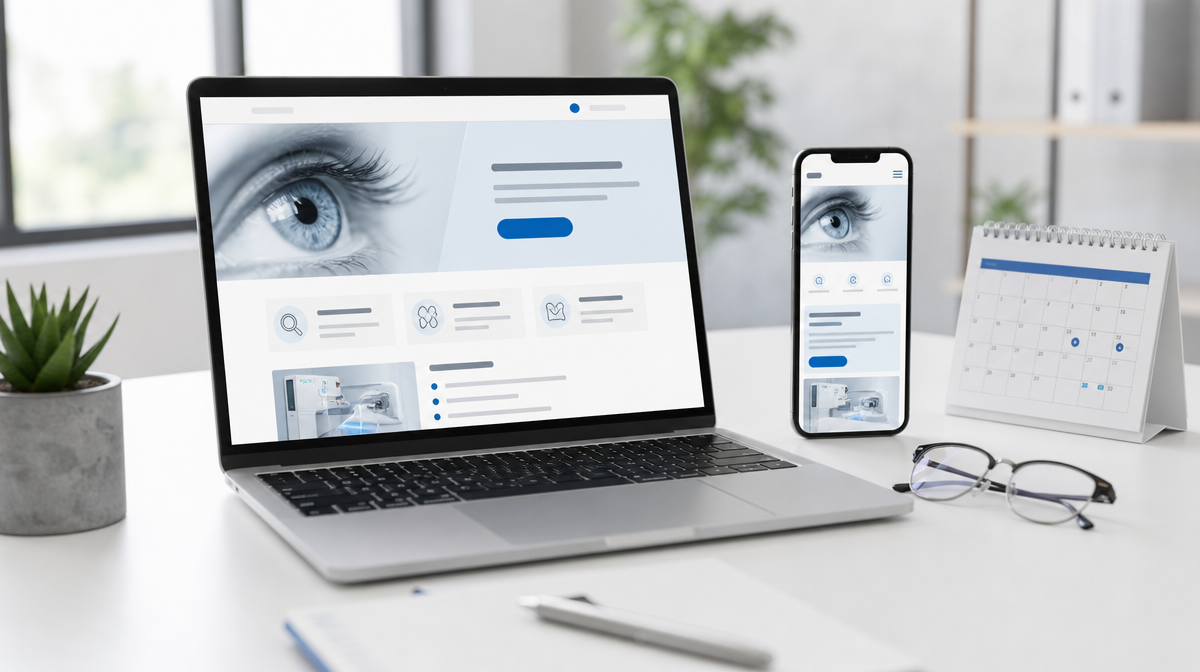
- Procedure-specific keyword targeting: Bidding on terms like “LASIK surgery cost,” “bladeless LASIK,” and “LASIK surgeon near me” captures patients in active evaluation mode. Competitor-name keywords can also be worth testing in markets where a dominant chain has strong name recognition.
- Dedicated landing pages for every campaign: Sending paid traffic to your homepage is one of the most common and costly mistakes in LASIK advertising. A focused landing page built around a single offer — free consultation, price transparency, financing options — consistently outperforms general site pages on conversion rate.
- Budget sequencing from high-intent to awareness: Start ad spend where purchase intent is highest, then expand into Facebook and Instagram once your conversion funnel is validated. Running awareness campaigns before you have a working lead-to-consult process wastes both money and momentum.
- Retargeting undecided visitors: Most first-time visitors won’t convert. Retargeting campaigns that follow past website visitors across platforms re-engage the 90%+ who left without booking, often at a fraction of the cost of acquiring a new click.
Social platforms serve a different function in LASIK marketing than search or email — they’re where undecided candidates form opinions about your surgeon before they ever run a Google search. Someone who hasn’t started comparing practices yet can still be reached through a well-placed Instagram ad or a Facebook video, and that early exposure shapes which names they recognize when active evaluation begins.
- Facebook and Instagram demographic targeting: Meta’s advertising tools let you reach users by age range, geographic radius, and interest categories — including people who follow eyewear brands, contact lens retailers, or vision correction content. This is awareness-stage advertising at its most efficient, surfacing your practice to candidates who are qualified but haven’t started searching yet.
- Patient testimonial videos: Nothing reduces surgical hesitation faster than watching a real patient describe their experience in their own words. Short-form clips — 60 to 90 seconds — perform particularly well as social ads and on procedure pages because they answer the emotional objections that statistics and feature lists can’t touch.
- Surgeon-led educational content: Videos where the operating surgeon explains the procedure, walks through candidacy criteria, or addresses common fears accomplish two things simultaneously: they position the doctor as a credible expert and they humanize the practice in a way that no written bio can replicate. Patients choosing an elective surgery want to know the person behind the laser.
The practices winning on social aren’t running generic brand awareness campaigns — they’re using video to compress the trust-building timeline that would otherwise take months of passive research.
For elective procedures priced between $4,000 and $6,000 per patient, your online review profile isn’t a nice-to-have — it’s a deciding factor. Prospective LASIK candidates read an average of 10 or more reviews before contacting a practice, and they’re doing that research on platforms you may not even be monitoring. A gap in your reputation coverage is a direct revenue leak — 40% of patients have reconsidered providers based on negative reviews.
- Monitor reviews across every relevant platform: Google gets the most attention, but Healthgrades, Yelp, Facebook, and RateMDs each attract patients at different stages of their decision. A four-star average on Google means little if Healthgrades shows three unaddressed complaints.
- Respond to all reviews, positive and negative: Thanking a satisfied patient publicly signals attentiveness. Responding professionally to a critical review — without disclosing any clinical details — signals maturity and accountability. Practices that ignore negative reviews look worse than those that engage thoughtfully.
- Systematize your review request process: The single most effective reputation tactic in LASIK marketing is timing. An automated SMS sent 24 to 48 hours post-procedure, when outcomes are fresh and patients are genuinely excited, generates review volume that manual outreach never approaches.
- Bring reviews onto your own site: Embedding a live review widget on your procedure pages and homepage means a prospective patient sees social proof without leaving your site — reducing the likelihood they navigate away to a competitor’s profile mid-research.
Review management isn’t a passive activity. Practices that treat it as an automated, ongoing system consistently outperform those that address reputation only after a problem surfaces.
LASIK has one of the longest consideration cycles of any elective procedure — the average candidate researches for three to six months before booking. That gap between first inquiry and scheduled consult is where most practices hemorrhage revenue without realizing it. Leads go cold, phones are unanswered, and follow-up stops after one or two attempts. A systematic lead-to-consult process closes that gap.
- Step 1 — Capture leads with a single-focus landing page: Ad traffic sent to a dedicated page built around one offer — a free candidacy screening, a pricing guide, or a financing calculator — converts at a measurably higher rate than general site traffic. Remove navigation links and competing CTAs so the only action available is submitting contact information.
- Step 2 — Contact every lead within five minutes: Research across industries consistently shows that speed-to-lead is the single biggest determinant of whether a prospect books. A lead contacted within five minutes is 21x more likely to qualify than one reached an hour later. Automation or a dedicated call center makes this achievable at scale.
- Step 3 — Run a multi-touch drip sequence: Most LASIK leads need seven to twelve touchpoints before committing. An automated sequence combining educational emails, financing reminders, and SMS check-ins keeps your practice visible across the full consideration window without requiring manual effort per lead.
- Step 4 — Reduce no-shows with pre-consult reminders: A booked appointment isn’t a guaranteed patient. Automated confirmation texts sent 48 hours out, followed by a same-day reminder, can cut no-show rates significantly — protecting the surgical volume your marketing spend already earned.
Most LASIK practices have a rough sense of how much they’re spending on marketing. Far fewer know what that spending is actually producing — and that gap between spend and outcome is where budgets quietly disappear. Tracking the right numbers transforms LASIK marketing from a cost center into a predictable revenue lever.
The metrics that matter most aren’t impressions or click-through rates — those are agency vanity stats. What you need are the numbers that connect directly to surgical volume:
- Cost per lead: Total ad spend divided by leads generated. This tells you how efficiently each channel is producing initial interest — useful for comparing Google Ads against Meta campaigns or organic traffic.
- Cost per consultation: Spend divided by booked consults. This accounts for lead quality, not just quantity. A channel generating cheap leads that never book is more expensive than one generating fewer, better-qualified inquiries.
- Consultation-to-procedure rate: The percentage of consults that result in scheduled surgery. A low rate here signals a sales process or candidacy screening issue — not a marketing problem.
- Patient acquisition cost: Total marketing investment divided by new surgical patients. This is the number that determines whether your LASIK marketing is profitable at your current procedure fee.
- Patient lifetime value: LASIK patients frequently return for premium lens procedures, dry eye treatment, or refer family members. Factoring in downstream revenue justifies higher acquisition costs that look unsustainable when viewed in isolation.
Practices that track these five numbers monthly can reallocate budget toward what’s working within a single billing cycle instead of guessing at the end of the year.
LASIK advertising operates under a compliance framework that most general marketers overlook — and the consequences of getting it wrong extend well beyond a disapproved ad. The Federal Trade Commission and individual state medical boards actively monitor refractive surgery advertising, and violations can result in formal complaints, fines, or disciplinary action against your medical license.
Four compliance principles apply directly to how you promote your LASIK practice:
- No guaranteed outcomes: Claiming patients will achieve 20/20 vision or eliminate glasses entirely is prohibited unless your data substantively supports that specific outcome for your patient population. Outcome language must be qualified with appropriate context.
- Transparent pricing disclosures: If your LASIK advertising features a per-eye price, that figure must reflect what a typical qualifying patient actually pays — including what’s covered and what isn’t. Promotional pricing that most patients can’t access invites FTC scrutiny.
- Accurate testimonial representation: Patient stories and before-and-after content must either reflect typical outcomes or include clear disclosures that individual results vary. Featuring only exceptional cases without disclosure is considered deceptive advertising.
- Platform-specific verification requirements: Google and Meta both require healthcare advertisers to complete verification processes before running certain ad types. Skipping this step doesn’t just risk disapproval — it can trigger account-level restrictions that take weeks to resolve.
Working with a LASIK marketing partner who understands healthcare advertising compliance from the outset saves you the considerably more expensive process of untangling regulatory problems after they’ve already affected your campaigns.
Choosing the right partner is its own decision — and it’s worth getting right. A LASIK candidate isn’t a typical consumer; they’re a medically disqualifiable prospect with a months-long decision horizon and a five-figure procedure attached to their hesitation, and an agency without refractive experience tends to learn that on your budget. The criteria for vetting a specialist — ophthalmology-specific client history, dashboard-level reporting, in-house execution, and compliance fluency — are involved enough that we cover them in depth separately, in our guides to choosing an ophthalmology marketing agency and what real ROI looks like.
Target Patients MD was built exclusively for medical practices — not e-commerce brands, not law firms, not anyone who doesn’t operate in a clinical environment. That specialization matters in LASIK marketing because the compliance landscape, patient psychology, and competitive dynamics of refractive surgery require a team that already speaks the language when they walk in the door.
The A.L.I. 360 platform — Target Patients MD’s proprietary AI-powered patient acquisition system — is built to optimize targeting and lead follow-up continuously rather than on a monthly review cycle. For ophthalmology marketing specifically, that focus translates into surgical volume, not just traffic reports.
What sets the model apart for refractive surgery practices:
- Done-for-you execution by an in-house team — no subcontractors, no handoffs, no quality gaps between strategy and delivery
- Ophthalmology-fluent campaign management — built on experience with 735+ medical practitioners across competitive markets
- AI-optimized targeting and follow-up — A.L.I. 360 continuously refines ad performance and lead nurturing without waiting for a monthly review cycle
- Transparent reporting tied to surgical outcomes — dashboards that show booked consultations and acquisition costs, not vanity metrics
If your current LASIK marketing program can’t tell you the cost per booked surgery at any given moment, that’s the problem worth solving first. Learn more about Target Patients MD and what a specialized ophthalmology marketing partner actually looks like in practice.
Doctors evaluating LASIK marketing programs tend to ask the same practical questions before committing to a strategy. Here are direct answers to the ones that come up most often:
- How much should a LASIK practice spend on marketing? There’s no universal figure, but competitive metro markets typically require meaningful monthly investment across paid and organic channels to generate consistent surgical volume. The more useful framing: what’s your target number of procedures per month, and what patient acquisition cost is sustainable at your current procedure fee? Work backward from there.
- How long does LASIK marketing take to generate new patients? Paid search can put your practice in front of active searchers within 48 to 72 hours of launch. Organic search rankings take considerably longer — typically three to six months before meaningful traffic shifts occur. Most practices run both simultaneously.
- What is a good cost per lead for LASIK practices? Cost per lead varies significantly by market, channel, and offer. The more meaningful benchmark is cost per booked consultation, since lead quality varies widely across platforms.
- Does artificial intelligence improve LASIK marketing performance? AI tools that optimize bid strategies, personalize follow-up timing, and score leads by conversion probability have shown measurable improvements in both cost efficiency and consult volume — particularly for practices running high lead flow that manual processes can’t keep pace with.
- Is SEO or paid search better for LASIK patient acquisition? Neither outperforms the other in isolation. Paid search captures immediate demand; SEO compounds over time. Practices that rely exclusively on one channel create a single point of failure in their patient pipeline.