


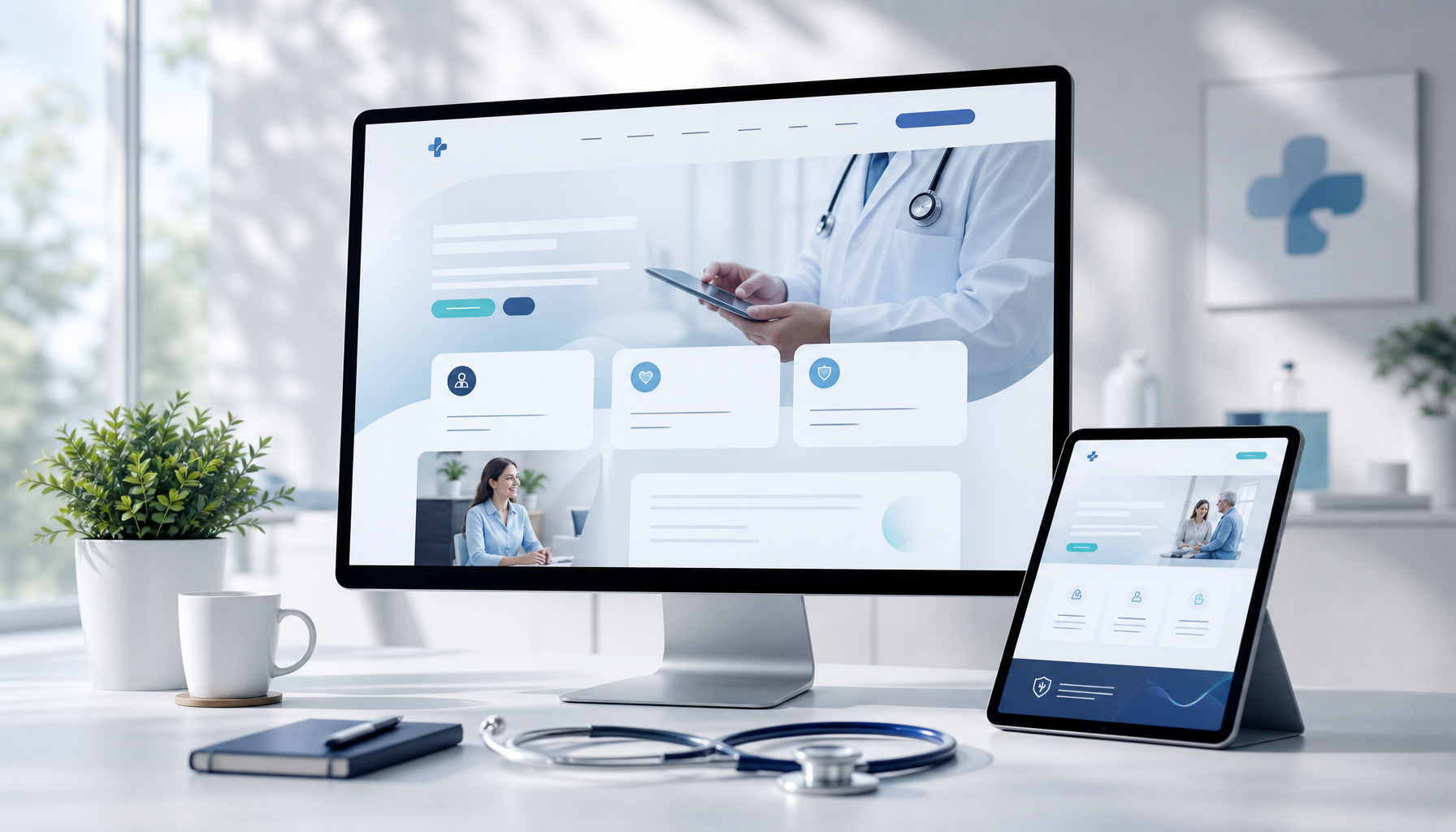
Most medical websites were built to satisfy a checklist, not to win patients. They have a homepage, an “About” page, a services list, and a contact form. They look reasonable on a laptop. And they do almost nothing to convert the person who lands on them at 9:47 PM researching their options before calling anyone. The medical website design examples worth studying are the ones that were built for that person.
The gap between a generic healthcare site and a high-converting one isn’t primarily aesthetic. It’s functional. A conversion-focused medical website is engineered around how patients actually make provider decisions, which means it removes doubt, answers objections, and creates a clear path to booking at every stage of the visit, not just on the contact page.
What separates the two comes down to four structural differences:
- Patient-centered navigation: The menu is organized around what patients need to find, such as conditions, procedures, and locations, not around how the practice is internally structured.
- Trust signals above the fold: Board certifications, verified review scores, and recognizable credentials appear immediately, before the visitor has to scroll or search for reassurance.
- Action-oriented page architecture: Every service page, every blog post, and every procedure overview guides the visitor toward a specific next step: a call, a booking, or a consultation request.
- Specialty-specific content: Rather than generic health information, the site speaks directly to the procedures and patient concerns that define your practice, matching what your highest-value patients are searching for.
Generic medical website design treats the site as a digital business card. Conversion-focused design treats it as your most productive patient acquisition channel.

Think of your website as a patient’s first clinical interaction with your practice. Before they call, before they fill out a form, they’re scanning your site and making a judgment call in a matter of seconds. The design elements below aren’t decorative choices. They’re the infrastructure that either keeps prospective patients moving toward a booked appointment or sends them back to the search results to find your competitor. They are also the most visible layer of your medical practice branding, so the look and tone of the site should match everything else a patient sees before the visit.
- Mobile-first layout: A large share of healthcare searches now happen on a smartphone. A site that shrinks a desktop layout down to fit a phone screen isn’t mobile-friendly; it’s just small. Build for the phone first, and the desktop version takes care of itself. Google evaluates the mobile version of your site for ranking, so this directly affects whether you show up when nearby patients search.
- Frictionless booking and direct CTAs: “Learn More” doesn’t book appointments. Buttons that say “Schedule a Consultation” or “Call Now,” placed in sticky headers and at the close of every service page, give patients a clear action at every decision point, not just when they’ve somehow found the contact page.
- Embedded review widgets: Pulling live ratings from Google and other review platforms directly onto your service pages does more trust-building than an “About Us” paragraph ever will, because most patients read reviews before they book, and it is one of the simplest wins in medical reputation management. Keep display controls HIPAA-conscious.
- Core Web Vitals performance: Google measures Largest Contentful Paint, Interaction to Next Paint, and Cumulative Layout Shift as ranking signals, which makes page speed a conversion issue as much as a technical one. A slow, jumpy site loses both search visibility and patient confidence at the same time. Google’s own Core Web Vitals documentation sets out the thresholds a page should meet.
- ADA-accessible navigation: Proper heading hierarchy, sufficient color contrast, and keyboard navigation aren’t just compliance checkboxes. They also improve usability for every visitor, regardless of ability.
| Feature | Generic Website | Conversion-Focused Medical Website |
|---|---|---|
| Navigation | Complex menus | Simplified, patient journey-based |
| Booking | Contact form only | Integrated online scheduling |
| Mobile experience | Scaled-down desktop | Built mobile-first |
| Trust elements | About page only | Reviews and credentials on every page |
| Load speed | Often slow | Optimized for Core Web Vitals |
Every specialty has a different patient psychology, and the best medical website design examples reflect that reality by building conversion features around how that specific patient makes decisions, not how patients in general behave.
- Medical spa: Impulse interest converts fast when friction disappears. The standout feature on high-performing med spa sites is a treatment menu with transparent pricing signals paired with a one-click consultation booking widget, capturing visitors while aesthetic curiosity is still warm. In crowded markets it matters even more, as our guide to med spa marketing New York explains.
- Plastic surgery: Patients are making a high-consideration decision that can take weeks or months. The conversion feature that moves the needle is prominently displayed financing information alongside surgeon credentials, a pairing that sits at the center of effective plastic surgery marketing, answering “Can I afford this?” and “Is this surgeon qualified?” before the patient has to ask.
- Ophthalmology and LASIK: Research-driven patients want to self-qualify before committing to a consultation. Interactive candidacy assessment tools, such as “Am I a LASIK candidate?” quizzes that collect contact information, convert hesitant browsers into warm leads at scale, and they belong in any serious ophthalmology marketing plan.
- Dental implants: Cost anxiety is the primary barrier. Sites that embed a financing calculator directly on the implant service page, showing monthly payment estimates rather than a lump-sum price, consistently reduce hesitation and increase consultation requests.
- Bariatric and medical weight loss: Decision cycles here stretch across months. Seminar or webinar registration features keep the practice top-of-mind during that extended research window and build a warm lead pipeline before the patient is ready to book.
- Regenerative medicine: Skepticism is the conversion killer. Detailed provider credential pages with specialty training, published research references, and video-format patient stories build the category credibility that regenerative medicine marketing depends on to turn curious visitors into confident consultation requests.
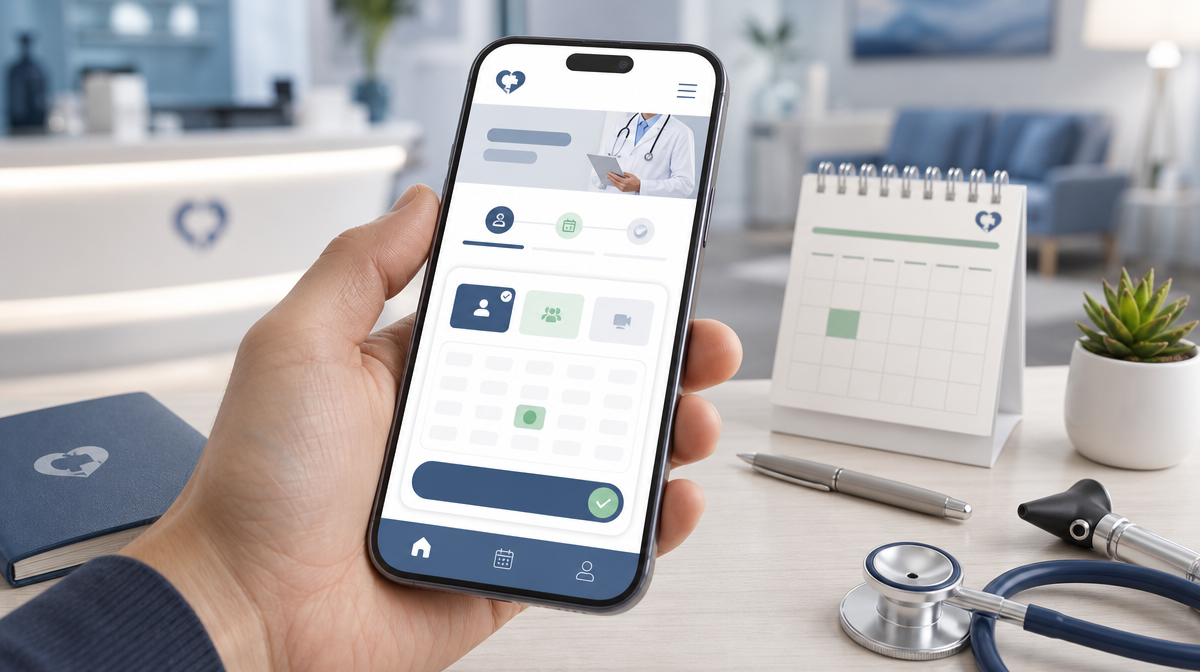
HIPAA isn’t just a compliance acronym your attorney mentions once a year. In the context of your website, it shapes what you’re permitted to collect, store, and transmit when a patient reaches out online. A single poorly handled contact form can expose your practice to penalties that dwarf the cost of building the site correctly in the first place. The HIPAA Security Rule sets the standards for protecting electronic health information, and your web infrastructure is part of that picture.
Every medical practice website needs four security layers treated as non-negotiable infrastructure, not optional upgrades:
- SSL certificate and HTTPS encryption: Any page where a patient enters personal information, including basic inquiry forms, must transmit that data over an encrypted connection. An HTTP site isn’t just a compliance problem; browsers now actively flag it as “not secure,” which kills patient confidence before they type a word.
- HIPAA-conscious contact and intake forms: Generic web form tools and consumer survey products are rarely set up for patient information. Your forms need to route submissions through a secure backend with appropriate Business Associate Agreements in place.
- Secure email integration: When a patient submits a question or appointment request, the notification your staff receives must travel through an encrypted, covered channel, not a standard consumer email account.
- Enterprise-grade hosting infrastructure: Shared hosting environments built for e-commerce or blogs carry security profiles incompatible with protected health information. Medical practices require hosting with documented security controls and signed BAAs from the hosting provider.
When evaluating any medical website design partner, ask specifically how each of these requirements is handled, and get the answer in writing before the project starts. Confirming your own compliance obligations with qualified counsel is always worth the time.
Your website’s design sets the stage, but it’s the conversion infrastructure underneath that actually turns visitors into scheduled patients. A visually impressive site without these mechanisms is like a beautifully designed waiting room with no front desk.
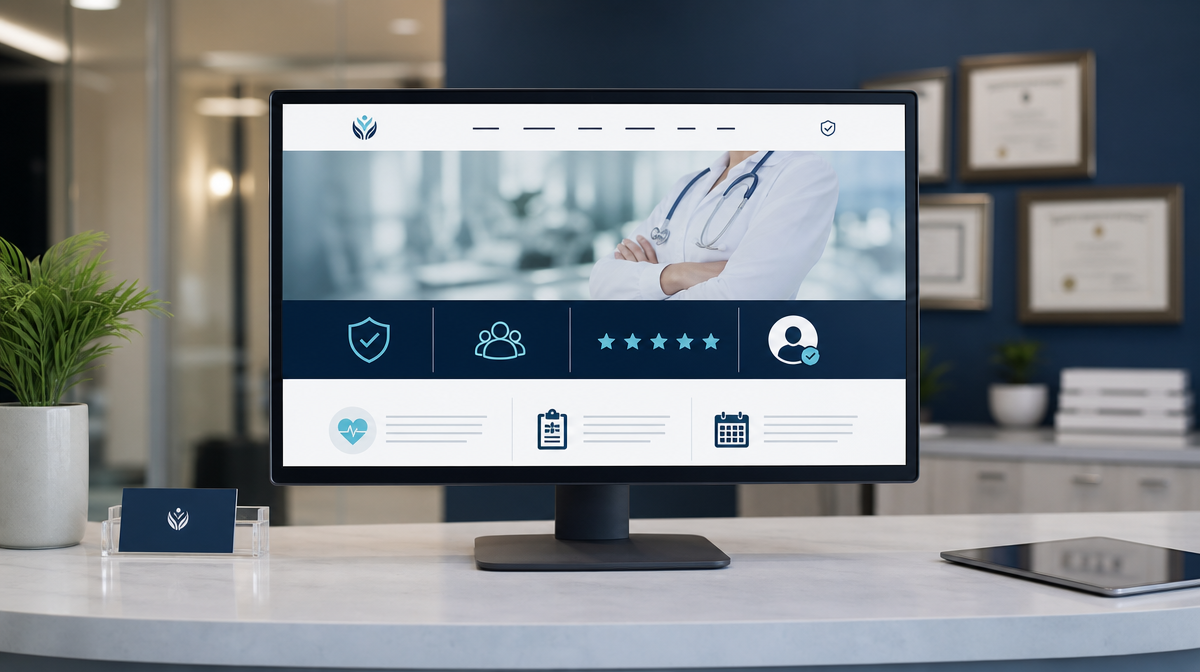
- Call tracking and lead attribution: Dynamic number insertion lets you see exactly which page, campaign, or keyword generated each phone call. Without this, you’re guessing which parts of your site earn their keep, and guessing wrong is expensive.
- AI-powered chat widgets: A prospective patient researching LASIK at 11 PM isn’t going to wait until morning to get answers. AI chat captures that interest in real time, qualifies the lead, and routes it to your team, with no staff required after hours, which is why it has become a core piece of AI medical marketing.
- True online scheduling vs. request forms: A “Request an Appointment” form creates a follow-up task for your staff. Integrated scheduling software lets the patient pick a time, confirm it, and receive a reminder, completing the booking loop without a single phone call.
- Secure intake and inquiry forms: Beyond compliance, well-designed intake forms reduce the friction of the first patient interaction. Pre-visit data collection that works on mobile, submits instantly, and routes correctly saves staff time and improves the patient’s first impression at the same time.
- Local SEO and Google Business Profile alignment: Your website’s service pages and location signals need to mirror what appears in your Google Business Profile. Inconsistent information across directories dilutes local authority and costs you map pack visibility, the single highest-intent placement in local search, and it is one of the first things medical SEO services should fix.
There is a newer layer on top of all of this. Patients increasingly get their first answer from an AI-generated summary rather than a list of links, and the sites that get cited there are the ones with clean structure and clearly written service pages. Building for AI-driven search visibility is now part of what a medical website design has to do.
Outranking local competitors isn’t a matter of having the newest-looking site. It’s about building a medical website design that compounds advantages over time through structure, exclusivity, and continuous optimization.
- Procedure-specific landing pages: A single “Services” page is invisible to search engines and useless to patients. Every procedure your practice performs deserves its own dedicated page, written around how patients actually phrase their searches, not how clinicians describe treatments. A practice with separate pages for gastric sleeve, gastric bypass, and revision surgery will outperform a competitor with one generic “weight loss surgery” page, which is the first thing a good bariatric marketing agency will build.
- Geographic exclusivity in design: Template-based sites create a structural disadvantage. If your web vendor is selling the same design to three practices within five miles of yours, you’re competing against your own website. A design built exclusively for your market prevents that from happening and gives search engines a cleaner signal of your distinct local identity.
- Analytics-driven iteration: Practices that treat launch as the finish line routinely lose ground to competitors who treat it as the starting point. Ongoing conversion tracking, heatmap analysis, and testing of key page elements such as procedure headlines, CTA placement, and form length compound into measurable ranking and lead volume gains over time.
- AI-powered content and personalization: Platforms that dynamically adjust page content based on visitor behavior, showing different messaging to a first-time visitor versus a returning one, consistently outperform static sites on both time-on-site and conversion rate.
That personalization layer is where the website stops being a brochure and starts being a system. A.L.I. 360 by Target Patients MD is a proprietary AI-powered patient-acquisition system for medical and dental practices. The name stands for Attract, Learn, and Influence.
Most web agencies will take your deposit, build you something that looks polished in a demo, and hand over login credentials when the project closes. What happens to your patient volume six months later is largely not their problem. That’s the fundamental question to resolve before signing anything.
When evaluating a medical website design partner, push past portfolio screenshots and ask the questions that expose how they actually operate:

- Healthcare-only focus: Does the agency understand specialty-specific patient behavior, medical advertising regulations, and the compliance requirements that make healthcare different from every other vertical, or do they treat your practice like a plumbing company with a waiting room? The difference between a medical marketing agency vs. general agency shows up here first.
- Conversion track record: Can they show new patient volume outcomes, not bounce rates, impressions, or design awards, from practices similar to yours in competitive markets?
- Compliance built into the build: Is HIPAA-conscious infrastructure standard in every project, or is it an add-on that gets value-engineered out when budgets tighten?
- Ongoing optimization model: What does the relationship look like 90 days after launch? A partner worth keeping has a structured process for monitoring, testing, and improving performance continuously.
- Design ownership and market exclusivity: Will you hold full rights to your site, and will the partner commit in writing that they won’t sell the same design to a competing practice in your area?
Target Patients MD combines custom medical website design with built-in SEO, HIPAA-conscious infrastructure, and AI-powered optimization, purpose-built for practices that measure success in new patients, not pixels. If you want to see how your current site measures up against the examples above, request a practice growth session.
Practices shopping for a medical website design partner tend to ask the same operational questions, and the answers clarify a lot before any contract gets signed.
- How much does a custom medical website cost?
Custom medical website design pricing varies considerably depending on the number of specialty service pages, whether integrated scheduling and AI chat tools are included, and what ongoing optimization support looks like. Practices that treat the site as a patient acquisition asset rather than a one-time expense tend to evaluate the investment against incremental new patient bookings rather than the invoice alone. - How long does it take to design and launch a medical website?
Most custom builds take several weeks to a few months from kickoff to live, and that window compresses when the practice comes prepared with approved content, photography, and a clear list of priority services. - Does my practice own the website after it is built?
Not always. Some vendors retain ownership of the design or underlying code. Confirm full intellectual property transfer in writing before the project begins, particularly if area exclusivity is part of the agreement. - How often should a medical practice redesign its website?
A full structural redesign every few years tends to keep the site competitive. Between redesigns, continuous content additions and conversion optimizations matter more than the redesign cycle itself. - Can AI tools improve medical website conversion rates?
Yes, meaningfully. AI-driven personalization that adjusts page messaging based on visitor behavior, combined with automated lead capture after hours, addresses the two biggest conversion gaps most practice websites currently have.