


New York City isn’t just competitive — it’s a different category of competitive. With thousands of licensed physicians, dentists, and specialists operating across five boroughs, your practice isn’t just competing with the office down the block. You’re competing with every provider who shows up in a patient’s Google search before you do.
Medical marketing is the process of using digital and traditional channels to attract, engage, and convert prospective patients into booked appointments. But in NYC, generic marketing strategies fall flat fast. The market demands a specialized approach built around how New Yorkers actually find and choose healthcare providers.
Here’s what makes medical marketing in NYC uniquely challenging:
- High competition: Every borough has dozens of practices fighting for the same patient searches, from “dermatologist Upper East Side” to “dentist near Tribeca.”
- Expensive digital advertising: NYC consistently ranks among the highest cost-per-click markets in the country, with major metros seeing healthcare ad costs 200–400% above national averages, meaning wasted ad spend adds up fast without precise targeting.
- HIPAA requirements: Healthcare marketing operates under strict federal compliance rules that most general marketing agencies aren’t equipped to navigate.
- Local search complexity: NYC patients search by neighborhood, not just city — which means your visibility in Astoria doesn’t automatically translate to visibility in Flushing, even though both are in Queens.
A healthcare-specific marketing strategy accounts for all of these variables from day one, rather than learning them on your dime.
A medical marketing agency is different from a general agency the same way a cardiologist is different from a GP — the specialization matters. While a generalist firm might know how to run Facebook ads or build a website, a healthcare-focused agency understands the full patient acquisition funnel: from the moment someone searches for a symptom to the moment they book an appointment at your practice.
The core function is straightforward: generate a consistent flow of qualified patient leads through digital channels, then convert those leads into scheduled appointments. Everything else — the SEO, the ads, the website, the reputation management — exists to serve that outcome.
In practice, a medical marketing agency in NYC handles the work that most practice owners simply don’t have time to manage themselves. That means done-for-you execution across every channel, not a strategy deck you’re left to implement alone. Key functions include:
- Patient acquisition: Building and managing campaigns that attract the right patients for your specific specialty and service area
- Lead generation: Capturing prospective patient interest through search, social, and paid channels before they choose a competitor
- Conversion optimization: Turning website visitors and ad clicks into actual appointment requests through compelling design and messaging
- Healthcare compliance: Ensuring every campaign, landing page, and communication meets HIPAA standards without slowing execution
The right agency doesn’t just understand marketing — it understands how patients make healthcare decisions, which is a fundamentally different buying process than almost any other industry.
Full-service medical marketing in NYC covers a wide range of channels — each one solving a different part of the patient acquisition problem. The best agencies don’t ask you to pick one; they deploy them together as a coordinated system. Here’s what that looks like in practice:
- Local SEO for NYC neighborhoods and boroughs: Optimizing your Google Business Profile, building citations across healthcare directories, and targeting ZIP code-level searches so patients in your specific neighborhood find you first — not a competitor three blocks away.
- Google Ads and medical PPC campaigns: Pay-per-click advertising puts your practice at the top of search results immediately. Medical-specific keyword targeting and HIPAA-compliant landing pages ensure the clicks you’re paying for actually convert into inquiries.
- HIPAA-compliant medical website design: A properly built medical site uses encrypted forms, secure data handling, and compliant email infrastructure — while also being optimized for mobile and designed to turn visitors into booked patients.
- Social media advertising and retargeting: Facebook and Instagram ads reach prospective patients by demographic and interest, while retargeting re-engages people who already visited your site but didn’t book.
- Email and text message patient outreach: Automated appointment reminders, recall campaigns, and lead nurturing sequences keep your schedule full and reduce patient drop-off between visits.
- Reputation and online review management: Agencies actively generate new reviews, monitor feedback, and respond across Google, Healthgrades, and Yelp — because 53% of patients won’t consider providers rated below 4 stars, and in NYC a 3.8 loses patients to the 4.7 down the street.
Not all medical practices market the same way — and they shouldn’t. A plastic surgery practice competing for cosmetic patients in Manhattan has completely different messaging, targeting, and channel priorities than a dental office trying to fill hygiene appointments in Brooklyn. Effective medical marketing NYC strategies are built around the specific patient journey for each specialty, not a one-size-fits-all template.
Here’s how marketing focus typically breaks down across the specialties most commonly served by NYC healthcare agencies:
- Medical spas: Campaign-driven promotions around Botox, CoolSculpting, and aesthetic procedures, with heavy emphasis on before-and-after visuals and seasonal offers that drive immediate bookings.
- Plastic surgery: Trust-building content, photo galleries, and high-intent search campaigns targeting patients researching specific cosmetic procedures — often a longer consideration cycle than other specialties.
- Dental practices: Local SEO and paid search for high-value services like implants and cosmetic dentistry, alongside general care campaigns designed to capture patients new to the neighborhood.
- Ophthalmology: Procedure-specific campaigns around LASIK and PRK, targeting patients who are actively comparing providers and financing options before committing.
- Bariatrics and medical weight loss: Educational content marketing paired with paid campaigns targeting GLP-1 program interest and weight loss surgery inquiries — a segment driven by an estimated 25 million Americans expected to be on GLP-1 treatment by 2030.
The common thread across all of these is intent-matched marketing: reaching the right patient at the right moment with messaging that speaks directly to what they’re already looking for.
Local SEO is the engine behind organic patient discovery in NYC — but the way it works here is more granular than in most markets. New Yorkers don’t search for “dentist in New York City.” They search for “dentist in Park Slope” or “orthodontist near Astoria.” That neighborhood-level specificity means your local SEO strategy has to match the way patients actually think about geography.
The foundation is your Google Business Profile (GBP). A fully optimized GBP — with accurate categories, service descriptions, photos, and consistent hours — is what determines whether your practice appears in the Google Maps local pack when someone nearby searches your specialty. In a dense city like New York, the difference between ranking first and fourth in that pack can represent dozens of lost patient inquiries per month.
Beyond your GBP, NAP consistency is critical. NAP stands for Name, Address, and Phone number — and these three data points need to match exactly across every directory where your practice is listed, including Healthgrades, Zocdoc, Yelp, and dozens of smaller citation sources. Inconsistencies confuse search engines and quietly suppress your local rankings.
For NYC practices specifically, effective local SEO also involves:
- ZIP code-level keyword targeting for neighborhoods like Upper East Side, Tribeca, and Brooklyn Heights
- Location-specific service pages that address the search patterns of patients in each area you serve
- Citation building across healthcare-specific directories to establish geographic authority
- Review velocity management to maintain a competitive star rating in high-density search environments
AI has moved well beyond a buzzword in medical marketing NYC — it’s now the operational layer that separates agencies running efficient, scalable patient acquisition from those still manually adjusting campaigns and guessing at messaging. In a market as expensive and competitive as New York, that gap matters.
In practical terms, AI functions as a real-time optimization engine across every channel your practice uses to attract patients. It processes performance signals faster than any human team can, then acts on them — adjusting bids, reallocating budget, and refining audience targeting before wasted spend accumulates.
Here’s where AI delivers the most meaningful impact for NYC practices:
- Campaign optimization: AI adjusts bids and targeting in real time based on conversion signals, reducing your cost per lead without requiring manual oversight.
- Chatbots and virtual assistants: AI-powered chat tools engage website visitors around the clock — answering common questions, pre-qualifying leads, and capturing contact information even when your front desk is closed.
- Predictive analytics: Machine learning models identify which leads are most likely to book based on behavioral patterns, so follow-up resources get directed where they’ll convert.
- Content optimization: AI analyzes which headlines, offers, and messaging variations actually drive appointment requests — then surfaces what’s working so campaigns improve continuously.
AI also plays a growing role in Generative Engine Optimization (GEO) — structuring your practice’s content so it surfaces in AI-powered search tools like ChatGPT and Google’s AI Overviews, which are increasingly where patients begin their provider research.
Choosing the right partner for medical marketing NYC is one of the highest-leverage decisions you’ll make for your practice. The wrong agency costs you time, budget, and patients you never knew you lost. Here’s what to actually look for before signing anything:
- Healthcare specialization and HIPAA compliance: Agencies that work exclusively in healthcare understand patient privacy requirements, ad platform restrictions for medical content, and the compliance infrastructure your campaigns need. Ask specifically how they handle HIPAA across landing pages, CRM systems, and email communications — and verify they can answer without hesitating.
- In-house execution versus outsourced work: Many agencies sell you a relationship with their team, then hand your account to offshore contractors. Ask who specifically will manage your SEO, run your ads, and build your pages. Direct access to specialists — not account managers relaying messages — is what drives consistent, accountable results.
- Transparent reporting and ROI dashboards: Good reporting goes beyond traffic and impressions. You should see lead volume, cost per patient inquiry, and conversion rates by channel — updated regularly and explained in plain language. If an agency can’t show you exactly where your budget is going and what it’s producing, that’s a problem.
- Performance accountability: Reputable agencies stand behind their work. Look for partners whose model is tied to real patient outcomes — booked patients, not activity metrics — and who can show exactly how their work translates into appointments.
The honest answer to “what will I get from this?” depends on your starting point, your specialty, and which channels you’re running — but there are consistent outcome categories that well-executed medical marketing NYC campaigns reliably produce. Understanding the difference between vanity metrics and real business outcomes will help you evaluate performance accurately.
Clicks and impressions look good in a report, but they don’t pay overhead. The outcomes that actually matter to your practice are:
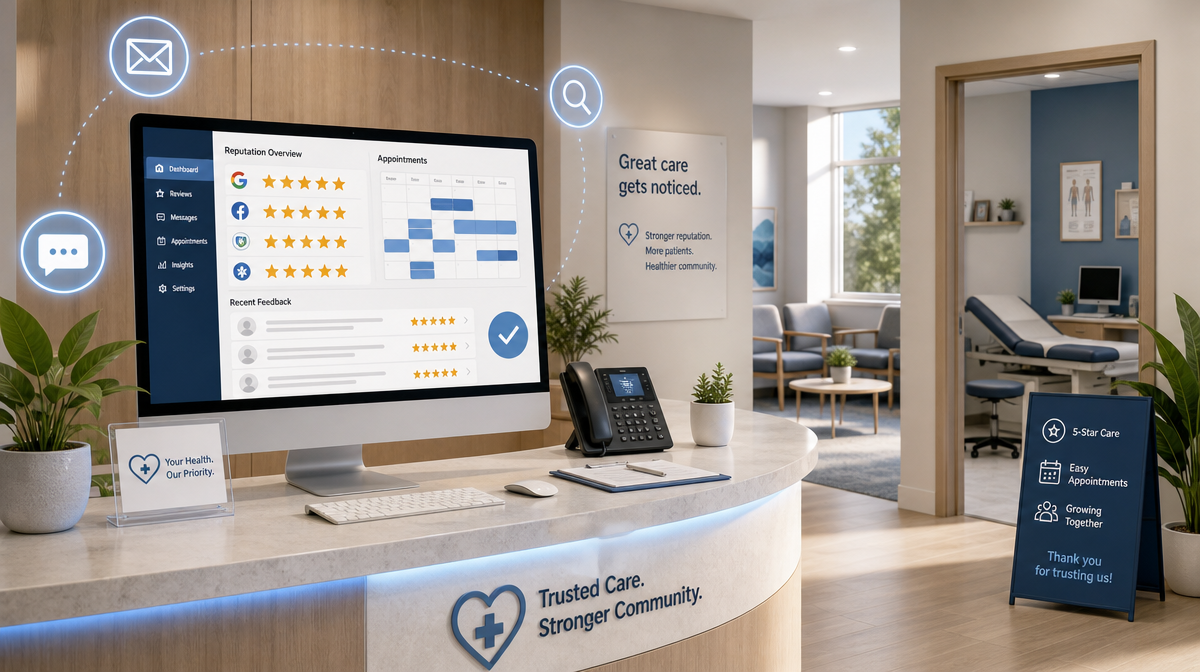
- Patient acquisition: A measurable increase in qualified leads contacting your practice — people actively searching for your specialty in your neighborhood, not random traffic with no intent to book.
- Search visibility: Higher rankings in Google Maps and organic results for the neighborhood-specific searches your prospective patients are already running.
- Reputation growth: A steady increase in review volume and average star rating across Google, Healthgrades, and Yelp — which directly influences how many patients choose you over a competitor with a stronger profile.
- Conversion improvement: A higher percentage of website visitors and ad clicks turning into actual appointment requests, driven by optimized landing pages and clearer calls to action.
- Lower cost per lead: As campaigns mature and targeting sharpens, the cost to acquire each new patient inquiry should trend downward — not stay flat or climb.
Paid advertising typically generates early traction within days of launch, while SEO compounds over months. Practices that run both simultaneously tend to see the fastest path from investment to a consistently fuller schedule.
If you’ve made it through everything above and you’re thinking “this is exactly what my practice needs — but I don’t have time to build it myself,” that’s precisely where Target Patients MD comes in. We handle your medical marketing so you can stay focused on what you actually went to school for.
Target Patients MD is a healthcare-exclusive agency serving NYC practices across every major specialty — from med spas and plastic surgery to dental, ophthalmology, and bariatrics. With over 735 medical practitioners served across the U.S. and Canada, we’ve built the systems, the compliance infrastructure, and the specialty-specific playbooks to move fast in competitive markets like New York.
Our proprietary A.L.I. 360 technology powers every campaign — combining AI-driven ad optimization, predictive lead scoring, and real-time performance dashboards into a single patient acquisition engine. It’s what allows us to deliver up to a 377% lift in patient acquisition for practices that make the switch from generic agencies or DIY marketing.
What makes us different in the context of medical marketing NYC:
- Healthcare-only focus — we don’t work with e-commerce brands or restaurants
- In-house execution — your campaigns are built and managed by specialists, not outsourced
- Neighborhood-level local SEO built specifically for NYC’s borough-by-borough search landscape
- New patients or you don’t pay — we back our work with a performance guarantee
Book a free consultation with Target Patients MD and find out exactly what a custom NYC patient acquisition strategy looks like for your practice.
- How much does medical marketing cost in New York City?Costs vary based on the services you need, your specialty’s competitive landscape, and your target patient volume. Most agencies offer tiered packages or custom pricing — expect a wider range in NYC than in smaller markets, given the higher ad costs and complexity involved.
- How quickly can a NYC medical practice see marketing results?Paid advertising can generate patient inquiries within days of a campaign going live. SEO typically takes several months to produce significant ranking movement. Practices that launch both simultaneously tend to see early wins from paid while organic visibility builds in the background.
- Are NYC medical marketing services HIPAA compliant?Reputable agencies that specialize in healthcare build compliance into every layer of their work — from encrypted website forms to HIPAA-compliant CRM systems and patient communications. Always ask specifically how an agency handles compliance before sharing any patient data or granting access to your systems.
- Can one agency handle multiple NYC practice locations?Yes. Experienced medical marketing NYC agencies manage multi-location campaigns by maintaining separate Google Business Profiles, location-specific SEO pages, and tailored ad targeting for each office. This ensures that your Midtown location ranks for Midtown searches and your Brooklyn office captures its own neighborhood traffic — without the two cannibalizing each other.
Most NYC practices don’t have a visibility problem — they have a conversion problem. Plenty of prospective patients are finding practices online every day. The question is whether those patients are finding yours, and whether your digital presence is compelling enough to make them pick up the phone or request an appointment instead of clicking to the next result.
Effective medical marketing NYC works by closing the gap between patient intent and patient action. That means building a presence that shows up when and where patients are searching, communicates trust quickly, and removes friction from the booking process. When all of those elements are aligned, marketing stops feeling like an expense and starts functioning like a patient pipeline.
The practices that see the strongest results from medical marketing tend to share a few common characteristics:
- They treat marketing as a system, not a campaign. One-off promotions produce one-off results. Sustained patient growth comes from interconnected channels working together continuously.
- They measure the right outcomes. Not just traffic or impressions, but booked appointments, cost per new patient, and revenue tied directly to marketing activity.
- They move fast in a market that doesn’t wait. In NYC, a competitor can claim your top search position or dominate your neighborhood’s Google Maps results within weeks of launching an optimized strategy.
- They partner with specialists, not generalists. Healthcare marketing has compliance requirements and patient psychology nuances that general agencies consistently underestimate.
Running a successful medical practice in NYC means wearing too many hats already. A complete medical marketing solution takes the entire digital growth function off your plate — not just one channel, but the full stack of services working as a coordinated system under one roof.
What separates a complete solution from a collection of disconnected vendors is integration. When your SEO, paid ads, website, reputation management, and patient outreach are all managed by the same team with shared data and shared goals, performance compounds. Each channel feeds the others rather than operating in isolation.
A complete medical marketing NYC solution typically includes:
- Campaign management: End-to-end oversight of paid and organic channels, with ongoing optimization rather than a set-it-and-forget-it approach
- Strategy development: A custom growth plan built around your specialty, your target neighborhoods, and the specific patient types you want to attract
- Website design and maintenance: A conversion-focused, HIPAA-compliant site that functions as the hub for all inbound patient traffic
- Ongoing support: Dedicated access to specialists who understand your practice — not a rotating cast of account managers reading from a brief
The practical benefit for busy practice owners is straightforward: one point of contact, one strategy, one set of performance metrics — instead of managing three separate vendors who each claim the other is responsible when leads dry up.
Winning in medical marketing NYC requires more than a single tactic — it requires a coordinated suite of search and digital services working together across the channels where NYC patients actually spend their time. Here’s what that looks like broken down by service category:
- Search engine optimization (SEO): Organic rankings built through technical site improvements, authoritative content, and keyword strategies targeting the specific procedures and neighborhoods your practice serves — not just broad “doctor in NYC” terms that are nearly impossible to rank for competitively.
- Local medical SEO: Borough-specific and ZIP code-level optimization that helps your practice appear in Google Maps results for the neighborhood searches your patients are actually running.
- Pay-per-click (PPC) management: Google Ads campaigns structured around high-intent medical keywords, with continuous bid management and conversion tracking tied directly to patient inquiries — not just clicks.
- Visibility audit and analysis: A diagnostic review of your current online presence to identify ranking gaps, missed keyword opportunities, and technical issues suppressing your search performance before new campaigns launch.
- Medical content marketing: Specialty-specific content that builds topical authority with search engines while educating prospective patients and establishing your providers as credible, trustworthy experts.
- Social media marketing: Platform-specific campaigns across Facebook and Instagram designed to reach prospective patients by demographic profile and geographic location — with compliant creative that meets healthcare advertising standards.
New York City’s healthcare landscape is one of the most search-saturated environments in the country. On any given day, hundreds of thousands of residents are actively researching providers, comparing practices, and making decisions about where to seek care — almost entirely online. Medical marketing NYC exists to position your practice in front of those patients at exactly the right moment.
The term covers a specific discipline: the application of digital marketing principles to the business of running a medical practice, with all the compliance requirements, patient psychology considerations, and competitive dynamics that entails.
For NYC practices, the core challenge isn’t awareness — it’s precision. Most providers already have some form of online presence. What separates practices that grow from those that stagnate is whether that presence is optimized for the specific patients they want to attract, in the specific neighborhoods they serve, at the specific moment those patients are ready to act.
That precision requires expertise across several interconnected disciplines:
- Search visibility at the neighborhood and ZIP code level
- Paid acquisition structured around medical intent, not generic traffic
- Conversion infrastructure that turns interest into booked appointments
- Compliance architecture that keeps every patient touchpoint within HIPAA guidelines
Before any strategy gets built, the most valuable thing a qualified agency can do for your NYC practice is tell you exactly where you stand right now. A complete site analysis cuts through the guesswork and gives you a clear picture of what’s working, what’s suppressing your visibility, and where the highest-leverage opportunities are hiding.
A thorough analysis goes well beyond checking whether your website loads quickly. For medical marketing NYC specifically, it examines the full competitive landscape your practice operates in — including which local competitors are outranking you for neighborhood-level searches, how your Google Business Profile compares to top performers in your specialty, and whether your current ad spend (if any) is targeting the right patient intent signals.
The key diagnostic areas a complete analysis should cover include:
- Technical SEO health: Crawl errors, page speed issues, mobile usability gaps, and indexing problems that quietly prevent search engines from ranking your pages
- Local visibility gaps: Missing or inconsistent citations across healthcare directories that are suppressing your Maps rankings by ZIP code and neighborhood
- Content and keyword coverage: Procedure and specialty pages you’re missing that competitors are actively ranking for in your service area
- Conversion audit: Friction points on your website — unclear calls to action, non-compliant forms, poor mobile layouts — that are costing you bookings from traffic you’re already receiving

Think of it as a baseline before the work begins: you can’t measure growth without knowing your starting point.
What actually separates one NYC medical marketing agency from another isn’t the services list — most agencies offer roughly the same menu. The real differentiators show up in how they execute, who they’ve worked with, and whether they can prove their results hold up in a market as demanding as New York.
Here’s what gives a specialized agency a genuine edge over the competition in this market:
- Deep knowledge of NYC’s competitive landscape: Agencies that have run campaigns across multiple boroughs understand which neighborhoods have saturated search results, which specialties face the highest cost-per-click pressure, and how patient behavior differs between a practice in Midtown versus one in Bay Ridge.
- Healthcare-exclusive client base: An agency that has served 500+ medical practices has already solved the problems your practice is about to encounter — from HIPAA-compliant tracking setups to specialty-specific ad copy that clears platform review without delays.
- Proprietary technology and systems: Generic agencies use the same off-the-shelf tools available to anyone. Agencies built specifically for medical marketing NYC often run proprietary systems that automate lead scoring, optimize ad spend in real time, and surface performance data in ways that standard dashboards can’t match.
- Proven specialty playbooks: Rather than building strategy from scratch for each new client, experienced healthcare agencies bring tested frameworks for specific verticals — med spa, dental, plastic surgery — that compress the timeline from launch to results.
In a city where every advantage compounds, working with an agency that has already navigated the specific obstacles your practice faces is worth more than a lower monthly retainer with a generalist.
Search engine optimization and marketing for NYC medical practices operates across two distinct tracks — organic and paid — that work best when they’re built and managed as a unified strategy rather than separate initiatives with separate goals.
On the organic side, medical SEO in New York requires more than standard keyword targeting. The competitive density means you’re not just optimizing for broad procedure terms — you’re building topical authority across a cluster of neighborhood-specific, procedure-specific, and intent-specific searches that together add up to meaningful patient volume.
On the paid side, search engine marketing (SEM) fills the gaps that organic rankings can’t cover immediately. Google Ads campaigns structured around high-value medical keywords put your practice in front of patients who are actively comparing providers right now — not six months from now when your SEO campaign has had time to mature.
The most effective medical marketing NYC strategies treat these two tracks as complementary:
- Organic SEO builds compounding long-term visibility that lowers your cost per acquisition over time
- Paid search delivers immediate patient inquiries while organic rankings develop
- Keyword data from paid campaigns informs which organic content to prioritize based on actual conversion performance
- Organic rankings reduce paid dependency as your practice earns more unpaid clicks for high-intent searches
Running both in isolation — SEO managed by one vendor, PPC managed by another — is one of the most common and costly mistakes NYC practices make.
A complete digital success strategy for your NYC practice isn’t built around any single channel — it’s built around a measurable return on every dollar you invest. That means moving beyond campaign launches and into a continuous improvement cycle where data from one channel actively improves performance across all the others.
Achieving that kind of return in medical marketing NYC requires four things working in parallel:
- Positive ROI from paid advertising: Your Google Ads and social campaigns should generate patient inquiries at a cost that makes business sense for your specific specialty — not just traffic that looks good in a dashboard.
- Compounding organic growth: SEO investments should build equity over time, reducing your reliance on paid spend as your practice earns more unpaid visibility for high-intent neighborhood searches.
- Optimized conversion rates: More traffic only produces more revenue if your website and landing pages are built to convert visitors into booked appointments — not just inform them and send them elsewhere.
- Retention and reactivation: Acquiring new patients is only half the equation. Email, text outreach, and recall campaigns keep existing patients returning, which meaningfully lowers your long-term cost per patient.
The practices that achieve sustainable digital success treat these four areas as interconnected levers, not independent projects. Pulling one without the others produces diminishing returns. Pulling them together produces a practice that grows predictably — even in a market as competitive as New York.
The way New Yorkers find and choose healthcare providers has shifted dramatically — and it didn’t happen gradually. Patients now arrive at your door having already Googled your name, read your reviews, compared your before-and-after photos, asked an AI chatbot which specialist is best for their condition, and checked whether you accept their insurance. The decision is often made before they ever contact your office.
This shift has real consequences for how medical marketing NYC needs to be structured. Strategies built around simply having a website and running occasional ads no longer reflect how patient decisions actually get made. The research phase is longer, the comparison process is more rigorous, and the trust signals patients look for — reviews, content, social proof, search visibility — carry more weight than they did even three years ago.
What this means practically for NYC practices:
- Patients research before they reach out: Your digital presence needs to answer the questions patients are asking before they ever call — not just after they’ve already decided to book.
- AI-generated search results are changing discovery: Tools like Google’s AI Overviews and ChatGPT now influence 26% of provider choices, which requires a different content and optimization approach than traditional SEO alone.
- Speed to trust matters: In a city with abundant options, a slow-loading site, sparse reviews, or outdated content sends patients directly to a competitor who looks more credible at a glance.
The practices growing fastest in New York aren’t necessarily spending more — they’re marketing in alignment with how patients actually behave today.
Hospital and health system marketing in New York City operates at a different scale and complexity than private practice campaigns. When you’re promoting a multi-department institution — or a specialty group embedded within a larger health network — the marketing challenge shifts from driving individual appointment bookings to managing patient volume across multiple service lines simultaneously.
For NYC hospitals and health systems, the core priorities look different from what a solo practitioner needs:
- Service line promotion: Cardiology, oncology, orthopedics, and behavioral health each require distinct campaigns targeting different patient demographics, search behaviors, and referral pathways.
- Physician promotion: Patients in NYC frequently search by physician name and specialty before selecting a facility — making individual provider profiles and content a meaningful driver of institutional volume.
- Brand awareness at scale: Larger systems compete not just for individual patients, but for community trust across entire boroughs, which requires consistent messaging across paid, organic, and social channels simultaneously.
- Population health management: Reaching underserved communities across the five boroughs requires geo-targeted campaigns calibrated to language, cultural context, and the specific health conditions prevalent in each neighborhood.
- Doctor-to-doctor referral marketing: For specialty departments, physician referral campaigns targeting primary care providers in the surrounding catchment area can drive higher-value patient volume than direct-to-consumer advertising alone.
The agencies best equipped to handle this work combine deep healthcare knowledge with the technical infrastructure to manage multi-location, multi-service campaigns without losing the neighborhood-level precision that NYC’s search landscape demands.
Private practice marketing in NYC operates under a different set of pressures than hospital or health system campaigns. As a solo practitioner or small group practice, you’re competing for the same patient searches as larger institutions with bigger budgets — which means efficiency and targeting precision matter more, not less.
The priorities for private practice patient acquisition typically center on three things: filling your schedule consistently, attracting the specific patient types your practice is built around, and doing it at a cost that makes sense for a smaller operation. That last point is where most private practices run into trouble — overspending on broad campaigns that attract the wrong patients, or underspending on channels that would actually move the needle.
What works for private practices in the NYC market specifically:
- Hyper-local targeting: Campaigns focused on the two or three neighborhoods within a reasonable distance of your office, not the entire city
- High-value service focus: Prioritizing marketing spend on the procedures and appointments with the strongest revenue per visit, not just volume
- Doctor-to-patient trust signals: Provider bios, credential highlights, and patient-facing content that position the individual physician — not just the practice name — as the reason to book
- Referral pathway development: Building relationships with complementary providers in your area who can send consistent patient volume without ongoing ad spend
Smaller practices that market smartly often outperform larger competitors in specific neighborhoods simply by being more relevant and more visible to the right patients.

Seniors and home health marketing in New York City addresses one of the most underserved and fastest-growing patient segments in the five boroughs. The challenge here isn’t just visibility — it’s reaching the right decision-maker. For senior care services, the person running the Google search is often an adult child in their 40s or 50s researching options for an aging parent, not the patient themselves. That distinction fundamentally changes how campaigns need to be structured.
Effective medical marketing NYC for this segment requires messaging that speaks to both audiences simultaneously — reassuring the prospective patient while addressing the practical concerns of the family member making the call. That dual-audience dynamic shows up in everything from ad copy to landing page design to the trust signals you prioritize.
Key marketing priorities for seniors and home health providers in NYC include:
- Future resident and family outreach: Campaigns targeting adult children searching for assisted living, memory care, or home health aides within specific boroughs and ZIP codes
- Hospice and home health branding: Content that builds credibility and communicates compassionate expertise before a family is ready to make a decision — often months before they actually reach out
- Thought leadership and community positioning: Educational content that establishes your organization as a trusted local resource, which carries particular weight in close-knit NYC neighborhoods
- Referral network development: Building relationships with hospital discharge planners, social workers, and primary care physicians who regularly connect families with home health services
Every effective medical marketing NYC campaign starts with a strategy — not a service menu. The distinction matters more than it sounds. Buying a collection of services without a unifying plan is how practices end up with an SEO vendor pulling one direction, a PPC agency pulling another, and no clear picture of what’s actually driving patient growth.
A well-built marketing strategy for an NYC practice defines three things before any execution begins: who you’re trying to reach, where those patients are in their decision-making process, and which channels will intercept them most efficiently given your specialty and service area. A dermatology practice in Midtown needs a fundamentally different approach than a bariatric surgeon in the Bronx — same city, completely different patient journey.
The strategic layer also determines how budget gets allocated across channels over time. Specifically, it should address:
- Audience segmentation: Defining the demographic profile, geographic radius, and intent signals of your highest-value patient types before a single ad goes live
- Channel prioritization: Identifying whether your fastest path to new patients runs through paid search, organic visibility, social, or a combination — based on your specialty’s competitive data, not assumptions
- Messaging development: Crafting positioning that differentiates your practice in a market where patients are comparing three to five providers simultaneously
- Performance benchmarking: Establishing baseline metrics so growth is measurable against a real starting point, not a vague sense of improvement
Without this foundation, even well-executed individual tactics tend to underperform — because they’re optimized in isolation rather than in service of a shared patient acquisition goal.
Data science is what turns a medical marketing campaign from educated guesswork into a system that gets sharper over time. For NYC practices operating in one of the most expensive and data-rich advertising environments in the country, the ability to extract actionable insight from campaign performance isn’t a nice-to-have — it’s what separates practices that scale from those that plateau.
In the context of medical marketing NYC, data science functions as the analytical backbone beneath every channel. It’s the process of collecting, segmenting, and interpreting patient behavior signals — from which search queries convert to which ad creative drives actual bookings — and using that information to continuously improve how and where your budget gets deployed.
The most meaningful applications for NYC medical practices include:
- Patient segmentation: Identifying which demographic and behavioral profiles convert at the highest rate by specialty, neighborhood, and service type — so targeting gets tighter with each campaign cycle
- Predictive analysis: Using historical performance data to forecast which patient cohorts are most likely to schedule, enabling proactive outreach before intent signals fade
- Messaging profiles: Mapping which value propositions resonate with specific patient segments, so ad copy and landing page content are calibrated to actual conversion patterns rather than assumptions
- Cross-channel attribution: Understanding which combination of touchpoints — organic search, paid ads, social — actually drives booked appointments, not just first clicks
Without this layer, even well-funded campaigns tend to recycle the same mistakes. With it, every dollar spent generates data that makes the next dollar more efficient.
Social media and search advertising work differently from SEO — instead of waiting for patients to find you, you’re putting your practice directly in front of people who match the profile of your ideal patient, whether they’re actively searching or not. For NYC practices, that distinction matters because the city’s sheer population density makes demographic and geographic targeting unusually precise.
Facebook and Instagram campaigns reach prospective patients based on age, location, interests, and life events — useful signals for specialties like med spas, weight loss, or elective procedures where patients aren’t always in active search mode but are receptive to the right message in the right context. A well-structured social campaign builds awareness before intent fully crystallizes.
Retargeting closes the gap between interest and action. When someone visits your website but doesn’t book, retargeting ads follow them across platforms — reminding them of your practice, reinforcing trust signals, and giving them a low-friction path back when they’re ready to move forward. In a competitive medical marketing NYC environment, most patients visit multiple practice websites before deciding. Retargeting keeps you top of mind during that comparison window.
A few things to keep in mind for healthcare-specific social campaigns:
- Platform ad policies restrict certain medical claims — compliant creative requires healthcare-specific expertise to navigate without constant disapprovals
- Lookalike audiences built from existing patient data can dramatically improve targeting efficiency when set up correctly
- Video creative outperforms static images for most medical specialties, particularly aesthetics and elective procedures
Content is the connective tissue between your practice and the patients searching for it. In a market like NYC — where patients research extensively before booking — the quality and specificity of what you publish directly influences whether Google surfaces your practice and whether prospective patients trust what they find.
Effective content marketing for NYC medical practices goes well beyond blog posts. It’s a structured approach to building topical authority across the procedures, conditions, and neighborhoods your practice serves — so search engines recognize you as the most relevant result for the searches that matter most to your growth.
What strong medical content actually looks like in practice:
- Procedure-specific pages: Dedicated, detailed pages for each service you offer — written for patients, not just search engines — that answer the questions patients are already asking before they call
- Neighborhood-relevant content: Articles and landing pages that connect your services to specific NYC communities, reinforcing your geographic relevance for local search
- Condition and symptom content: Educational pieces that intercept patients earlier in the research phase, before they’ve narrowed down to a specific provider
- Provider authority content: Physician bios, Q&A features, and thought leadership pieces that position your providers as credible experts — a trust signal that carries significant weight in a city with no shortage of options
Content that’s built around genuine patient questions — rather than keyword stuffing — is also increasingly important for visibility in AI-powered search tools, where answer quality determines whether your practice gets cited or ignored.
Video content has become one of the most effective patient acquisition tools available to NYC medical practices — and it’s still underutilized by most providers competing in this market. While written content builds search authority and paid ads drive immediate inquiries, video accelerates trust in a way that static formats simply can’t replicate. A prospective patient watching a 90-second walkthrough of your practice, hearing a physician explain a procedure in plain language, or seeing the environment where they’d receive care is already mentally closer to booking than someone who only read a service page.
For specialties where the decision involves significant personal investment — plastic surgery, med spas, bariatrics, LASIK — video isn’t optional. It’s the medium that closes the gap between interest and commitment.
The most effective video formats for NYC medical practices include:
- Procedure explainer videos: Short, clear walkthroughs of your most-searched services that answer the questions patients are already Googling before they call
- Provider introduction videos: Physician-facing content that builds personal connection and positions your team as credible, approachable experts in a city full of anonymous practice listings
- Practice tour content: Facility walkthroughs that reduce first-visit anxiety and differentiate your environment from competitors
- Social video ads: Short-form creative optimized for Facebook and Instagram placement, designed to generate awareness among prospective patients who aren’t yet in active search mode
Video also supports Generative Engine Optimization efforts — structured video content is increasingly surfaced by AI-powered search tools when patients ask procedure-specific questions.
Digital marketing for NYC medical practices spans a broader ecosystem than most practice owners realize when they start looking for help. Beyond the core channels already covered — SEO, paid search, social, and reputation management — there’s a layer of digital infrastructure that determines whether all of those channels actually perform at their ceiling or quietly underdeliver.
That infrastructure includes the technical components patients never see but that directly shape their experience: geo-fencing campaigns that serve ads to people physically near your practice location, behavior-based audience targeting that reaches prospective patients based on the health-related content they’ve consumed, and search retargeting that re-engages users who searched relevant terms but didn’t land on your site yet.
For medical marketing NYC specifically, a few digital tactics consistently move the needle in ways that generalist approaches miss:
- Geo-fencing: Delivering ads to mobile devices within a defined geographic perimeter — useful for practices near hospitals, urgent care competitors, or high-traffic transit corridors
- Behavior targeting: Reaching patients based on demonstrated health interest signals, not just demographic profiles
- Audience targeting by condition or life event: Structuring campaigns around patients who are actively navigating a health decision relevant to your specialty
- Optimization and reporting: Continuous performance monitoring that ties digital activity to actual patient inquiries — not vanity metrics
These tactics work best when they’re coordinated across a single strategy rather than deployed piecemeal by separate vendors with no shared visibility into what’s converting.
Attracting patients is only half the equation for a growing NYC medical practice. The other half is building the clinical team capable of delivering care to them. Recruitment marketing — the discipline of applying digital strategy to physician and staff hiring — has become an increasingly critical function for practices scaling in competitive markets like New York.
The same channels that drive patient acquisition can be repurposed to reach qualified candidates: targeted social ads, SEO-optimized career pages, and paid search campaigns that surface your open positions in front of physicians, NPs, and PAs actively exploring opportunities in specific boroughs or specialties.
For NYC practices, recruitment marketing typically focuses on:
- Audience research and channel management: Identifying where your ideal candidates spend time online and structuring outreach accordingly — LinkedIn for physicians, specialty-specific forums for allied health roles
- Culture and brand storytelling: Communicating what makes your practice a compelling place to work, not just a place that has openings — particularly important in a city where top-tier clinicians have no shortage of options
- Customized messaging: Tailoring outreach to specific roles and specialties rather than running generic job postings that blend into the noise
- Content distribution: Amplifying your employer brand through the same digital infrastructure that supports your patient-facing marketing
Practices that integrate recruitment marketing into their broader digital strategy — rather than treating it as a separate HR function — tend to fill positions faster and attract candidates who are already aligned with the practice’s positioning and patient focus.
Creative execution is where strategy becomes something a prospective patient actually sees, feels, and responds to. In a city as visually saturated as New York, generic stock-photo campaigns and templated ad creative don’t move the needle — patients scroll past them the same way they ignore a taxi ad they’ve seen a hundred times. Distinctive creative is what stops the scroll and builds the kind of immediate impression that makes someone click instead of keep moving.
For NYC medical practices, strong creative output spans multiple formats and serves different functions depending on where a patient is in their decision process:
- Digital and print ad creation: Campaign-specific visuals built around your specialty and target patient profile — not repurposed from a template library shared across dozens of other practices
- Photography and video production: Original assets that capture your actual providers, environment, and patient experience rather than the same royalty-free imagery your competitors are already using
- Interactive and immersive formats: 3D virtual tours and interactive content that reduce first-visit anxiety for patients considering procedures with a longer consideration cycle
- Collateral and branded materials: Consistent visual identity across every patient-facing touchpoint, from appointment confirmation emails to in-office signage
The practical value of strong creative in medical marketing NYC is measurable: higher click-through rates on paid ads, longer time on site, and more completed appointment request forms. Creative isn’t decoration — it’s a conversion lever that either earns attention or wastes the media budget behind it.
New York’s healthcare market is unlike any other in the country — and the reasons NYC doctors, dentists, and specialists need dedicated marketing support go well beyond simply “more competition.” The dynamics here create specific pressures that generic digital marketing simply isn’t designed to address.
- Unique patient demographics: NYC’s population is extraordinarily diverse across language, culture, income, and healthcare expectations. Effective campaigns have to account for that complexity — a single English-language ad targeting broad demographics misses the majority of the market.
- Technological expectations: New Yorkers are among the most digitally sophisticated healthcare consumers in the world. They expect fast-loading mobile sites, online booking, and instant answers — practices that don’t meet that bar lose patients before the first interaction.
- Evolving healthcare needs: Telehealth expansion, GLP-1 program demand, and shifting insurance landscapes mean the services patients are searching for change faster here than in most markets. Marketing that doesn’t adapt quickly leaves revenue on the table.
- Trust-building in a skeptical market: In a city where patients have dozens of credible options for almost every specialty, establishing credibility through reviews, content, and consistent visibility isn’t optional — it’s the baseline for being considered at all.
- Health equity and underserved communities: Practices serving communities across all five boroughs face the additional challenge of reaching patients who may face language barriers, insurance limitations, or historical mistrust of the healthcare system.
Each of these factors demands a marketing approach built specifically around how New York patients think, search, and decide — not a repurposed playbook from a smaller or less complex market.
NYC healthcare marketing agencies offer a more comprehensive and compliance-aware service stack than general digital agencies — because the patient acquisition problem here is genuinely more complex. Beyond the core channels already covered in this guide, full-service agencies bundle several additional capabilities that address the full patient lifecycle, not just the top of the funnel.
- Brand development and positioning: Crafting a distinct identity for your practice — including messaging, visual standards, and differentiation strategy — so patients immediately understand why you’re the right choice over the competitor two blocks away.
- Patient engagement and experience tools: Appointment scheduling integrations, two-way communication platforms, and post-visit feedback mechanisms that improve satisfaction scores and reduce no-show rates.
- Event and community marketing: Organizing or promoting health-focused events, webinars, and community outreach initiatives that build neighborhood-level trust — a meaningful signal in NYC’s borough-driven communities.
- Data analytics and performance monitoring: Ongoing measurement frameworks that track patient acquisition cost, channel attribution, and conversion rates — giving practice owners a clear view of what’s actually driving growth versus what’s just generating activity.
- Multi-location campaign management: Coordinating separate but strategically aligned campaigns for practices with offices across multiple boroughs, ensuring each location builds its own neighborhood presence without cannibalizing the others.
The agencies delivering the strongest results in medical marketing NYC don’t treat these as standalone add-ons — they integrate them into a single patient acquisition system where each component reinforces the others.
The NYC healthcare marketing space includes agencies ranging from boutique local shops to national firms with New York offices. What they offer varies significantly — in specialization, execution model, and the types of practices they’re actually equipped to serve well. Understanding how to read those differences helps you make a faster, better decision.
Most agencies serving the medical marketing NYC market fall into one of a few categories:
- Healthcare-exclusive agencies: Built specifically for medical practices, with compliance infrastructure, specialty-specific playbooks, and client bases made up entirely of providers. These agencies don’t need to learn healthcare on your account.
- General digital agencies with a healthcare division: Broader service offerings that include healthcare as one vertical among many. Quality varies widely depending on how much of the team actually works in healthcare versus rotating across industries.
- Local NYC-focused agencies: Smaller firms with strong knowledge of the five-borough market but sometimes limited capacity for practices with complex multi-channel needs or multiple locations.
- National performance agencies: Larger operations with proprietary technology and scalable systems, often best suited for practices ready to invest in full-funnel patient acquisition rather than single-channel fixes.
No single agency type is universally right. The correct fit depends on your specialty, your growth stage, and whether you need someone to build your marketing infrastructure from scratch or optimize what’s already running. The agencies that consistently deliver in this market share one trait: they measure success in booked appointments, not activity metrics.
New York City doesn’t reward practices that market like it’s five years ago. The patient journey has changed, the search landscape has changed, and the competitive bar has risen to the point where a well-funded but poorly targeted strategy burns budget without filling schedules. What works here is a coordinated approach — one that combines the right channels, the right compliance infrastructure, and the right data layer to make every dollar accountable.
The practices that grow consistently in this market share a common characteristic: they treat medical marketing NYC as an ongoing system rather than a series of one-off projects. Strategy informs execution. Data from paid campaigns improves organic targeting. Reputation management reinforces what paid ads promise. Each piece makes the others more effective over time.
A few principles that separate sustainable growth from short-term results in this market:
- Precision beats volume: Reaching 500 highly qualified prospective patients in your specific neighborhood outperforms reaching 5,000 unqualified users across the city
- Trust compounds: Every five-star review, every piece of authoritative content, and every accurate directory listing adds to a credibility profile that becomes harder for competitors to displace
- Speed matters: In NYC, a competitor can claim your search position or dominate your local pack within weeks of launching an optimized strategy — waiting costs more than starting imperfectly
- Specialization wins: Agencies and strategies built specifically for healthcare consistently outperform generalist approaches in both compliance and conversion