


IV therapy marketing refers to the full set of digital and offline strategies a clinic uses to attract patients seeking hydration drips, vitamin infusions, NAD+ therapy, and related treatments. It covers everything from how your clinic appears in a Google search to how you follow up with a patient who visited your website but never booked an appointment.
Here’s the reality: the IV therapy industry — projected to reach $5.66 billion by 2033 — has grown fast, and so has the competition. Drip bars, mobile providers, med spas, and concierge wellness brands are all targeting the same local patients you are. Without an active marketing system, your clinic becomes invisible — not because your service is inferior, but because a competitor showed up first in the search results, ran the ad, or collected more reviews.
Digital presence is no longer optional for IV therapy clinics. Patients are making booking decisions based on what they find online — your Google ranking, your review count, your website experience, and whether your social media looks credible. A clinic that delivers excellent care but invests nothing in its digital footprint will consistently lose bookings to a competitor who invests even modestly in the right channels.
The good news: IV therapy is one of the most marketable services in the wellness space. Treatments are visual, results are tangible, and patient motivations — energy, recovery, immunity, longevity — are deeply relatable. That combination makes IV therapy marketing unusually effective when the right systems are in place.
Before you choose a single channel, you need to answer the question every prospective patient is silently asking: why you instead of the clinic down the street? Most IV clinics never do — they describe what they offer rather than why it matters. The clinics that consistently fill their books own a specific position in the market, built on three pillars:
- Clinical credibility: Board-certified medical directors, licensed nursing staff, and documented safety protocols aren’t just operational requirements — they’re marketing assets. Patients choosing an injection-based service want proof that someone qualified is in charge, and clinics that lead with credentials convert skeptical prospects faster than those leading with aesthetics alone.
- Service specialization: Clinics that focus on a defined niche — athletic recovery, NAD+ optimization, immune support — communicate expertise. Being everything to everyone signals that you’re nothing in particular; a narrower focus actually drives more bookings because patients self-identify and trust that you understand their specific need.
- Patient experience: From the first click to the post-treatment follow-up text, every touchpoint either builds or erodes trust. Clinics that optimize the full journey — not just the drip itself — generate the word-of-mouth referrals no ad budget can replicate.
Differentiation isn’t a branding exercise — it’s the engine behind sustainable patient growth, and it shapes every decision that follows.
Effective IV therapy marketing doesn’t start with ad copy or keywords — it starts with knowing exactly who you’re trying to reach. Your clinic likely serves several distinct patient types, and each one responds to completely different messaging, offers, and channels.
- Busy professionals and executives: These patients want a 45-minute appointment that solves a problem — low energy, a rough morning after, or a travel recovery. Convenience and speed are everything. They respond to messaging around same-day availability, express drips, and the ability to book from their phone in under a minute.
- Athletes and active lifestyle patients: Performance-driven patients who want faster muscle recovery, amino acid replenishment, and hydration support after training. They’re often already spending on supplements and coaching, so IV therapy fits naturally into their recovery stack. Lean into outcomes: faster bounce-back, better performance metrics.
- Wellness and weight loss seekers: Patients exploring vitamin infusions, lipotropic injections, or detox drips as part of a broader health journey. They tend to research thoroughly before booking, so educational content and detailed service pages carry more weight with this group.
- NAD+ and anti-aging audiences: Your highest-ticket segment. These patients are investing in longevity and want clinical credibility before they commit. Provider credentials, detailed treatment explanations, and patient testimonials matter more here than a discount offer.
- Brides, travelers, and event-driven clients: These patients have a hard deadline and a specific outcome — pre-wedding glow packages, jet-lag recovery, hangover drips. They generate urgency-based bookings that respond well to seasonal promotions and partnerships with hotels, wedding venues, and gyms.
Knowing which segments your clinic serves — and which ones you want to grow — shapes every downstream marketing decision, from which keywords you target to how you write your ad creative.
Your unique value proposition (UVP) is the one-sentence answer to “why come to you instead of the clinic down the street.” Crafting one that converts comes down to three decisions made before you write a single ad:
- Define your specialty: Pick the treatment category or patient outcome you execute better than anyone in your market. “We offer IV therapy” is a menu description; “the area’s only clinic built around NAD+ longevity protocols” is a position — and the narrower the claim, the more it filters in the right patients.
- Communicate clinical trust: Credentials, certifications, sterile compounding partnerships, and documented protocols belong in your marketing copy, not buried in a footer. Patients weighing a $300 drip against a $199 option will pay the premium when they can see exactly who’s administering it.
- Create a consistent brand identity: Your clinic name, visual palette, tone, and in-office experience should all tell the same story. Inconsistency signals a practice that hasn’t figured out who it is — and patients notice.
Most IV therapy clinics don’t have a service problem — they have a system problem. The treatments are excellent, the staff is skilled, and the space looks great. But without a structured marketing engine working in the background, bookings stay unpredictable and growth stalls. The seven strategies below form the core of a repeatable patient acquisition system.
- Build a conversion-focused clinic website: Your website is doing the selling when you’re not available. Mobile-first design, HIPAA-compliant intake forms, clear service pages, and one-click booking remove the friction between a curious visitor and a confirmed appointment.
- Rank locally with SEO and Google Business Profile: When someone searches “IV therapy near me,” the clinics in the map pack capture the majority of clicks. Consistent NAP data, optimized GBP categories, and steady review volume are what put you there.
- Run targeted Google Ads and Meta Ads: Google captures patients already searching for your services; Facebook and Instagram build demand among audiences who didn’t know they needed you yet. Both channels work better together than either does alone.
- Generate and showcase patient reviews: Automated post-appointment review requests via email or SMS turn satisfied patients into a compounding trust asset that influences both search rankings and booking decisions.
- Launch email and SMS retention campaigns: Reactivating an existing patient costs a fraction of acquiring a new one. Drip sequences, rebooking reminders, and membership promotions keep your schedule filled between new-patient campaigns.
- Promote memberships and service packages: Monthly membership models convert one-time drip buyers into predictable recurring revenue — and give your marketing team a compelling offer to promote year-round.
- Use retargeting to recapture lost visitors: Pixel-based ads follow website visitors who browsed your service menu but didn’t book, bringing them back when they’re ready to commit.
Your website isn’t just a digital brochure — it’s the first clinical impression a prospective patient forms about your practice. And unlike a waiting room, it’s working (or failing) around the clock without any staff involvement. A poorly built site doesn’t just underperform; it actively leaks revenue by sending paid traffic straight to your competitors.
The clinics filling their schedules consistently share a few non-negotiable website characteristics:
- Mobile-first design: The majority of IV therapy searches happen on smartphones. If your site loads slowly or forces patients to pinch-zoom through a service menu, they’re gone within seconds — and your ad spend goes with them.
- Dedicated service pages: Each treatment — Myers’ Cocktail, NAD+, glutathione, athletic recovery — deserves its own page with benefits, ingredients, expected outcomes, and transparent pricing. Vague menus don’t convert.
- Frictionless online booking: Every additional step between “I want this” and “appointment confirmed” costs you patients. Embedded scheduling tools that work without a phone call are table stakes now.
- Visible trust signals: Provider credentials, licensing information, patient testimonials, and before/after photos address the hesitation that keeps first-timers from committing.
- HIPAA-compliant intake forms: Collecting patient information through a standard contact form creates compliance exposure. Secure, encrypted intake tools protect both your patients and your practice.
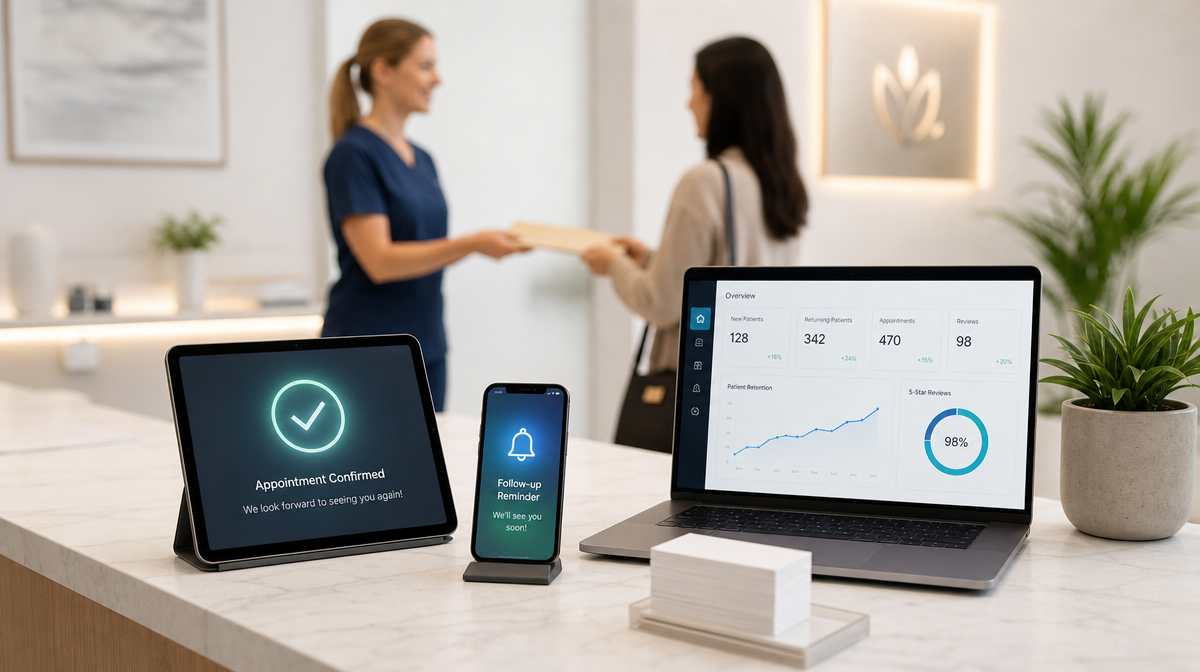
Think of your website as the hub where every other marketing channel — paid ads, local SEO, email campaigns — eventually deposits traffic. Solid medical website design ensures that hub converts visitors; if it has holes, no amount of upstream spend will fix your booking numbers.
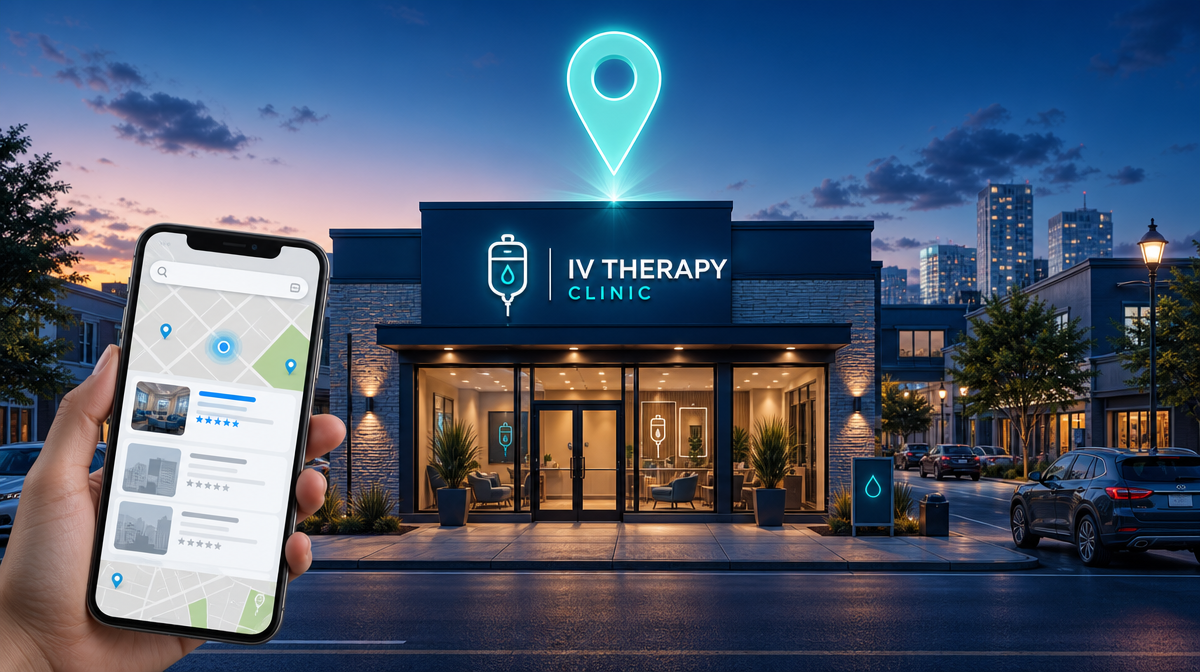
When a patient in your city types “IV hydration near me” into Google, three clinic listings appear before any website results do — that’s the map pack, and it’s where the majority of booking decisions happen. Claiming that real estate requires deliberate local SEO work, not just having a Google Business Profile that you set up once and forgot about.
Your Google Business Profile is the operational command center for local visibility. The categories you select, the services you list, the photos you upload, and the Google Posts you publish weekly all feed the algorithm that determines whether you appear in those top three spots or get buried below competitors. Incomplete profiles consistently rank below optimized ones — it’s that straightforward.
Beyond your GBP, local SEO for IV therapy clinics involves four additional levers:
- Citation consistency: Your clinic name, address, and phone number must appear identically across every online directory — Yelp, Healthgrades, WebMD, Vitals, and dozens of others. Mismatches erode the trust signals Google uses to rank local results.
- Geo-targeted keyword pages: Content optimized for phrases like “IV hydration [city]” or “vitamin infusion [neighborhood]” tells Google precisely which geographic market you serve.
- Review velocity: Clinics with a steady stream of new reviews outrank those with a large but stagnant review count. Recency matters as much as volume.
- Service-specific GBP entries: Adding individual treatments — NAD+ therapy, Myers’ Cocktail, athletic recovery drips — as distinct services expands the search queries your profile can match.
Local SEO is a compounding investment. The groundwork you lay today determines whether patients three months from now find you or your competitor first.
Paid advertising is the fastest way to put your clinic in front of patients who are actively ready to book — not browsing, not researching, but ready. While SEO builds momentum over months, a well-structured ad campaign can generate appointment requests within 48 hours of launch. For IV therapy clinics, three distinct paid channels each serve a different role in your acquisition funnel.
- Google Search Ads: These ads intercept patients mid-decision — someone who just typed “IV drip for fatigue” or “hangover IV therapy downtown” and is comparing options right now. The key is tight keyword-to-landing-page alignment: an ad for athletic recovery drips should send patients to a page about athletic recovery, not your homepage. Mismatched intent kills conversion rates regardless of click volume.
- Facebook and Instagram Ads: Social platforms excel at generating demand among patients who haven’t searched yet but match your ideal profile — wellness-conscious adults, fitness enthusiasts, professionals in high-stress industries. Visual creative carries the weight here. Short video clips of the treatment environment and real patient testimonials consistently outperform static imagery in IV therapy campaigns.
- Retargeting campaigns: When someone spends 90 seconds on your NAD+ service page and leaves without booking, that visit isn’t wasted — unless you have no retargeting pixel installed. Pixel-based ads serve those visitors dynamic content featuring the exact treatment they viewed, recapturing purchase intent before a competitor does.
Running all three channels in coordination — search capturing intent, social building awareness, retargeting closing the gap — produces compounding results that no single channel can replicate alone.
Paid ads and SEO bring patients to your door — but organic content is what convinces them to walk through it. For IV therapy clinics, a consistent content presence across blogs and social platforms does something no ad can replicate: it builds the kind of familiarity that turns a hesitant first-timer into a patient who already trusts you before they’ve met you.
The most effective content approach for IV hydration businesses treats education as a patient acquisition tool. When someone searches “is IV therapy safe?” or “what’s in a Myers’ Cocktail?” and your blog answers that question clearly and credibly, you’ve captured a prospect who wasn’t ready to book an ad — but was ready to learn. That educational credibility shortens the decision cycle significantly.
Here’s what a working organic content mix looks like for a clinic:
- Blog posts targeting patient questions: Cover treatment safety, what to expect during a first appointment, ingredient breakdowns, and condition-specific benefits. These pages also fuel your IV therapy SEO by matching the exact phrases patients type when researching.
- Behind-the-scenes social content: Photos and short videos of your team, your space, and the treatment process humanize your clinic and reduce the anxiety that keeps first-time patients from committing.
- Patient stories and testimonials: Shared with proper consent, real patient experiences on Instagram or Facebook carry social proof that no branded post can manufacture.
- Short-form video: A 30-second Reel showing a calm, professional drip experience answers more patient objections than a paragraph of copy ever will.
Organic social deserves its own playbook — the platform you prioritize should match where your target patient actually spends time:
- Instagram: Visual documentation of your treatment environment, staff credentials, and real patient transformations builds the ambient trust that converts browsers into first-timers. Behind-the-scenes content — your sterile prep process, a nurse explaining an ingredient — does more credibility work than any polished promo graphic.
- TikTok: Short clips that bust common IV therapy myths or walk through a typical appointment generate organic reach from people who didn’t know they were interested. Authenticity outperforms production value by a wide margin here.
- Facebook: Community-building and event promotion still drive engagement for local clinics, and reviews posted to your page factor into how seriously prospects take you.
Consistency matters more than volume. Two quality posts per week, published reliably, compound into a content library that works for your practice long after the publish date.
Online reviews are the closest thing to a referral that a stranger can give you — with 61% of patients prioritizing reviews over personal referrals — and in IV therapy, where patients are literally letting someone put a needle in their arm, that trust signal carries enormous weight. A clinic with 12 reviews and a 4.2-star average will lose the booking to a competitor showing 87 reviews and 4.8 stars, even if your service is objectively better. The math is that simple.
The problem most clinic owners run into isn’t that patients are unhappy — it’s that 57% of satisfied patients rarely or never leave a review unprompted. An automated request sent via text within two hours of an appointment ends dramatically outperforms a verbal reminder at checkout. Timing is everything: the patient is still feeling good, the experience is fresh, and the friction of leaving a review is at its lowest.
A complete reputation system for an IV therapy practice covers four distinct areas:
- Multi-platform presence: Google carries the most ranking weight, but Yelp, Facebook, and Healthgrades each capture patient research at different stages of the decision process.
- Automated post-visit requests: Triggered by appointment completion in your CRM, not by staff memory.
- Professional response protocol: Thank every positive review publicly — it signals engagement to future patients reading your profile. Address negative reviews calmly and privately when possible.
- On-site display: Embedding a live review widget on your website closes the loop, turning your reputation into a conversion tool rather than just a ranking signal.
Clinics that treat review generation as a passive afterthought consistently underperform on local search rankings compared to those running a structured, automated reputation program.
Acquiring a new patient costs significantly more than keeping one — and for IV therapy practices, that gap is especially wide because your best patients have recurring needs. The executive who books a Myers’ Cocktail after a tough travel week will be back next month if you remind them at the right moment. Without an automated communication system, that rebooking depends entirely on the patient remembering to reach out — which most won’t.
Email and SMS work differently inside a retention strategy, and smart clinics deploy both deliberately:
- Welcome sequences: A new patient’s first 72 hours post-appointment are when their experience is most vivid and their receptiveness is highest. An automated welcome series sets expectations for follow-up care, introduces your membership options, and establishes your clinic as a long-term wellness partner rather than a one-time transaction.
- Interval-based rebooking reminders: Different treatments have natural rebooking windows — NAD+ patients often return every 30 to 90 days, while athletic recovery patients may book weekly. Automating reminders around those intervals removes the dependency on patient initiative.
- Segmented promotional campaigns: A first-time patient and a six-visit member should never receive identical messaging. Segmentation lets you send a loyalty reward to regulars while sending an introductory offer to patients who haven’t returned in 60 days.
- Membership nurture tracks: Members who feel recognized and rewarded renew. Exclusive early access to new drip formulations or member-only pricing reinforces the value of staying enrolled.
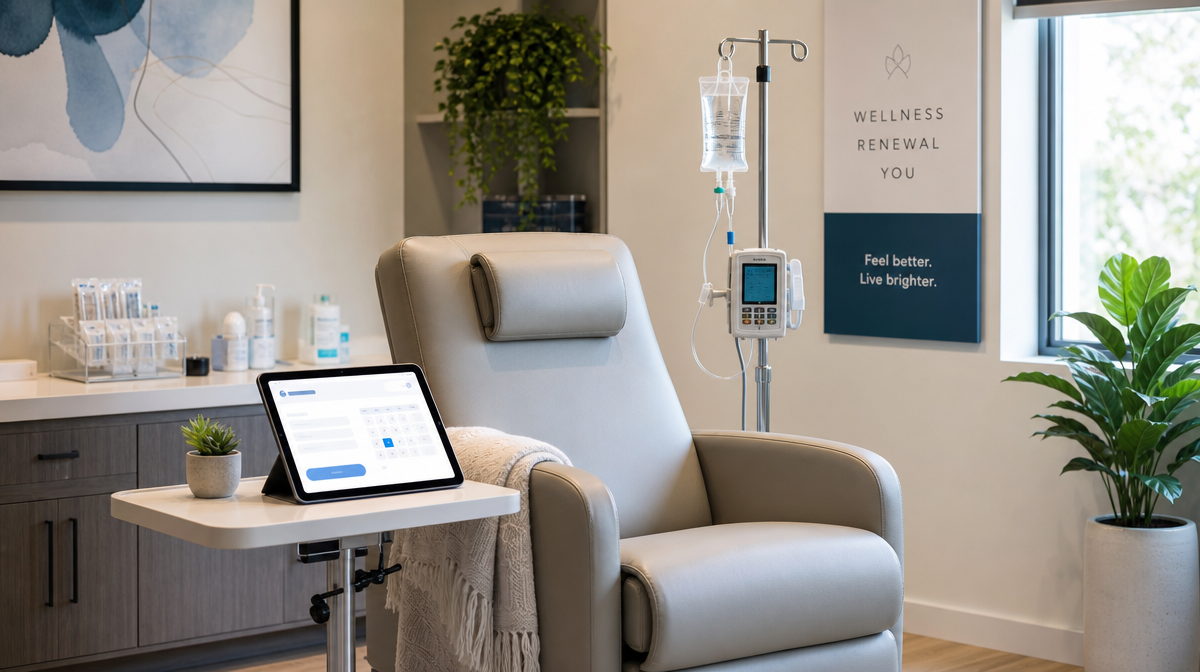
The clinics that grow fastest aren’t necessarily the ones spending most on IV therapy marketing — they’re the ones losing the fewest patients between visits. Whether you build that system in-house or hand it to an IV therapy marketing agency, the retention engine is what compounds your returns.
Most marketing tools react to what already happened — AI anticipates what’s about to happen. That shift from reactive to predictive is where IV therapy clinics are starting to find a genuine edge over competitors still running campaigns the old-fashioned way.
- AI-powered local SEO and GEO: Google’s AI Overviews now surface direct answers before patients ever click a website. Generative Engine Optimization (GEO) structures your clinic’s content so it gets cited by AI-generated results — not just ranked in traditional search. Clinics optimized for GEO appear in answer boxes that their competitors’ static pages will never reach.
- Predictive analytics for smarter ad spend: Instead of reviewing last month’s numbers and guessing where to reallocate budget, AI-powered predictive tools analyze behavioral patterns in real time — identifying which patient segments are most likely to book within a given window and shifting spend accordingly. The practical result is fewer wasted impressions and a lower cost per booked appointment.
- AI chatbots and automated booking: A prospective patient researching NAD+ therapy at 11 PM doesn’t want to wait until your front desk opens. AI-driven chat tools answer clinical questions, recommend appropriate treatments based on patient-reported symptoms, and complete the scheduling process — all without staff involvement. Practices using 24/7 automated engagement consistently capture inquiries that would otherwise go cold overnight.
Platforms like Target Patients MD’s A.L.I. 360 integrate these capabilities into a single system built specifically for medical practices, so you’re not stitching together disconnected tools while trying to run a clinic.
Running IV therapy marketing without tracking the right numbers is like administering a drip without checking the patient’s vitals — you’re operating blind. The KPIs below tell you whether your marketing dollars are producing a return or just producing activity.
- Cost per lead (CPL): Divide your total ad spend by the number of inquiries generated. This single number tells you how efficiently each channel is converting budget into potential patients — and flags immediately when a campaign starts underperforming.
- Cost per booking: A sharper version of CPL that accounts only for patients who actually scheduled. A low CPL paired with a high cost per booking usually signals a broken follow-up process, not a bad ad.
- Conversion rate: The percentage of website visitors who become leads. If you’re driving substantial traffic but conversions are below 3–5%, the problem lives on your website — not in your ad targeting.
- Show rate: Of every patient who booked, how many actually attended? A declining show rate points to confirmation and reminder gaps in your scheduling workflow.
- Patient lifetime value (LTV): Total revenue generated per patient across all visits and memberships. LTV determines how much you can responsibly spend to acquire each new patient while remaining profitable.
- Return on ad spend (ROAS): Revenue generated divided by ad spend. For IV therapy practices with high-ticket treatments and repeat visit potential, a ROAS target of 4:1 or higher is a reasonable benchmark to hold campaigns accountable to.
Track these metrics inside a unified dashboard rather than checking platforms separately — fragmented reporting produces fragmented decisions.
Budget conversations make most practice owners uncomfortable, but going in blind is more expensive than any agency retainer. The right investment level for IV therapy marketing depends on three variables: your market’s competitiveness, how quickly you need to fill your schedule, and whether you’re building from scratch or optimizing an existing patient base.
The DIY path looks cheaper on paper. In practice, it trades dollars for hours — hours spent learning ad platforms, managing citation directories, writing service pages, and chasing reviews while your actual clinical work sits waiting. Most owners who try it end up with inconsistent execution and no clear read on what’s actually working.
When choosing a medical marketing agency, the service model matters as much as the price:
- Monthly retainers bundle ongoing SEO, paid ad management, and reputation work into a predictable monthly fee — best for clinics that want a fully managed system without project-by-project oversight.
- Pay-per-lead models shift financial risk toward the agency, but scrutinize lead quality definitions carefully before signing anything.
- Project-based engagements work for discrete deliverables like a website build or a GBP audit, but rarely support the sustained execution that IV hydration business growth actually requires.

Regardless of pricing structure, four criteria should filter your agency shortlist: documented experience with healthcare or wellness clients specifically, transparent reporting tied to actual bookings rather than impressions, no long-term contracts that lock you in before results are proven, and a clear process for HIPAA-compliant campaign execution.
Target Patients MD was built specifically for clinics like yours — not general businesses, not e-commerce brands, but medical practices that need a predictable flow of qualified patients and a marketing system that understands healthcare compliance from the ground up.
The A.L.I. 360 platform sits at the center of everything, combining AI-driven local visibility, CRM-based lead tracking, and automated patient communication into one integrated system. Instead of logging into five separate tools to piece together a picture of your marketing performance, you see every lead, every booking, and every campaign result in a single dashboard built for practice operators — not marketing analysts.
For IV therapy clinics specifically, that integration matters because your patient journey rarely follows a straight line. Someone might find you through a Google search, browse your NAD+ page, disappear for two weeks, then book after receiving a retargeted ad. A.L.I. 360 tracks that entire sequence so you know exactly which touchpoints are producing revenue — and which ones you can stop paying for.
- Specialized in IV therapy and wellness clinic marketing — not a generalist agency learning your industry on your dime
- Month-to-month engagements — results earn continued investment, not a long-term contract
- CRM-connected lead tracking — every inquiry tied to its source, every booking measured against real spend
- Full-stack execution — SEO, paid ads, reputation management, and AI automation running as one coordinated system
Learn more about Target Patients MD and find out what a fully managed IV therapy marketing system looks like for your practice.
Is IV therapy a profitable business to market?
Yes — IV therapy carries strong per-treatment margins, and patients who book once for hangover recovery or immune support frequently return for higher-ticket services like NAD+ or athletic recovery packages. The revenue math becomes compelling once a membership model is layered in.
How long does IV therapy marketing take to show results?
Google Ads and Meta campaigns can generate appointment requests within the first week of launch. Organic search visibility through SEO typically builds over three to six months, but the compounding nature of that traffic makes it the more cost-efficient channel over a 12-month horizon.
Do mobile IV therapy providers need different marketing than brick-and-mortar clinics?
The channels overlap significantly, but the strategy shifts. Mobile providers prioritize service-area radius targeting and convenience-first messaging, while fixed clinics lean harder on map pack rankings and in-clinic trust signals like photos and provider credentials.
What advertising rules apply to IV therapy clinics?
FTC guidelines govern what health outcome claims you can make in ad copy — unsubstantiated language around curing or treating conditions creates compliance exposure. HIPAA rules apply any time patient data or testimonials are used in promotional materials. Running campaigns through a healthcare-specialized agency reduces that risk considerably.
What is the 3-3-3 rule in healthcare marketing?
The framework holds that a prospective patient gives you 3 seconds to capture attention, 3 minutes to hold interest, and needs roughly 3 meaningful touchpoints before committing to book. For IV therapy practices, that translates directly into punchy ad creative, a fast-loading service page, and a retargeting sequence that follows up after the initial visit.