


Most procedure marketing follows a simple formula: show results, highlight credentials, run some ads. Rhinoplasty doesn’t work that way. The patient journey is fundamentally different from nearly every other elective procedure, and treating it like a standard plastic surgery marketing play is exactly why so many practices end up with a full ad spend and an empty consult calendar.
A few things set rhinoplasty apart in ways that demand a genuinely different approach:
- Longer decision cycle: Rhinoplasty patients typically research for six to eighteen months before booking a consult. They’re comparison-shopping surgeons, saving photos, watching procedure videos, and reading forums long before they ever fill out a contact form. Your marketing has to stay relevant across that entire window — not just capture a single moment of intent.
- Highly visual procedure: Results live on the most visible part of a person’s face. That raises the trust threshold considerably. Patients aren’t just evaluating your skill — they’re deciding whether they trust you with something they’ll see every time they look in a mirror.
- Emotional investment: Many rhinoplasty candidates carry years of self-consciousness into their research process. Messaging that feels clinical or transactional will lose them. The emotional dimension requires nuance that generic plastic surgery copy rarely delivers.
- Competitive landscape: In most major markets, rhinoplasty — with over 210,000 procedures annually — is one of the most advertised procedures in cosmetic surgery. You’re not just competing for clicks — you’re competing for trust against dozens of surgeons running nearly identical campaigns.
Effective rhinoplasty marketing accounts for all four of these factors simultaneously, not as an afterthought.
Rhinoplasty marketing works best as a system — each channel reinforcing the others across a patient journey that can span well over a year. The ten strategies below are organized to reflect how rhinoplasty patients actually move from discovery to consultation, not just how most practices happen to spend their budgets.
- Rhinoplasty SEO and generative engine optimization: Ranking for terms like “rhinoplasty surgeon” and “nose job cost” still drives significant organic traffic, but AI search is changing who gets cited. Generative Engine Optimization (GEO) structures your content so that ChatGPT, Perplexity, and Google’s AI Overviews — which now trigger on 88% of healthcare queries — recommend your practice when patients ask questions out loud.
- Google Ads and PPC for high-intent rhinoplasty searches: Patients searching “best rhinoplasty surgeon near me” are ready to act. Capture them with tightly themed ad groups, negative keywords that filter out non-surgical seekers, and landing pages built to convert — not just inform.
- A conversion-focused rhinoplasty website: Board certifications, hospital affiliations, and media features need to appear above the fold, not buried in a bio. Mobile-first design and sub-three-second load times are non-negotiable when most searches happen on phones.
- Before and after galleries that convert: Consistent lighting, standardized angles, and categorization by nose type or ethnicity turn a gallery into a trust engine. Embed it directly on procedure pages rather than isolating it in a separate section patients rarely find.
- Instagram and TikTok content: Instagram rewards polished before/after carousels and Reels demonstrating surgical precision. TikTok rewards myth-busting and educational short-form content that answers the questions patients are already searching.
- Surgeon personal brand and thought leadership: Media appearances, peer-reviewed publications, and conference presentations position you as a rhinoplasty specialist — not a generalist who also does noses.
- Patient reviews and video testimonials: Request reviews at the right post-procedure moment and distribute them across Google, RealSelf, Healthgrades, and your own site. Video testimonials carry disproportionate weight for a procedure this visible.
- Targeted Meta Ads for ethnic and revision rhinoplasty: First-time patients and revision candidates require completely different messaging. Lookalike audiences built from past consult conversions let you reach new patients who mirror your best surgical outcomes.
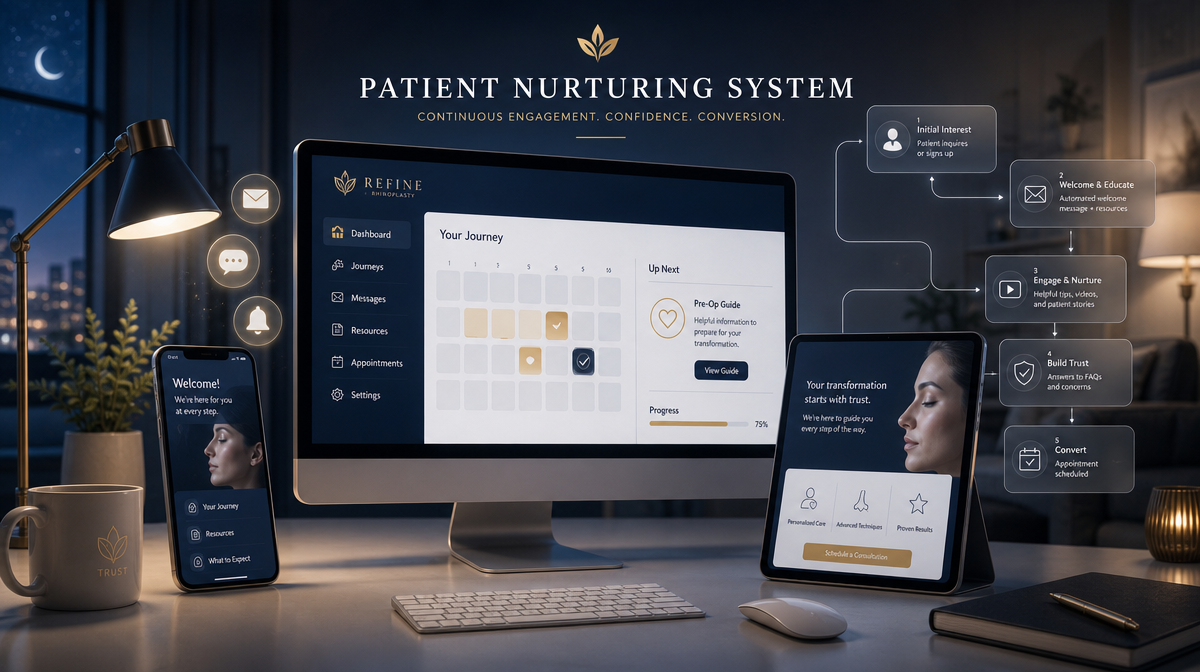
- Email and SMS nurture for the long decision cycle: Segmented drip campaigns keep your practice visible across months of research. SMS reminders reduce no-shows once a consult is booked.
- AI-powered patient acquisition: Platforms like A.L.I. 360 combine AI chatbots, machine learning ad optimization, and automated follow-up sequences to engage prospective rhinoplasty patients around the clock — including the 2 a.m. moments when they’re deep in their research.
Knowing which strategies to run is only half the battle — knowing whether they’re actually producing rhinoplasty patients is what separates a practice that scales from one that guesses. Most practices track vanity metrics like impressions and clicks when the numbers that actually matter are downstream.
| Metric | What It Measures | Why It Matters for Rhinoplasty |
|---|---|---|
| Cost per lead | Marketing spend divided by total inquiries | Indicates efficiency of top-of-funnel campaigns |
| Cost per consultation | Spend divided by booked consults | Shows lead quality, not just quantity |
| Consultation-to-surgery rate | Percentage of consults that convert | Reflects both marketing targeting and in-office experience |
| Patient acquisition cost | Total marketing spend per new surgical patient | The ultimate measure of marketing ROI |
On the budget side, there’s no universal number that fits every practice. A surgeon in a highly competitive metro building a rhinoplasty specialty from scratch needs a different allocation than an established practice defending market share. What does hold true across markets: paid search typically demands the largest share because cosmetic surgery CPCs reach $15–$50+ per click, with rhinoplasty among the highest, while SEO and content compound over time and lower your blended cost per acquisition.
Prioritize channels based on where your practice currently has gaps. If your consult volume is low, paid channels fill the pipeline faster. If your consultation-to-surgery rate is the problem, the issue likely isn’t your rhinoplasty marketing spend — it’s your in-office conversion process, and no ad budget will fix that.
The decision usually comes down to one honest question: does your practice have the bandwidth and specialized knowledge to execute rhinoplasty marketing at a competitive level, or are you filling that gap with good intentions and stretched staff?
There are genuine reasons to keep marketing in-house, and they’re worth acknowledging:
- Direct control: Approvals move faster, messaging stays tightly aligned with how the surgeon actually communicates, and there’s no translation layer between the practice’s voice and what goes out the door.
- Institutional knowledge: An internal team understands the nuances of your patient base, your surgeon’s preferences, and the practice culture in ways an outside team has to earn over months.
That said, the practical realities of rhinoplasty marketing — high CPCs, rapidly shifting AI search behavior, platform-specific compliance requirements — tend to expose the limits of generalist in-house execution quickly.
When evaluating an outside agency, ask specific questions before signing anything:

- What percentage of your current clients are rhinoplasty or facial plastic surgery practices?
- How do you measure cost per consultation, not just cost per lead?
- What does your onboarding timeline look like before campaigns go live?
- How do you handle HIPAA compliance across paid and email channels?
Red flags to avoid: agencies that lead with follower counts instead of consult volume, can’t explain their attribution model, or bundle rhinoplasty into a generic “plastic surgery package” without procedure-specific strategy. Rhinoplasty patients behave differently than the average cosmetic surgery prospect, and your agency should be able to demonstrate that they know the difference.
Target Patients MD was built specifically for practices where patient acquisition isn’t a side project — it’s the difference between a thriving surgical schedule and a half-empty consult calendar. The focus is plastic surgery and aesthetic medicine, which means the team already understands how rhinoplasty patients think, research, and decide before you ever have to explain it.
The engine behind the approach is A.L.I. 360, a proprietary AI patient acquisition platform that integrates the components rhinoplasty practices actually need under one roof:
- AI-driven SEO and GEO that positions your practice in both traditional search results and AI-generated recommendations
- Google Ads and paid social management optimized specifically for rhinoplasty conversion goals, not generic cosmetic surgery benchmarks
- Google Business Profile optimization to capture high-intent local searches at the moment patients are ready to act
- Conversion-focused website development built to turn rhinoplasty researchers into booked consultations

What separates this from a standard agency relationship is accountability. Target Patients MD operates on a results-based model built around patient growth and measurable campaign performance. That kind of accountability only makes sense when the team behind it has genuine confidence in the system — and genuine experience with the procedure-specific nuances that rhinoplasty marketing demands.
If your rhinoplasty consult volume isn’t where it should be, learn more about Target Patients MD and book a free consultation to see exactly what a procedure-specific strategy looks like for your practice.
Rhinoplasty marketing questions come up constantly from practice owners trying to make smarter decisions with limited time and budget. Here are direct answers to what surgeons ask most often.
- How much should a rhinoplasty practice spend on marketing?
Budget is driven by your specific growth targets, how saturated your local market is, and how many surgical cases you currently perform — most practices allocate a meaningful percentage of gross revenue to marketing, with that figure scaling up during active growth phases or when entering a new sub-specialty like revision rhinoplasty. - How long does rhinoplasty SEO take to show results?
Organic search typically takes several months to build meaningful traction, whereas paid search campaigns can generate consultation requests almost immediately after launch — making a blended approach the practical choice for most practices. - What is a typical cost per lead for rhinoplasty marketing?
Cost per lead varies considerably depending on your market size and the channels you use — practices in highly competitive metros routinely see higher costs than those in smaller or mid-size markets where auction pressure is lower. - How does marketing for revision rhinoplasty differ from primary rhinoplasty?
Revision candidates have typically had a negative experience elsewhere, making them more cautious, more research-intensive, and far less price-sensitive — messaging that leads with surgical expertise and specialization converts this audience far better than promotional offers. - Which social media platform works best for rhinoplasty surgeons?
Instagram remains the strongest platform for showcasing visual results, while TikTok is increasingly effective for educational content aimed at younger patients still early in their decision process.