


Plastic surgery digital marketing has evolved well beyond a basic website and a few Google ads. Today, it’s a layered, always-on system designed to meet prospective patients wherever they are — whether that’s scrolling Instagram at 11pm, comparing surgeons on Google, or reading a recovery guide before their first consultation.
The most effective strategies organize activity across three distinct channel types, each serving a different role in the patient acquisition funnel:
- Owned channels like your website and email list — These are assets your practice controls completely. No algorithm can take them away, and they compound in value over time. Your website anchors every other marketing effort; your email list lets you nurture prospective patients directly.
- Earned channels like SEO and patient reviews — Visibility you build through consistent optimization and a strong reputation. Organic search rankings and review volume signal credibility to both Google and prospective patients who are still deciding whether to book.
- Paid channels like Google Ads and social advertising — These generate immediate exposure for procedures and drive traffic while your organic presence continues to grow. They require ongoing budget but can be dialed up or down based on your capacity and seasonal demand.
What separates practices that grow from those that plateau is usually not the channels they use — it’s whether those channels are working together. A well-executed plastic surgery digital marketing strategy treats all three as interconnected, not as isolated line items in a budget.
Cosmetic surgery is almost entirely elective, which means the psychology driving patient decisions looks nothing like a typical healthcare purchase. Nobody wakes up needing a rhinoplasty the way they need an emergency appendectomy. That distinction shapes everything about how high-value patients find, evaluate, and ultimately choose a surgeon.
The research cycle for a procedure like a mommy makeover or facelift often stretches across weeks or months. Patients quietly gather information long before they ever contact a practice — watching YouTube procedure walkthroughs, saving Instagram posts, reading Reddit threads, and cross-referencing surgeon credentials across multiple platforms. By the time they fill out a contact form, many have already formed a strong opinion about who they trust.
Several behavioral patterns consistently separate cosmetic surgery patients from other healthcare consumers:
- They require visual proof before committing. Before-and-after galleries carry more persuasive weight than credentials or pricing for most prospective patients evaluating aesthetic results.
- They are highly price-aware but not necessarily price-driven. Because procedures are cash-pay, patients compare costs across multiple surgeons — but perceived quality and trust often outweigh the lowest quote.
- They vet reputation obsessively — 84% check online reviews before selecting a provider. Star ratings, review volume, and how surgeons respond publicly to feedback all factor into the decision in ways that rarely apply to insurance-covered care.
- They start their search on a smartphone. Initial discovery most commonly happens on mobile, which means a slow or hard-to-navigate site loses patients before they ever read a word about your expertise.
Understanding these patterns is what separates generic digital marketing from plastic surgery digital marketing that actually converts high-intent prospects into booked consultations.
Your website is doing more work than you probably realize — and in most cases, it’s quietly losing patients before they ever reach your phone number. For a plastic surgery practice, the site isn’t just a brochure; it’s the mechanism that either converts interest into consultations or lets that interest evaporate.
Three medical website design priorities consistently separate high-performing plastic surgery sites from the ones that look fine but underdeliver:
- Mobile-first layout with frictionless CTAs. If a visitor has to pinch, zoom, or hunt for a “Book a Consultation” button, you’ve already lost the conversion. Buttons should be thumb-accessible, forms should be short, and page load speed should be measured in seconds — not hope.
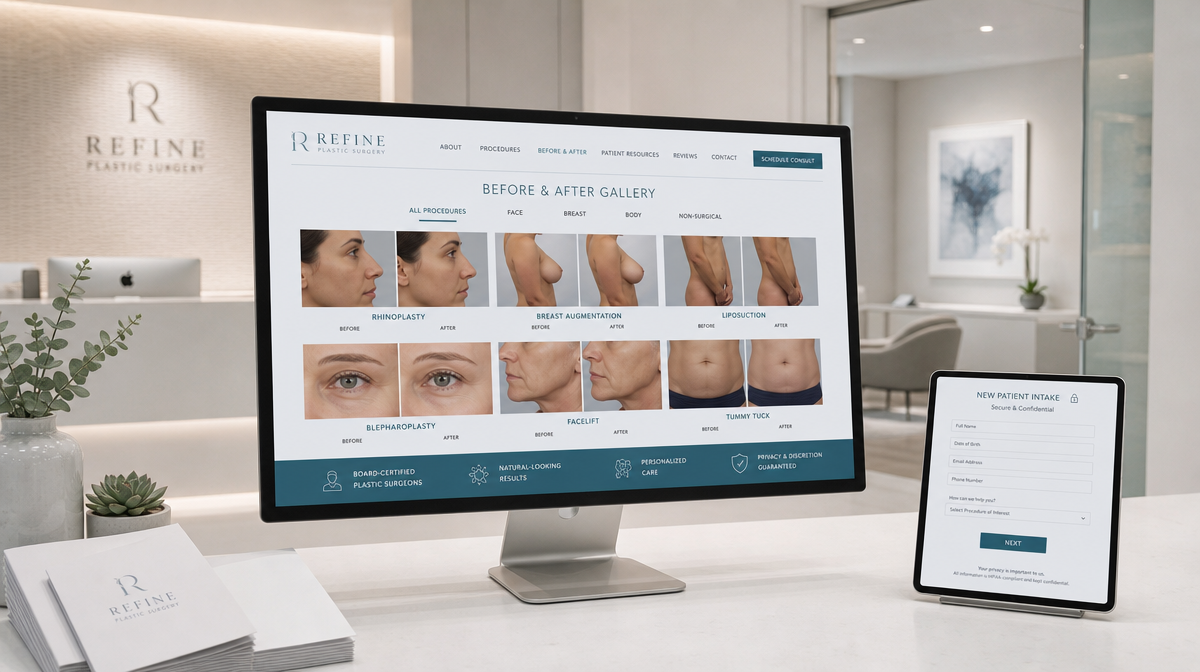
- Before-and-after galleries organized by procedure. A patient researching breast augmentation doesn’t want to scroll through rhinoplasty results to find relevant examples. Procedure-specific galleries with consistent photo quality and proper consent documentation do the trust-building work that no headline ever could.
- HIPAA-compliant intake forms and communication tools. Standard web forms are not built for healthcare data. Any form collecting patient information — consultation requests, health history, photo submissions — needs to run through encrypted, HIPAA-compliant infrastructure to protect both your patients and your practice from significant legal exposure.
One underappreciated element: surgeon biography pages. Patients in the evaluation phase are vetting the human behind the scalpel, not just the practice name. A biography that includes training background, philosophy, and authentic personality cues measurably increases the likelihood a visitor requests a consultation rather than bouncing to a competitor’s site.
SEO is the long-game channel that keeps producing patient inquiries without a cost-per-click attached to every visit. For plastic surgeons, it works across three distinct layers — technical infrastructure, procedure-specific content, and local search visibility — and neglecting any one of them creates a ceiling on how far the other two can take you.
Technical SEO is the foundation most practices overlook until rankings stall. Search engines need to efficiently crawl and index your site, which means proper schema markup, a logical URL hierarchy, and Core Web Vitals scores that don’t embarrass you. A site that loads beautifully on a desktop but scores poorly on Lighthouse isn’t competitive in markets where five other board-certified surgeons are actively investing in theirs.
Procedure-level content is where organic traffic actually gets captured. Dedicated pages for rhinoplasty, breast augmentation, body contouring, and other services — each built around the specific questions patients type into Google — pull in high-intent visitors at every stage of their decision process. Topics like recovery timelines, candidacy criteria, and realistic outcome expectations tend to rank well precisely because they answer what patients genuinely want to know.
Local search is the third layer, and for most practices it’s the highest-leverage one. Your Google Business Profile directly influences whether you appear in the map pack when someone searches “plastic surgeon near me.” Three factors drive that placement:
- Profile completeness — services listed, photos updated, Q&A populated
- Review velocity — a steady stream of recent ratings signals an active practice
- NAP consistency — your name, address, and phone number must match exactly across every directory where your practice is listed
When you need consultation bookings this month — not six months from now — paid advertising is the lever that moves fastest. PPC campaigns for plastic surgeons can go from setup to live inquiries within days, making them the right tool whenever you’re launching a new procedure, entering a competitive market, or simply need to fill the schedule.
Google Search campaigns are the workhorse of plastic surgery advertising because they intercept patients who are already actively looking. Someone typing “rhinoplasty surgeon in Dallas” or “tummy tuck consultation near me” has cleared the awareness stage entirely — they’re in buying mode. Bidding on those high-intent terms puts your practice in front of the most qualified traffic available in paid search.
Performance Max campaigns extend that reach by letting Google’s machine learning serve ads across Search, Display, YouTube, and Gmail simultaneously, optimizing toward the conversion signals you define. The tradeoff is less granular control, so it works best alongside — not instead of — a tightly managed Search campaign.
Meta and Instagram ads operate differently. Rather than capturing existing demand, they generate it by reaching users who match your ideal patient profile by age, location, and interest. Visual creative is everything here — scroll-stopping imagery of results, short procedure explainer videos, and surgeon-forward content consistently outperform text-heavy formats for cosmetic services.
- Retargeting campaigns re-engage visitors who browsed your site but didn’t convert, keeping your practice visible throughout a research cycle that can span weeks
- Dedicated landing pages matched to specific procedures dramatically improve conversion rates compared to sending paid traffic to a generic homepage
- Geographic bid adjustments let you concentrate spend in the zip codes most likely to produce cash-pay patients worth pursuing
Three execution decisions separate practices that see strong ROI from those that burn through budget:
- Procedure-specific landing pages: Sending paid traffic to your homepage is one of the most common and costly mistakes in cosmetic surgery advertising. Every ad group should connect to a dedicated page that mirrors the search term, presents relevant before-and-after results, and has a single clear path to booking a consultation.
- Bid on consultation and cost queries: Searches like “breast augmentation consultation” or “how much does a facelift cost” represent patients deep in the decision process — these are the clicks worth paying for.
- Retarget visitors who didn’t book: Elective surgery has a long consideration cycle. A patient who visits your liposuction page and leaves without converting is still a warm lead. Retargeting campaigns keep your practice visible during the weeks they continue comparing options.
Without this structure, even a generous ad budget produces leads that never become booked procedures.
Social media’s role in a plastic surgery practice goes deeper than posting before-and-afters and hoping the algorithm cooperates. It’s where prospective patients form their first real impression of who you are as a surgeon — your aesthetic sensibility, your communication style, and whether they’d feel comfortable sitting across from you in a consultation room.
Platform selection matters more than most practices acknowledge. A systematic review published in the Aesthetic Surgery Journal found that Instagram generates the highest engagement among patients under 35, while Facebook remains dominant for patients aged 36 and older. TikTok is carving out real territory for non-surgical treatments and procedure education among younger demographics, particularly for content that leans into humor and transparency rather than polished self-promotion.
The content mix that consistently builds trust and drives consultation requests tends to cluster around three pillars:

- Surgeon-forward storytelling — behind-the-scenes glimpses, philosophy-driven posts, and live Q&A sessions that let patients assess your personality and expertise before ever booking
- Educational Reels and short-form video — procedure overviews, recovery myth-busting, and candidacy explainers that answer the questions patients are already searching for
- Patient outcome content — properly consented result posts organized by procedure type, which research consistently identifies as the content most likely to be saved and shared
One finding worth acting on: only 15% of plastic surgeons post content daily, while over 70% of millennials engage with social platforms multiple times each day. That gap is a competitive opening hiding in plain sight.
In plastic surgery, your reputation isn’t just a marketing asset — it’s the primary decision variable for patients choosing between surgeons with comparable credentials and results. According to research cited by Yahoo! Finance, 45% of patients say they’re more likely to choose a provider who actively responds to reviews. That single behavior — responding — moves the needle more than most practices realize.
The mechanics of review generation matter as much as the ask itself. Automated follow-up sequences triggered after a positive appointment touchpoint — say, a post-op check-in or a satisfaction survey at the two-week mark — consistently outperform manual outreach because timing is everything. A patient who just had a smooth recovery experience is far more likely to leave a detailed, enthusiastic review than one contacted three months later.
Handling negative reviews requires a specific discipline in healthcare settings. You cannot confirm or deny that the reviewer is a patient, which rules out the kind of detailed, personalized responses other industries use. What you can control:
- Acknowledge the concern without confirming the relationship — “We take all feedback seriously and invite you to contact us directly”
- Keep the tone professional and empathetic — defensive responses often damage credibility more than the original review
- Respond consistently and promptly — response patterns signal to future patients how your practice handles problems
Video testimonials represent a distinct tier above written reviews. A 60-second patient story — properly consented and filmed with reasonable production quality — builds the kind of emotional connection that star ratings simply cannot replicate, especially for high-consideration procedures where fear and uncertainty are part of the patient’s experience.
Written reviews are easy to dismiss. A five-star rating with two sentences of generic praise doesn’t answer the question every prospective patient is actually asking: what was it really like? Video testimonials answer that question in a way no star rating ever can — because watching a real patient describe their experience, in their own words, with visible emotion, bypasses skepticism in a way that typed text simply cannot.
Social proof in plastic surgery marketing carries unusual weight because the stakes of the decision are so personal. A patient considering a facelift or body contouring procedure isn’t just evaluating clinical outcomes — they’re trying to imagine themselves trusting you with something irreversible. Video closes that trust gap faster than any other format.
- Filmed patient story testimonials: The most effective videos focus on the journey — the anxiety before surgery, the recovery experience, and the emotional outcome — not just the physical result. Capture these with documented consent, professional lighting, and a format that works natively on your website, YouTube channel, and social profiles simultaneously.
- Procedure walkthrough videos hosted by you: When you explain what happens during a rhinoplasty or breast augmentation in plain language, on camera, you reduce patient anxiety and demonstrate expertise before a single consultation is booked. These videos position you as the authority — not a stranger.
- YouTube as an active search channel: YouTube processes more than 3 billion searches per month. Patients searching “what does a tummy tuck recovery feel like” are finding answers there right now — and if your practice isn’t producing that content, a competitor is.
Email and SMS are the two channels where your practice controls the entire relationship — no platform algorithm deciding who sees your message, no pay-per-impression cost attached to reaching someone who already raised their hand.
The real power of email isn’t the broadcast — it’s the timing. Different patient segments need different messages depending on where they are in the decision cycle:
- Lead nurture sequences — prospective patients who downloaded a procedure guide or requested a brochure but haven’t booked yet benefit from a drip series covering candidacy criteria, what to expect during a consultation, and financing options
- Post-procedure follow-ups — recovery milestone check-ins serve double duty: they improve patient satisfaction scores and naturally create the conditions for a review request or a referral conversation
- Seasonal promotional campaigns — non-surgical treatments like injectables and skin resurfacing respond well to time-limited offers tied to predictable demand windows, such as pre-summer or pre-holiday periods
- Reactivation campaigns — patients who had a procedure two or three years ago are among the highest-converting segments for maintenance treatments and complementary procedures, yet most practices never systematically reach back out
- Consultation reminders and re-engagement sequences: Automated texts sent 24 and 48 hours before scheduled consultations measurably reduce no-show rates. Separately, a short drip sequence targeting leads who went cold — sent at 7, 21, and 45 days after initial inquiry — recovers a meaningful percentage of prospects who simply got busy and forgot to follow up.
- Post-operative care sequences: Structured follow-up messages after surgery — covering recovery milestones, answering common day-three questions, and checking in at the two-week mark — improve patient satisfaction scores and generate the kind of organic review activity that no incentive program can replicate.
- Repeat-patient promotions: Your existing surgical patients are warm prospects for non-surgical add-ons like injectables, laser treatments, and skincare. A quarterly SMS to your post-procedure list costs almost nothing and consistently outperforms cold acquisition campaigns on cost per booked appointment.
One compliance note that often gets skipped: any email platform handling patient communications needs to be HIPAA-compliant with a signed Business Associate Agreement in place. Standard platforms like Mailchimp are not configured for this by default, which creates real exposure if your list includes existing patients.
AI is no longer a future-state consideration for plastic surgery practices — it’s actively reshaping how patients discover surgeons, how campaigns optimize in real time, and how practices stay visible as search behavior shifts away from traditional blue-link results.
The most immediate change is happening at the top of Google. AI Overviews now generate synthesized answers to queries like “best rhinoplasty surgeon in [city]” or “what is recovery like after a facelift” — pulling from sources Google’s systems determine to be authoritative and well-structured. Practices that format their procedure content with clear headers, direct answers to common questions, and schema markup are far more likely to be cited in those summaries than sites built purely around keyword density.
Beyond search visibility, AI is changing how marketing budgets get allocated. Machine learning models can now analyze conversion patterns across campaigns and automatically shift spend toward the audience segments and ad formats producing the lowest cost per booked consultation — a level of optimization that would require a full-time analyst to replicate manually.
Google’s AI Overviews now appear above traditional organic results for a significant share of cosmetic procedure queries — and they pull their answers from a specific type of content. Generative Engine Optimization (GEO) is the practice of structuring your website so that AI systems select your practice as a cited source when patients ask questions like “what’s the best procedure for loose skin after weight loss” or “how do I choose a board-certified plastic surgeon.”
This is genuinely new territory in plastic surgery digital marketing, and most practices haven’t touched it yet — which means the competitive window is open right now.
- Format content for AI extraction: AI Overviews favor pages with clear, direct answers in the opening sentence of each section, descriptive H3 headings, and FAQ schema markup. If your procedure pages bury the key answer in paragraph four, AI systems will cite a competitor who leads with it.
- Reinforce the authority signals AI models trust: Board certification credentials, medical citations, consistent NAP data across directories, and surgeon-attributed content all function as trust signals that AI ranking systems weight heavily — the same way a peer-reviewed source gets cited over a forum post.
- Deploy an AI chatbot for after-hours inquiries: A prospective rhinoplasty patient researching at 11 PM won’t wait until morning. AI chat tools integrated into your website can answer procedure questions, qualify leads by procedure interest and timeline, and capture contact information for next-day follow-up — turning passive traffic into actionable leads while your office is closed.
Practices that optimize for AI visibility now will hold a compounding advantage — cited brands earn 35% more clicks — as AI-generated answers continue displacing traditional search results across high-intent cosmetic procedure queries.
For practices already running solid fundamentals across plastic surgery digital marketing channels, AI functions as an amplifier — compounding results that would otherwise plateau.
HIPAA compliance in plastic surgery advertising isn’t a checkbox — it’s an ongoing operational discipline with real financial consequences for getting it wrong. The FTC and HHS have both increased scrutiny of healthcare marketing practices, and plastic surgery sits in a particularly exposed position because so much of its marketing relies on exactly the types of content that carry compliance risk.
Four areas demand specific attention when building a compliant plastic surgery digital marketing program:
- Before-and-after photo authorization — Written patient authorization must be obtained before any result images are used in advertising, social media, or website content. The authorization needs to specify exactly how and where the images will be used, and it must be documented and retained.
- Testimonial consent documentation — Written permission is required before publishing any patient story, quote, or video testimonial. The FTC also requires disclosure when a patient has received compensation or free services in exchange for a review.
- Retargeting pixel configuration — Meta’s Pixel and Google’s tracking tags can inadvertently capture protected health information when placed on procedure pages or consultation forms. This creates a data-sharing arrangement with a third party that may not have a Business Associate Agreement in place — a risk that has already cost healthcare providers over $100 million in pixel-related fines and settlements since 2023.
- Third-party ad platform agreements — Not all advertising platforms will sign a Business Associate Agreement, which limits how patient data can flow through those systems. Knowing which platforms will and won’t sign is essential before building campaigns that touch any patient information.
When in doubt, legal review of your advertising infrastructure is significantly cheaper than an OCR investigation.
Most plastic surgery practices track the wrong numbers. Impressions, follower counts, and website sessions look impressive in a monthly report but tell you almost nothing about whether your marketing spend is producing revenue. The metrics that actually matter connect directly to patient acquisition and procedure profitability.
Start with the numbers closest to money:
- Cost per lead (CPL) — divide total marketing spend by the number of qualified inquiries generated in the same period. This baseline metric lets you compare channel efficiency side by side and catch underperforming campaigns before they drain budget for months.
- Cost per booked consultation — a more meaningful denominator than raw leads, because a high lead volume means little if your front desk isn’t converting inquiries into scheduled appointments. This metric exposes whether a marketing problem or a sales process problem is limiting growth.
- Lead-to-patient conversion rate — the percentage of inquiries that ultimately undergo a procedure. Tracking this by channel reveals which sources bring genuinely qualified patients versus browsers who never intended to book.
- Revenue per procedure type — not all procedures carry equal margin, and not all channels drive the same mix. Attributing revenue to specific campaigns shows you which investments produce the highest-value patients, not just the most patients.
- Patient lifetime value — particularly relevant for practices offering injectables, skin treatments, and maintenance procedures alongside surgical services. A patient who returns three times annually is worth dramatically more than their first procedure suggests.
Connecting these figures requires clean attribution from first touch to closed revenue — which means your CRM, booking system, and ad platforms need to communicate with each other consistently.
Not every agency that claims to serve plastic surgeons actually understands the business. The difference between a partner who accelerates your growth and one who burns through your budget while producing vanity metrics often comes down to a few specific evaluation criteria worth applying before signing anything.
- Healthcare-specific expertise — A generalist digital agency can run ads and build websites. What they typically cannot do is navigate the intersection of medical advertising regulations, cosmetic patient psychology, and HIPAA-compliant campaign infrastructure simultaneously. Ask directly whether the team has worked exclusively or predominantly in healthcare.
- Reporting tied to patient acquisition — Monthly reports should show consultation volume, cost per acquisition, and procedure-level attribution — not just traffic trends and click-through rates. If a prospective partner leads with impressions and engagement as primary success metrics, that’s a signal worth taking seriously.
- Integrated execution under one roof — Coordinating separate vendors for SEO, paid ads, web design, and reputation management creates gaps where accountability disappears. A single team running all channels can optimize across them rather than defending individual silos.
- Outcome-based accountability — The strongest partnerships hold themselves accountable to actual patient results, not effort or activity. Target Patients MD, for example, backs its A.L.I. 360 plastic surgery digital marketing system with a results guarantee built around patient growth and measurable campaign performance. Learn more at targetpatientsmd.com.
Credentials and case studies matter, but the right question to ask any prospective partner is simple: can you show me the actual patient numbers, not just the rankings?
- How much does digital marketing cost for a plastic surgery practice? Monthly investment varies considerably depending on market size, procedure mix, and how aggressively you want to grow. Practices in competitive metro markets typically allocate budget across website maintenance, SEO, paid search, social advertising, and reputation management combined — with total spend ranging from a few thousand dollars monthly for foundational programs to significantly more for full-funnel, high-volume campaigns.
- How long does plastic surgery SEO take to show results? Meaningful ranking movement generally requires several months of consistent effort before it translates into measurable organic inquiry volume. Paid advertising fills that gap immediately while SEO builds momentum in the background.
- Should a plastic surgeon hire an agency or build an in-house team? Most practices find that an agency partnership delivers faster results at lower total cost than hiring, training, and managing specialists across SEO, paid media, web development, and compliance in-house — particularly because healthcare marketing requires a level of regulatory familiarity that generalist hires rarely bring on day one.
- Which channel works best for high-ticket procedures like rhinoplasty? Google Search captures patients who are already procedure-aware and actively comparing surgeons. Social platforms build familiarity and desire earlier in the decision journey, making both channels complementary rather than competing for the same role.
- Is Facebook advertising HIPAA compliant for plastic surgeons? It can be, provided campaigns avoid using protected health information for targeting or audience building. Pixel tracking on sensitive procedure pages creates compliance gray areas that require careful technical configuration and legal review before launching.
Plastic surgery digital marketing draws from a broader ecosystem than most practice owners initially expect. It isn’t a single tool or platform — it’s the coordinated use of digital channels to attract prospective patients, build credibility, and convert interest into scheduled consultations across every stage of the decision process.
At its core, a complete program addresses five functional areas:
- Website infrastructure — the technical and visual foundation that every other channel drives traffic toward, built to load quickly, display results compellingly, and capture inquiries securely
- Search engine optimization — the ongoing process of earning organic visibility for procedure-specific and location-based queries that high-intent patients are actively typing into Google
- Paid advertising — structured campaigns on Google and social platforms that generate predictable inquiry volume tied directly to budget and targeting parameters
- Reputation and review management — the systems that build, monitor, and protect the star ratings and patient feedback that prospective patients consult before shortlisting any surgeon
- Content and social presence — the ongoing publishing of educational and visual material that positions your practice as the credible, trustworthy choice before a patient ever contacts you
What distinguishes effective plastic surgery digital marketing from a scattered collection of tactics is integration. Each component feeds the others — SEO content supports paid landing pages, reviews reinforce ad credibility, and social content drives return visits that eventually convert. Practices that treat these as separate line items rather than a connected system consistently leave patient volume on the table.
Knowing whether your plastic surgery digital marketing is working requires more than checking whether the phone is ringing. Without structured measurement, you cannot distinguish between a channel that’s genuinely driving booked procedures and one that’s generating noise that never converts.
Several tools provide reliable visibility into performance across different parts of the funnel:
- Google Search Console — shows which procedure-specific queries are generating impressions and clicks, revealing gaps between what patients search for and what your site currently ranks for
- Call tracking software — assigns unique phone numbers to individual campaigns so you can tie inbound calls directly to the ad, page, or channel that generated them
- Heatmapping tools — record how visitors interact with key pages like consultation request forms and before-and-after galleries, exposing friction points that analytics alone won’t surface
- CRM attribution reporting — connects the lead source captured at inquiry to the procedure eventually performed, closing the loop between marketing spend and actual revenue
One discipline that separates high-performing practices from the rest is reviewing data on a defined cadence rather than reactively. Monthly performance reviews that examine consultation volume by channel, form abandonment rates, and keyword movement create a feedback loop that compounds over time — each cycle producing sharper targeting and tighter budget allocation.
The goal isn’t more dashboards. It’s building a clear line of sight from every marketing dollar spent to the patient outcomes that justify spending it.
The compliance landscape for plastic surgery advertising is more fractured than a single federal standard suggests. While HIPAA governs practices that qualify as covered entities, a plastic surgeon’s marketing obligations don’t stop there — and many practitioners don’t realize they’re operating under multiple overlapping frameworks simultaneously.
The American Society of Plastic Surgeons publishes its own ethics and advertising guidelines that apply regardless of HIPAA status. These align closely with the Federal Trade Commission’s rules prohibiting unfair or deceptive practices — which means a cosmetic surgeon who isn’t technically a HIPAA covered entity can still face regulatory action for misleading claims about outcomes, qualifications, or pricing.
State licensing laws add another layer that varies significantly by jurisdiction. Several states have enacted truth-in-advertising requirements specifically targeting cosmetic procedure marketing, including rules about how board certifications must be disclosed and what terminology surgeons are permitted to use in promotional materials. A plastic surgery digital marketing campaign that’s fully compliant in one state may create liability in another.
- Specialty certification claims — advertising as a “board-certified plastic surgeon” carries specific requirements that differ from general board certification language
- Influencer and commission-based partnerships — subcontracting social promotion to influencers introduces FTC disclosure obligations that the practice itself is responsible for enforcing
- Opt-in requirements — several states impose affirmative consent standards for marketing communications that are stricter than federal defaults
Working with a marketing partner who understands this multi-jurisdictional exposure — not just HIPAA in isolation — is what keeps a practice protected as it scales its digital presence.
Think of your plastic surgery website as a 24-hour sales consultant who never calls in sick. Every structural and visual decision either moves a prospective patient closer to booking or quietly nudges them toward a competitor’s site instead.
Speed is the first filter. Google’s own data shows that conversion probability drops sharply as mobile page load time increases beyond three seconds — and cosmetic surgery patients, who are often browsing during lunch breaks or late evenings on their phones, will not wait. Compressing images, eliminating render-blocking scripts, and choosing hosting infrastructure built for healthcare sites rather than generic WordPress installs all contribute to the load times that keep visitors engaged.
Beyond speed, the structural hierarchy of your site determines whether patients find what they need or abandon in frustration. A few design decisions that consistently separate high-converting plastic surgery websites from underperforming ones:
- Procedure-specific landing pages — each targeting a distinct service with its own unique content, imagery, and conversion path rather than cramming multiple procedures onto a single generic services page
- Surgeon credentialing displayed prominently — board certification, fellowship training, and professional affiliations positioned where patients encounter them early, not buried in an about section
- Trust signals near every call-to-action — aggregate review scores, accreditation badges, and patient outcome statistics placed adjacent to consultation request buttons, not separated by several scrolls
- Accessible contact options — phone, form, and chat available simultaneously, because different patients prefer different communication channels at different stages of their research
The website is also where every other component of your plastic surgery digital marketing investment lands — paid clicks, organic search traffic, social referrals. A weak destination undermines strong channel performance across the board.
Search engines treat plastic surgery websites as YMYL content — “your money or your life” — which means Google applies significantly stricter quality standards to these pages than it does to a recipe blog or a sports news site. That classification has direct implications for how you structure your SEO program and what it takes to actually move rankings in competitive cosmetic surgery markets.
Keyword research for plastic surgery SEO requires more surgical precision than most practices apply. Generic terms like “plastic surgeon” carry enormous competition and rarely convert as efficiently as longer, intent-specific phrases that reflect where a patient is in their decision process. Queries containing modifiers like “cost,” “recovery,” “before and after,” and “consultation” indicate someone actively comparing options — and those are the visitors worth capturing.
Three technical priorities consistently determine whether a plastic surgery site ranks or stalls:
- Structured data markup — physician schema, FAQ schema, and review schema help search engines surface richer results that occupy more real estate on the page and signal authority to prospective patients
- Internal linking architecture — connecting procedure pages to related recovery guides, FAQ content, and financing information creates topical depth that search algorithms reward with stronger domain authority
- Duplicate content elimination — practices with multiple procedure pages that share boilerplate descriptions inadvertently compete against themselves in search results, diluting ranking potential across the entire site
One often-overlooked SEO asset is the surgeon’s professional biography page. Search engines index these as authority signals, and a well-structured bio that includes training credentials, published work, and specialty focus areas can independently rank for queries that procedure pages alone won’t capture.
In plastic surgery, reputation management extends well beyond star ratings — it’s the active infrastructure that determines whether your practice appears trustworthy to a stranger who has never met you and is considering handing you significant money and physical trust simultaneously.
Most practices treat review generation as a passive activity, waiting for satisfied patients to volunteer feedback. The practices that consistently outrank competitors on Google Maps and RealSelf take a more deliberate approach:
- Platform diversification — Google carries the most weight for local search visibility, but Healthgrades, RealSelf, and Yelp each attract distinct patient segments. A concentrated review presence on a single platform creates fragility; spreading volume across multiple directories builds resilience.
- Review recency signals — A practice with 200 reviews but nothing posted in eight months looks stagnant to both patients and search algorithms. Consistent new review volume matters more than total count in most local ranking calculations.
- Internal escalation before public complaint — Practices with a clear post-appointment feedback mechanism — a simple satisfaction survey sent within 48 hours — catch dissatisfied patients before frustration turns into a public one-star post. Giving patients a private channel to raise concerns dramatically reduces the rate of negative public reviews.
The competitive edge in reputation management often belongs to practices that treat it as a clinical operations issue, not a marketing afterthought. When your front desk team understands that a satisfied patient who never leaves a review is a missed opportunity, the entire patient experience starts working in service of your digital presence.
Advertising management for a plastic surgery practice is less about running ads and more about building a system that qualifies demand before it ever reaches your front desk. The distinction matters because unqualified traffic — people clicking out of curiosity rather than intent — burns budget and consumes staff time without producing revenue.
Effective plastic surgery advertising management operates across several coordinated functions that most practices either handle piecemeal or skip entirely:
- Campaign architecture by procedure profitability — allocating heavier spend toward high-margin services like facelifts and body contouring rather than spreading budget evenly across every procedure you offer
- Lead scoring and routing — automatically categorizing inbound inquiries by procedure interest, geography, and engagement depth so your team prioritizes the consultations most likely to convert
- Ad scheduling aligned with consultation capacity — pausing or reducing spend during periods when your schedule is already full prevents the operational strain of inquiries you cannot service promptly
- Negative keyword management — filtering out searches for insurance-covered reconstructive procedures, medical tourism, and unrelated queries that drain plastic surgery digital marketing budgets without producing cash-pay patients
- Competitive conquest targeting — bidding on branded terms adjacent to competing practices in your market to capture patients who are still in active comparison mode
The practices that extract the most value from advertising aren’t necessarily spending more — they’ve built tighter feedback loops between campaign data and operational decisions, which compounds efficiency over time.
Running a plastic surgery practice leaves little room for learning marketing from scratch. Between surgical schedules, patient consultations, and staff management, most surgeons simply don’t have the bandwidth to stay current with algorithm changes, ad platform policy updates, and compliance shifts happening simultaneously across multiple channels.
That’s where structured marketing support changes the growth trajectory for a practice. The difference between practices that scale predictably and those that stay stuck often comes down to whether someone is actively managing the system — not just setting it up once and walking away.
Comprehensive plastic surgery digital marketing support typically covers several operational functions that fall through the cracks when ownership is unclear:
- Ongoing content production — procedure pages, blog posts, and educational resources require regular updates to maintain search relevance and satisfy Google’s quality standards for medical content
- Platform monitoring and optimization — ad performance, keyword bid adjustments, and audience refinements need active attention on a weekly cadence, not quarterly check-ins
- Directory and citation maintenance — business listings across health-specific directories drift out of sync over time, quietly undermining local search performance
- Compliance auditing — consent documentation, pixel configurations, and platform agreements require periodic review as regulations and platform policies evolve
Practices that treat marketing support as a one-time project rather than an ongoing operational function consistently find themselves rebuilding from a weaker position every twelve to eighteen months — reacting to ranking drops or lead volume declines rather than preventing them.
Plastic surgery sits in a category Google treats with particular scrutiny. Because cosmetic procedures involve significant financial and physical commitment, search engines apply elevated quality filters to determine which practices deserve prominent placement — and those filters reward depth, accuracy, and demonstrated expertise over simple keyword repetition.
The practical consequence is that SEO functions as a trust-transfer mechanism before a patient ever contacts your office. Ranking on page one for a procedure query like “mommy makeover surgeon in [city]” signals to prospective patients that an authoritative third party — Google itself — has vetted your practice as a credible resource. That implied endorsement carries weight that paid placements simply don’t.
Several specific advantages make SEO a non-negotiable component of plastic surgery digital marketing for practices pursuing sustainable growth:
- Compounding return on investment — unlike paid clicks that stop the moment your budget pauses, organic rankings continue generating inquiries month after month without incremental cost per visit
- Procedure-intent alignment — patients searching for specific procedures by name are further along in their decision process than social media audiences, producing higher consultation-to-inquiry ratios
- Competitive differentiation in saturated markets — in major metro areas where multiple board-certified surgeons compete for the same patients, search visibility often determines who gets the consultation request and who gets skipped entirely
- Authority signals that support every other channel — a well-ranked, content-rich site strengthens ad quality scores, improves social credibility, and gives patients something substantive to evaluate during their research phase
A complete plastic surgery SEO program is more than publishing blog posts and hoping Google notices. The components that actually move rankings — and keep them there — break down into four functional areas that work together rather than independently.
- Site architecture and crawlability — clean URL structures, properly formatted title tags, descriptive image alt text, and logical heading hierarchies make it straightforward for search engines to categorize every page and surface it for relevant queries
- Intent-matched content — knowing what search terms prospective patients use at each stage of their research, then building pages that directly address those queries, is what separates sites that attract qualified visitors from those that rank for terms nobody actually searches
- Competitive monitoring — SEO isn’t a one-time configuration; it’s an ongoing process of analyzing who ranks above you, why they rank there, and what adjustments close the gap
- E-E-A-T compliance — Google’s quality framework for medical content demands demonstrated experience, expertise, authoritativeness, and trustworthiness, which means citing credible sources, keeping procedure information clinically accurate, and making surgeon credentials easy to verify
Local SEO deserves its own attention within this framework. Optimizing for location-specific queries — including accurate business data across health directories and a fully built-out Google Business Profile — determines whether your practice surfaces for nearby patients who are actively ready to book rather than just browsing.
Technical SEO is the layer of plastic surgery digital marketing that patients never see — and that’s exactly why it matters so much. Search engines crawl your site before any human does, and the signals they pick up during that process determine whether your practice earns a ranking position or gets buried beneath competitors who simply built their infrastructure better.
For plastic surgery specifically, technical issues compound faster than in most industries. High-resolution before-and-after images, video embeds, and visually rich procedure pages create significant performance overhead that poorly configured sites never recover from. A technically sound build addresses these pressures proactively rather than patching problems after rankings have already dropped.
Several technical factors carry disproportionate weight in competitive cosmetic surgery markets:

- Core Web Vitals scores — Google measures how quickly your largest content element loads, how stable your layout is during rendering, and how fast the page responds to the first user interaction; with only 42% of mobile sites passing all three thresholds, cosmetic sites with heavy image galleries frequently fail these benchmarks without dedicated optimization
- HTTPS security and crawl hygiene — broken internal links, redirect chains, and orphaned pages waste crawl budget that should be spent indexing your highest-value procedure content
- Canonicalization — practices offering similar procedures across multiple locations often generate duplicate content signals that suppress rankings until canonical tags resolve the conflict
- XML sitemap accuracy — an outdated sitemap pointing to deprecated pages actively misleads search engine crawlers, slowing the indexation of new content you’ve invested in creating
Technical SEO isn’t glamorous, but it’s the prerequisite that determines how much return you extract from every other investment in your marketing program.
Google classifies plastic surgery websites as YMYL content — “your money or your life” — which means thin, generic procedure descriptions won’t survive in competitive search environments. The bar for quality is set by medical journal standards, not lifestyle blog standards, and content that falls short simply doesn’t rank.
What actually earns organic placement is substance: thorough, original pages that address the full scope of what a patient wants to understand before making a high-stakes decision. That means going beyond a procedure overview to cover candidacy criteria, what distinguishes different surgical approaches, realistic outcome expectations, and the questions patients are genuinely typing into search engines.
Several content characteristics consistently drive stronger rankings for plastic surgery practices:
- Procedural depth over breadth — a single comprehensive rhinoplasty page covering anatomy, technique variations, and healing milestones outperforms five shallow pages every time
- Cited sources and clinical accuracy — referencing peer-reviewed literature and professional society guidelines satisfies Google’s E-E-A-T requirements for medical content specifically
- Original research and data — proprietary statistics, surgeon commentary, and practice-specific insights cannot be replicated by competitors and signal genuine expertise to crawlers
- Keyword distribution that mirrors natural language — stuffing search terms into awkward sentence constructions triggers quality filters; content written for humans first tends to distribute relevant phrases organically
Content also creates compounding value across a broader plastic surgery digital marketing program — well-ranked pages improve ad quality scores, give social media something substantive to link back to, and give prospective patients the informational depth they need to trust your practice before ever requesting a consultation.
Local visibility for a plastic surgery practice depends on more than having a website that mentions your city name. Search engines triangulate your location relevance using signals scattered across dozens of data sources — and inconsistencies between those sources quietly suppress your rankings without ever sending you a warning.
The most actionable steps for improving local discoverability involve several interconnected elements:
- Claim and fully complete your Google Business Profile — add every procedure category your practice offers, upload recent photos of your facility and team, enable the booking feature if available, and populate the Q&A section with answers to common patient questions before strangers post inaccurate ones
- Audit your listings across health-specific directories — Healthgrades, Zocdoc, Vitals, and WebMD each feed location data into search algorithms; a phone number that differs by a single digit across these platforms signals unreliability to crawlers
- Build location-specific content on your site — pages that reference your city, nearby neighborhoods, and regional landmarks in a natural context help search engines confirm geographic relevance beyond just your registered address
- Earn local backlinks from credible regional sources — mentions from local hospital affiliations, medical associations, and community organizations carry stronger geographic authority signals than generic directory submissions
One often-missed lever: embedding a Google Map on your contact page and using LocalBusiness schema markup in your site code gives search engines a structured, machine-readable confirmation of your practice location — a small technical detail that meaningfully supports local pack placement in competitive markets.
Running a plastic surgery practice is already a full-time job — actually, it’s more than that. You’re managing surgical schedules, consultations, staff, credentialing, and patient outcomes simultaneously. Adding a sophisticated multi-channel digital marketing program to that list without dedicated expertise behind it is how practices end up with a half-maintained website, an abandoned social profile, and ad campaigns nobody has reviewed in four months.
The practices that grow fastest aren’t necessarily the ones with the biggest budgets. They’re the ones where someone is actively accountable for the marketing system as a whole — not just individual pieces of it. When plastic surgery digital marketing is managed as a connected program rather than a collection of tasks assigned to whoever has a spare hour, the compounding effect on patient volume becomes measurable within a single quarter.
Several operational realities determine whether a practice’s marketing actually scales:
- Specialization beats generalism — cosmetic patient psychology, medical advertising restrictions, and visual-first content strategy require domain knowledge that takes years to develop, not a general marketing background
- Consistency outperforms intensity — practices that publish regularly, respond to reviews promptly, and optimize campaigns on a weekly cadence outperform those that sprint and stall
- Accountability structures matter — clear ownership of every marketing function, with defined performance benchmarks, prevents the slow drift that turns a working program into a neglected one
The goal isn’t to add more work to your plate. It’s to build a system that runs reliably whether you’re in the OR or on vacation.
Plastic surgery marketing occupies a unique corner of healthcare promotion because the purchase decision is driven by desire rather than necessity. That distinction means the strategies that work for urgent care clinics or primary care practices — high-frequency, broad-reach messaging — produce weak results when applied to elective cosmetic procedures.
What actually moves the needle for cosmetic practices is a discipline built around trust accumulation over time. Prospective patients aren’t responding to a single ad or a single review; they’re building a composite picture of your practice across multiple touchpoints before they ever reach out. Every channel in your marketing mix either adds to that picture or creates noise that undermines it.
The practices seeing the strongest patient volume growth share a few structural commitments:
- Procedure-specific targeting — treating rhinoplasty, body contouring, and facial rejuvenation as distinct marketing campaigns with separate messaging, audiences, and conversion paths rather than bundling them under a generic cosmetic surgery umbrella
- Cash-pay patient qualification built into the funnel — filtering for patients who understand the investment involved before they consume front-desk time, through pricing transparency and educational content that sets realistic expectations upfront
- Visual-first creative across every channel — cosmetic surgery is a visual category, and practices that invest in professional photography and video production at the asset level outperform those relying on stock imagery regardless of how well their campaigns are structured
Cosmetic surgery marketing rewards specificity. Generic positioning in a competitive market produces generic results.
The real argument for integration isn’t philosophical — it’s mathematical. Each channel in a plastic surgery digital marketing program performs better when the others are running alongside it, and the lift is measurable. A prospective patient who first encounters your practice through an Instagram Reel, later finds your rhinoplasty page through organic search, and then sees a retargeting ad while reading a lifestyle publication has had three distinct brand interactions before submitting a consultation request. That sequence converts at a meaningfully higher rate than any single-channel exposure ever will.
What breaks down in most practices isn’t the individual tactics — it’s the connective tissue between them. Consider what happens when channels operate in isolation:
- Paid traffic sent to a weak website produces expensive leads that never convert, making the ad platform look ineffective when the real problem is the destination
- Strong SEO rankings with no review presence sends organic visitors to a profile with three stars and four reviews — enough credibility damage to push them toward a competitor who ranks lower but looks more trusted
- Social content with no email follow-up infrastructure generates interest that evaporates because there’s no mechanism to re-engage prospective patients who weren’t ready to book the day they watched your video
Integration means designing these dependencies intentionally from the start — building each channel to feed the next rather than treating them as separate budget line items competing for resources. The practices that grow consistently aren’t outspending competitors; they’re out-coordinating them.