


Telehealth marketing is the work of making a practice’s virtual visits findable, clearly scoped, easy to book, and connected to the in-person care patients already trust. That definition matters because most of what gets written on the subject is aimed at somebody else: national virtual-first brands with venture funding, hospital systems with a dedicated digital team, or rural programs built around a grant. The independent practice that added video visits during a busy season and never quite decided how to talk about them is usually left to work it out alone.
This post is for that practice. Virtual care in a local office is not a separate business with its own patients. It is a service line, the same way extended hours or a second location is a service line, and it succeeds or fails on whether the people who already know your name can find it, understand it, and use it without friction. The marketing job is narrower than the vendors would have you believe, and considerably more winnable. Where it touches search, it is an extension of the medical SEO services a practice is already running rather than a new discipline with its own vocabulary.
One clarification before the table, because the two terms get used interchangeably. Telemedicine marketing usually refers to promoting clinical visits delivered remotely, while telehealth marketing is the broader term that also covers remote monitoring, patient education, and the messaging around all of it. For a practice, the distinction rarely changes the plan. The patient searching for a video appointment does not care which word you used.
The first decision is which visits belong on a screen and which do not, and the clearest way to make that decision is to write it down in language a patient could read.
| Visit type | Usually a good fit for a virtual visit | Usually belongs in the office |
|---|---|---|
| Follow-ups and check-ins | Results conversations, medication reviews, care-plan adjustments | Anything that needs an exam, a test, or a procedure |
| New patients | An initial conversation about history, goals, and fit | The complete assessment that needs hands-on evaluation |
| Urgent concerns | Deciding what the next step should be | Delivering that next step once it is clear |
| Ongoing care | Routine monitoring between office visits | Periodic in-person reassessment |
The table is not a clinical protocol, and every practice will draw the lines differently. It is a marketing document. Its purpose is to give the front desk, the website, the booking page, and the ad copy the same answer to the question a patient is really asking, which is whether this particular problem can be handled from their kitchen table.

Findable comes first because nothing else happens without it, and this is where most practices are quietly invisible. The typical practice website mentions virtual visits in one sentence on the homepage or a single line in the FAQ, and search engines treat a sentence as a sentence. There is nothing to rank. A dedicated page that explains what a virtual visit at your practice is, who it suits, how to book one, what happens before it starts, and what to do if it turns out an office visit is needed gives Google something to index and gives a nervous patient something to read at eleven at night.
The searches themselves are conversational, and the page should answer them in the same register. People ask whether they can see their doctor online, whether a follow-up can be done by video, and whether a practice near them offers virtual appointments. Those phrasings belong on the page in plain sentences rather than in a keyword list. The Google Business Profile needs the same attention: when virtual care is marked as available and described as a service, the map result reflects it, and the map result is often the first thing a local patient sees.
State licensure sets the real boundary of the market. A clinician can only deliver a virtual visit to a patient located in a state where that clinician is licensed or otherwise permitted to practice, and the federal telehealth resource on licensing across state lines lays out how the options differ from state to state. For a local practice this is a feature, not a limitation. You are not trying to be a national platform. You are the practice down the road that also offers video visits, and every piece of marketing should say so, because that is precisely the thing the national platforms cannot claim.
Paid search deserves a word of caution here. The broad virtual-care queries are contested by companies with advertising budgets no independent practice will match, and bidding against them on generic terms is a way to spend quickly and learn little. A practice does better bidding narrowly on its own geography and its own specialties, letting the organic page carry the broad phrases, and reserving paid budget for the specific service lines where a virtual first visit is a real advantage.
Clearly scoped is the pillar that protects trust. A patient who books a video visit for something that needed an exam, and only discovers that on the call, does not blame themselves. They conclude that the practice wasted their time, and they say so in the review. The fix is not a longer disclaimer. It is using the language from the table everywhere a decision gets made: on the virtual-visit page, in the booking flow when they choose a visit type, and in the confirmation message that arrives afterward. Consistency across those three touchpoints does more for trust than any badge or promise.
The planning discipline behind this is not new. The federal guide to developing a direct-to-consumer telehealth strategy recommends defining the program’s parameters, who it serves, what it offers, and how it connects to the rest of care, before any outreach begins. A practice that can state its virtual scope in two sentences has done the hardest part of the marketing already.
Easy to book is where good intentions usually die. Many practices that offer virtual visits still ask patients to call the office to arrange one, which means the visit type that exists to save a trip begins with a phone queue. Online scheduling that shows virtual slots as their own visit type, with the next available time visible before any form is filled in, changes the experience completely. This is a design question as much as a technology question, and it is one of the clearest cases for medical website design that treats booking as the point of the site rather than a link in the footer.
The details after the click matter just as much. Patients want to know which device they can use, how the link will reach them, whether there is a form to complete before the visit, and what to do if the connection fails. Each of those questions, left unanswered, is a reason to abandon the booking or to miss the visit. Practices that see weak show rates for virtual appointments almost always have a preparation problem rather than an advertising problem. A short, plain confirmation sequence that answers all four questions in advance fixes more no-shows than any amount of additional spend.
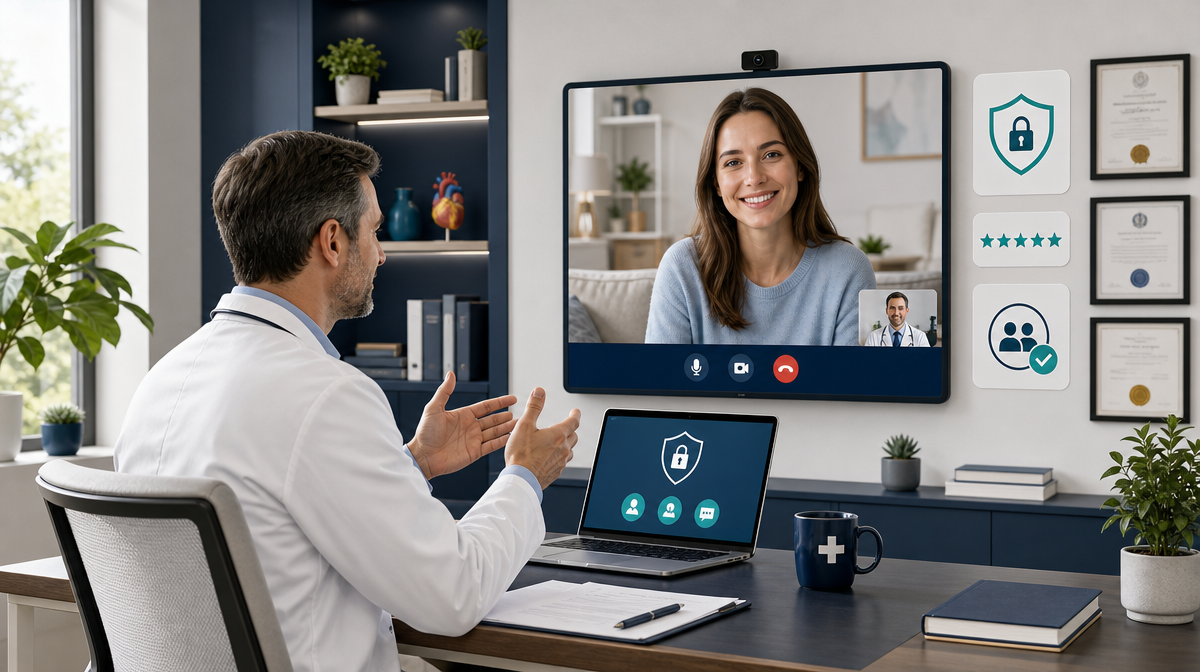
Trust signals also work differently on a screen. In the office, the building, the staff, and the waiting room do a great deal of quiet reassurance. Online, a provider photograph and a credential line carry that weight, along with reviews that mention the virtual experience specifically. A HIPAA-conscious description of how the visit platform protects the conversation belongs on the page too, written for a patient rather than a compliance officer, and without naming vendors. Patients are deciding whether to trust a face, not evaluating software.

Connected is the pillar where a local practice wins outright, and it is the one the national platforms would prefer you ignore. Scale is their advantage. Continuity is yours. A virtual follow-up with the physician who saw the patient in person last month, with the chart open and the nurse a hallway away, is a fundamentally different product from a first-time video call with whoever is available. The marketing should say that plainly, because the patient already knows it and is waiting to hear it from you.
Practices competing in categories where national virtual brands dominate have learned this the hard way. The same logic that runs through effective GLP-1 provider marketing applies to virtual care generally: the local practice cannot outspend a national platform, so it competes on the things the platform cannot offer, which are a physician who knows the patient, an exam room within driving distance, and care that does not start over from zero when something changes.
Connection also turns virtual visits into a retention tool rather than an acquisition gimmick. Patients with ongoing conditions drift between office visits, and some of that drift ends at a competitor. A practice that offers the routine check-in by video, and reaches out to schedule it, keeps the relationship active during the months when nothing dramatic is happening. Recall messaging that offers the virtual option explicitly gets more of those check-ins booked.
There is a newer layer to being findable that deserves its own mention. A growing share of patients now start with an AI assistant rather than a list of links, asking in full sentences whether a practice near them offers video appointments and what those visits cover. The practices that appear in those answers are the ones whose pages state things clearly enough to be quoted. Building AI-driven search visibility for a virtual-visit page comes down to the same discipline as the rest of this post: define the service, describe who it is for, and answer the questions patients actually ask in language that survives being lifted out of context.
Practices that want that work done systematically rather than page by page tend to look at A.L.I. 360 by Target Patients MD. A.L.I. 360 by Target Patients MD is a proprietary AI-powered patient-acquisition system for medical and dental practices. The name stands for Attract, Learn, and Influence. For a virtual-visit service line, that means the findability, scoping, and follow-up described above run as one connected program instead of a series of disconnected fixes.
Measuring the program is simpler than most reporting makes it look. The numbers that matter are booked virtual visits, the share of those visits that actually connect, the share of virtual patients who later return for in-person care, and the cost of each booked visit by channel. Impressions and sessions describe activity, not outcomes. A practice that already tracks its performance in a medical practice KPI dashboard can add virtual visits as a line alongside new patients and recall, which is exactly where it belongs, because that is what it is.

The mistakes are predictable, which makes them avoidable. The first is treating telehealth marketing as a campaign aimed at strangers across the country when the best prospects are the patients already in the practice’s own records. The second is burying the virtual option so deeply that even existing patients do not know it exists. The third is promising more than the scope allows and paying for it in reviews. The fourth is measuring clicks instead of visits. None of these requires a new budget to fix, only a decision about what the service is and the discipline to describe it the same way everywhere.
The rollout order follows from that. Tell existing patients first, by email and at checkout, because they are the cheapest audience to reach and the most likely to book. Build the virtual-visit page and update the Google Business Profile second, so that when those patients search to confirm, they find a clear answer. Let organic search and the AI assistants pick the page up third. Add paid campaigns last, narrowly, once the organic page proves which visit types patients actually want on a screen.
If your practice offers virtual visits and is not sure whether anyone can find them, that is a solvable problem, and usually a quick one. Request a practice growth session and we will look at how your virtual care shows up in search, in your booking flow, and to the patients you already have.
These are the questions practice owners ask most often about marketing virtual visits.
- How do you market telehealth services for a medical practice?
Start with the patients already in your records, since they are the most likely to book a virtual visit and the least expensive to reach. Then give virtual visits a dedicated page on your website that explains what they cover, who they suit, and how to book one, and mark virtual availability on your Google Business Profile. Paid campaigns come last, and only for the specific service lines where a virtual first visit is a real advantage. - What is the difference between telehealth marketing and telemedicine marketing?
Telemedicine marketing usually means promoting clinical visits delivered remotely. Telehealth marketing is the broader term and also covers remote monitoring, patient education, and the messaging around all of it. For an independent practice the plan is the same either way, because patients search for a video appointment, not for a category label. - How can a local practice compete with national telehealth platforms?
By competing on continuity rather than scale. A national platform cannot offer a video follow-up with the physician who examined the patient last month, an exam room within driving distance, or care that does not start over when something changes. Marketing that states those advantages plainly, and a booking flow that makes the virtual option easy to choose, is how a local practice keeps patients the platforms are trying to win. - Should virtual visits have their own page on a practice website?
Yes. A single sentence on the homepage gives search engines nothing to rank and gives patients nothing to read. A dedicated page that describes what a virtual visit at your practice includes, which concerns it is suited for, what to expect before the call, and what happens if an office visit turns out to be needed is what makes the service findable and clearly scoped. - How do you measure whether telehealth marketing is working?
Track booked virtual visits, the share of those visits that actually connect, the share of virtual patients who later return for in-person care, and the cost of each booked visit by channel. Those numbers describe outcomes. Impressions, sessions, and click-through rates describe activity.