


Audiology has a structural quirk that shapes everything about how patients arrive, and most marketing for hearing practices ignores it completely: the person searching is frequently not the person who needs care.
A spouse notices the television creeping louder. An adult child notices their parent nodding along to conversations they clearly did not follow, or asking for a third repetition at a restaurant. That family member is the one typing something into a search box late at night after a frustrating holiday dinner — comparing clinics, reading reviews, checking credentials, sometimes booking the appointment outright. The patient themselves is often the last to accept there is anything to address.
Which means your marketing is doing two jobs at once, for two people with entirely different concerns. The family member needs to believe your practice is trustworthy and easy to deal with. The patient needs to believe that walking through your door is not an admission of decline. Those are different messages, and a single piece of copy trying to carry both usually lands with neither.

Understanding why the patient resists is where audiology marketing either succeeds or wastes its budget. Hearing loss carries a stigma that vision correction shed decades ago. Glasses became fashion; hearing devices still read to many people as a public announcement about aging. Add that the change is gradual — accommodations accumulate so slowly that the person adjusts without noticing — and you get someone who has genuinely not registered a problem, being told by a relative that one exists.
That produces the single most important insight for anyone marketing a hearing practice. The objection you are facing is not price, and it is not which device to buy. It is whether there is anything wrong at all. Marketing that leads with technology or cost addresses an objection the person has not yet reached, which is why so much of it feels like it bounces off. Marketing that lowers the cost of simply finding out — a straightforward first step, no commitment, nothing to decide on the day — reaches people the harder sell never touches.
Practically, that means your most valuable page is probably not the one about devices. It is the one that answers what actually happens at an evaluation: how long it takes, what it involves, that nobody will pressure them into anything, and that plenty of people come in and learn their hearing is fine. Removing the fear of the appointment is a different job from selling what follows it, and it is the one that gets people through the door.
For the family member, the job is different again. She is not trying to be talked into anything — she has already decided something should happen. What she needs is reassurance that her parent will be treated with dignity rather than sold to, and a way to act without a fifteen-minute phone tree. Booking that works online, without requiring the patient to be present or cooperative, removes real friction at the exact moment she has the motivation to act. Content she can forward matters too: a short, plain explanation she can send rather than having the conversation herself is often the thing that finally moves it forward.
The tone question underneath all of this is delicate and worth naming. Marketing to the family member while writing about the patient can slide into talking about older adults as problems to be managed, and patients notice. The practices that handle this well address both audiences with the same respect — the family member’s concern is legitimate, and so is the patient’s autonomy.

Then there is the over-the-counter question, which generates more anxiety in this profession than the evidence currently supports. Since the regulatory change opened the category, a great deal of strategy has been built around an assumed collapse in traffic. The data has not borne that out — peer-reviewed work in Frontiers in Audiology and Otology notes that only a small share of adults aged 40 and over with hearing difficulty reported purchasing an over-the-counter device, with survey evidence suggesting a negligible impact on existing practices so far. The category may yet expand the overall market rather than divide it.
That matters strategically because competing on price against a retail shelf is a losing position you do not actually need to take. The durable ground is what the retail channel structurally cannot offer: an evaluation that identifies what is actually happening, verification that a device is doing what it should, recognition of causes that need medical attention rather than amplification, and adjustment over time as someone adapts. The American Academy of Audiology’s position statement on the audiologist’s role with these devices is worth reading on exactly this point, since it frames the professional’s contribution around evaluation and support rather than around the transaction.
The framing that works with patients and families is not that the retail option is bad. It is that buying a device is a different thing from finding out what is going on — and that the second is worth doing first regardless of what someone eventually decides to purchase. That position is credible, it is true, and it does not require you to argue against a price you cannot match.
| What the patient is deciding | What your marketing should do |
|---|---|
| Whether anything is wrong | Make finding out feel easy and low-stakes |
| Whether to be seen at all | Explain the appointment, remove the unknown |
| Whether to trust the practice | Credentials, reviews, and plain language |
| What it will cost | Address coverage before they have to ask |
That last row is worth dwelling on, because coverage confusion quietly costs hearing practices more patients than competition does. Traditional Medicare has historically not covered hearing aids, while some Advantage plans include a benefit of some kind — and patients routinely arrive with no idea which situation applies to them. Coverage rules vary by plan and change over time, so the specifics belong in a conversation rather than a promise, but addressing the question plainly on your site is far better than leaving people to discover it in your office. Someone who cannot work out what a visit will cost frequently books nothing, and that hesitation is invisible in your analytics.
Local search carries most of the discovery, and it is the part of audiology marketing that rewards completeness rather than cleverness. Google is direct about what drives placement in local results — relevance, distance, and prominence — with complete business information and review activity feeding two of the three. For a hearing practice that means naming your services specifically, keeping hours accurate, and treating the profile as something you maintain rather than set up once.
Worth remembering what people actually type, though, because it is rarely clinical. Somebody searching on a parent’s behalf asks why their mother keeps asking them to repeat things, not for an audiological evaluation. Content that starts from that phrasing reaches the person doing the searching; content that starts from the service name reaches only those already informed enough to use it.

Your website has an accessibility obligation here that most specialties can treat casually and you cannot. Your patient population skews toward older adults who may have vision changes alongside hearing changes, and who are frequently less patient with a confusing interface. Readable type, real contrast, obvious navigation, and a booking path that does not require guessing are not nice-to-haves in this specialty — they are the difference between an appointment and a closed tab. Those decisions are what medical website design is actually for when your audience is who it is.
Reviews carry unusual weight for the same reason. A family member vetting practices on someone else’s behalf reads far more carefully than a person booking for themselves, because the decision feels like a responsibility rather than a preference — and 84% of patients check online reviews before choosing a provider. What she is looking for is not a star average but evidence that other people in her situation were treated well. Reviews mentioning a specific circumstance outperform generic praise substantially. Ask consistently and close to the visit, respond to everything including criticism, and remember that any identifiable patient story used publicly requires written authorization first. A systematic approach to reputation management is doing ranking work and conversion work simultaneously.
Referral relationships deserve more attention than they usually get. Primary care physicians and ENT practices see these patients first and often mention the issue before any family member does, which makes them a steadier source than any campaign. The work is unglamorous — making referral logistics easy and closing the loop with communication back about the patient — but a referring provider who hears nothing after sending someone will send the next one elsewhere. For ENT practices that offer hearing care in-house, audiology is one service line among several, and ENT marketing works best when each of those lines gets its own pages and its own patient journey.
Something else is shifting that suits a specialty where people search by symptom rather than by service. Increasingly they describe what they are noticing to an assistant and ask what it might mean, before reaching a results page at all. Those systems synthesize answers and attribute sources rather than ranking pages, which makes content that plainly answers the question a worried family member actually asks unusually valuable. Practices paying attention to AI in healthcare SEO structure content accordingly — direct answers, plain language, and enough local specificity that a system can place them.
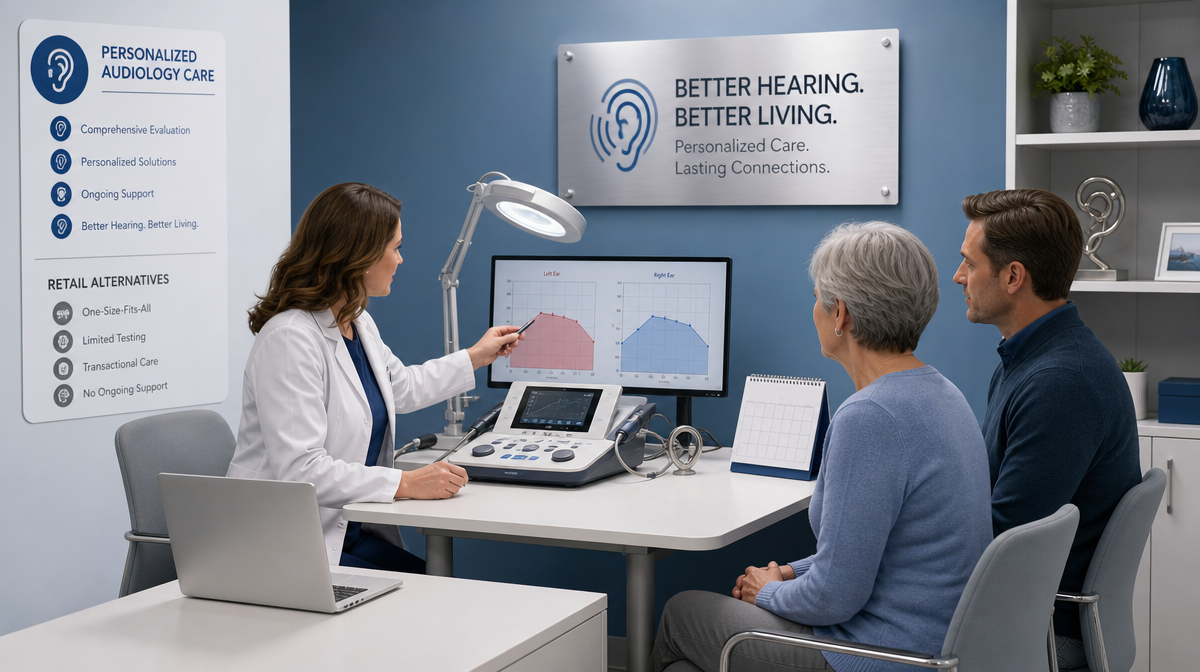
Measurement in audiology marketing should reflect how long this decision actually takes. Tracking device sales alone is misleading, because the meaningful early signal is evaluations booked and kept — someone who comes in and learns their hearing is fine has still entered a relationship that may matter in three years. Watch what proportion of inquiries become appointments, what proportion of appointments are attended, and how many people return when the time comes. A practice measuring only what sold this month will consistently undervalue the work that fills next year.
Retention matters more here than the transaction-focused framing suggests, since hearing changes over time and someone who trusted you once is far likelier to return than to start over. The systems behind that are covered in our guide to patient retention strategies, and the broader diagnostic approach to finding where people fall out is in our guide to how to get more patients.
The independent advantage in all of this is the same one that runs through private practice marketing generally: you can be patient in ways a retail operation cannot. You can let someone come in, learn nothing is urgent, and come back in two years. You can take the time the conversation actually needs. In a specialty where the decision is emotional and slow, that is not a soft advantage — it is the whole business.
If running that alongside a clinical schedule is not realistic, A.L.I. 360 by Target Patients MD is a proprietary AI-powered patient-acquisition system for medical and dental practices — the name stands for Attract, Learn, and Influence — built to keep search, paid, reputation, and follow-up running as one program rather than four. If your schedule has gaps and you cannot tell where the inquiries are going, get in touch and we will show you.
Here are direct answers to the questions hearing practices ask most often.
How do audiologists get more patients? By making the first step feel small. The barrier is rarely price or device choice — it is whether the person accepts anything is wrong. Content explaining what an evaluation actually involves, plus booking that works without a phone call, converts better than anything promoting devices.
Should audiology marketing target family members? Usually yes, alongside the patient rather than instead of them. A spouse or adult child is frequently the one searching and comparing, and they need different reassurance than the patient does. The care required is in addressing both without talking about the patient as a problem to be managed.
How should practices respond to over-the-counter hearing aids? Not by competing on price. Published data suggests adoption has been more limited than early predictions expected, and the durable position is what the retail channel cannot offer — evaluation, verification, recognition of causes needing medical attention, and adjustment over time.
Why do patients wait so long to seek help? Because the change is gradual enough to accommodate without noticing, and because the stigma attached to hearing devices has not faded the way it did for glasses. Both are addressable in how you frame the first appointment, and neither is addressable by promoting technology.
What should an audiology practice measure? Evaluations booked and kept, rather than devices sold. Someone who comes in and learns their hearing is fine has still entered a relationship, and a practice measuring only this month’s sales will undervalue the work filling next year’s schedule.