


Optometry is the only corner of healthcare where the practice is genuinely two businesses sharing one address. There is the clinical side — the exam, the diagnosis, the ongoing management of eye health — which runs on insurance, referral, and an annual recall cycle. And there is the optical dispensary, which runs on retail margin, inventory, and a purchase decision the patient makes while standing at a display of frames. Most optometry marketing advice treats the practice as a medical office and stops there, which quietly ignores where a large share of the profit actually comes from.
That produces the problem every independent practice lives with: you have to market the exam and defend the dispensary at the same time, and those are different jobs requiring different messages. A patient can complete the exam with you, take the prescription you just wrote, and buy glasses from an online seller before they reach the parking lot. Marketing that fills the chair while losing the optical sale is a treadmill — busy, expensive, and not obviously getting anywhere.
Start with what actually brings someone in. Very little of it is urgent. A parent notices a child squinting at homework. Someone realizes they are holding their phone further away than they used to. A contact lens wearer runs out of supply. Almost nobody arrives with a crisis, which means demand is largely elective, largely deferrable, and largely triggered by a small nudge at the right moment. That single fact should shape your entire approach, because a practice competing for attention that people can indefinitely postpone needs to be present when the nudge arrives rather than shouting louder.

Local search is where most of that presence gets decided, and it is the part of optometry marketing that rewards completeness more than cleverness. Google is direct about what drives placement in local results — relevance, distance, and prominence — with complete business information and review activity feeding two of the three. For an optometry practice that means naming your services specifically rather than generically, keeping hours accurate through holidays when larger competitors go dark, and treating the profile as something you maintain rather than something you set up once.
Consistency across directories matters more than it sounds. Your practice name, address, and phone number need to match exactly everywhere they appear — a suite number formatted differently in one listing, an old phone number still live in another, and the signal degrades. It is unglamorous work with no visible payoff until you notice you have stopped losing ground to practices that did it.
Beyond the profile, dedicated pages beat a single services page. Someone researching a specific concern converts far better on a page written for that concern than on a general overview that mentions it in a list. That also gives search engines something concrete to rank, which is the same reason it works for patients: specificity reads as competence.
The website has one more job in optometry that it does not have elsewhere, and practices consistently underestimate it. Insurance confusion is a genuine conversion killer here, because vision plans and medical insurance are different things and most patients do not know which applies to the appointment they are trying to book. Someone who cannot work out what a visit will cost frequently books nothing at all. Most practices address this with a line saying they accept most major plans, which resolves nothing — explaining the distinction plainly, and what to bring, removes a real barrier and cuts down the front-desk time spent answering the same question repeatedly. Alongside booking that works without a phone call and a site that loads properly on a phone, that clarity is what medical website design is actually for in this specialty.

Now the dispensary, which is where independent practices lose the most and talk about it the least. Online sellers and large optical chains compete on price and convenience, and they will win both of those comparisons every time. Competing there is a losing position — the margin is not available and the volume is not reachable.
What is available is everything that happens before the patient reaches the frame board. A dispensary sale is largely won during the exam, in the conversation about what the patient actually needs, how their prescription interacts with how they spend their day, and what options exist that they did not know about. A patient who leaves understanding their own eyes is a very different prospect from one who leaves holding a piece of paper. That conversation is not a marketing tactic in the usual sense, but it determines the outcome more than any campaign, and it is worth training for deliberately.
The marketing job around it is to make staying feel easy rather than to make leaving feel wrong. Showing what you carry on your own site keeps browsing in your ecosystem instead of sending people to search elsewhere. Being straightforward about what you can and cannot match on price is more credible than avoiding the subject. And following up shortly after the exam, while the prescription is still fresh, recovers a meaningful share of patients who left genuinely undecided rather than genuinely committed to buying elsewhere.
Which brings up recall, the highest-return activity available to an optometry practice and the one most independents underuse. The annual cycle here is unusually predictable — closer to dental hygiene than to most of medicine — which means you know roughly when each patient should return, and that is a rare advantage. Practices that automate the reminder before the habit breaks, rather than after the patient has already gone a year without thinking about it, keep relationships that would otherwise dissolve through nothing more than inertia.
Reactivation is the same idea applied further back. Patients who have not visited in a year and a half or more have not usually defected — they have forgotten, and a message acknowledging the gap with a clear next step brings a real share of them back at a fraction of what acquiring a stranger costs. The systems behind both are covered in our guide to patient retention strategies, and they apply here with unusual force precisely because the timing is so predictable.
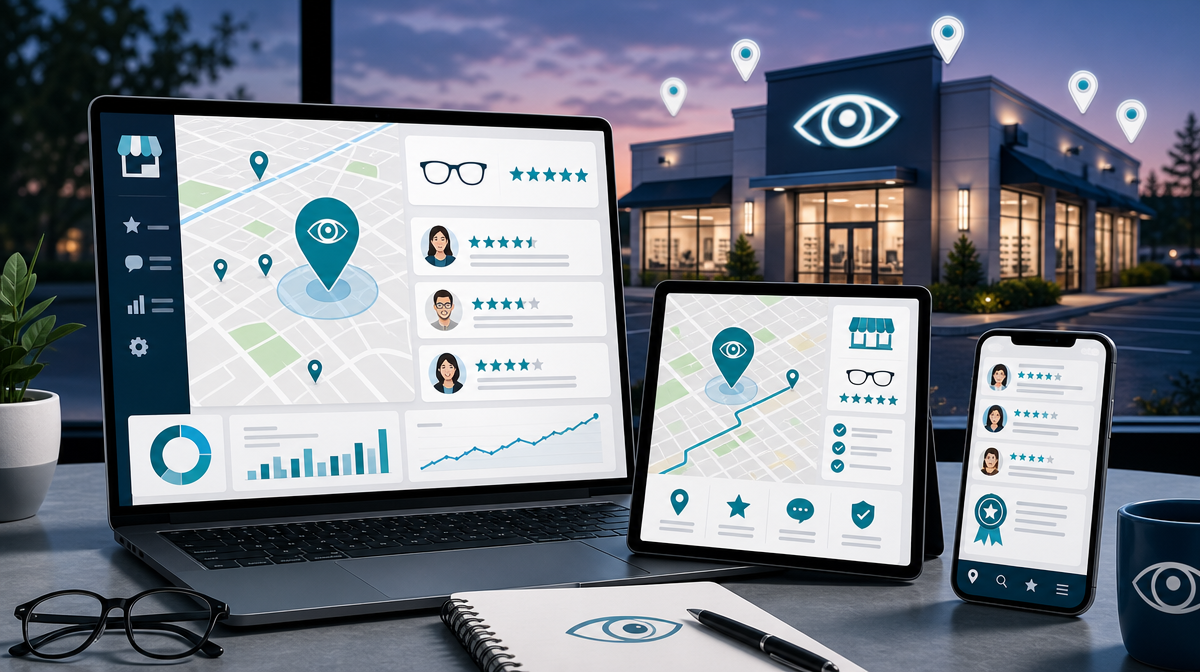
Reviews carry particular weight in a category patients often treat as interchangeable. 84% of patients check online reviews before choosing a provider, and when someone cannot tell from the outside what distinguishes one practice from another, reviews become the deciding input. What matters is not the star average so much as recency and specificity — a handful of recent reviews describing a real experience outperforms a larger pile of old generic ones. Ask consistently and close to the visit, respond to everything including criticism, and remember that any identifiable patient story used publicly requires written authorization first. A systematic approach to reputation management is doing ranking work and conversion work at once.
The deeper competitive answer, though, is clinical rather than promotional. Medical eye care, dry eye, myopia management, and specialty contact lens fitting are services a retail optical operation cannot replicate at a register, and they bill differently from routine optical benefits. Building visibility around what you handle that a chain does not is more durable than competing on frame prices, and it shifts your revenue mix toward encounters where price is not the primary comparison. The American Optometric Association notes that doctors of optometry provide two-thirds of primary eye care in the United States — a scope most patients considerably underestimate, and the gap between what you actually do and what people assume you do is itself a marketing opportunity.
The practical difficulty is that patients do not search for services they do not know exist. Someone whose eyes feel tired at the end of every workday is not looking up a treatment name. They are describing a symptom, if they search at all. Content that starts from the complaint rather than the solution reaches those people; content that starts from the treatment name reaches only the small number already informed.
That matters more now that a growing share of patients describe a symptom to an assistant before they ever reach a results page. Those systems synthesize answers and attribute sources rather than ranking pages, so content written as a direct answer to the question someone actually asks has a real advantage over clinical overview text. Practices paying attention to AI in healthcare SEO structure content accordingly — plain answers, enough specificity that a system can place you locally, and material written for the way a worried person phrases things rather than the way a chart does.

Measurement in optometry marketing should reflect the fact that this is two businesses rather than one. Tracking new patients alone tells you almost nothing, because a practice can grow exams while the dispensary shrinks and look healthy right up until it isn’t.
| What to track | What it tells you |
|---|---|
| Exams booked by source | Which channels actually produce appointments |
| Optical capture rate | Whether the dispensary is holding or leaking |
| Recall completion | Whether relationships are surviving the year |
| Reactivation response | How much dormant revenue is recoverable |
| Value over the relationship | What you can afford to spend acquiring someone |
Capture rate deserves watching monthly rather than annually, because a decline shows up gradually and is far easier to address early. A drop across a single quarter is a signal about what is happening in the exam room and at the frame board, and no amount of new patient advertising corrects it.
The independent advantage in all of this is the same one that runs through private practice marketing generally: you can be specific in ways a chain cannot. You know the schools, the employers, the neighborhoods. You can decide something on a Tuesday and have it running by Thursday. And the patient sees the same person year after year, which is worth more in a category built on annual returns than any promotion. Where the practice sits within the broader eye care landscape — including when to refer out and how that relationship works both directions — is covered in our guide to eye doctor marketing.
If running that alongside a clinical schedule is not realistic, A.L.I. 360 by Target Patients MD is a proprietary AI-powered patient-acquisition system for medical and dental practices — the name stands for Attract, Learn, and Influence — built to keep search, paid, reputation, and recall running as one program rather than four. If your exam schedule has gaps or your dispensary is leaking sales you should be keeping, get in touch and we will show you where.
Here are direct answers to the questions independent practices ask most often.
How do optometrists get more patients? Local search does the heaviest lifting for most single-location practices — a complete Google Business Profile, consistent listings across directories, and dedicated pages for the services you want to grow. Recall does the rest, since a practice that keeps the patients it already has needs far fewer new ones to grow.
How do you compete with online eyewear retailers? Not on price, which is not a winnable comparison. The dispensary sale is largely decided during the exam, in the conversation about what the patient actually needs and why. Showing what you carry on your own site and following up shortly after the visit recovers patients who left undecided rather than committed to buying elsewhere.
What is the most effective optometry marketing channel? For most practices, local search — it reaches people at the moment they decide to act, costs little to maintain, and improves every other channel. Paid search is the practical bridge while that builds, particularly for specific services rather than generic exam terms.
How often should an optometry practice run recall campaigns? Continuously rather than in bursts, triggered by each patient’s own exam date rather than a calendar blast. Reaching someone shortly before their year is up works considerably better than reaching them after it has passed and the habit has broken.
Should an optometry practice market medical eye care separately? Usually yes. Those services bill differently, face less price comparison, and are the clearest thing a retail optical operation cannot replicate. The difficulty is that patients search by symptom rather than by service name, so content has to start from the complaint.