



If you’ve ever handed your bariatric program’s marketing to a generalist agency, you already know what happens: generic “weight loss” ad copy, campaigns that attract people interested in diet programs rather than surgical candidates, and a coordinator team fielding calls from prospects who have no idea a BMI requirement even exists. A bariatric marketing agency is built around a fundamentally different operating model — one where the agency understands that gastric sleeve patients, bypass candidates, and revision surgery prospects are three distinct audiences who need three distinct messages.
The gap between generalist and specialist shows up most clearly in the parts of bariatric patient acquisition that require insider knowledge:
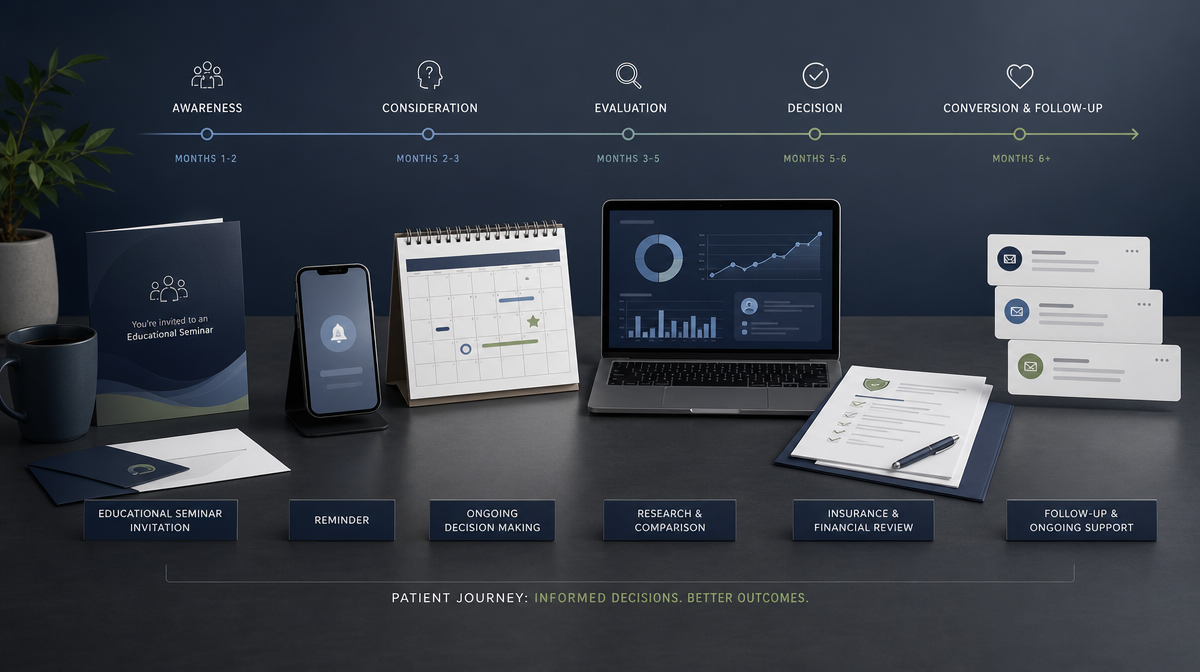
- Decision cycles measured in months, not days: Bariatric prospects research for 6–18 months before committing. A generalist agency optimizes for quick conversions; a bariatric-focused agency builds nurture infrastructure designed for the long haul.
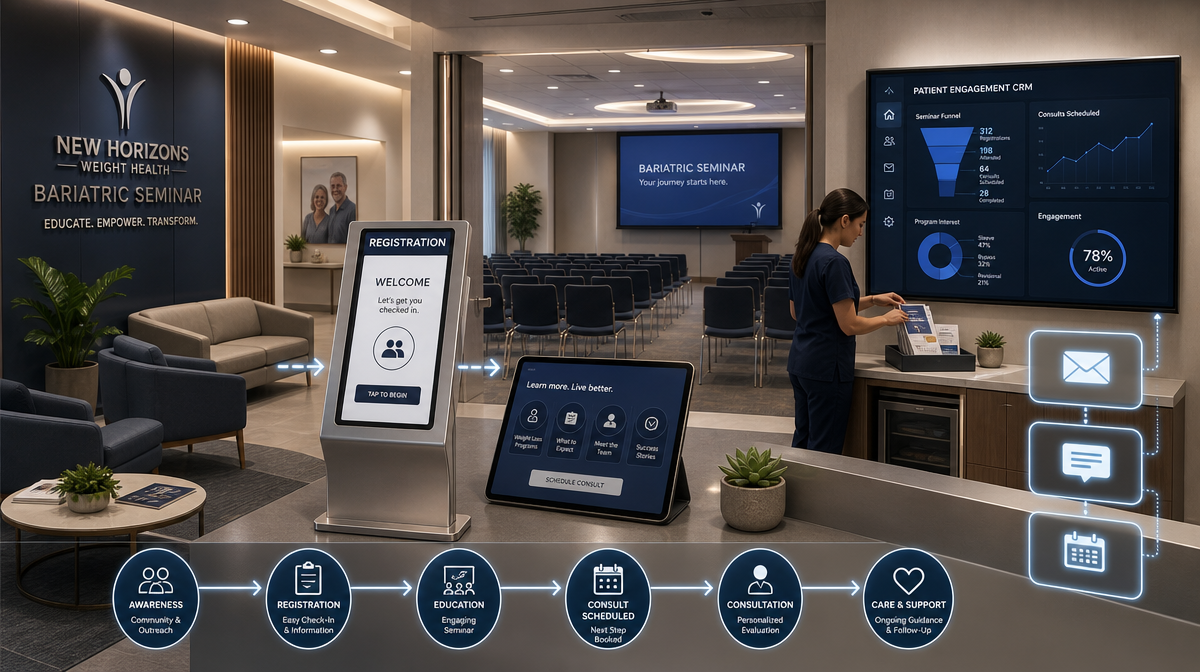
- Seminar-based conversion architecture: Most bariatric programs require attendance at an educational event before a consultation can even be scheduled. That’s a funnel structure no dermatology or orthopedic campaign has ever needed to solve.
- Sensitive, dignity-first messaging: Obesity is a deeply personal condition. Ad copy that inadvertently shames or stereotypes prospects kills trust before it’s ever built — and a generalist rarely knows where that line is.
- Surgical qualification literacy: Campaigns that reach people who don’t meet BMI thresholds or insurance criteria waste your budget and burn out your coordinator staff with unqualified inquiries.
The right bariatric marketing agency doesn’t just run ads — it understands the clinical and operational realities your practice lives with every day.
Most elective specialties follow a predictable marketing arc: prospect sees ad, prospect books appointment, prospect shows up. Bariatric surgery marketing operates on an entirely different timeline — and that timeline is the single biggest reason a standard agency engagement fails your program before the first campaign ever launches.
The average bariatric prospect takes 12 months or longer from initial curiosity to surgical scheduling. During that window, they’re not passively waiting. They’re watching transformation videos, reading procedure comparison forums, calculating whether their insurance will cover anything, and quietly deciding whether they trust your program enough to attend a seminar. A bariatric marketing agency has to architect systems that stay relevant across every one of those micro-decisions.
Each phase of that journey demands a completely different marketing response:
- Early research stage: Prospects need educational content that answers clinical questions — BMI thresholds, procedure differences, expected recovery — not promotional messaging pushing them toward a consult they’re nowhere near ready for.
- Seminar consideration stage: The prospect knows surgery is possible for them. Now they need a low-friction path to register, plus enough reassurance through reminder sequences that they actually show up.
- Insurance and financing stage: Coverage confusion kills conversions. Targeted content that demystifies pre-authorization requirements or presents self-pay financing options keeps prospects moving rather than disappearing.
- Post-surgery advocacy stage: Satisfied patients become a compounding asset — but only if automated outreach captures their story before the emotional window closes.
Building this kind of stage-aware infrastructure requires an agency that has mapped this exact journey before, not one learning it on your budget.
The short answer is yes — but the platform rules are strict enough that most practices running campaigns without specialized guidance end up either wasting budget or unknowingly violating ad policies. Understanding exactly where the guardrails sit is what separates a compliant, high-performing bariatric campaign from one that gets flagged, disapproved, or banned.
Each platform presents a distinct set of constraints your campaigns must navigate:
- Google Ads: Procedure-specific keywords like “gastric sleeve surgery” and “bariatric surgeon near me” are fully approvable, but before-and-after imagery and absolute weight loss claims trigger policy violations. Your ads can promote consultations and educational seminars without issue — the restrictions kick in when copy makes guarantees about outcomes.
- Meta (Facebook and Instagram): You cannot directly target users by health condition or weight-related interest categories. What you can do is reach high-intent audiences through contextual behavioral signals, custom audiences built from website visitors, and lookalike modeling based on your existing patient list — none of which rely on prohibited health-interest targeting.
- YouTube: Educational video content performs particularly well here, and the platform’s retargeting capabilities let you stay visible to prospects who watched a procedure overview but haven’t registered for a seminar yet.
A qualified bariatric marketing agency knows how to engineer campaigns within these boundaries without sacrificing reach. The practices that struggle are typically running the same ad structure they’d use for a med spa — a format that simply doesn’t map to surgical patient acquisition or platform compliance requirements for this specialty.
Compliance in bariatric advertising isn’t just about avoiding a slap on the wrist — with over $100 million in HIPAA fines tied to tracking technology violations since 2023, a single misconfigured pixel on your seminar registration page can expose your practice before a single patient ever walks through the door. The regulatory stakes are higher here than in most medical specialties because you’re capturing data from people actively disclosing a sensitive health condition.
Three specific areas require airtight protocols in every bariatric campaign your practice runs:
- Lead capture forms: Patient health information must never appear in URL parameters after form submission. A prospect’s weight, BMI, or insurance status passing through a standard query string is a documented PHI exposure — and it happens constantly on forms built by teams without bariatric compliance experience.
- Retargeting pixel placement: Pixel-based audience lists cannot be built from visitors to procedure-specific pages — a sleeve gastrectomy page or insurance eligibility checker — without compliant server-side configurations and appropriate Business Associate Agreements with your ad platforms.
- Patient testimonials in ads: Written HIPAA authorization is required before any patient story, transformation journey, or before-and-after reference appears in paid media. Verbal consent is not sufficient, and a release signed for your website doesn’t automatically extend to paid advertising placements.
A competent bariatric marketing agency structures your entire tech stack — CRM, landing pages, forms, and pixel architecture — around these requirements from day one. Retrofitting compliance after a campaign launches is significantly more expensive than building it correctly upfront, and the reputational risk of a breach in this specialty is particularly acute given the sensitive nature of the patient population you serve.
No single channel fills a bariatric surgical schedule on its own — and practices that bet everything on Google Ads alone tend to discover that reality around month three, when their pipeline stalls between seminar registration and consult attendance. The channel mix that actually moves patients from curiosity to the operating table looks different from any other specialty’s marketing stack.

- Bariatric SEO and local search: Organic rankings for procedure-specific terms like “gastric sleeve surgeon near me” or “lap band revision specialist” capture prospects deep in the research phase — people who already know surgery is their path and are now evaluating who performs it. Google Business Profile optimization is frequently the deciding factor when a prospect chooses between two equally credentialed surgeons.
- Paid search (PPC): Procedure-specific ad groups — sleeve, bypass, revision, and ESG each in separate campaigns — outperform broad “weight loss surgery” groupings because they match landing page content precisely to search intent. Negative keyword lists matter enormously here; without them, your budget absorbs clicks from people searching for diet programs and gym memberships.
- Meta and YouTube: Social platforms build awareness and drive seminar registrations, particularly for prospects who haven’t yet committed to surgery but are actively consuming weight-loss content. Video testimonials perform exceptionally well for keeping your program visible during the consideration window.
- Email and SMS nurture: Automated sequences deliver educational content, financing information, and seminar reminders over weeks or months. SMS specifically improves show rates for both virtual and in-person educational events — a metric that directly determines how many consults your coordinator team handles each week.
- Website infrastructure: Dedicated procedure pages, insurance information sections, and mobile-optimized seminar registration flows convert traffic that every other channel generates. A weak website is where bariatric patient acquisition goes to die.
Seminars are the operational heartbeat of most bariatric programs — and they’re also where the majority of practices hemorrhage revenue without realizing it. A prospect who registers but doesn’t attend represents a full acquisition cost with zero return. Closing that gap is one of the highest-leverage things a specialized bariatric marketing agency delivers, and it requires infrastructure most practices simply don’t have in place.
The funnel that actually moves a registered prospect into a surgical consultation involves four distinct operational layers:
- Registration architecture: A dedicated landing page matched to the specific seminar format — virtual or in-person — with a streamlined form that captures only what’s needed to qualify the registrant without creating friction that kills completions.
- Confirmation and pre-event sequence: An immediate confirmation email followed by a structured reminder cadence across both email and SMS — a combination shown to reduce no-shows by 30–50%. The timing and message content of each touchpoint is engineered to reduce attrition, not just acknowledge the registration.
- Post-seminar workflow: Attendees who don’t schedule a consult within 48 hours need a specific follow-up sequence — one that addresses the insurance and financing questions that typically stall momentum at this exact stage.
- CRM pipeline tracking: Every prospect from initial ad click through surgery completion lives inside a single tracked workflow, so your coordinator team always knows where each patient stands and what action is due.
The table stakes here aren’t creative — they’re operational. Practices that treat seminar marketing as just running a registration ad miss the infrastructure that converts attendance into consult volume. That infrastructure is what a purpose-built seminar funnel actually delivers.
Most bariatric practices track clicks, cost per lead, and maybe seminar registrations — and then wonder why those numbers don’t translate into predictable surgical volume. The disconnect is a measurement problem. Vanity metrics tell you your campaigns are running; the KPIs below tell you whether your program is actually growing.
- Cost per seminar registrant: The first checkpoint in your funnel. This number varies significantly by market and channel — competitive metros routinely run $40–$120 per registration — but its real value is as a baseline for comparing campaign efficiency across Google, Meta, and organic sources.
- Seminar show rate: The percentage of registrants who actually attend. A show rate below 50% signals a problem in your confirmation and reminder infrastructure, not your advertising. Fixing this metric alone can double consult volume without spending an additional dollar on media.
- Cost per qualified consult: This filters out the window-shoppers. A qualified consult means the prospect met surgical criteria and attended the appointment. It’s a far more meaningful number than raw cost per lead because it reflects actual pipeline quality.
- Consult-to-surgery conversion rate: If your program schedules 40 consults per month but only converts 8 into surgical cases, the bottleneck isn’t marketing — it’s the post-consult follow-up workflow or financing support.
- Cost per surgical case: Total marketing spend divided by completed surgeries. This is the number a serious bariatric marketing agency should be accountable to, because it’s the only metric that directly maps to practice revenue.
Tracking these metrics in sequence reveals exactly where prospects are dropping out — which means you fix the right problem instead of pouring more budget into a leaky funnel.
The decision cycle problem in bariatric surgery isn’t just a marketing challenge — it’s a data problem. You have hundreds of prospects in your pipeline at any given moment, each at a different stage of readiness, and your coordinator team has no reliable way to know which ones are three weeks from scheduling surgery and which ones need six more months of education. That’s exactly the gap that AI-powered patient acquisition closes.
A sophisticated bariatric marketing agency deploys artificial intelligence across four distinct leverage points in your program’s growth engine:
- Predictive lead scoring: Machine learning models analyze behavioral signals — page visits, content consumption patterns, seminar registration timing — to identify which prospects have the highest probability of converting to a surgical case. Your coordinator team stops working every lead equally and starts prioritizing the ones most likely to schedule.
- Automated bid optimization: AI continuously reallocates your ad spend toward the audiences, times of day, and keyword combinations that are actually producing qualified consults — without waiting for a human to pull weekly reports and make manual adjustments.
- Conversational AI: Chatbot systems answer procedure questions, insurance eligibility inquiries, and seminar registration requests at 2 a.m. on a Sunday — the exact moment a motivated prospect decides to take action.
- Creative performance optimization: AI tools test ad copy variations, landing page headlines, and email subject lines continuously, compounding small conversion improvements into meaningfully lower cost per surgical case over time.
Target Patients MD’s A.L.I. 360 technology applies this framework specifically to bariatric patient acquisition, producing conversion rates that significantly outperform what standard campaign management achieves.
Most agency contracts are structured to protect the agency, not your surgical case volume. You pay a fixed monthly retainer whether your seminar seats fill up or sit empty — and the agency collects the same check either way. That arrangement made sense in an era when marketing results were genuinely difficult to attribute. In bariatric surgery marketing, where every conversion point from seminar registration to scheduled procedure is trackable, it’s simply an outdated model that transfers all the financial risk to your practice.
The engagement structures worth considering are built around shared accountability:
- Performance-based compensation: Agency fees tied directly to delivered leads, qualified consults, or completed surgical cases — so the agency’s revenue grows when yours does.
- Hybrid base-plus-bonus arrangements: A modest operational retainer covers infrastructure costs, while performance bonuses activate only when the agency exceeds agreed targets. Both sides carry appropriate risk.
- Guarantee-backed engagements: Some specialized bariatric marketing agencies commit to specific patient acquisition outcomes or restructure billing when targets aren’t met. This model forces the agency to underwrite its own claims rather than simply promise them.
The practical test is simple: ask any agency you’re evaluating whether they measure success by booked patients or by activity reports. If it’s the latter, their incentives are misaligned with yours from the first invoice. At Target Patients MD, the model is straightforward — built around patient growth and measurable campaign performance, not vanity metrics. That’s what real accountability looks like for a bariatric practice owner evaluating where to put their marketing budget.
Bariatric prospects are among the most research-intensive patients in any surgical specialty. Before a candidate ever contacts your program, they’ve likely spent weeks reading reviews on Google, Healthgrades, and RealSelf — 84% of patients check online reviews before choosing a provider, and a single unaddressed negative comment about a coordinator’s bedside manner can quietly eliminate your practice from their shortlist. That research behavior makes reputation management a revenue issue, not just a PR one.
What a specialized bariatric marketing agency builds here goes well beyond monitoring star ratings:

- Automated post-op review requests: Timing matters enormously. Review requests sent during the early recovery window — when patients are experiencing their first meaningful weight loss milestones — capture authentic enthusiasm that generic follow-up emails miss entirely.
- Multi-platform aggregation: Bariatric patients leave feedback across Google, Facebook, Healthgrades, and obesity-specific communities simultaneously. Monitoring one platform while ignoring others creates blind spots that shape prospect decisions without your knowledge.
- HIPAA-compliant response protocols: Responding to a negative review without inadvertently confirming someone was your patient is a skill set that requires specific training — a generic “we’re sorry you had this experience” template can itself become a compliance exposure.
- Patient story content strategy: Transformation narratives collected with proper written authorization become evergreen assets across your website, paid social campaigns, and seminar registration pages — compounding their value across every channel simultaneously.
The practices consistently winning surgical case volume in competitive markets treat reputation infrastructure as a core component of patient acquisition, not an afterthought addressed when a bad review surfaces.
The final filter before signing an agency agreement isn’t about their portfolio deck or their case study slide — it’s about whether their operating model was actually built around bariatric surgery’s commercial realities, not retrofitted to fit them.
Five evaluation criteria separate purpose-built bariatric marketing agencies from practices that simply added “bariatric” to their specialty list:
- Surgical case volume as the primary success metric: Ask specifically whether the agency reports on completed procedures, not just lead counts. Any agency that defaults to impressions and click-through rates as proof of performance has never been held accountable to an OR schedule.
- Seminar funnel ownership: The registration-to-consult pipeline is the operational core of bariatric patient acquisition. Confirm the agency builds and manages this infrastructure directly, not through a third-party vendor they’ve never integrated with your CRM.
- Bariatric-specific compliance experience: General HIPAA awareness isn’t sufficient. The agency should demonstrate specific familiarity with pixel placement protocols on procedure pages, testimonial authorization workflows, and platform ad policy restrictions for surgical weight loss.
- Dual-segment messaging capability: Insurance-driven candidates and self-pay prospects require separate landing pages, distinct nurture sequences, and different qualifying criteria. An agency that runs one message to both audiences is leaving revenue on the table.
- Transparent cost-per-case reporting: A credible bariatric marketing agency connects marketing spend directly to surgical volume in its reporting — not as a footnote, but as the headline metric your monthly review centers on.
Target Patients MD works exclusively with medical practices on patient acquisition, with the metrics and accountability structure that surgical volume growth actually demands.
Bariatric surgery practices tend to have very specific operational questions before committing to an agency relationship — and the answers vary more than most generic marketing resources acknowledge. The five questions below come up consistently from program directors and practice owners evaluating their options.
- How quickly will paid campaigns generate inquiries? Most practices see inbound lead activity within the first week of launching paid search. Converting those early inquiries into scheduled surgical cases is a different timeline — typically three to six months — because the bariatric decision cycle doesn’t compress regardless of how well your campaigns perform.
- What separates a bariatric marketing agency from a medical weight loss agency? The focus is surgical. A bariatric-specialized agency builds its entire infrastructure around procedure-specific funnels, seminar attendance systems, and OR-level conversion metrics. Medical weight loss agencies typically center their model on non-surgical programs, GLP-1 prescribing, and lifestyle interventions — a meaningfully different patient population with different qualification criteria.
- Do these agencies work with hospital-based programs or only independent practices? Both. Hospital-affiliated bariatric service lines and freestanding surgical centers use the same underlying patient acquisition model, though institutional compliance requirements and approval workflows may add complexity to campaign launches for hospital programs.
- Should a bariatric practice market GLP-1 medications alongside surgical procedures? Many programs now do. A qualified bariatric marketing agency can segment messaging so surgical candidates and non-surgical prospects receive entirely separate nurture tracks — preventing GLP-1 content from cannibalizing surgical consult volume.
- What contract terms are standard? Month-to-month and short-term performance-backed agreements are increasingly common among specialized agencies, reflecting growing confidence in measurable outcomes rather than long-term retainer lock-ins.