

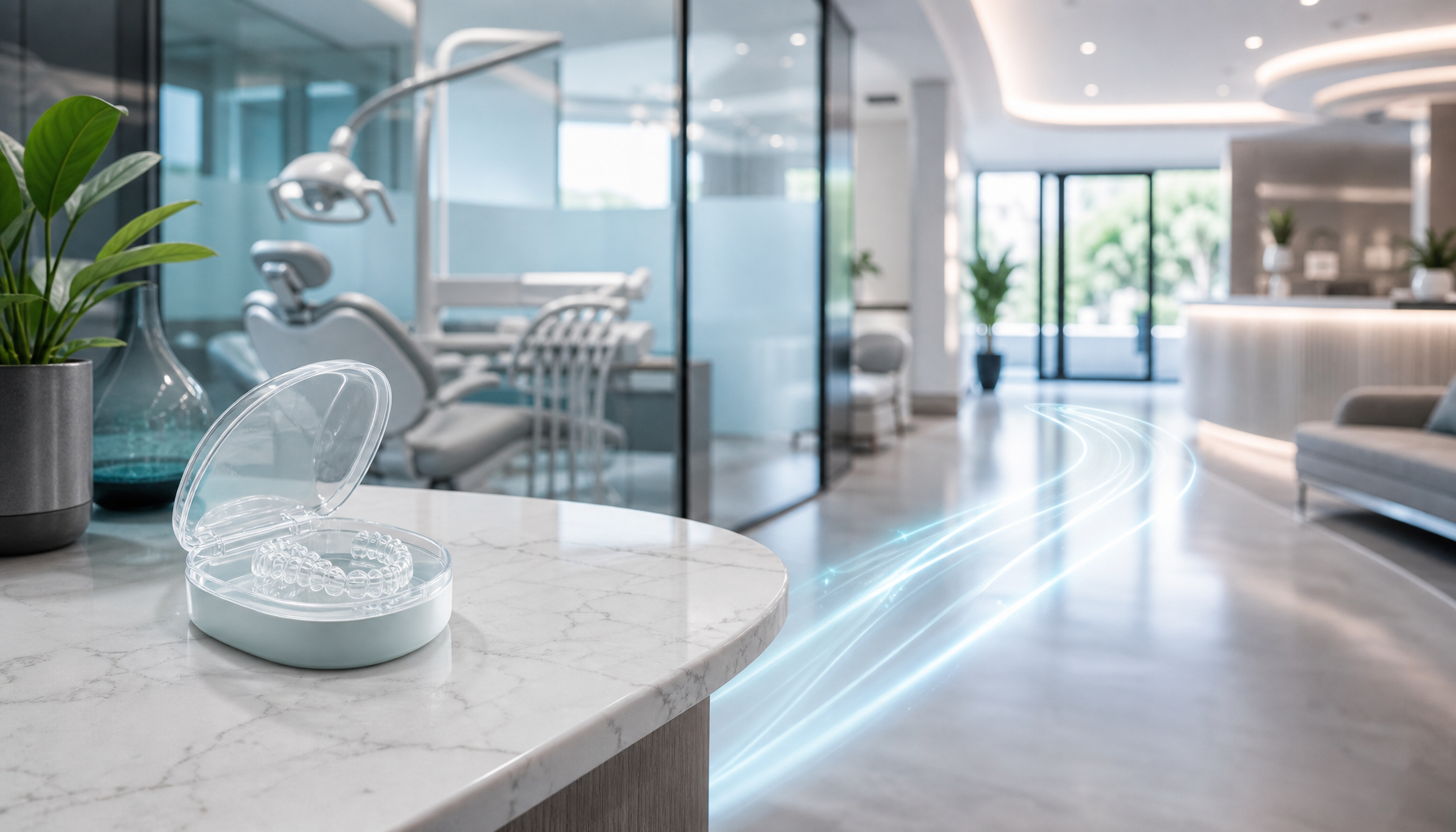
If you’re an Invisalign provider, you already feel the pressure. The clear aligner market — projected to reach $56.81 billion by 2033 — has transformed from a specialty differentiator into a crowded commodity fight, and the competitive dynamics have shifted dramatically against independent practices.
A decade ago, being an Invisalign-certified provider in your city was enough to stand out. Today, that credential is table stakes. The number of active Invisalign providers has grown to 295,000 trained practitioners worldwide, meaning your patients have no shortage of choices within a short drive. Corporate dental chains advertise clear aligners aggressively with national media budgets that most private practices can’t match on their own.
Then there’s the direct-to-consumer pressure. Even though brands like SmileDirectClub have stumbled, the idea of mail-order aligners planted a seed in patients’ minds: straighter teeth should be affordable and accessible. That expectation now walks into your consultation room with every prospective Invisalign patient, and it shapes orthodontic marketing well beyond aligners.
Invisalign marketing — the strategies practices use to attract, convert, and retain clear aligner patients — has become the deciding factor between a practice that hits Diamond Provider status and one that watches case volume stagnate. With roughly one in three dentists reporting they aren’t busy enough, the practices winning today aren’t necessarily the best clinicians. They’re the ones showing up first in search results, running smarter paid campaigns, and converting consultations at a higher rate than their competition.
Understanding where the competition is actually coming from is the first step toward outrunning it.
Need more consultations on your schedule? The fastest wins usually come from matching channel to intent instead of trying to force every patient through the same path. A teenager comparing options, a parent researching financing, and an adult ready to book a consultation all need different entry points.
- Run high-intent Google Search Ads: When someone types “Invisalign near me” or “clear aligners cost,” they’re not browsing — they’re ready to book. Google Ads lets you place your practice directly in front of these bottom-of-funnel prospects the moment they search. These are your highest-quality leads because the intent is already there; you’re not manufacturing interest, you’re intercepting it. A clinic in Dallas, for example, can bid on neighborhood-level terms and send every click to a dedicated booking page instead of a generic homepage.
- Launch Meta and TikTok awareness campaigns: Not every patient knows they want Invisalign yet. Paid social media advertising on Facebook, Instagram, and TikTok reaches people earlier in their decision journey. Before-and-after smile transformations perform exceptionally well in these formats — visual results stop the scroll and spark the “I want that” moment that starts a patient’s research process. TikTok’s Green Screen and Spark Ads formats can also extend the life of a single patient video by turning organic-style content into a paid asset.
- Capture local demand with Invisalign SEO: Optimizing your website to rank for searches like “Invisalign [your city]” builds a pipeline that compounds over time. Unlike paid ads, medical SEO doesn’t stop delivering when you pause a budget. More on this in the local SEO section below. Practices that publish neighborhood-specific pages often find they capture searches that broader service pages never touch.
- Reactivate existing patients with email and SMS: Your current patient database is one of the most underused assets in Invisalign marketing. Warm leads are already in your system.
- Recall campaigns: Re-engage patients who inquired but didn’t book
- Promotional offers: Limited-time Invisalign specials to existing patients
- Treatment reminders: Automated SMS for consultations and follow-ups
Where you spend your Invisalign marketing budget matters as much as how much you spend. Each channel reaches a different patient at a different stage of their decision — and mixing them up wastes money fast.
- Search engine marketing (SEM): Paid search ads on Google and Bing put your practice in front of patients who are already comparing providers. Smart keyword bidding on terms like “Invisalign cost” combined with ad copy that leads with a specific offer — a free consultation, a financing option — separates your listing from every other practice running generic ads in your market. In competitive suburbs, extensions such as call buttons and location links can materially lift click-through rates because they remove one more step between search and appointment.
- Paid social media advertising: Facebook and Instagram let you retarget visitors who browsed your website but never booked. TikTok opens the door to a younger adult demographic that responds to authentic, unpolished content. Because clear aligner results are inherently visual, social ads carry a natural advantage here that other dental treatments simply don’t. Short-form testimonials filmed in a treatment chair often outperform polished studio creative because they feel less scripted.
- Organic SEO and content: A well-optimized Invisalign service page, supported by blog content answering real patient questions, builds search visibility that compounds month over month. Invisalign SEO takes longer to produce results than paid channels, but it’s the only channel where you eventually earn traffic without paying per click. Search Console data can reveal which pages are already attracting impressions, giving you a low-cost roadmap for future content.
- Direct mail and community outreach: Postcards, school partnerships, and local sponsorships won’t replace digital — but for practices in tight geographic markets, they reinforce brand recognition and keep your name visible to households who haven’t searched yet. A mailer tied to a local event or school calendar can feel less like advertising and more like neighborhood presence.
| Channel | Patient Intent | Time to Results | Best For |
|---|---|---|---|
| SEM/Google Ads | High | Immediate | Ready-to-book leads |
| Paid Social | Low–Medium | Weeks | Awareness, retargeting |
| Organic SEO | High | Months | Long-term visibility |
| Direct Mail | Low | Weeks | Local brand building |
Your website is often the first impression — does it convert? Most practice websites were built to look credible, not to book appointments. There’s a meaningful difference, and for Invisalign specifically, that gap costs you cases every single week.
A generic dental website with a buried “we offer Invisalign” line on your services page won’t cut it against competitors running dedicated, purpose-built landing pages. Here’s what actually moves visitors from browsing to booking:
- Dedicated Invisalign landing pages: A standalone page focused entirely on clear aligner treatment — separate from your general services — keeps visitors in the right context. Include transparent pricing ranges, treatment timelines, candidacy information, and a single unmistakable call to action. Relevance drives conversions; a distracted page doesn’t. Pages that answer “Am I a candidate?” and “How long will this take?” tend to hold attention longer than pages that simply list services.
- Before and after smile galleries: Patients deciding on Invisalign need to picture themselves in the results. A curated gallery of real cases from your own practice builds far more trust than stock photography. Collect proper, HIPAA-conscious photo consent upfront so you can publish freely as cases complete. A mix of adult and teen cases helps visitors recognize their own situation in the results.
- Online booking and live chat: A patient who has to call during business hours to schedule a free consultation may not call at all. Online booking widgets eliminate that friction entirely. AI-powered chatbots handle after-hours inquiries — answering questions about cost, process, and availability — so you’re capturing leads at 10 p.m. that your competitors are losing. Some practices also use calendar routing so prospective patients can choose the next available provider without a back-and-forth exchange.
Every element on your Invisalign pages should serve one goal: turning a curious visitor into a confirmed consultation on your calendar.
How do you stand out in a crowded feed when every other Invisalign provider in your city is posting the same stock smiles and promotional graphics? The answer is content that feels real — and increasingly, the most persuasive content isn’t coming from your practice at all.
User-generated content (UGC) refers to photos, videos, and posts created by your actual patients rather than your marketing team. A patient documenting their aligner journey on Instagram carries more credibility with prospective patients than anything your front desk staff could script. When someone sees a relatable person — same age, same insecurities about their smile — sharing an authentic result, the psychological distance between “curious” and “ready to book” collapses.
- Short-form video and Reels: TikTok, Instagram Reels, and YouTube Shorts reward treatment journey content — week-by-week progress, day-in-the-life aligner routines, and reveal moments. These formats get algorithmic distribution that static posts simply don’t, putting your practice in front of audiences who’ve never heard your name.
- Patient-generated content: Create a branded hashtag, set up a photogenic moment in your office, and give happy patients a gentle nudge to share. Repost with written permission. A single patient post reaching their 800 local followers is targeted word-of-mouth you didn’t have to produce.
- Staff and micro-influencer content: Your team members using Invisalign are walking testimonials. Local micro-influencers with 5,000–20,000 engaged followers frequently outperform celebrity partnerships because their audiences trust them — and their endorsement doesn’t read like an ad.
When a prospective Invisalign patient pulls out their phone and searches “Invisalign provider near me,” three practices appear in the local map pack before any website results. If yours isn’t one of them, that patient is calling someone else. Local SEO is the infrastructure that determines which practices earn those spots — and Google Business Profile (formerly Google My Business) is the single most influential lever in that system.
Your Google Business Profile functions as a real-time signal to Google about your legitimacy, relevance, and activity as an Invisalign practice. An incomplete or neglected profile quietly suppresses your local pack rankings while a competitor with a fully optimized listing captures the patients you should be seeing.
Optimizing your profile for Invisalign patient acquisition means going beyond the basics:
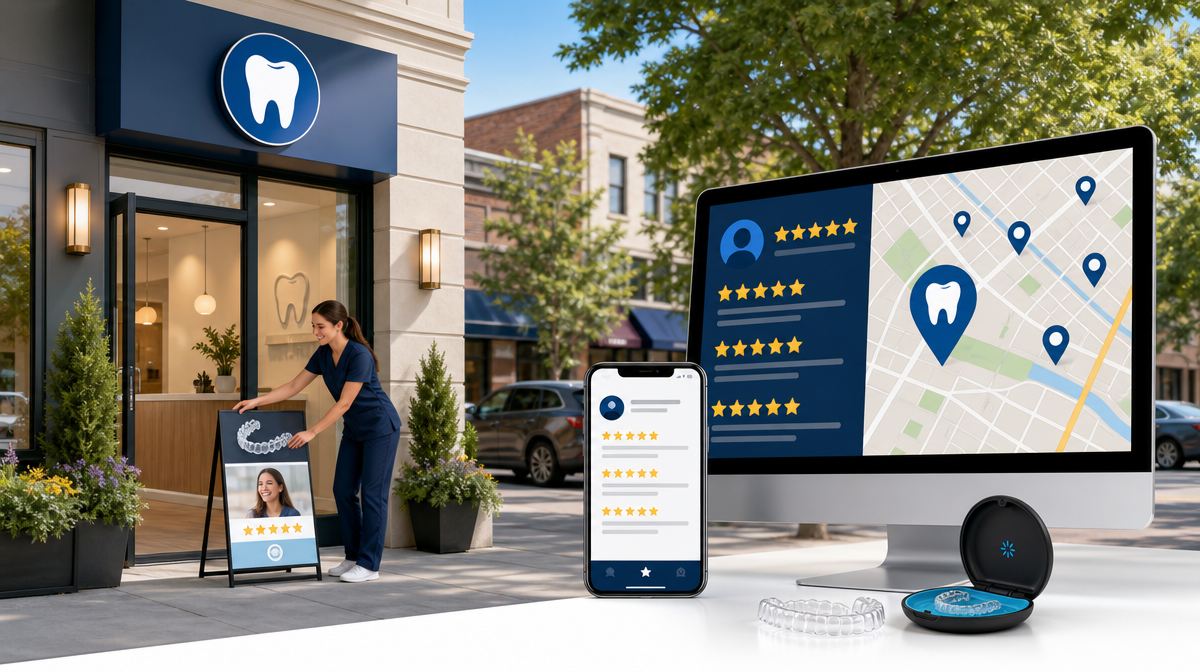
- Complete your profile: Add services, photos, hours, and Invisalign as a service
- Collect reviews: More positive reviews improve local rankings and build immediate trust with prospective patients
- Post regularly: Google Business posts signal ongoing activity and keep your profile fresh in the algorithm
- NAP consistency: Ensure your name, address, and phone number match exactly across every online directory
Citation building — getting your practice listed accurately across dental directories, Yelp, Healthgrades, and local business sites — reinforces that NAP consistency and strengthens your authority as a verified Invisalign provider in your market. Think of each citation as a vote of confidence that nudges Google toward ranking you higher when nearby patients are ready to book.
Getting leads is only half the battle — here’s how to close them. A full consultation calendar means nothing if patients walk out without signing. Most practices lose Invisalign cases not during the marketing phase, but inside the four walls of the office, at predictable friction points that are entirely fixable.
- Step 1: Pre-consult nurture and reminders. Automated email and SMS sequences sent between booking and appointment day do two things: they cut no-shows — a systematic review found appointment reminders reduce missed appointments by an average of 41% — and they warm patients up before they sit down. Educational content about the treatment process, financing options, and what to expect from their first visit converts a skeptical appointment into a motivated one.
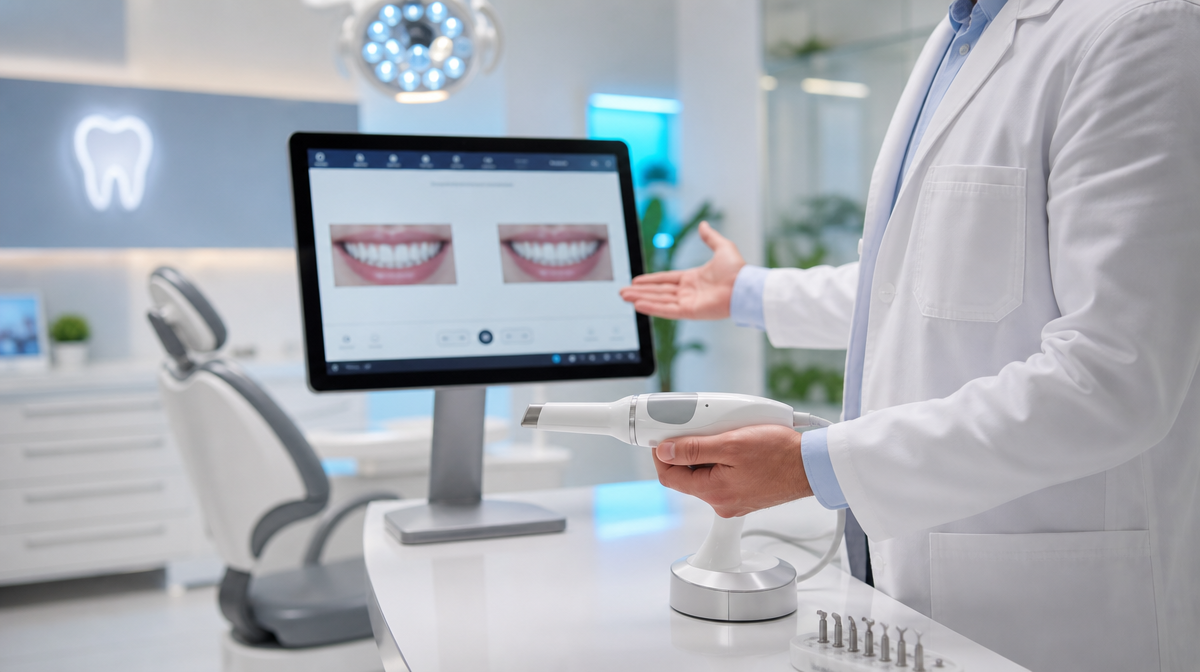
- Step 2: iTero scan and simulation experience. Nothing accelerates case acceptance faster than showing a patient their projected outcome. The iTero digital scanner produces a smile simulation in minutes — and patients who see their future smile during the consultation are significantly more likely to sign the same day. This single step has measurable impact on conversion rates across practices of every size.
- Step 3: Same-day case presentation. A well-trained treatment coordinator who presents treatment options, timeline, and investment clearly — without burying the conversation in clinical jargon — is worth more than most marketing tactics combined. Same-day presentations outperform follow-up attempts by a wide margin.
- Step 4: Follow-up sequences for undecided patients. For patients who don’t commit immediately, a structured nurture sequence — spaced over two to three weeks and mixing FAQs, patient testimonials, and financing reminders — keeps your practice top of mind without feeling like pressure. Text-message reminders sent at 48-hour intervals often revive cases that email alone misses.
Cost is the objection that kills more Invisalign cases than any clinical hesitation or scheduling conflict. When a patient hears a treatment investment between $4,000 and $8,000 and has no clear path to affordability, they leave your office to “think about it” — and most of them don’t come back.
The practices consistently hitting their Invisalign case start targets have figured out that financing isn’t just a payment option — it’s a closing tool that belongs in your consultation flow from the first minute, not as an afterthought when a patient flinches at the total.
Structure your financing presentation around three levers:
- Third-party financing: Options like CareCredit and Proceed Finance let patients apply and receive approval in minutes, often with promotional interest periods. Align Technology has also partnered with financing providers specifically designed for clear aligner treatment costs, making approval more accessible than traditional credit applications.
- In-house payment plans: Spreading the investment across the active treatment period — typically 12 to 18 months — removes the sticker shock entirely and reframes the conversation around a monthly number most patients find manageable.
- Insurance coordination: Many patients don’t realize their orthodontic benefits apply to Invisalign. Maximizing those benefits before presenting the out-of-pocket balance meaningfully reduces the gap your financing needs to cover.
The framing matters as much as the options themselves. Treatment coordinators who introduce monthly payment figures early — before presenting the full case fee — report consistently higher same-appointment acceptance rates than those who lead with the total investment.
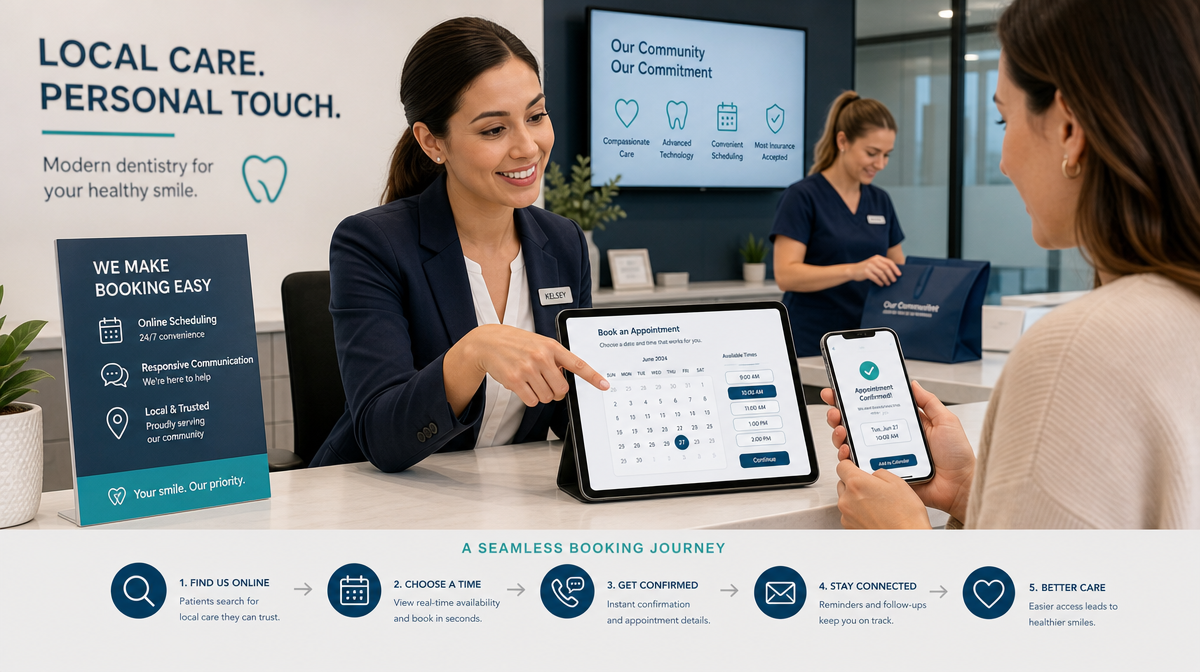
Your reputation is your best marketing asset — and for Invisalign specifically, it works harder than almost any paid channel you can run. 84% of patients read online reviews before selecting a healthcare provider, and clear aligner candidates are particularly research-intensive shoppers. They’re comparing three or four practices before committing to a free consultation.
The practices generating the most Invisalign case starts aren’t leaving reviews to chance. They’re running systematic collection processes that treat reputation the same way they treat ad spend — as an investment with a measurable return.
- Automated review requests: Trigger email and SMS requests within 24–48 hours of a positive patient interaction, when the experience is freshest. Target Google first, then Healthgrades and Facebook. Timing and platform targeting together can double your monthly review velocity without any additional staff effort.
- Video patient testimonials: A 60-second clip of a patient describing their Invisalign experience — in their own words, on their phone — outperforms polished studio content across every placement: website, social ads, and retargeting campaigns. Collect HIPAA-conscious consent at the same time as your photo releases.
- Patient referral incentives: Existing patients who completed Invisalign are your most credible ambassadors. A structured referral program offering account credits, gift cards, or whitening treatments creates a repeatable word-of-mouth engine. Track referral sources in your practice management software so you can identify which patients are generating the most new case starts and reward them accordingly.
The shift happening in Invisalign marketing right now isn’t about a new ad format or a better keyword strategy — it’s a fundamental change in how patient acquisition systems operate. Practices running manual campaigns, checking dashboards weekly, and following up on leads through spreadsheets are competing against AI-driven systems that make hundreds of micro-decisions per hour without any human involvement.
For practice owners, the practical implications are significant. AI tools embedded in modern patient acquisition platforms don’t just automate repetitive tasks — they learn from your specific patient data and continuously improve outcomes over time. Here’s where that intelligence is already being applied:
- AI chatbots: 24/7 patient engagement and appointment scheduling without front desk involvement
- Predictive lead scoring: Identify which leads are most likely to convert based on behavioral signals before your team spends time on them
- Automated campaign optimization: AI adjusts bids and targeting in real-time, shifting budget toward the audiences and placements generating actual consultations
- Content personalization: Tailor messaging based on where a patient is in their decision journey — first-time visitor versus someone who’s already visited your pricing page twice
Platforms like Target Patients MD’s A.L.I. 360 are built specifically around this model — using AI to connect Invisalign marketing channels into a single, self-optimizing acquisition engine rather than a collection of disconnected tools. This is the direction the entire industry is moving, and the gap between early adopters and everyone else widens every month.
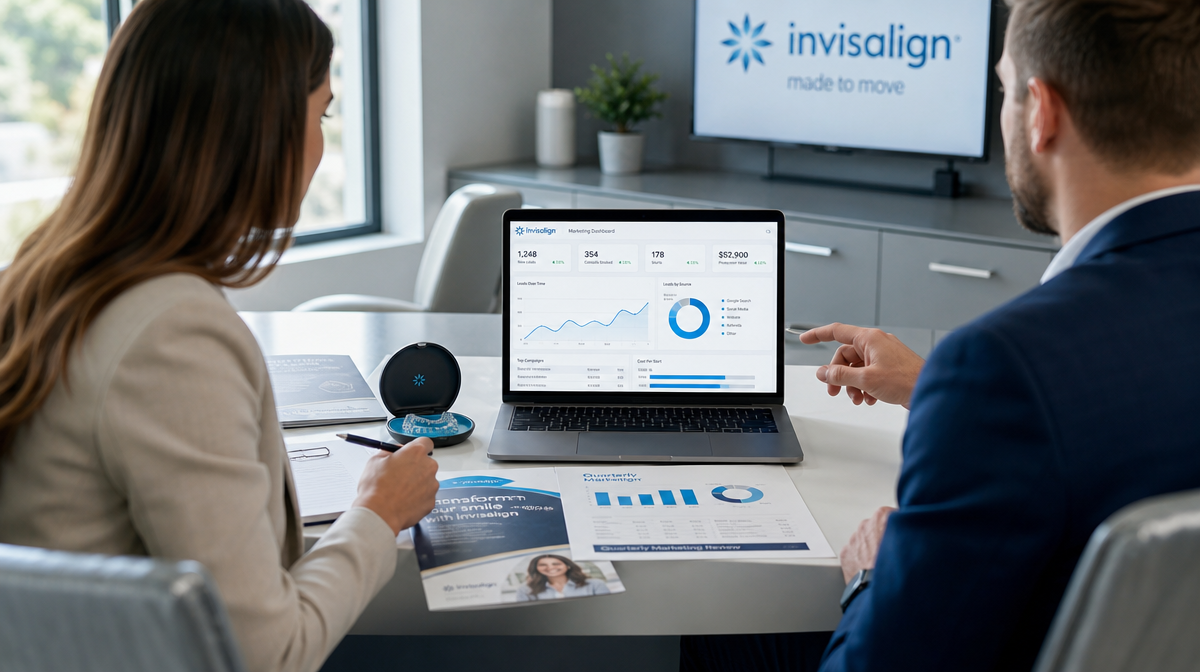
Running Invisalign marketing without tracking cost per lead and cost per case is like adjusting treatment without taking X-rays — you’re guessing where the problem is. These two numbers tell you whether your patient acquisition system is actually working or just spending.
Benchmarks vary meaningfully by market size, competition density, and channel mix, so treat these as directional targets rather than universal standards:
- Cost per lead (CPL): Ad spend divided by total leads generated. In competitive metro markets, Invisalign CPL through Google Ads typically runs between $40 and $120. Social campaigns often produce lower CPL figures, but those leads convert at a lower rate — so a cheaper lead isn’t always a better one.
- Cost per case (CPA): Total marketing spend divided by cases actually started. This is the number that matters most to your bottom line. Practices with strong consult-to-start conversion rates see CPA land between $300 and $700. Practices with leaky consult processes can see that number climb well past $1,000 even with efficient advertising.
- Consultation-to-case conversion rate: The ratio of completed consultations to signed treatment plans. Industry averages hover around 40–60%, but top-performing practices with trained treatment coordinators and structured same-day presentation processes consistently hit 65–75%.
| Metric | Definition | What It Tells You |
|---|---|---|
| Cost Per Lead (CPL) | Ad spend ÷ leads generated | Efficiency of lead generation |
| Cost Per Case (CPA) | Total marketing spend ÷ cases started | True patient acquisition cost |
| Conversion Rate | Consultations ÷ cases signed | Effectiveness of your consult process |
Tracking these metrics monthly gives you the visibility to isolate exactly where revenue is slipping — whether that’s a lead generation problem, a consult quality problem, or a follow-up gap — and fix it with precision instead of guesswork.
Most Invisalign providers trying to scale their case volume face the same structural problem: they’re running disconnected tactics — a Google Ads campaign here, an occasional Instagram post there, a follow-up email their front desk remembers to send — without a unified system tying lead generation, conversion, and retention into one measurable engine.
Target Patients MD was built specifically to solve that problem for dental and orthodontic practices. Our dental marketing work isn’t limited to driving traffic — it’s architected around booked appointments and signed cases, which means every campaign decision ties back to a number that actually appears on your revenue report.
The practice-facing results come from the A.L.I. 360 platform — a proprietary AI system that connects your paid search, social advertising, local SEO, and patient follow-up sequences into a single self-optimizing loop. Rather than requiring you to manage multiple vendors and reconcile conflicting data across platforms, the entire acquisition funnel runs through one integrated system that adjusts in real time based on what’s actually converting in your specific market.
Fully managed execution means your team stays focused on patient care while the marketing infrastructure runs in the background. No vanity metrics, no monthly reports padded with impressions and reach figures — just qualified Invisalign consultations on your calendar and the data to prove where each one came from.
Ready to fill your schedule with qualified Invisalign patients? Learn more about Target Patients MD and what a fully managed Invisalign marketing system looks like for practices at your growth stage.
Invisalign marketing questions come up constantly among practice owners trying to figure out where to focus their time and budget. Here are direct answers to the ones that matter most.
- How do you promote Invisalign in a dental practice? The most effective combination pairs Google Ads targeting high-intent searches with social media campaigns built around before-and-after visuals, local SEO, and a structured patient referral program. In-office, consistent marketing materials at every patient touchpoint — combined with treatment coordinator training — convert more consultations into signed cases.
- How much should a dental practice budget for Invisalign marketing each month? Budgets vary based on your market’s competition level and how aggressively you want to grow, but the right number is one you can sustain consistently rather than spike and pull back. Start at a level you can maintain for at least 90 days and scale based on your actual cost-per-case performance.
- Is Invisalign SEO more effective than paid ads for patient acquisition? They serve different purposes — paid ads generate consultations quickly while SEO builds compounding visibility over months. Practices seeing the strongest case volume growth typically run both simultaneously rather than choosing between them.
- How long does Invisalign marketing take to generate new patients? Paid advertising can produce consultation requests within days of launching. SEO typically requires several months before meaningful rankings and traffic materialize. A combined approach captures both immediate wins and sustainable long-term growth.
- Can small dental practices compete with corporate orthodontics for Invisalign patients? Yes — independent practices win on personalized care, local reputation, and targeted digital marketing that corporate chains can’t replicate at the individual practice level. Strong Google reviews and precise local targeting consistently help smaller practices outperform larger competitors in their immediate service area.