



Medical SEO is the process of optimizing your practice’s online presence so that patients searching for the care you provide can actually find you — before they find your competitors down the street. It sits at the intersection of three distinct disciplines working together: local search visibility, clinically accurate content, and technical website performance.
Think of it as the digital equivalent of having the best-located office in town, except the “location” is page one of Google. A patient searching “knee pain specialist near me” or “botox provider in [your city]” is actively looking to book. Medical SEO is what determines whether your practice appears in those results or disappears entirely.
Unlike general business SEO, healthcare SEO carries additional weight because Google treats medical content under stricter evaluation standards — more on that shortly. But at its core, a solid medical SEO foundation rests on three pillars:
- Local SEO: Claiming and optimizing your Google Business Profile so nearby patients find your practice first in map results
- Content optimization: Building patient-focused educational pages around the conditions, treatments, and symptoms your practice addresses
- Technical SEO: Ensuring your website loads fast, works flawlessly on mobile devices, and handles patient data through HIPAA-conscious forms and encrypted connections
When these three elements operate together consistently, your practice stops relying entirely on paid ads to fill your schedule — and starts building an organic patient pipeline that compounds over time.
If you’ve ever hired a general marketing agency and wondered why results were underwhelming, the answer often comes down to one thing: healthcare is not a standard vertical. Google applies a classification called YMYL — Your Money or Your Life — to medical content, which means your website is held to a fundamentally different (and significantly higher) evidentiary bar than a restaurant or a retail brand.
The practical consequences for your practice are real and immediate. A blog post written by an uncredentialed copywriter won’t perform the same way a physician-reviewed page will. A contact form that doesn’t use encrypted submissions creates both a compliance liability and a trust gap that Google’s quality raters notice. These aren’t edge cases — they’re daily realities for practices relying on generalist SEO vendors.
Here’s where medical SEO diverges most sharply from conventional search optimization:
- Content standards: General SEO rewards quality writing; healthcare SEO demands medically accurate, physician-reviewed content or risks ranking penalties
- Compliance obligations: Standard websites have no HIPAA exposure; your booking forms, chat widgets, and data collection points do
- Trust signals: A coffee shop earns trust through Yelp stars; your practice earns it through board certifications, provider credentials, and transparent clinical information
- Local intent: For most businesses, local SEO is a bonus channel — for a medical practice, it’s the primary battlefield where new patients are won or lost
Generalist agencies miss these distinctions constantly. The stakes of that gap aren’t just lower rankings — they’re empty appointment slots.
Google’s quality evaluation framework has two components every practice owner running a healthcare website needs to understand. E-E-A-T stands for Experience, Expertise, Authoritativeness, and Trustworthiness — the four lenses Google’s quality raters use to assess whether a website deserves prominent placement. YMYL (Your Money or Your Life) is the classification that triggers that heightened scrutiny in the first place, and medical content sits squarely inside it.

What this means practically: Google doesn’t just reward well-written health pages — it actively rewards credentialed health pages. A service page authored anonymously or reviewed by a content writer rather than a licensed clinician signals low E-E-A-T, regardless of how polished the prose is. Your competitors with physician-bylined content and linked provider credential pages have a structural ranking advantage that keyword stuffing alone will never overcome.
Demonstrating strong E-E-A-T in medical SEO requires action across four areas:
- Experience: Feature real practitioner backgrounds and clinical context that only someone with hands-on patient care experience could provide
- Expertise: Have board-certified physicians formally review and byline every clinical page on your site
- Authoritativeness: Build internal links connecting content pages back to your physician profile pages and credential documentation
- Trustworthiness: Display certifications visibly, maintain an active HTTPS certificate, and provide transparent contact information — including a physical address
Practices that treat these signals as optional are essentially competing at a structural disadvantage in every local search result that matters.
Every new patient relationship your practice will ever have starts the same way: someone opens a search engine and types a question. Not a referral call, not a billboard glance — 77% of patients start on Google.
What makes medical SEO different from other marketing investments is where it intercepts patients in their decision process. Someone searching “cardiologist accepting new patients in [city]” or “what to do about chronic knee pain” isn’t browsing casually — they’re actively shopping for a provider. Organic search puts your practice directly in front of that intent at the exact moment it exists.
The downstream benefits compound in ways that paid advertising simply cannot match:
- Attract patients ready to book: High-intent search queries deliver people who have already decided they need care — your page just needs to convince them you’re the right provider
- Build credibility before the first call: Ranking prominently signals institutional authority to prospective patients who are simultaneously comparing an average of 21 providers
- Lower your cost per patient over time: Unlike ad spend that evaporates the moment you pause a campaign, well-executed SEO generates patient inquiries long after the initial investment
- Outperform nearby competitors in specialty searches: Ranking for procedure-specific terms like “meniscus repair surgeon” or “GLP-1 provider” captures patients your general-practice competitors can’t reach
For a private practice operating on fixed overhead, that compounding return is the difference between a full schedule and a marketing budget that never quite justifies itself.
A strong medical SEO strategy doesn’t hinge on one tactic done exceptionally well — it requires five interconnected pillars operating simultaneously. Weakness in any single pillar limits the ceiling of the others.
- Technical SEO for healthcare websites: Search engines need to crawl, read, and index your site before any content can rank. This means clean site architecture, properly implemented schema markup for medical practices, and HIPAA-conscious forms that don’t create data liability. Because most patients search on smartphones, mobile-first indexing isn’t optional — it’s the baseline Google evaluates first.
- On-page optimization and patient-focused content: Service pages and educational posts built around the conditions, symptoms, and procedures your practice actually treats. Every page should target how patients phrase their searches, not how clinicians document diagnoses. Physician-reviewed content is the standard — not a differentiator.
- Off-page SEO and authoritative link building: Backlinks from health publications, medical associations, and .edu domains signal to Google that your practice is a credible source within the healthcare space. Digital PR — getting featured in local health journalism or contributing expert commentary — accelerates this process naturally.
- Local SEO and citation management: Your Google Business Profile, NAP consistency across directories like Healthgrades, Vitals, and Bing Places, and accurate listings across the web collectively determine whether your practice surfaces when nearby patients search.
- Reputation and review signals: Patient reviews influence local pack rankings directly. A systematic approach to generating reviews and responding to feedback isn’t a courtesy — it’s a measurable ranking factor your competitors are already managing.
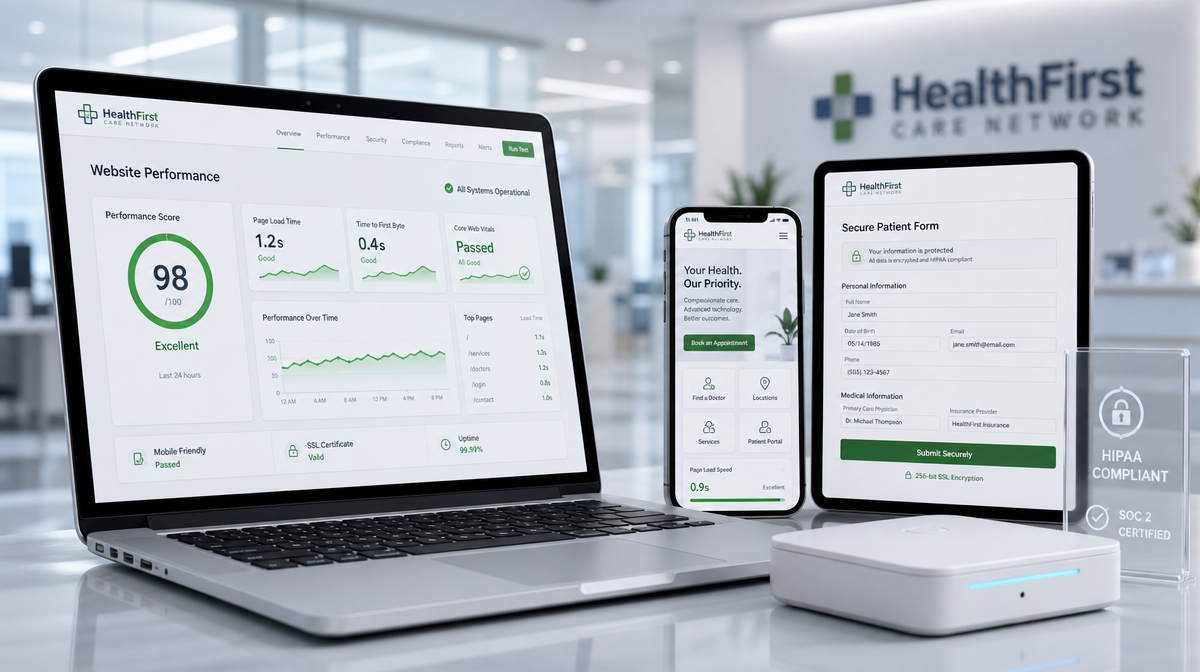
Knowing the pillars of medical SEO is one thing — putting them to work in your practice is another. These six steps translate strategy into actions your team can execute starting this week.
- Publish physician-reviewed content on a consistent schedule: Create dedicated pages for each condition you treat and each procedure you perform, with a licensed provider formally reviewing and bylined on every clinical page. One new, substantive page per month outperforms a burst of thin posts followed by silence.
- Run a technical audit and submit your XML sitemap: Open Google Search Console and check for crawl errors, orphaned pages, and blocked URLs that are quietly preventing your best content from being indexed at all.
- Compress images and validate Core Web Vitals: Use Google’s PageSpeed Insights to identify the specific elements slowing your site. Heavy, unoptimized images are the most common culprit — and the fastest fix available to most practices.
- Audit every patient-facing form for HIPAA-conscious data handling: Your appointment scheduler, contact forms, and any live chat tool must use SSL encryption and handle patient information carefully. This isn’t just a legal consideration — it’s a trust signal patients notice before they ever hit submit.
- Pursue backlinks from medical associations and local health media: Pitch expert commentary to regional health journalists, contribute guest posts to specialty publications, or pursue continuing education partnerships with nearby universities. Each credible inbound link strengthens your domain’s authority in Google’s eyes.
- Connect call tracking to your analytics: Traffic and rankings tell you what’s visible. Call tracking tied to Google Analytics tells you which keywords are actually driving booked appointments — the only metric that directly maps to practice revenue.
Most patients don’t search for “the best orthopedic surgeon in the country” — they search for one they can drive to. That geographic reality makes local SEO for doctors the single highest-leverage channel in your entire medical SEO program, and it deserves a more systematic approach than most practices give it.
Start with your Google Business Profile — not just claiming it, but treating it as a living asset. That means selecting the correct primary and secondary categories, uploading genuine photos of your facility and team, publishing Google Posts around seasonal health topics or new service offerings, and maintaining accurate hours across every holiday. Incomplete profiles lose the local pack to competitors who simply filled in every field. That same profile is what an assistant reads aloud when a patient asks for a practice nearby, which is why voice search for medical practices starts with the same fields.
Your NAP consistency — Name, Address, and Phone number — must match exactly across every directory where your practice appears. A suite number listed differently on Healthgrades versus Vitals versus Apple Maps creates conflicting signals that suppress your local rankings. The directories worth prioritizing:
- Healthgrades — where patients actively evaluate and compare providers
- Vitals and WebMD — high-authority health directories with direct ranking influence
- Bing Places and Apple Maps — often overlooked, but collectively covering a meaningful share of searches
- Yelp — still relevant for patients cross-referencing review sentiment
If you operate more than one location, each office needs its own dedicated page — not a shared contact page with a dropdown. Location-specific pages with embedded maps, individual staff bios, and neighborhood-relevant content signal to Google that each location is a distinct, credible entity worth surfacing to nearby patients.
Search behavior is shifting underneath your practice in real time — 47% of patients now use AI to find providers. When a patient asks ChatGPT “who are the best knee replacement surgeons near me” or triggers a Google AI Overview with “what causes chronic migraines,” the answer they receive doesn’t come from a paid ad — it comes from whatever sources the AI model has determined are credible enough to cite. That selection process is where your next wave of patient acquisition either gets captured or disappears entirely.
This emerging discipline is called Generative Engine Optimization (GEO) — structuring your content so AI systems pull from it when generating answers to health queries. It’s distinct from traditional ranking tactics because the goal isn’t just appearing in a list of blue links. It’s being the source an AI summarizes, quotes, or recommends directly to a patient who may never scroll further.
For your practice, the practical implications come down to a few concrete factors AI systems reward:

- Structured, factual content: Clearly organized pages that answer specific clinical questions in plain language are far more likely to be surfaced in AI-generated responses than dense, promotional copy
- Cited authority signals: Physician bylines, board credentials, and links to professional associations signal to AI models that your content meets the evidentiary threshold for health information
- Schema markup: Properly implemented medical schema helps AI systems understand exactly what your practice offers, where you’re located, and who your providers are
A.L.I. 360 by Target Patients MD is a proprietary AI-powered patient-acquisition system for medical and dental practices — the name stands for Attract, Learn, and Influence — and it is built to position practices across both traditional search and AI-generated discovery, because the two channels are increasingly inseparable.
One of the most common questions practice owners ask before committing to a medical SEO investment is simple: when will I actually see patients coming in from this? The honest answer depends heavily on where your practice is starting from — and the variables involved matter more than any generic timeline you’ll find elsewhere.
Your starting position shapes everything. A practice with an established domain, existing indexed pages, and some baseline local visibility will see measurable momentum from targeted optimizations much faster than a brand-new website with zero search history. New domains require search engines to build trust from scratch — a process that can’t be artificially accelerated regardless of how aggressive the strategy is.
The competitive environment around your specialty adds another layer of complexity. Here’s how the landscape typically breaks down:
- New website with no prior domain history: Requires a longer runway for indexation, authority accumulation, and ranking stability before consistent patient inquiries begin flowing
- Established site with existing rankings: Targeted technical fixes and content additions can produce visible improvements noticeably faster, since trust signals are already partially in place
- High-competition specialties like plastic surgery, aesthetic medicine, or dental implants: Require sustained, multi-channel effort over an extended period — quick wins exist, but dominant rankings take deliberate, ongoing work
The practical implication for your practice: treat medical SEO as infrastructure spending, not a campaign. The compounding nature of organic search means the practices investing consistently today are building an asset that keeps generating appointments — while competitors relying solely on paid ads start from zero every billing cycle.
Pricing for medical SEO varies widely, and that range exists for legitimate reasons — not just agency markup. Understanding what drives cost helps you evaluate proposals with a sharper eye instead of defaulting to the cheapest option and wondering later why your schedule isn’t filling.
Four variables determine where your investment lands:
- Scope of services: A one-time technical audit carries a very different price than a full-service engagement covering content production, link acquisition, and ongoing optimization. Know which deliverables you’re actually buying before comparing quotes side by side.
- Practice size and location count: A solo practitioner in a mid-sized market has meaningfully different needs than a multi-location specialty group in a major metro. More locations mean more local SEO work, more citation management, and more location-specific content — all of which add to the engagement scope.
- Competitive intensity: Plastic surgery, dental implant marketing, and aesthetic medicine in dense urban markets require sustained, resource-intensive effort to move rankings. Lower-competition specialties in smaller communities reach visibility faster and at lower ongoing cost.
- Agency specialization: Healthcare-only agencies command higher rates than generalists — and typically justify them. Understanding HIPAA requirements, E-E-A-T standards, and physician credentialing processes isn’t knowledge a generalist agency develops overnight. That expertise gap shows up directly in your results timeline and in whether your site creates compliance exposure.
The framing that serves most practice owners best: evaluate medical SEO as a patient acquisition cost, not a marketing line item. The relevant question isn’t what the monthly retainer costs — it’s what a new patient is worth to your practice over their lifetime as a patient.
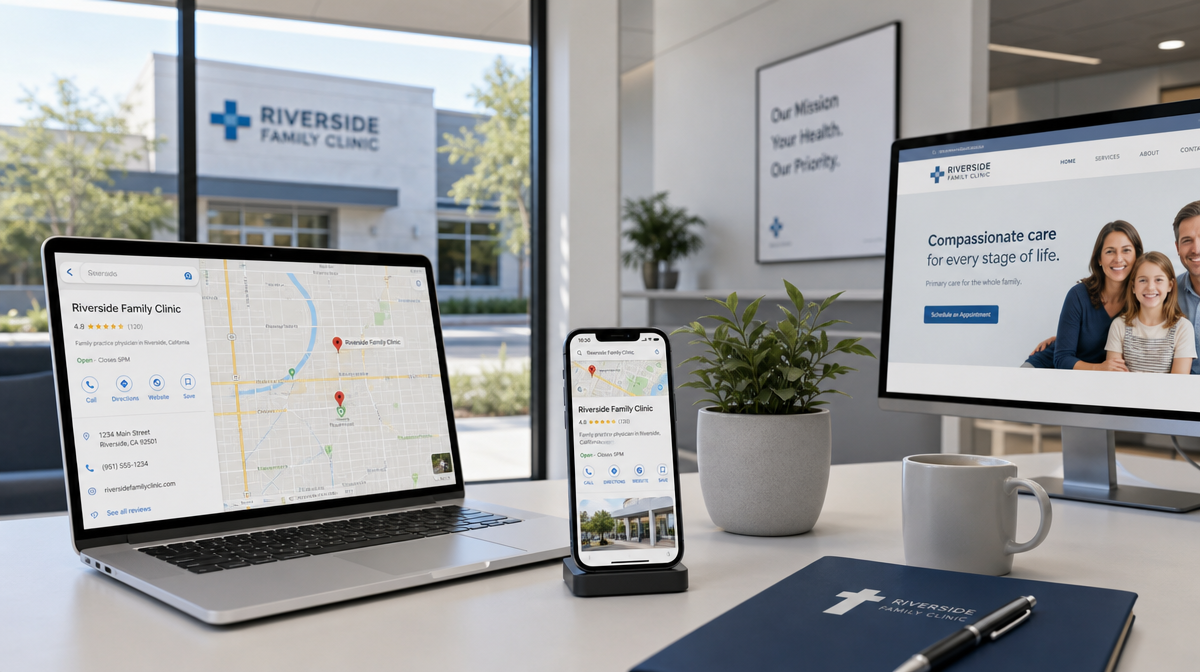
Not all agencies that pitch you on medical SEO actually understand how healthcare practices acquire patients. The difference between a generalist vendor and a true healthcare specialist shows up quickly — in your compliance exposure, in the quality of the content they produce, and ultimately in whether your phone rings.
Before signing anything, put every candidate through these four filters:
- Healthcare-only specialization: Ask directly what percentage of their client base is medical practices. Agencies that split their attention across e-commerce, restaurants, and law firms haven’t built the institutional knowledge around HIPAA obligations, physician credentialing workflows, or E-E-A-T requirements that healthcare demands. Generic SEO playbooks applied to a medical practice routinely create compliance gaps that show up as liabilities, not rankings.
- Proof measured in booked appointments: Any agency can show you a keyword ranking report. Ask instead for evidence of new patient volume — actual appointment growth attributed to organic search. If they can’t connect their SEO work to front-desk outcomes, they’re optimizing for metrics that don’t pay your overhead.
- Transparent dashboards with clear attribution: You should be able to log in at any point and see which keywords are generating calls, which pages are converting, and how organic performance trends over time. Opaque monthly PDFs are a red flag — not a reporting standard.
- An in-house team with no outsourced execution: Content written offshore by writers unfamiliar with clinical accuracy introduces E-E-A-T risk with every page published. Ask who specifically will write, optimize, and report on your account — and whether those people are employees or contractors.
The practices that consistently outperform their local competitors on search aren’t necessarily the ones with the best clinical outcomes or the most experienced physicians. They’re the ones that made a deliberate decision to treat patient acquisition as a system — not a series of one-off marketing experiments.
Medical SEO done well is infrastructure. It doesn’t behave like a campaign you launch, evaluate for sixty days, and either renew or cancel. It behaves like the reputation you’ve spent years building in your community — slow to establish, difficult to displace once it’s in place, and genuinely valuable precisely because your competitors can’t copy it overnight.
That’s where the right partner changes the equation. Target Patients MD works exclusively with medical practices — not law firms, not e-commerce brands, not restaurants. Across more than 735 practitioners, the work centers on one outcome: more booked appointments from patients who were already searching for what you offer.
What that looks like in practice:
- Healthcare-exclusive focus — every strategy is built around patient acquisition, not vanity metrics
- AI-powered patient acquisition through the A.L.I. 360 platform, designed for both traditional search and the AI-driven discovery channels reshaping how patients find providers
- Transparent, attribution-first reporting — you see appointments generated, not just rankings climbed
Your schedule won’t fill itself. Learn more about Target Patients MD and what a healthcare-only approach to medical SEO looks like for your practice.
- What does SEO stand for in medical marketing? SEO stands for Search Engine Optimization — the technical and content-based process of improving where your healthcare website appears when patients search Google and other search engines for providers like you.
- Does medical SEO create HIPAA exposure? The optimization work itself doesn’t create HIPAA exposure, but the tools layered onto your website can. Any form, appointment widget, or chat feature that collects patient information must use encrypted submissions and HIPAA-conscious data handling — otherwise your site becomes a liability regardless of how well it ranks.
- Can I handle medical SEO myself or do I need outside help? Basic tasks like updating your Google Business Profile or fixing a broken page are manageable in-house. But the combination of clinical content standards, technical auditing, compliance requirements, and link acquisition is genuinely specialized work — most practice owners find that attempting it alone produces slower results and higher compliance risk than partnering with a medical SEO agency.
- How is medical SEO different from medical SEM? SEO earns organic placement through content quality and technical performance; SEM refers to paid placements like Google Ads. Both channels serve patient acquisition, but they operate independently — ad spend has no effect on your organic rankings.
- Does medical SEO work for a practice that just opened? Yes, but newer domains require more groundwork before rankings stabilize. Starting with strong local SEO fundamentals and well-structured service pages accelerates the authority-building process considerably.
- What actually proves medical SEO is working? Booked appointments and new patient volume attributed to organic search — tracked through call recording and form submission analytics — not keyword positions or raw traffic numbers alone.