


Med spa marketing in New York is the practice of attracting, converting, and retaining aesthetic patients through digital channels — but doing it in a market that operates by entirely different rules than anywhere else in the country. New York City isn’t just competitive; it’s a category of its own.
Consider the sheer density. Manhattan alone has more med spas per square mile than most entire U.S. cities, meaning your practice is one scroll away from a dozen alternatives offering the same Botox, filler, and laser treatments. Generic campaigns built for a suburban market simply don’t survive here.
Then there’s the clientele. NYC patients are unusually research-driven — they compare credentials, read reviews across multiple platforms, and often consult friends before booking a single consultation. A vague “we’re the best” message gets ignored. Specificity, proof, and trust signals do the work.
Perhaps the most overlooked challenge is neighborhood fragmentation. The Upper East Side patient is not the same as the Williamsburg patient, and neither resembles the SoHo crowd. Each micro-market has distinct income levels, aesthetic preferences, and content expectations. What converts in one ZIP code can actively repel prospects in another.
- High competition density: More med spas per square mile than any other U.S. market
- Affluent, research-driven clientele: NYC patients compare providers extensively before booking
- Neighborhood micro-markets: Upper East Side vs. SoHo vs. Williamsburg require distinct messaging
Before you build a single campaign, you need an honest picture of who is actually booking appointments at NYC med spas — because the answer is more nuanced than “women who want Botox.” The New York aesthetic patient skews toward four distinct profiles, each requiring a different marketing message to convert:
- The lunch-break optimizer: A 32–48 year old professional in finance, law, or media who has exactly 45 minutes and wants a treatment with zero downtime. She books on her phone, expects instant confirmation, and will not wait on hold. Speed and convenience are the deciding factors.
- The ingredient-conscious researcher: Often wellness-adjacent, she’s already read three Reddit threads about the difference between Sculptra and Radiesse before landing on your website. She responds to clinical authority, provider credentials, and transparent treatment explanations — not vague promises about “looking refreshed.”
- The socially-discovered patient: She found your practice through a TikTok or an Instagram Reel, not a Google search. She’s younger, often booking her first aesthetic treatment, and her trust is built through visual proof and peer validation rather than star ratings.
- The loyal membership seeker: She’s already a med spa patient somewhere — possibly your competitor. She’s looking for a practice that will reward her consistency with pricing that reflects her long-term value.
Once you know who you’re marketing to, the next decision is how you position against the practice three blocks away offering the same treatment menu. Standing out in a market this saturated isn’t about better ads or a prettier website — it’s a deliberate positioning decision, a clearly defined reason a patient in your specific neighborhood should choose you.
- Build a sharp, service-led brand position: The practices that dominate specific NYC neighborhoods aren’t generalists — they’re known for something. “The Sculptra specialists of Tribeca” or “Brooklyn’s go-to clinic for natural-look filler” is a more bookable identity than “full-service med spa.” Owning a specific treatment category or patient outcome gives your marketing a center of gravity that generic competitors can’t replicate.
- Own a neighborhood instead of the whole city: Competing for “med spa NYC” puts you against every established practice in all five boroughs. Winning “Botox Flatiron” or “laser treatments Park Slope” is a far more achievable and profitable objective. Hyper-local keyword targeting, neighborhood-specific landing pages, and Google Business Profile optimization tuned to your immediate ZIP code turn geographic proximity into a genuine competitive advantage.
- Productize your signature treatments: Branded treatment packages with clear names, transparent pricing, and bundled outcomes are significantly easier to market — and remember — than a generic service list. A named package signals confidence, simplifies the booking decision, and creates a shareable offer that travels well on social platforms.
- Use social proof as a conversion asset: NYC patients don’t take provider claims at face value. A robust portfolio of documented patient results, posted with proper consent, does more persuasive work than any ad copy. Practices that consistently surface real outcomes — not stock photography — convert at measurably higher rates across every channel.
Most generalist agencies treat a med spa like a boutique clothing store — push the ad, drive the click, count the conversions. That approach ignores a fundamental reality: aesthetic medicine is a regulated healthcare environment, and the marketing that surrounds it carries legal obligations that a typical digital agency has never encountered.
HIPAA-conscious campaign design isn’t optional, and it’s more nuanced in advertising than most practice owners realize. Pixel-based tracking tools on booking forms, retargeting configurations, and even certain Meta ad audience parameters can create compliance exposure if they’re not set up correctly. A generalist agency that doesn’t know the difference between a standard lead form and a protected health information trigger is a liability, not an asset.
Beyond compliance, there’s the patient journey itself. Aesthetic patients don’t behave like retail shoppers making impulse purchases. They move through an extended consideration cycle — researching treatments, vetting injectors, and evaluating trust signals — before they ever pick up the phone. A healthcare-specialized agency understands how to build campaigns that meet patients at each stage of that journey rather than just targeting bottom-of-funnel intent.
The difference becomes even sharper when you look at platform coverage. Generic agencies default to Google and Yelp. A specialized partner knows that aesthetic patients also rely on Healthgrades, RateMDs, and Vitals when evaluating providers — and that your absence from those platforms costs you patients your competitors are quietly capturing.
- HIPAA-conscious design: Built into campaign architecture, not retrofitted as an afterthought
- Patient journey expertise: Campaigns mapped to the full consultation-to-booking cycle
- Accurate medical terminology: Messaging that reflects clinical credibility, not guesswork
- Expanded platform coverage: Healthgrades, RateMDs, and Vitals included alongside Google
Running a successful med spa in New York requires more than one or two marketing tactics firing independently. The practices that consistently fill their booking calendars operate with an integrated system where every channel reinforces the others — SEO builds authority, paid ads capture immediate demand, and a well-designed website turns that traffic into booked consultations.
Think of it as an ecosystem rather than a checklist. When med spa marketing in New York is structured correctly, each service layer compounds the performance of the next. Your organic rankings reduce your cost per click. Your reputation drives higher conversion rates from paid traffic. Your email campaigns bring back patients who found you through social media months earlier.
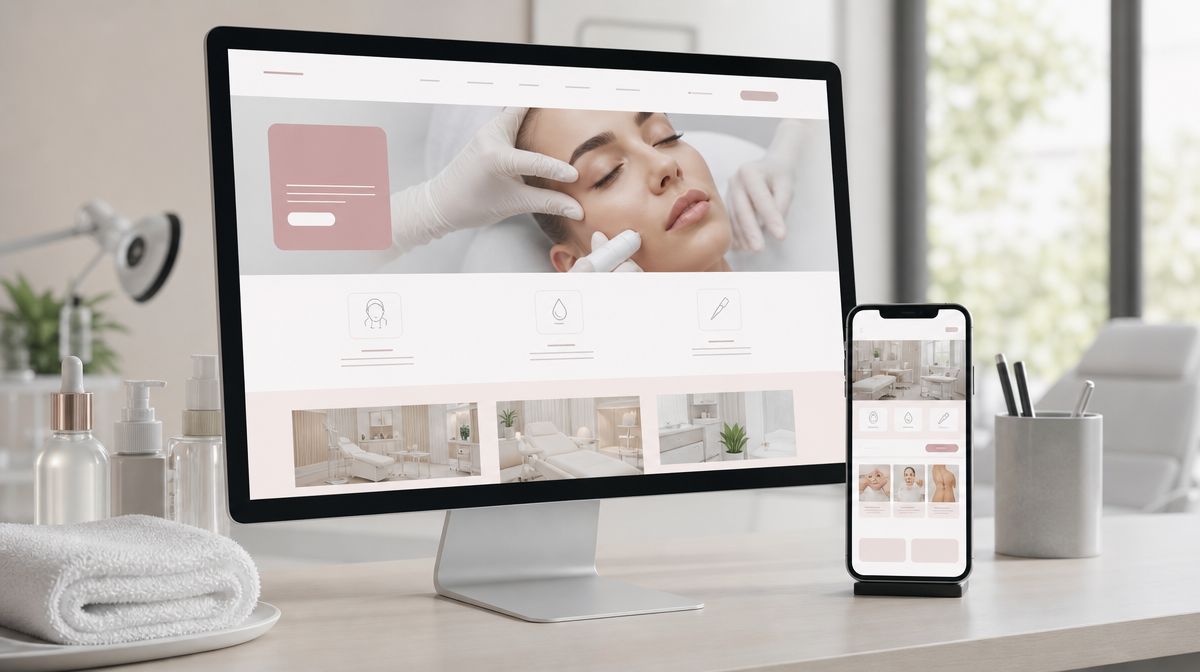
The five core services that anchor a complete aesthetic marketing program include:
- Search engine optimization for aesthetic clinics: Organic rankings that put your practice in front of patients actively searching for Botox, fillers, laser treatments, and body contouring in your area
- Paid search and social advertising: Immediate visibility through Google and Meta campaigns targeting high-intent prospects ready to book
- Conversion-focused website design: Mobile-first, fast-loading pages with integrated booking tools that turn visitors into scheduled appointments
- Reputation and review management: Systematic collection and monitoring of patient reviews across the platforms aesthetic patients actually use to make decisions
- Email and SMS patient outreach: Automated campaigns that keep existing patients returning for maintenance treatments and seasonal promotions
Local SEO is the discipline of optimizing your online presence so patients searching within a specific geographic area find your practice — not a competitor three blocks away. In a city where someone searching “Botox Upper East Side” and someone searching “Botox Williamsburg” are looking for entirely different experiences, neighborhood-level targeting isn’t a nice-to-have. It’s the foundation of any effective med spa marketing strategy in New York.
Most practices make the mistake of optimizing for broad city-level terms and calling it done. The problem is that “med spa New York City” puts you in a fight against every established practice across all five boroughs simultaneously. Hyper-local content — dedicated landing pages, neighborhood-specific service descriptions, and location-anchored blog content — lets you compete in smaller, more winnable arenas where your proximity is actually a selling point.
Three components drive local search performance for NYC aesthetic practices:
- ZIP code and borough-level targeting: Separate content strategies for neighborhoods like Tribeca, SoHo, and the Upper East Side, each reflecting the distinct demographics and treatment preferences of those communities
- Google Business Profile optimization: A fully built-out profile with accurate location data, treatment-specific service categories, current photos, and active Q&A management is what earns placement in Google Maps results when patients search nearby
- Local citations and directory listings: Consistent name, address, and phone information across directories — from Yelp to Healthgrades to Apple Maps — signals credibility to search engines and strengthens your local ranking authority
Organic search builds your long-term foundation, but paid advertising is what fills appointment slots this week. For practices investing in med spa marketing in one of the highest-cost digital advertising environments in the country, the difference between profitable campaigns and wasted budget comes down to how precisely your ads match patient intent at each stage of the decision process.
Three campaign types form the backbone of a high-performing paid strategy for aesthetic practices:
- Google Ads for Botox and filler searches: When someone types “Botox injector Midtown” or “lip filler near me NYC,” they have already decided they want the treatment — they’re choosing a provider. Search ads intercept that moment with a direct offer, capturing patients who are ready to book rather than still browsing. Tight keyword matching and procedure-specific landing pages are what separate a profitable campaign from one that burns through budget on irrelevant clicks.
- Meta Ads for CoolSculpting and body contouring: Body treatments require a different creative approach because patients often don’t know they’re interested until they see a compelling visual. Facebook and Instagram ads let you tell a story through before-and-after imagery, short video demonstrations, and outcome-focused copy — building awareness among audiences who fit your ideal patient profile before they ever search.
- Retargeting campaigns: The majority of first-time website visitors leave without booking. Retargeting serves follow-up ads specifically to those visitors as they browse other sites and social platforms, keeping your practice visible during the consideration period that often stretches days or weeks for aesthetic treatments.
Each campaign type targets a different point in the patient decision cycle — and together, they ensure no qualified prospect slips through the cracks.
Likes and followers are vanity. Consultations are currency. The mistake most NYC med spas make on social media is optimizing for engagement metrics that look impressive in a monthly report but never translate to a patient in the chair. A content strategy built around lead generation looks fundamentally different — and performs fundamentally differently.

Aesthetic practices have a natural advantage on visual platforms: the results speak for themselves. The challenge is structuring content so that compelling visuals are paired with conversion paths — clear calls to action, direct message prompts, and frictionless links to booking pages. Without that architecture, even the most stunning before-and-after reel is just entertainment.
Four content formats consistently move NYC aesthetic audiences from passive scrollers to active inquiries:
- Before/after transformations: Documented patient results, shared with proper consent, are the single most persuasive content type in aesthetic marketing — they answer the question every prospect is silently asking: can you actually do this for someone who looks like me?
- Educational reels: Short-form video explaining how treatments work, what to expect during a session, or how to choose between similar procedures reduces the fear barrier that keeps hesitant patients from booking
- Provider spotlights: Featuring your injectors and aestheticians by name builds the personal trust that drives patients to request a specific provider — a loyalty dynamic that dramatically increases retention
- Behind-the-scenes content: Showing the clinical environment, the consultation process, and the people behind the practice demystifies the experience for first-time aesthetic patients
Your website isn’t just a digital brochure — in the context of med spa marketing in New York, it’s the single point where every upstream marketing effort either pays off or falls apart. Traffic from Google, paid ads, and social media all lands here. If the experience doesn’t immediately signal expertise and make booking effortless, you’ve paid to send patients to a dead end.
The technical bar in NYC is particularly unforgiving. Aesthetic patients in this market are comparing three or four practices simultaneously, and a slow-loading page or a clunky mobile layout is reason enough to close the tab and book somewhere else. Google’s Core Web Vitals — the speed and stability metrics that influence search rankings — are also patient experience metrics. A site that ranks well and converts well is built to the same standard.
Five design elements separate a high-performing aesthetic website from an expensive placeholder:
- Mobile-first responsive design: The majority of aesthetic patients browse and book from their phones, not a desktop — your layout must perform flawlessly at every screen size
- Prominent online booking widget: Every additional step between interest and appointment is a drop-off point; inline booking removes that friction entirely
- Before/after galleries: Visual proof of outcomes is what separates a practice that earns trust from one that merely claims it
- Provider credentials and bios: Patients choosing an injector want to know exactly who will be treating them and what qualifies that person
- Clear pricing or consultation CTAs: Transparent cost signals prevent the sticker-shock abandonment that quietly kills conversion rates
In aesthetics, the stakes of a bad review are higher than in almost any other service category. Patients are making decisions about their faces and bodies — and when trust is the primary purchase driver, a pattern of unaddressed negative feedback or a thin review profile can quietly redirect bookings to the practice down the street, regardless of how skilled your injectors actually are. Medical Economics reports that 84% of patients check online reviews before choosing a provider.
What separates practices that dominate their local reputation from those that struggle isn’t the volume of positive experiences — it’s whether those experiences get documented publicly. Most satisfied patients won’t leave a review unless prompted at exactly the right moment. Automated post-visit outreach via email and SMS, timed within 24 to 48 hours of an appointment, captures feedback while the experience is still fresh and the patient’s enthusiasm is at its peak.
Three components make up a complete reputation management system for NYC aesthetic practices:
- Automated review generation: Systematic post-visit requests that make leaving a review a two-tap process — not a task patients have to remember on their own
- HIPAA-conscious review display: Showcasing patient feedback on your website without inadvertently disclosing protected health information requires specific technical and legal guardrails that most generic tools skip entirely
- Multi-platform monitoring: Google, Yelp, Healthgrades, RateMDs, and Vitals each attract different segments of the aesthetic patient population — responding professionally across all of them signals the kind of attentiveness that prospective patients notice before they ever book
Aesthetic treatments are inherently cyclical. Botox metabolizes in three to four months. Filler gradually absorbs. Laser packages require multiple sessions spaced weeks apart. That biological reality means your existing patient base represents a predictable, recurring revenue stream — but only if you have a system that stays in front of them between visits.
Email and SMS campaigns are that system. The practices that see the strongest patient lifetime value in the NYC market aren’t just acquiring new patients — they’re running automated outreach sequences that turn a single Botox appointment into a long-term client relationship worth thousands of dollars annually.
The most effective retention campaigns for New York aesthetic practices are built around four trigger types:
- Treatment reminders: Automated messages timed to each treatment’s typical maintenance window — a Botox reminder at week ten, a filler check-in at month five — bring patients back before they even notice the results fading
- Seasonal promotions: Summer body contouring packages and pre-holiday skin prep campaigns align your offers with the moments patients are already thinking about their appearance
- Birthday and anniversary offers: Personalized milestone rewards create an emotional connection that generic promotional blasts can’t replicate, and they drive bookings during periods that would otherwise be quiet
- New service announcements: Introducing a new treatment to your existing patient list is the lowest-cost, highest-conversion sales motion in med spa marketing — these patients already trust you
AI in marketing context means software that analyzes behavioral data, predicts outcomes, and automates decisions faster than any human team can execute manually. For NYC med spas competing across dozens of micro-markets simultaneously, that speed and precision is the difference between a campaign that scales and one that plateaus.
Target Patients MD’s A.L.I. 360 technology applies this directly to aesthetic patient acquisition — processing signals across search behavior, demographic data, and engagement patterns to continuously refine who sees your ads, when they see them, and what message they receive. Practices using this system can see meaningful gains in patient acquisition, reflecting what happens when targeting decisions are driven by machine learning rather than manual guesswork.
Three AI-driven capabilities are reshaping med spa marketing in New York right now:
- Predictive analytics and audience targeting: AI identifies which prospect segments have the highest probability of booking a specific treatment, then concentrates ad spend toward those audiences — reducing wasted impressions and lowering cost per acquisition
- Generative engine optimization (GEO): As Google AI Overviews and ChatGPT increasingly answer patient questions directly in search results, GEO ensures your practice is cited as a trusted source within those AI-generated responses — a visibility layer that traditional SEO alone cannot capture
- AI chatbots and automated scheduling: A prospective patient researching lip filler at 11 p.m. on a Sunday won’t wait until Monday morning to get answers — an AI-powered chat interface books consultations and handles common questions around the clock, capturing demand that would otherwise expire overnight
Marketing spend without measurement is just optimism with a budget. Before you can judge whether your med spa marketing in New York is working, you need to agree on which numbers actually matter — and ignore the ones that just feel good to report.
The metrics worth tracking are the ones with a direct line to revenue. Vanity numbers like impressions and follower growth tell you about reach; the KPIs below tell you about business performance:
- Cost per lead: What you pay for each inquiry — a call, a form submission, a direct message — before you know whether that person will ever book
- Cost per acquisition: What you pay for each patient who actually completes a booked appointment, which is the number that determines whether your marketing is profitable
- Booking rate: The percentage of inquiries that convert to scheduled appointments, which reveals whether your front desk or follow-up process is the bottleneck rather than the marketing itself
- Patient lifetime value: The total revenue a single patient generates across repeat visits, referrals, and treatment upgrades — the metric that reframes acquisition cost as an investment rather than an expense
- Return on ad spend: Revenue attributed to paid campaigns divided by what you spent running them, expressed as a ratio that tells you whether each advertising dollar is multiplying or disappearing
Tracking these numbers requires proper attribution setup from day one — UTM parameters, call tracking, and CRM integration that connects a booked appointment back to the specific campaign that generated it.
Choosing the wrong agency costs more than their monthly retainer — it costs you months of lost bookings and a reputation you’ll have to rebuild. The NYC aesthetic market moves fast, and a bad partnership sets you back in ways that are hard to quantify until you’re already behind.
Three criteria separate agencies worth hiring from ones worth avoiding:
- Healthcare and aesthetic industry specialization: Ask a prospective agency how they handle HIPAA-conscious ad configurations, which aesthetic-specific review platforms they actively manage, and how they structure campaigns differently for injectables versus body contouring. Vague answers reveal a generalist who will learn your industry on your dime.
- Transparent reporting and ROI dashboards: You should never have to ask how your campaigns are performing. The right partner provides real-time access to dashboards that tie specific campaigns to booked appointments — not just clicks — and schedules regular strategy calls where those numbers are explained in plain language rather than buried in a PDF.
- Reporting tied to booked patients: An agency should report against the outcomes that matter — booked appointments and revenue by channel, not activity metrics. Look for a partner whose reporting connects their work directly to the patients who actually showed up, so you always know what your investment is producing.
The right agency functions as a growth partner embedded in your practice’s success — not a vendor executing tasks and invoicing monthly regardless of outcome.
Target Patients MD was built exclusively for healthcare practices — not restaurants, e-commerce brands, or law firms that happen to call themselves “full-service.” That specialization means every campaign, every landing page, and every automation sequence is designed with the specific regulatory environment, patient psychology, and competitive dynamics of medical aesthetics in mind.
For New York med spas specifically, the work begins with understanding your neighborhood before touching a single ad setting. Practices in Tribeca attract different patients than those in Astoria or Park Slope, and the messaging, imagery, and offer structure that fills one practice’s calendar won’t necessarily move the needle for another three miles away.
What you get with Target Patients MD is a complete patient acquisition system, not a collection of disconnected services:
- Reporting from day one: Built around booked appointments and new patient volume, not activity metrics
- A.L.I. 360 AI technology: Proprietary targeting and optimization that continuously improves campaign performance across every channel
- Healthcare-only expertise: A team that works exclusively with medical and dental practices and understands the compliance, terminology, and patient journey nuances that generalist agencies consistently get wrong
- Integrated channel management: SEO, paid ads, reputation, and patient retention working as a single coordinated system rather than siloed tactics
Book a free consultation at targetpatientsmd.com and find out exactly what a tailored med spa marketing strategy in New York looks like for your specific practice, location, and growth goals.
- How much does med spa marketing cost in New York?
- Investment varies considerably depending on which services you need, how saturated your specific neighborhood is, and what growth targets you’re working toward. A single-location practice in a moderately competitive borough will require a different budget than a multi-treatment clinic trying to dominate Manhattan search results. The most accurate way to understand your specific cost is through a free strategy consultation that accounts for your current baseline, competitive landscape, and revenue goals.
- How long until a NYC med spa sees results from digital marketing?
- Paid advertising typically begins generating inquiries within the first few days of a live campaign. Organic search rankings build more gradually — meaningful traffic gains generally emerge over several months as content authority accumulates. Most practices see measurable new patient activity within the first few weeks when paid and organic channels are running in parallel.
- Can a med spa advertise on Google and Meta without creating HIPAA exposure?
- Yes, when campaigns are configured correctly. Proper setup requires specific pixel restrictions, appropriate audience targeting parameters, and landing pages that avoid collecting protected health information without adequate safeguards. Compliance ultimately depends on how a practice configures and operates its own systems — the risk comes from misconfiguration, not the platforms themselves.
- What should a New York med spa expect from a marketing engagement?
- A strong partner ties reporting to the outcomes that matter — booked appointments, cost per acquisition, and revenue by channel — and reviews performance with you regularly, so you can see exactly what your investment is producing as the engagement develops rather than waiting on a PDF full of impressions and clicks.
- Can a marketing agency help launch a new med spa in New York City?
- Yes. Pre-opening support typically includes brand development, website buildout, local SEO foundation work, and launch campaigns designed to generate an initial patient base before the doors open.