


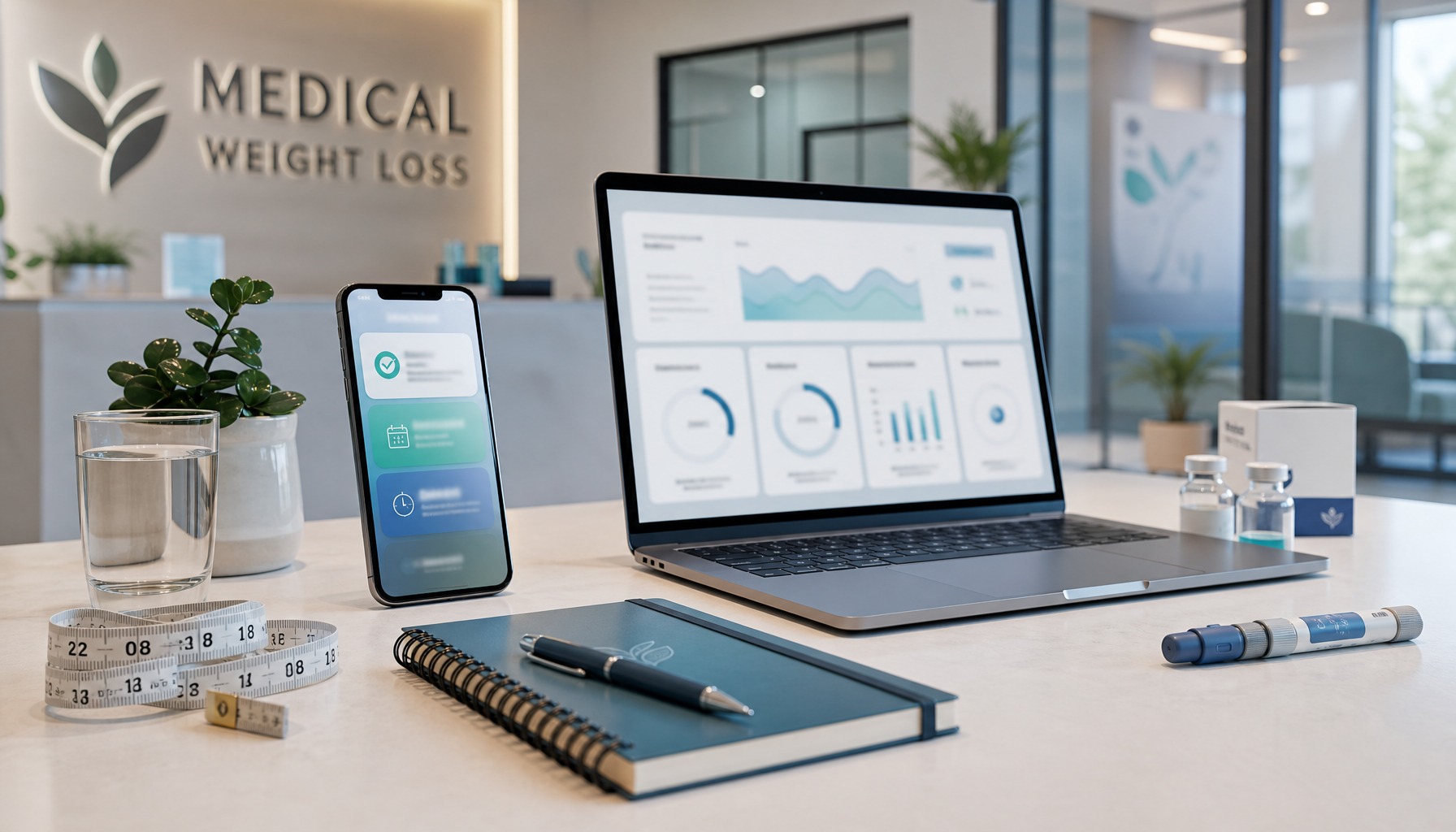
Medical weight loss marketing is the practice of promoting physician-supervised weight management programs to patients who are actively looking for clinically backed solutions — not another fad diet or over-the-counter supplement. It sits at the intersection of healthcare marketing and patient education, requiring a strategy that’s built around trust, credentials, and clinical outcomes rather than flashy before-and-after promises.
What separates this niche from general wellness marketing is the nature of the patient relationship. Someone considering a medically supervised program is often making a significant health decision, not an impulse purchase. That means your marketing has to do more than grab attention — it has to build confidence in your expertise and your process before a single appointment is booked.
The explosive growth of GLP-1 medications like Semaglutide (the active ingredient in Ozempic and Wegovy) and Tirzepatide (found in Mounjaro and Zepbound) has dramatically expanded patient demand for medical weight loss programs. That demand — projected to reach 30 million patients by 2030 — has also intensified competition, making a well-executed marketing strategy more critical than ever for clinics that want to stand out.
Effective medical weight loss marketing typically focuses on three core pillars:
- Trust-building: Demonstrating that care is physician-supervised and clinically rigorous
- Patient education: Explaining how your program differs from commercial or self-directed approaches
- Expert positioning: Showcasing provider credentials, certifications, and clinical oversight to attract informed patients
A general digital marketing agency can build you a decent-looking website and run some Google Ads. What they can’t do is navigate the web of healthcare advertising regulations, understand why a weight loss patient takes six to eight weeks to convert, or know that the keyword “Ozempic near me” carries very different compliance implications than “gym membership near me.” That gap between generic and specialized is where clinics lose money.
The patient decision journey in this space is longer and more emotionally loaded than most healthcare decisions. With 77% of patients searching online before booking an appointment, prospective patients are often researching quietly for months, comparing options, reading reviews, and weighing cost before they ever fill out a form. A marketing strategy built for a retail business — or even a general medical practice — simply isn’t calibrated for that kind of consideration cycle.
There are also regulatory layers that generic agencies routinely mishandle. The FDA, FTC, and major ad platforms each impose specific restrictions on how prescription medications and weight loss outcomes can be advertised. One non-compliant ad can get your account suspended or expose your practice to legal risk.
Then there’s the competition factor. The GLP-1 surge — now representing 8 of every 100 prescriptions filled — hasn’t just brought in more patients, it’s brought in more clinics, telehealth platforms, and direct-to-consumer pharmacy services all bidding on the same keywords. Winning in that environment requires:
- Deep niche targeting that separates motivated, high-intent patients from casual browsers
- Compliance-aware creative that converts without triggering platform restrictions
- Rapid lead follow-up systems designed for the specific conversion patterns of weight loss patients
The following twelve tactics cover the full spectrum of a high-performing medical weight loss marketing strategy — from the foundational elements that establish your clinic’s credibility online to the advanced automation tools that turn inquiries into booked appointments. Each one is actionable on its own, but the clinics seeing the strongest patient acquisition results are the ones running them together as a coordinated system.
- Build a distinct weight loss clinic brand — Define what makes your physician-supervised program different and communicate that consistently across every patient touchpoint.
- Launch a high-converting weight loss clinic website — Your site should be mobile-first, load fast, and guide visitors toward a consultation with clear calls to action and HIPAA-compliant intake forms.
- Rank higher with weight loss SEO and local search — Optimize your Google Business Profile and target location-based keywords so patients searching nearby find you first.
- Drive bookings with Google Ads and Meta Ads — Run pay-per-click campaigns targeting high-intent searches to put your clinic in front of patients who are ready to act.
- Attract patients with GLP-1 and Semaglutide campaigns — Build dedicated campaigns around trending medications to capture demand at peak interest.
- Grow reach with social media marketing — Use Facebook and Instagram to educate, engage, and build a community around your program.
- Convert leads with SMS and email nurturing — Automated follow-up sequences keep your clinic top of mind until a prospect is ready to schedule.
- Educate patients with content marketing and blogs — Answer the questions your ideal patients are already searching for to build authority and organic traffic.
- Run limited-time promotions and offers — New patient specials and seasonal campaigns create urgency and lower the barrier to a first consultation.
- Strengthen trust with reviews and reputation management — A steady stream of verified patient feedback is one of the most persuasive conversion tools available.
- Personalize patient acquisition with AI — Intelligent systems optimize campaigns, engage leads around the clock, and deliver personalized messaging at scale.
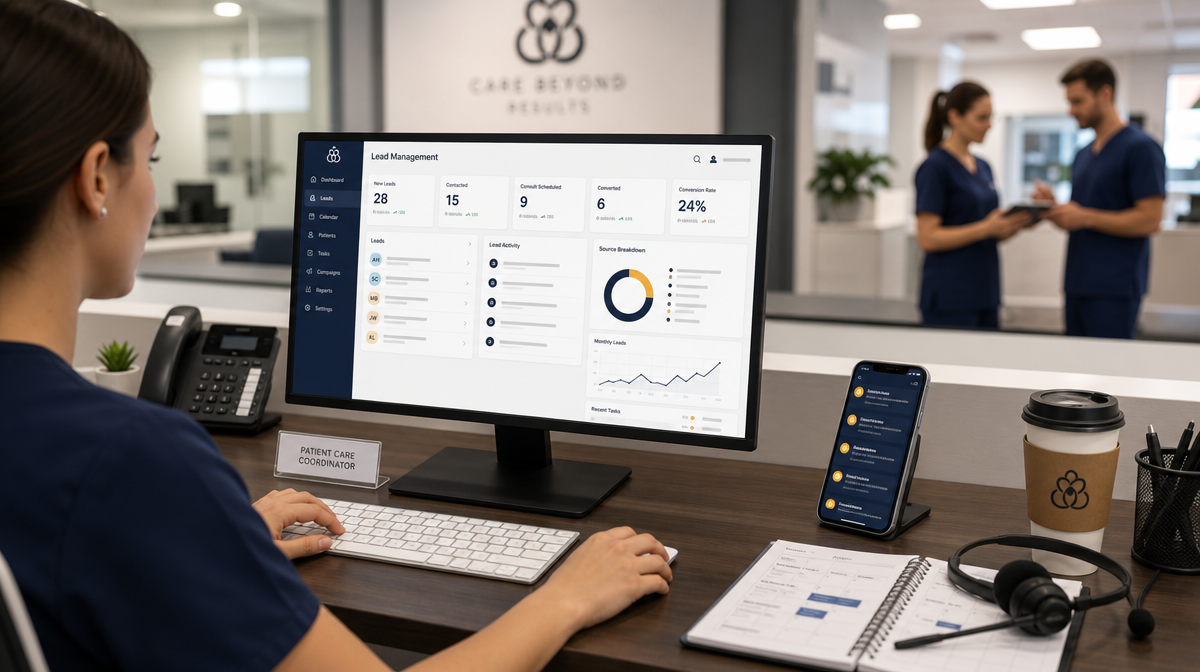
- Centralize leads with a weight loss CRM — A purpose-built lead management system ensures no inquiry goes cold and every prospect moves through a structured follow-up process.

GLP-1 medications occupy a legally complex advertising space, and the rules differ significantly depending on the platform, the claim, and whether the drug is FDA-approved for weight loss specifically or prescribed off-label. Getting this wrong isn’t just a compliance headache — it can result in ad account termination, FTC enforcement action, or state medical board scrutiny.
The core principle governing all GLP-1 advertising is that you cannot make unqualified efficacy claims, guarantee specific outcomes, or imply that a prescription medication is available without appropriate medical oversight. Both the FDA and FTC hold healthcare advertisers to a higher standard than general consumer brands, particularly when weight loss is involved.
Here’s what compliant GLP-1 marketing looks like in practice:
- Avoid outcome guarantees: Phrases like “lose 30 pounds in 90 days” or “guaranteed results” violate FTC guidelines and expose your practice to enforcement action
- Disclose physician supervision: All ads referencing prescription medications must make clear that treatment requires a clinical evaluation and a valid prescription
- Follow Google’s healthcare advertising policies: Ads for prescription drugs require Google certification and must comply with local pharmaceutical advertising laws
- Respect Meta’s sensitive health restrictions: Facebook and Instagram prohibit ads that imply a user has a specific medical condition or that target users based on health status
- Use brand names carefully: Advertising Ozempic or Wegovy by name may require additional platform approvals; generic references to “GLP-1 programs” often carry fewer restrictions
- Include appropriate disclaimers: Results disclosures, individual variation language, and side-effect acknowledgments are expected in compliant creative
When in doubt, lead with education rather than promotion — content that explains how GLP-1 medications work and who qualifies as a candidate consistently outperforms hard-sell ad copy while staying on the right side of every regulatory body involved.

Running campaigns without tracking the right numbers is the marketing equivalent of driving with your eyes closed. In medical weight loss marketing, the metrics that matter most aren’t vanity stats like impressions or follower counts — they’re the numbers that connect your ad spend directly to revenue.
Four key performance indicators should anchor every weight loss clinic’s reporting dashboard:
- Cost per lead (CPL): Your total ad spend divided by the number of leads generated. This tells you how efficiently your campaigns are attracting inquiries.
- Cost per consultation: The total marketing investment required to get one patient into a booked appointment. This accounts for leads that don’t convert, making it a more honest performance measure than CPL alone.
- Patient acquisition cost (PAC): The full marketing spend needed to bring in one paying patient — including leads, consultations, and no-shows. This is the number that determines whether your campaigns are actually profitable.
- Return on investment (ROI): Revenue generated relative to marketing spend. For weight loss clinics, this calculation should factor in patient lifetime value, since GLP-1 program patients often stay on treatment for 12 months or longer.
| Metric | What It Measures |
|---|---|
| Cost per lead | Ad spend divided by leads generated |
| Cost per consultation | Total marketing cost per booked appointment |
| Patient acquisition cost | Full cost to acquire one paying patient |
| ROI | Revenue generated versus marketing investment |
Clinics that track all four metrics — not just CPL — consistently make smarter budget decisions and identify underperforming channels before they drain resources.
- How much does medical weight loss marketing cost?
Pricing typically ranges from $1,200 to $3,000 per month depending on the services included, your market size, and whether you’re running paid ads alongside organic strategies. Clinics in competitive metro areas or those investing in full-funnel campaigns — SEO, PPC, and CRM automation together — generally sit toward the higher end of that range. - How long does it take to see results from medical weight loss marketing campaigns?
Paid advertising on Google and Meta can generate qualified patient inquiries within the first two to four weeks of a campaign launching, while SEO typically requires three to six months before organic rankings and traffic gains become meaningful. Most clinics benefit from running both simultaneously so short-term paid results fund the longer-term organic growth. - Can weight loss clinics advertise GLP-1 medications on Google and Meta?
Yes, with platform-specific restrictions and required certifications in place — see the compliance section above for a full breakdown of what claims are permissible and which ad formats carry the fewest restrictions. - What is the best marketing channel for a new weight loss clinic?
Google Ads is generally the fastest path to new patient inquiries for a clinic with no existing online presence, while local SEO builds the sustainable foundation that reduces long-term dependence on paid spend. - Do weight loss marketing agencies require long-term contracts?
Many agencies lock clients into six- to twelve-month agreements, though this varies widely. Target Patients MD operates without long-term contracts, so your continued partnership is earned by results rather than enforced by paperwork.

If you’ve read this far, you already know that scattered, one-size-fits-all marketing doesn’t move the needle for a physician-supervised weight loss program. What you need is a team that has built patient pipelines specifically for this specialty — not adapted a general healthcare playbook and hoped for the best.
Target Patients MD works exclusively with medical practices, and our GLP-1 marketing expertise runs deep. We understand the nuances of Semaglutide and Tirzepatide campaigns, the compliance boundaries that protect your license, and the patient psychology that drives someone from their first Google search to a booked consultation.
Here’s what you get when you partner with us:
- Proprietary A.L.I. 360 technology that optimizes campaigns and personalizes outreach at a scale no manual process can match
- A purpose-built lead management system with instant quotes, financing options, SMS and email automation, call recording, and 1-click intake forms
- A performance guarantee backed by a track record with 735+ medical practitioners
- No long-term contracts — your business is earned month after month through measurable results, not locked in by fine print
Clinics working with our system have seen patient acquisition volume climb by 377%, with 90% reporting meaningful results from day one of launch. If your weight loss clinic is ready to compete at that level, schedule a consultation with Target Patients MD today.