



Physical therapy SEO is the practice of making your clinic visible in search results when nearby patients are actively looking for the care you provide. Think of it as the digital version of a well-placed sign — except instead of foot traffic, you’re capturing the attention of someone who just typed “PT near me” into their phone while icing a knee on the couch.
The critical distinction between physical therapy SEO and general search optimization is geography. Unlike an e-commerce brand trying to reach customers nationwide, your practice draws from a defined radius — typically five to fifteen miles. That constraint actually works in your favor, because it narrows the field and makes local relevance the primary ranking factor. Virtually every meaningful search for a PT clinic carries a location signal, whether that’s a city name, a zip code, or the phrase “near me,” which is why the same principles that govern medical SEO generally have to be applied through a strictly local lens here.
Physical therapy practices also compete differently than national brands or hospital systems. Your patients aren’t comparison-shopping across states. They want someone close, available, and credible — and physical therapy SEO works by signaling all three of those qualities to Google through your location data, the conditions you treat, and the neighborhoods you serve.
When a patient’s back gives out on a Monday morning, they don’t flip through a referral directory. They grab their phone. That moment of search is where new patient volume is won or lost, and it determines whether your clinic shows up or gets skipped entirely.
The connection between rankings and booked appointments is more direct in physical therapy than in almost any other specialty. Patients searching for care aren’t browsing casually — they’re in pain, they’ve usually already tried rest and over-the-counter remedies, and they’re ready to schedule. That purchase-ready mindset makes search traffic uniquely valuable compared to social impressions or display ads.
Three dynamics explain why this channel consistently drives new patients for PT clinics. The first is that visibility reads as trust: patients treat top results as an implicit endorsement, assuming that if Google ranks a clinic first, it earned the spot. The second is intent — someone typing “physical therapy for knee pain” has already self-diagnosed the need and is one click from calling your front desk. The third is that referral patterns have shifted. Even patients sent by an orthopedic surgeon or a primary care physician routinely research their options online before booking, which means your search presence influences referral-driven patients too, not just cold ones. That overlap is worth remembering when you’re investing in relationships with orthopedic practices — the referral and the search result reinforce each other.
The practical implication is blunt: a clinic ranking in the top three for its core local terms will consistently out-schedule a competitor with better equipment, a nicer facility, and no digital visibility.
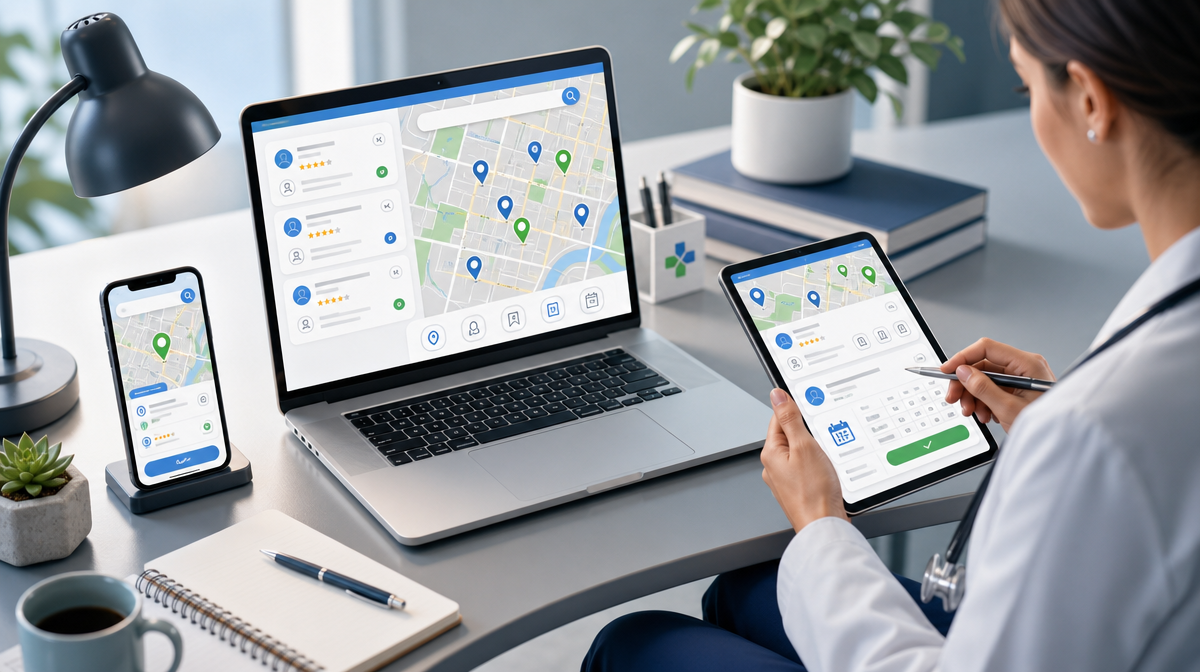
The Google map pack — the cluster of three business listings with star ratings, phone numbers, and directions that appears above every organic result — is the highest-value real estate in physical therapy SEO. For most “physical therapist near me” queries it occupies the entire visible screen on a smartphone before a patient scrolls at all. Winning that placement requires a different set of signals than traditional website rankings, because Google evaluates proximity, relevance, and prominence rather than page content alone.

Four things move the needle. Claiming and fully building out your Google Business Profile comes first: select “Physical Therapist” as your primary category, add relevant secondary categories like sports rehabilitation or orthopedic PT, complete the services list, upload real clinic photos, set accurate hours, and add a direct booking link. Consistent name, address, and phone data across directories comes second, because mismatches between your profile and Yelp, Healthgrades, Zocdoc, or WebMD send conflicting signals that quietly suppress local rankings. Third is a steady stream of reviews, which are among the strongest map pack factors — a post-visit text or email combined with responding to every review, positive or critical, builds the velocity Google rewards. And fourth, if you serve multiple zip codes or surrounding communities, each deserves its own page with genuinely local content rather than copy-pasted text with the city name swapped out.
Keyword research is the process of identifying the exact phrases prospective patients type when they need care, and for physical therapy those phrases almost always carry a location signal. Skipping this step means optimizing for terms nobody in your zip code is actually searching.
Intent matters as much as volume. A patient typing “what causes sciatica” is still in research mode; a patient typing “sciatica physical therapist” plus a city has their insurance card out. Your strategy should prioritize the second group while capturing the first with educational content. Three categories consistently produce the most qualified traffic. Condition-plus-city combinations are the workhorses — phrases like “rotator cuff physical therapy” or “post-surgical rehab” paired with your market — and they deserve individual service pages rather than one general page trying to rank for everything. “Near me” and conversational queries drive enormous volume and increasingly arrive by voice in a longer, question-shaped form, with your Google Business Profile as the primary vehicle for capturing them. And long-tail treatment terms like “dry needling” or “pelvic floor PT for postpartum” plus a location attract patients with narrow, urgent needs, where competition is lower and conversion is higher because those patients rarely need convincing once they find you.
Google Search Console is the practical starting point here — it shows which terms already bring visitors to your site before you invest in any paid keyword platform.
On-page optimization covers everything you control directly on your own website: the elements that tell Google what your clinic does, where you do it, and who you serve. Three areas drive most of the impact. Title tags and meta descriptions come first, since the title is the clickable headline patients see in results — service plus location plus clinic name is the reliable formula — and while meta descriptions don’t affect rankings directly, a clear call to action measurably improves click-through. Mobile performance and page speed come second, because the majority of healthcare searches now happen on phones, and a page that takes several seconds to load on a mobile connection loses a meaningful share of visitors before your services ever appear; running your key pages through Google PageSpeed Insights surfaces the specific problems worth fixing. Schema markup is third — structured code that acts as a translation layer between your site and Google, where local business, medical business, and physical therapy types can unlock rich results showing your hours, rating, and address before a patient clicks at all. This is where medical website design stops being an aesthetic question and becomes a ranking one.
None of these are one-time fixes. Treat on-page work as a periodic audit, especially after adding service pages or changing clinic information.
Your treatment pages and blog posts determine which conditions Google associates with your clinic and, by extension, which patients find you first. A single generic services page covering everything from ACL rehab to vertigo is invisible to the patients who need those specific services most. Dedicated condition-level content is how practices build topical authority — the signal that tells Google your clinic is genuinely expert in a given area, which is the same principle behind effective healthcare content marketing in any specialty.
Three content types produce the most measurable results. Condition and treatment pages are the foundation — a separate page for every condition you treat and every modality you offer, each targeting its own keyword cluster and giving Google a specific, rankable asset tied to real searches. Educational content captures patients earlier: questions like how long recovery takes after rotator cuff surgery, or what to bring to a first appointment, represent genuine search volume, and answering them builds trust with people who are weeks from scheduling. Video and patient stories round it out, since a short clinic walkthrough or a patient success story increases time on page — a behavioral signal Google tracks — and hosting video on YouTube creates a second indexable asset outside your site. Any patient story or testimonial requires written authorization before publication; a verbal yes in the clinic isn’t sufficient.
Consistency matters more than volume. One well-researched condition page per month outperforms a burst of thin content followed by silence.
Everything so far lives on assets you control. Off-page optimization is the other half: the signals that come from other websites pointing back to yours, which Google treats as third-party endorsement. In a field where credibility drives patient decisions, those endorsements carry real weight — and quality outranks quantity. A single link from a regional hospital’s referring provider directory does more than a dozen from generic business listings.
Three tactics consistently move the needle. Healthcare directory listings on Healthgrades, Vitals, Zocdoc, WebMD, and local hospital or physician referral directories function as both citations and potential links, and many patients use those platforms directly to vet providers. Referral partner cross-links are underused: your orthopedic surgery partners, the practices doing sports medicine marketing in your area, and local gyms or sports teams often maintain a resources or partners page, and a link from there connects you to established local authority while reinforcing the relationship itself. And community contributions — a quoted perspective in a local story on sports injuries, or a sponsored community race that lists your clinic on the event page — earn the kind of editorially placed links that generic link-building can’t replicate.
Reviews deserve their own mention here, because in local search they function as a ranking input rather than just social proof. Volume, recency, and your response rate all feed the algorithm, which makes reputation management a search discipline as much as a trust one.
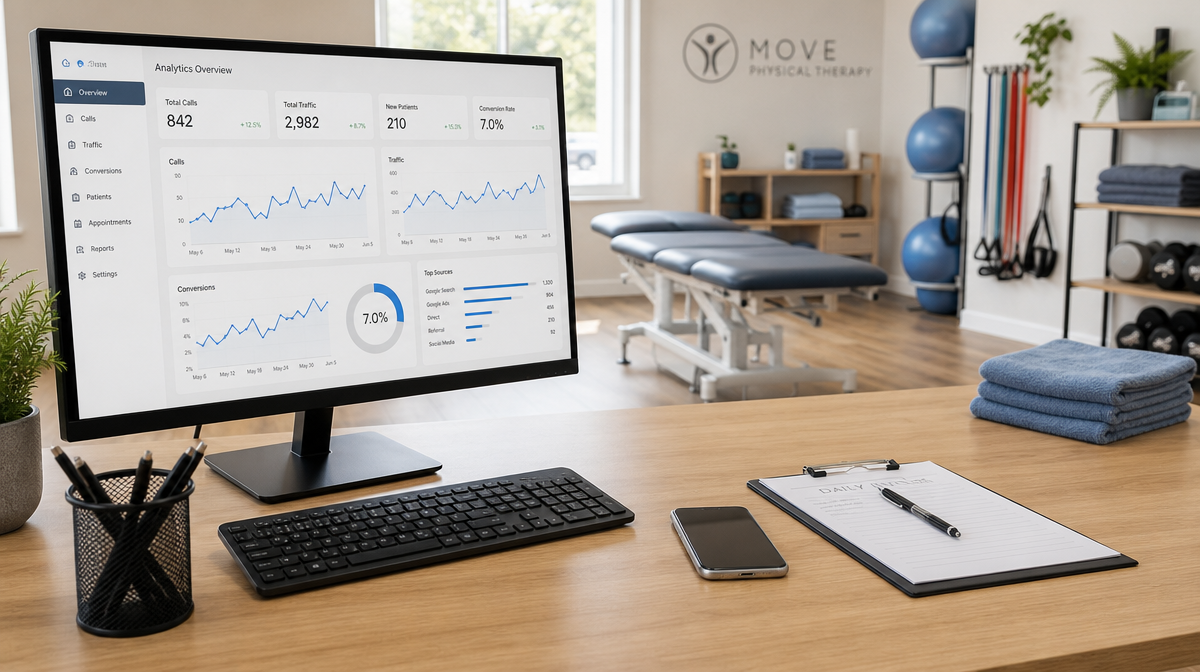
Running physical therapy SEO without measurement is like treating a patient without a diagnostic workup. The good news is that you don’t need an enterprise software budget to start. Google’s own free tools cover most of what a single-location clinic needs: Search Console shows which terms bring visitors and flags technical problems, Analytics tracks behavior once they arrive, your Business Profile dashboard reports calls and direction requests from the map listing, and PageSpeed Insights diagnoses the load-time issues costing you appointments. Most practices can run a solid operation on those four before spending anything. Paid keyword research and citation-tracking platforms become worth adding later, particularly if your practice has moved locations or rebranded, since outdated directory data quietly suppresses local rankings.
Most practice owners track the wrong numbers. Ranking reports and monthly traffic totals feel like progress, but neither tells you whether your schedule is fuller than it was three months ago. Watch keyword positions with an eye specifically on movement into the top three, where click-through climbs sharply — not merely whether you appear somewhere on page one. Look at organic traffic page by page, because a treatment page with no organic sessions after three months needs a content or technical review. Track phone calls and form submissions from organic visitors, which are the real leading indicators, and set up conversion tracking so you can isolate them. Read your Business Profile insights, which report calls, direction requests, and website visits that never touch your site at all. And ask new patients how they found you during intake — when that answer aligns with ranking improvements, you have genuine proof the investment is producing appointments rather than impressions.
Review these monthly rather than quarterly. Search results compound slowly, but problems like a dropped ranking or broken call tracking cost you patients every week they go unnoticed.
A few errors show up repeatedly in underperforming clinic websites, and most are fixable without a developer. Leaving your Google Business Profile unclaimed, incomplete, or stale is the fastest way to disappear from map results — patients see that profile before they ever reach your website. Keyword stuffing no longer works and makes copy unreadable, which drives patients away and signals low quality. Copy-pasting location pages with only the city name changed creates duplicate content that Google consolidates or ignores. Neglecting mobile costs you patients who bounce before reading a single service description. Skipping conversion tracking means optimizing blind. And abandoning the effort after six weeks misses the compounding phase entirely, where rankings stabilize and traffic starts building on itself.
Search results looked essentially the same for two decades, and then they didn’t. AI Overviews — the AI-generated summary boxes now appearing above organic results for a growing share of queries — have changed how patients interact with search, and for some healthcare questions a patient reads the synthesized answer and never clicks a website at all. Generative engine optimization is the emerging discipline of structuring content so that AI-powered search tools actually pull from your clinic’s information when generating those summaries. It differs meaningfully from traditional ranking work, because AI systems favor content that is authoritative, clearly structured, and grounded in verifiable claims, while thin or keyword-heavy pages get ignored.

Two implications matter right now. Structured, expert-authored content wins citations — pages that clearly attribute expertise through credentials, specializations, and clinical rationale appear in AI answers far more often than anonymous generic copy. At the same time, hyper-local queries still favor traditional signals, since AI Overviews appear less frequently for searches like “PT clinic near me” where Google defaults to map results. Your local fundamentals remain the foundation; generative optimization is the layer above them. Clinics publishing credible, well-structured content now are building the citation history that AI systems will draw from as this channel matures.
Whether to handle this in-house comes down to three practical constraints: how many hours you can realistically dedicate each week, whether anyone on staff has done technical website work, and how competitive your local market actually is. Foundational work is genuinely doable internally — a motivated owner or front desk coordinator can claim a Business Profile, respond to reviews, and publish a condition page monthly, and that compounds meaningfully in smaller markets.
The calculus shifts under a few specific conditions. Multiple locations each need their own local strategy, citation profile, and page architecture, which quickly outgrows a part-time internal effort. Competitive metros where several well-funded groups already invest professionally are hard to close ground on with a DIY approach. Technical problems like crawl errors, broken schema, and speed issues require expertise most clinical staff don’t have, and ignoring them costs rankings daily. And corporate chains entering your market change the math — though this is also where an independent clinic has a structural advantage, because proximity and genuine local reviews carry weight in the map pack that a national ad budget cannot simply buy.
A useful frame: if time spent on search work is displacing patient care or the administrative priorities only you can handle, the opportunity cost of doing it yourself usually exceeds the cost of help.
Generalist agencies can run ads and post to social media for almost any industry. What they typically cannot do is understand why a cash-based practice needs an entirely different keyword strategy than the insurance-based clinic down the street, or how referral relationships and direct search traffic interact in this specialty. That gap in clinical context shows up in the work, and in your patient volume. Practices that partner with healthcare-only specialists tend to see faster traction for a specific reason: the strategy starts from an accurate picture of how patients actually choose a provider rather than a template repurposed from a home services campaign. It’s the same distinction that separates strong physical therapy marketing from generic local advertising — the channel is only as good as the understanding behind it.
Target Patients MD works exclusively with medical practices — no retail, no restaurants, no e-commerce. That focus means physical therapy SEO gets treated as a patient acquisition problem rather than a rankings problem, with accountability tied to booked evaluations and cost per acquisition rather than traffic reports that look impressive without translating into revenue. If your schedule has open slots that should be filled and you’ve outgrown what a part-time internal effort can deliver, get in touch and we’ll show you where the gap is.
Here are answers to the questions PT clinic owners ask most often about search.
How long does SEO take to work for a physical therapy clinic? Meaningful movement generally builds over three to six months as technical health, condition pages, and local signals mature, with results compounding well beyond that. Local map pack improvements often appear sooner than organic website rankings, since Business Profile changes are processed faster than site-wide authority builds.
What’s the difference between physical therapy SEO and general medical SEO? Physical therapy is an almost entirely local discipline, because patients rarely travel far for care. That makes the map pack, proximity signals, and neighborhood-level content far more decisive than they are for specialties drawing from a wider region, and it means condition-and-city pages carry more weight than broad service pages.
Do PT clinics need a separate page for each condition they treat? Yes. Google rewards topical relevance at the page level, so a dedicated page per condition consistently outperforms a single combined services page. Each one should own its primary term and answer the candidacy, timeline, and expectation questions patients research beforehand.
How important is Google Business Profile for a PT clinic? It is the single highest-impact asset in local search. For most “near me” queries the map pack occupies the entire first screen on a phone, and your profile determines whether you appear there — often before a patient reaches any website at all.
Can a small PT practice outrank a corporate chain? Often, yes. Local search rewards proximity, review quality, and genuine neighborhood relevance rather than raw budget, which gives an independent clinic real structural advantages in its immediate radius even against a much larger competitor.