


Most treatments can get away with a generic “we offer X” approach and still book patients. PRP is not one of them. The treatment sits in an unusual position in the market — widely recognized by name, frequently misunderstood in practice, and carrying a reputation that ranges from “breakthrough regenerative therapy” to “celebrity fad” depending on who your prospect last talked to.
That reputation gap is your first marketing problem. A prospect who Googled PRP last week may have landed on a glowing orthopedic journal summary, a skeptical consumer watchdog piece, or a tabloid story about a celebrity vampire facial. Each of those leaves a completely different impression — and your marketing has to account for all three.
The second problem is structural. PRP is not a single-audience treatment. The same centrifuge serving your joint pain patients is also serving your hair restoration patients and your aesthetic clientele. Those groups have almost nothing in common: different ages, different search behaviors, different objections, different decision timelines. Effective PRP therapy marketing requires segmented strategies for each application — not one campaign trying to speak to everyone at once.
- The autologous angle is a genuine differentiator: “Your own body’s healing” resonates differently than synthetic or pharmaceutical alternatives, but it requires explanation to land.
- Skepticism is baked in: Many prospects arrive pre-loaded with doubt from mixed media coverage and need trust-building content before they’ll book.
- Multi-application complexity demands segmentation: Hair, joints, aesthetics, and sexual wellness audiences search differently, convert differently, and require distinct messaging strategies.
Before you spend a dollar on platelet-rich plasma advertising, you need to know who is actually sitting in the waiting room — because the four primary PRP patient groups behave so differently that a single campaign targeting all of them will convert none of them effectively.
- Hair restoration patients (men 30–55): These are methodical researchers comparing PRP to transplants, finasteride, and minoxidil over weeks or months. They respond to clinical outcome data — a 2025 meta-analysis of 43 RCTs confirmed PRP increases hair density — and physician credibility, and they frequently search comparison terms like “PRP vs hair transplant” before ever contacting a clinic. Paid search targeting this group requires patience — the booking cycle is long.
- Orthopedic and sports injury patients (adults 35–65): Many arrive after physical therapy has stalled or a surgeon has recommended waiting. They are solution-oriented and motivated by avoiding surgery, making terms like “PRP injection for knee” and “non-surgical knee pain treatment” high-converting entry points. Physician referral relationships also move this segment significantly.
- Aesthetic and skin rejuvenation patients (women 35–55): Often already medspa clients who discovered vampire facials or PRP microneedling through social media. Visual content and transformation stories drive their decision-making — though before/after restrictions require creative compliance workarounds.
- Sexual wellness patients (men and women seeking P-Shot or O-Shot): This group searches privately, avoids explicit ad language, and converts best through educational content with strong privacy reassurances. Explicit campaign targeting here tends to backfire.
Each segment demands its own messaging, channel mix, and conversion strategy. Collapsing them into one campaign is one of the most common — and expensive — mistakes in PRP therapy marketing.
Most PRP clinics in any given market are making the same positioning mistake: leading with the treatment instead of the differentiator. Their websites say “we offer PRP therapy” and stop there. That’s not positioning — that’s a menu item. Real competitive separation comes from exposing the specific details competitors are too vague or too cautious to publish.
Start by auditing the top three or four local competitors. Look at what they’re not saying. You’ll typically find that nobody specifies their preparation protocol, platelet concentration targets, or whether they use ultrasound guidance for injection precision. Publishing that information — in plain language — immediately signals clinical seriousness to a prospect comparing options.
- Protocol transparency: Specify whether you use a single-spin or double-spin centrifuge process and why your concentration levels matter — a 2025 narrative review confirmed PRP formulation variability directly impacts outcomes — for the specific condition being treated. Most competitors skip this entirely.
- Physician case volume: A provider who has administered 500+ PRP injections for a specific indication carries more implicit credibility than a general “board-certified” claim. Quantify your experience where you can.
- Combination treatment positioning: Pairing PRP with microneedling, exosomes, or targeted rehabilitation protocols creates a differentiated offering that standalone competitors can’t easily match.
- Outcomes documentation: Systematically collecting patient outcome data — even structured satisfaction surveys — gives you defensible, specific claims that generic campaigns never achieve — the specificity that defines real regenerative medicine marketing.

The clinics winning on PRP therapy marketing locally aren’t outspending competitors. They’re out-detailing them — and that specificity is what converts a skeptical researcher into a booked consultation.
Here’s something most PRP clinic owners don’t realize: your local SEO competition is weaker than you think. While Cleveland Clinic and Mayo Clinic dominate broad informational queries like “what is PRP,” they’re not competing for the localized, treatment-specific searches where your next patient is actually looking. Ranking for “PRP knee injection [your city]” or “vampire facial near me” requires a fraction of the authority needed to crack generic health terms — and most local clinics haven’t bothered to optimize for them at all.
The keyword opportunity breaks down into four distinct categories, each capturing patients at different stages of their decision:
- Treatment-plus-location terms: “PRP for hair loss [city],” “PRP injection clinic near me” — these capture patients ready to book, not just browse.
- Comparison queries: “PRP vs cortisone injection,” “PRP vs hyaluronic acid for knees” — searchers comparing options are highly motivated and respond well to educational positioning.
- Cost-intent searches: “How much does PRP therapy cost” signals serious consideration, not casual curiosity.
- Condition-specific terms: “PRP for tennis elbow,” “PRP for androgenetic alopecia” — these long-tail terms convert exceptionally well because the patient has already self-diagnosed.
Your Google Business Profile is equally important. Select the most specific service categories available, upload photos that actually show the PRP process, and seed your Q&A section with the questions prospects type before calling. A GBP optimized around PRP-specific content can land you in the local map pack — where a significant share of high-intent appointment searches end. A medical SEO agency with healthcare-only experience will have built this for practices in your specialty before.
Paid channels are where PRP therapy marketing either pays for itself quickly or bleeds budget on unqualified clicks. The difference comes down to campaign architecture — specifically, whether you’re treating PRP as one product or four distinct patient acquisition funnels.
On Google Search, the fatal mistake is running a single campaign across all PRP applications. A prospect searching “PRP injection for rotator cuff” and one searching “vampire facial near me” need completely different ad copy, landing pages, and conversion paths. Separate campaigns by treatment type let you control bids, messaging, and negative keyword lists independently. On the negative keyword side, terms like “PRP stocks,” “PRP meaning,” and “what is plasma” burn significant budget on zero-intent traffic — filter them aggressively from day one.
Meta and Instagram earn their place specifically for aesthetic PRP. The visual nature of skin rejuvenation and microneedling results makes these platforms a natural fit, and lookalike audiences built from your existing aesthetic patient list tend to outperform interest-only targeting. The complication is Meta’s restrictions on before/after medical imagery — sidestep this by leading with process content and patient experience narratives rather than outcome photos.
- Retargeting is non-negotiable for PRP: Most prospects research for weeks before booking. A retargeting sequence that serves educational content first, then testimonial videos, then a time-sensitive consultation offer mirrors the actual decision timeline rather than fighting it.
- Landing page alignment determines conversion rate: An ad about knee PRP that drops users on a general “regenerative medicine” page loses the patient. Every campaign needs a dedicated, condition-specific destination.
- Ad copy that acknowledges skepticism converts better: Language like “not sure if PRP is right for you?” outperforms pure benefit claims for a treatment category where doubt is the default starting position.
Your next PRP patient may never type a query into Google at all. They’re asking ChatGPT — used by over 40 million people daily for health information — “is PRP worth it for knee pain” or prompting Perplexity “where can I get PRP therapy in [city],” and whoever gets cited in that AI-generated answer effectively owns the consultation. This is Generative Engine Optimization, and most PRP clinics haven’t touched it yet.

GEO isn’t a replacement for traditional PRP SEO — it’s a parallel layer, part of the broader shift in how AI is reshaping regenerative medicine marketing. AI systems like Google’s AI Overviews, ChatGPT, and Perplexity pull answers from sources they assess as credible, structured, and specific. Vague practice descriptions and thin service pages don’t get cited. Content that directly answers a defined question, cites verifiable clinical context, and uses clean formatting does.
The content architecture that earns AI citations looks different from standard blog writing:
- Direct Q&A formatting: Pages that open with a clear question and answer it within the first paragraph match how AI systems extract responses.
- Condition-specific definitions: Explaining exactly how PRP works for hair follicle stimulation versus cartilage repair — not just “PRP promotes healing” — gives AI models specific, citable information.
- Authoritative sourcing: Referencing peer-reviewed data or professional society positions signals credibility to AI ranking systems.
A.L.I. 360 by Target Patients MD, a proprietary AI-powered patient-acquisition system for medical and dental practices — the name stands for Attract, Learn, and Influence — builds GEO-ready content structures into your PRP therapy marketing automatically, so your practice surfaces in AI-generated answers rather than getting buried beneath health system content that was never optimized for how patients actually ask questions today.
A PRP landing page that doesn’t convert isn’t just wasting ad spend — it’s actively losing patients to the competitor whose page answered their questions faster. The structural difference between a page that books consultations and one that gets abandoned usually comes down to how specifically it addresses the concerns of that application’s patient, not PRP patients in general.
The table below shows how page elements should shift based on the treatment being promoted:
- Headline formula: Hair restoration pages should lead with outcome and timeline (“Regrow Thinning Hair Without Surgery — See Results in 3–6 Months”). Joint pages should lead with the surgical alternative angle (“Skip the Surgery — PRP Injections for Knee and Shoulder Pain”). Aesthetic pages should anchor on the experience (“The Vampire Facial, Done Right — by a Board-Certified Physician”).
- Social proof placement: Reviews should appear immediately below the hero section — not buried in a footer. Filter displayed testimonials by treatment type so a hair loss patient sees hair-specific outcomes, not a joint patient’s success story.
- FAQ section as a pre-objection tool: Address the three questions every PRP prospect has before they’ll book: Does it hurt? How long until I see results? What happens if it doesn’t work for me? Leaving these unanswered forces patients to search for answers elsewhere — and they often don’t come back.
- CTA specificity: “Schedule Your PRP Hair Consultation” outperforms “Contact Us” because it confirms the patient is in the right place at the exact moment they’re deciding whether to act.
- Physician credentials and protocol details: Listing your centrifuge system, concentration methodology, and injection technique directly on the page differentiates you from competitors who list nothing.
PRP prospects are researchers by nature. Before they ever call your front desk, they’ve typically spent days — sometimes weeks — consuming information about whether the treatment is legitimate, how long results take, and whether the cost is justified. If your practice isn’t producing the content they’re consuming during that research phase, a competitor who is will get the consultation.
The content types that actually move PRP prospects toward booking share one characteristic: they answer the specific question the patient is already asking, not the question you wish they were asking.
- People Also Ask blog posts: Questions like “how many PRP sessions do I need for hair loss” and “why does PRP take so long to work” appear directly in Google search results. Writing thorough, plain-language answers to these positions your practice as the authority while capturing organic traffic from patients mid-research.
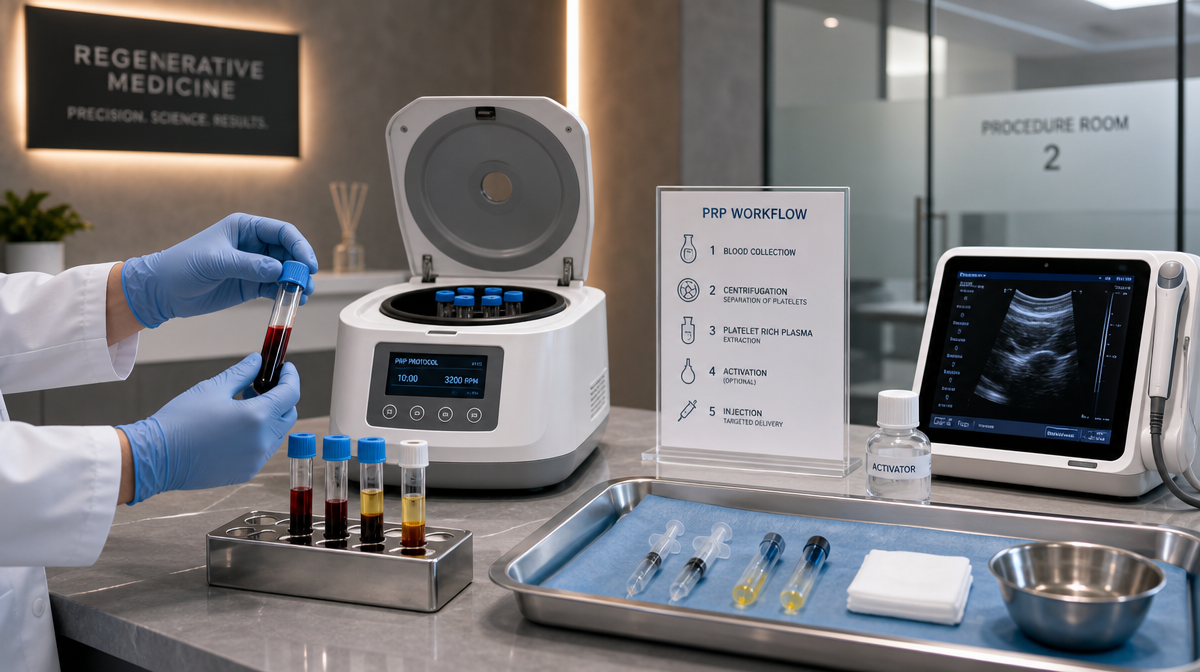
- PRP preparation process videos: Showing the blood draw, centrifuge spin, and injection sequence demystifies a procedure that sounds alarming to first-timers. Familiarity reduces cancellation rates and no-shows for initial consultations.
- Comparison guides by condition: A prospect weighing “PRP vs cortisone for shoulder pain” needs a direct, honest comparison — not a sales pitch. Practices that publish these guides earn trust and frequently win the booking even when they acknowledge PRP isn’t right for everyone.
- Results timeline content: Managing expectations upfront with clear “what to expect at week 4, week 8, and month 6” content reduces buyer’s remorse and increases series completion rates once patients do book.
Educational content does double duty in PRP therapy marketing — it builds the credibility that converts skeptical prospects while simultaneously generating the organic search traffic that reduces your dependence on paid acquisition over time.
PRP occupies an interesting regulatory gray zone — and that gray zone is exactly where clinics get into trouble. The treatment itself is generally lower-risk than other biologics precisely because it’s autologous: the FDA exempts same-procedure autologous blood products from the full 21 CFR Part 1271 biologic framework. That exemption, however, applies to the procedure — not to your marketing copy.
The FDA’s Center for Biologics Evaluation and Research monitors clinic websites and social media for promotional language that crosses from describing a procedure into making disease treatment claims. The line isn’t always obvious, but the legal distinction is concrete:
- Acceptable structure/function framing: “PRP supports the body’s natural tissue repair process” or “promotes joint comfort” stays within defensible promotional territory.
- Problematic disease claims: “PRP treats osteoarthritis,” “reverses cartilage damage,” or “cures erectile dysfunction” positions PRP as a drug-level therapy — language that invites a warning letter regardless of how confident you are in your clinical outcomes.
- Before/after photo liability: Visual comparisons that imply disease resolution — not just aesthetic improvement — can constitute an implied disease claim even without a single word of explanatory text.
- Device representation risk: Marketing PRP for indications not covered by your centrifuge system’s FDA clearance introduces a separate layer of off-label device exposure that most clinics overlook entirely.
Protecting your practice starts with an advertising review process — someone with regulatory awareness reading every piece of PRP therapy marketing before it publishes. Pair that with documented evidence files supporting any outcome claims you do make, and informed consent language that accurately reflects PRP’s investigational status for specific indications.
Prospective PRP patients behave differently from almost any other aesthetic or regenerative medicine consumer: they read reviews the way a first-year medical student reads a textbook. They’re not skimming for star ratings — they’re hunting for outcome-specific language that confirms the treatment worked for someone with their exact condition. A five-star review that says “great staff, clean office” does almost nothing for PRP conversion. A review that says “my knee stopped locking up after my third session” closes the sale.
That specificity doesn’t happen by accident. When you follow up with PRP patients post-treatment, the review request itself needs to prompt outcome language — something like “Would you share how your experience with PRP for [hair/knee/skin] has gone?” gives patients a frame that produces the detail your next prospect needs to see.
- Monitor beyond Google: RealSelf is where aesthetic PRP patients research vampire facials and microneedling. Healthgrades is where orthopedic PRP patients validate physician credibility. A strategy that covers only Google misses the platforms where your most valuable patient segments actually do their homework.
- Display reviews by treatment type: Embedding filtered PRP testimonials on each condition-specific service page — hair reviews on the hair page, joint reviews on the orthopedic page — keeps social proof contextually relevant rather than generic.
- Respond to negative reviews with clinical precision: When a patient reports disappointing results, a response that acknowledges the multi-session timeline and individual variation protects your reputation while managing realistic expectations for prospects reading the exchange.
Target Patients MD’s reputation platform aggregates reviews across 20+ sites, so your PRP-specific feedback is visible and organized — not scattered across platforms your team doesn’t have time to monitor manually.

Most PRP revenue walks out the door after session one — not because patients are unhappy, but because nobody told them the treatment was designed to be a series. Hair restoration protocols typically call for three to four initial sessions spaced four to six weeks apart, followed by annual maintenance. Joint applications often require two to three rounds before peak benefit. If your front desk is treating each appointment as a standalone transaction, you’re leaving the majority of each patient’s lifetime value on the table.
The fix starts before the first needle goes in. Presenting PRP as a protocol — not a one-time procedure — during the consultation sets the expectation that multiple visits are the standard of care, not upselling. Patients who understand this upfront complete their series at dramatically higher rates than those who discover it afterward.
- Package pricing removes the friction of repeat decisions: A patient who pre-purchases a three-session hair restoration package doesn’t have to recommit mentally or financially before each visit. Completion rates climb when the decision only has to happen once.
- Automated SMS sequences between sessions: Brief check-ins at the two-week and four-week marks — noting what patients may or may not notice yet — normalize the slow results timeline and reduce mid-series dropout before visible improvement appears.
- Annual maintenance campaigns: Patients who completed a hair or joint series 10–12 months ago are your warmest possible leads. A targeted email referencing their original results and recommending a maintenance session converts at a fraction of the cost of new patient acquisition, which is why maintenance outreach sits at the center of effective patient retention strategies.
- Adjacent service cross-selling: PRP aesthetic patients are natural candidates for microneedling series, skin boosters, or collagen-stimulating treatments that complement their existing investment.
Running a PRP service across four patient segments — each with its own search behavior, compliance considerations, channel mix, and retention cycle — is genuinely complex work. Most medical marketing generalists aren’t equipped to handle the regulatory nuance of PRP advertising claims, let alone the technical demands of GEO optimization or condition-specific landing page architecture. That’s where working with a healthcare-specialized partner changes the math.
Target Patients MD is built exclusively for medical practices. The A.L.I. 360 platform combines AI-driven patient acquisition with fully managed execution across every channel that moves PRP bookings — search, paid, social, reputation, and AI-generated answers. You don’t manage vendors or coordinate between a web team and an ad agency. One system handles the full acquisition funnel, from first impression to booked consultation.
- Healthcare-only expertise: Every campaign is built by a team that understands FDA advertising boundaries, HIPAA-conscious lead capture, and the clinical nuances that separate effective PRP messaging from liability exposure.
- Multi-segment campaign architecture: Hair, joint, aesthetic, and sexual wellness PRP campaigns run as separate, optimized funnels — not one generic ad group trying to speak to everyone.
PRP therapy marketing rewards specificity, consistency, and speed of execution. If you’re ready to stop leaving high-margin appointments unfilled, learn more about Target Patients MD and what a fully managed patient acquisition system looks like for your practice.
PRP therapy marketing questions tend to cluster around four practical concerns that don’t always get a straight answer. Here’s what practice owners ask most often:
- How much does PRP marketing cost per patient acquired? There’s no universal number because cost per acquisition shifts based on your market’s competitiveness, which PRP application you’re promoting, and your channel mix. Hair restoration campaigns in competitive metro markets will carry a higher cost per booked consultation than orthopedic PRP in a mid-sized city with few active competitors. Track cost per lead and cost per booked consultation as your primary metrics — not impressions or clicks — and benchmark against your PRP treatment revenue per patient to determine acceptable acquisition thresholds.
- How quickly will marketing fill my PRP schedule? Paid search campaigns can generate consultation requests within the first week of launch. Organic search and content-driven authority take three to six months to compound meaningfully. Most practices running integrated campaigns — paid plus local SEO plus reputation — see a measurable schedule impact within 90 days.
- Are PRP ads allowed on Facebook and Instagram? Yes, with important caveats. Meta permits PRP advertising but flags claims that imply guaranteed medical outcomes or use prohibited before/after framing. Aesthetic PRP applications consistently outperform other categories on these platforms when creative focuses on the patient experience rather than clinical outcome language.
- Does PRP marketing differ between aesthetic and orthopedic practices? Significantly. Aesthetic PRP converts through visual social channels and medspa-adjacent audiences. Orthopedic PRP relies more heavily on search intent, physician credibility signals, and referral relationship development — entirely different execution priorities.