


Urgent care SEO, sometimes called urgent care search engine optimization, is the work of making a walk-in clinic the result a nearby patient sees, and taps, when they need care right now. Someone choosing a dermatologist or a surgeon may compare options for days or weeks. Someone with a feverish child on a Sunday evening decides in a few minutes, on a phone, usually from a car or a kitchen.
That compressed decision changes what matters. The patient is not building a shortlist. They look at a map, check which clinics are open, glance at the stars, and go. Distance and hours do most of the filtering, and a clinic missing from that first screen is rarely considered at all, however good the care inside it is.
This guide covers the search side only: profiles, location pages, service pages, reviews, technical basics and measurement. It is one part of a wider urgent care marketing plan, and it is the part that decides whether a patient with an immediate need ever learns your clinic exists. For a group with several sites there is a second job, which is making sure each clinic ranks in its own neighborhood instead of competing with its sister locations.
Urgent care searches fall into a handful of patterns, and each one should be answered by a different page or profile.
| What the patient searches | What they need to see | Page that should rank |
|---|---|---|
| “Urgent care near me” or “urgent care open now” | Distance, hours, wait | Google Business Profile and the location page |
| A symptom or service, such as “stitches,” “strep test” or “X-ray near me” | That the clinic treats it today | Service or symptom page |
| “Urgent care that takes” a named insurance plan, or cost | Accepted plans, self-pay prices | Insurance and pricing page |
| “Pediatric urgent care” | Ages seen, hours | Pediatric service page |
| The clinic’s name | Directions, phone, online check-in | Location page and profile |
Read the table as a division of labor. SEO for urgent care clinics stalls when one page tries to do all of these jobs, which is the most common reason a clinic sits on page two or three for searches it should own.
Start with the Google Business Profile, because for an urgent search it is often the only thing the patient reads. Each staffed clinic needs its own verified profile, with the business name written exactly as it appears on the door and the address and phone number exactly as they appear on the website. Google’s guidelines for representing your business spell out what is allowed in a name, an address and a category, and following them closely is what keeps a profile from being edited or suspended at the worst possible moment.
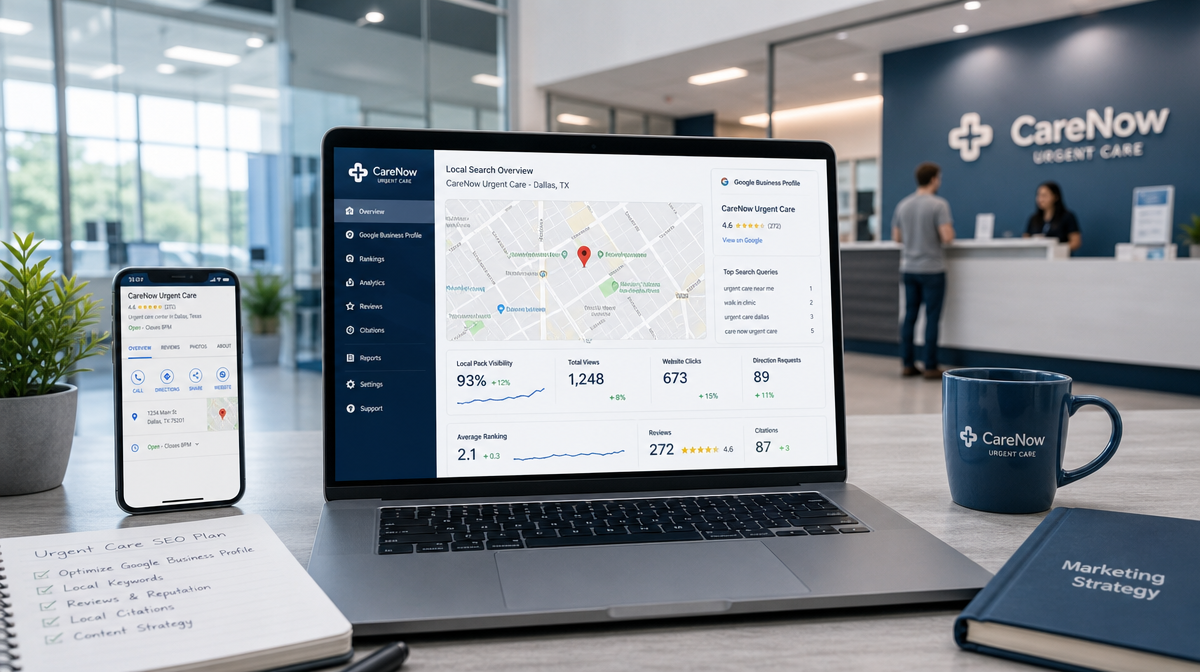
Category choice carries real weight. The primary category should be “Urgent care center” rather than a broader medical label, because the category tells Google which searches the profile is relevant to. The services list should then name each service the clinic truly offers on site in plain terms, such as X-rays, stitches, sports physicals, flu shots and drug screens, since every accurate entry gives the profile another search it can appear for.
Hours are where urgent care profiles win or lose visits. A patient who sees “Closed” moves to the next pin instantly, and a patient who drives to a clinic marked open and finds a locked door usually leaves a one-star review. Publish special hours for every holiday ahead of time, update the profile the same day a schedule changes, and add an online check-in link if you offer one. Current photos of the entrance and parking help patients recognize the building.
Remove what should not exist. Duplicate profiles, listings for a closed location, and provider profiles that outrank the clinic all split the signals a single clean profile would collect.
A profile needs a page behind it. Each clinic should have its own location page on the website, linked from its profile, because one “Locations” page listing six addresses gives Google nothing specific to rank for any of them. This is also where a patient lands when they tap “Website” from the map, so it has to answer the urgent questions without scrolling: is it open, how do I get there, can I check in online, do you take my plan.
What goes on the page should be true of that clinic and no other. Include the hours, an embedded map, a tap-to-call phone number, the services and providers at that site, parking details, and the landmarks or cross streets a local would use to describe where it is.
Multi-location groups run into trouble when they build one template and swap the city name. Pages that differ only by a place name read as thin, near-duplicate content, and they can compete against each other, so the clinic across town appears for a search made next door. Local SEO for urgent care groups depends on unique content per location, one profile per location, and internal links from each service page to the nearest clinics.
It also helps to be clear about what urgent care is not. A clinic that tries to rank for annual physicals and chronic condition management is chasing searches with a different intent and a slower decision. Those belong to primary care marketing, where patients compare and commit over time. Urgent care pages perform best when they stay focused on same-day needs.
Service and symptom pages capture the patient who has already decided what kind of help they need. Searches such as “stitches near me” or “strep test today” are lower in volume than “urgent care near me,” but the person typing them is close to walking in. Each common reason for a visit deserves its own page, written in the words patients use and linked to the locations that offer it.
A good service page is short and practical. It says that the clinic treats the problem, what the visit involves, whether an appointment is needed, and when the emergency room is the right choice instead. Describe the service and avoid sliding into advice that helps someone diagnose themselves at home, which adds risk for the clinic and does nothing for the visit.
Clinics that see children should give that its own page as well. Parents search differently, often adding “pediatric” or “for kids,” and they want to know the youngest age the clinic treats. The same thinking that shapes pediatric marketing for a dedicated practice applies here: speak to the parent, answer the age and hours questions first, and keep the page separate from the adult services.
Injury searches are another strong group. Sprains, possible fractures, cuts and sports injuries bring patients who need imaging and a quick answer, and a page for each makes the clinic visible for them. If your clinic shares patients with a bone and joint group, the two sites can support each other, with the urgent care page covering the same-day visit and the specialist covering follow-up, much as orthopedic SEO focuses on procedure and condition searches.
Two more page types round out the set. Occupational health pages for employer physicals, drug screens and workplace injury care should be written for the employer or HR manager who is searching on behalf of a workforce. Seasonal pages for flu shots and school or sports physicals work best as permanent pages refreshed each year, well before demand rises, since a page published at the peak has little time to be crawled and ranked.
Reviews do two jobs in urgent care search. Google describes local ranking in terms of relevance, distance and prominence, and review count and rating are part of how it judges prominence. For the patient, the star rating beside each pin is often the tiebreaker between two clinics that are both nearby and both open.
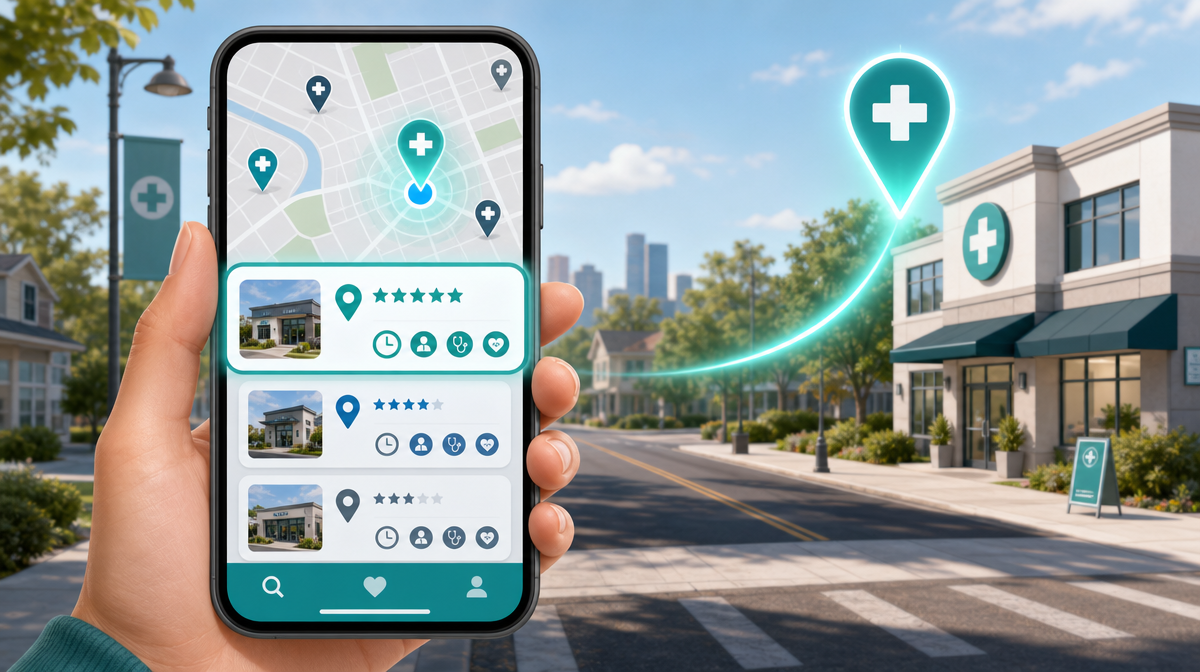
A steady flow matters more than a single push, because patients read the newest reviews first. The simplest system is a text message sent soon after the visit with a direct link to the review form. Ask every patient the same way, and do not offer incentives or filter who is asked, since both conflict with Google’s review policies.
Respond to reviews, including the unhappy ones, and keep every response HIPAA-conscious. That means never confirming that the reviewer was a patient, never mentioning a condition, visit date or treatment, and moving the details to a phone call. A calm, general reply shows future patients how the clinic handles problems without disclosing anything.
The technical side of urgent care SEO is mostly about the phone. Nearly every urgent search happens on a mobile connection, so the location page has to load quickly, show hours and a tap-to-call button at the top, and open directions in one tap. Heavy images, pop-ups that cover the screen and check-in forms that are hard to complete with a thumb all cost visits at the moment the patient has chosen you.
Structured data helps search engines read the facts on each location page without guessing. Google’s documentation on local business structured data describes how to mark up a name, address, phone number, opening hours and coordinates, and a more specific type such as MedicalClinic can be used for each site. Every location page should carry its own markup with its own details, and those details should match the visible page and the profile exactly.
Consistency extends beyond your own site. Keep the clinic’s name, address and phone number identical on map apps, health listings and insurance provider directories, and update them together when anything changes, because Google compares those sources. Local links help too: a mention from a school district, a youth sports league or an employer’s benefits page signals that the clinic is part of that community.
Virtual visits need their own home. If the clinic offers video urgent care, give it a separate page with its own hours, states served and visit types, because mixing it into every location page blurs what each one is about. The approach used in telehealth marketing applies: a virtual service has no street address to rank from, so it depends on clear service content and should link back to the physical clinics for hands-on care.
A growing share of patients never reach the map at all. They ask an AI assistant, or read the AI summary at the top of Google, where to take a sprained wrist tonight, and they receive a short answer that names one or two clinics. These tools select a few sources they can verify, which rewards clinics whose facts are stated plainly and repeated consistently across the web.

Becoming one of those sources draws on everything above. Service pages that state what is treated, for whom and when, location pages with hours and addresses in text, complete profiles and recent reviews all give an AI system something concrete to cite. Building AI-driven search visibility is less a separate project than a higher standard of clarity applied to the pages and listings a clinic already needs.
Target Patients MD manages this work for clinics through one connected program. A.L.I. 360 by Target Patients MD is a proprietary AI-powered patient-acquisition system for medical and dental practices. The name stands for Attract, Learn, and Influence. For an urgent care group, that means profiles, listings, location pages, review requests and reporting are handled together for every clinic.
Measure urgent care SEO by what patients do, not only by where a keyword sits. The useful numbers are calls, direction requests and website taps from each Google Business Profile, online check-ins from organic search, and the positions of your main terms. Track rankings from several points across the service area, because a patient two miles east sees a different map than someone standing in your parking lot.
Report every clinic separately, because a group average can look healthy while two locations fall behind for specific, fixable reasons such as wrong hours on one listing or a thin location page.
Urgent care SEO rewards clinics that keep the basics accurate and specific: one tended profile and one real page for every location, a page for each reason patients come in, a steady stream of reviews, and a site that works on a phone. All of it has to be maintained, and groups feel that weight as they add sites. If you would like help building it across your clinics, request a practice growth session and we will review where each location stands in local search today.
- How long does urgent care SEO take to show results?
Profile corrections, such as hours, categories and duplicate listings, change what patients see within days and often influence map visibility over the following weeks. New location and service pages commonly take a few months to earn their positions, and longer where established clinics hold the top spots. No one can promise a date or a position, so judge progress by the trend in calls, direction requests and check-ins. - Does each urgent care location need its own page and Google Business Profile?
Yes. Every staffed clinic that patients can visit should have its own verified profile and its own page on your website, with details that are unique to that site. A single website with one page per location is the usual structure, and separate websites for each clinic are not needed. - What keywords should an urgent care clinic target?
Target four groups: “near me” and “open now” searches, which the profile and location page answer; services and symptoms, such as stitches, X-rays or strep tests; insurance and cost; and specialized needs such as pediatric care, employer physicals and seasonal services. Give each group its own page instead of placing every term on one. - How do reviews affect urgent care rankings?
Review count and rating are part of how Google judges a clinic’s prominence, which is one of the factors behind local results. Recent reviews also reassure patients who are choosing between nearby clinics in a hurry. Ask every patient in the same way, never offer incentives, and keep every response HIPAA-conscious. - How is urgent care SEO different from SEO for a primary care practice?
Primary care patients research and choose a long-term doctor, so that work leans on provider pages, condition content and the new patient process. Urgent care is decided in minutes by distance and hours, so profiles, location pages and accurate hours carry more weight, and service pages focus on same-day needs.