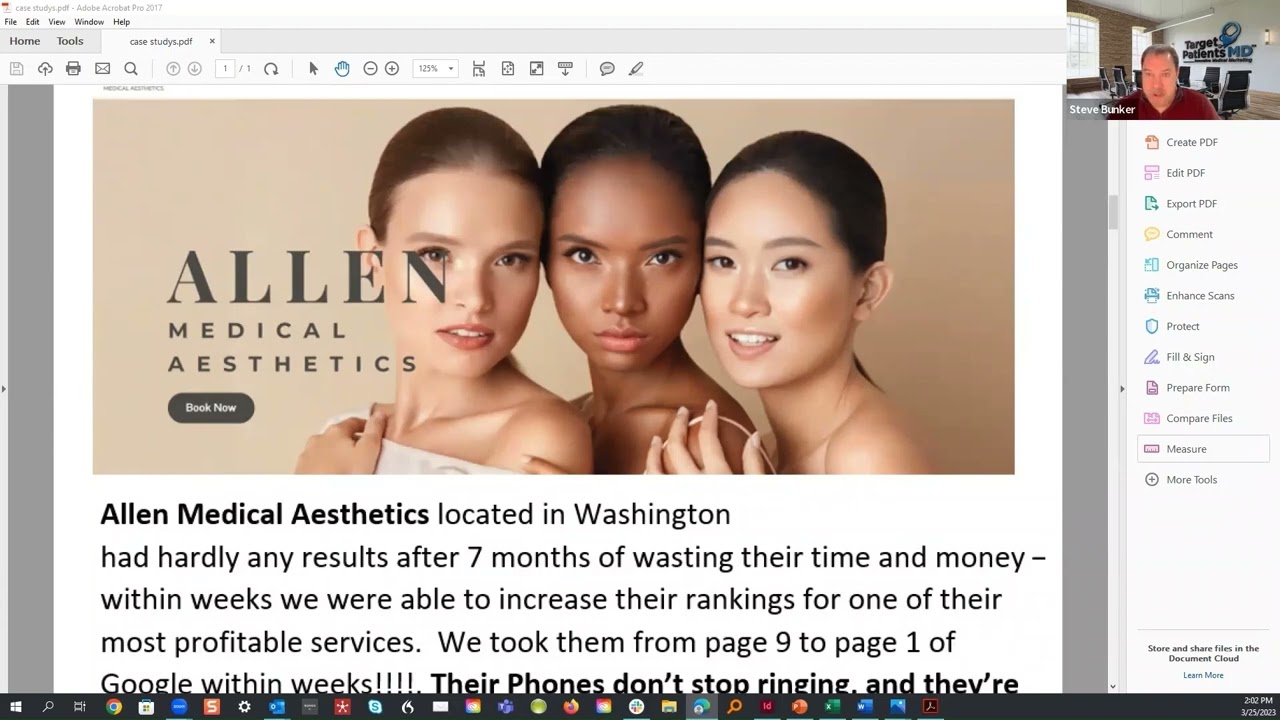



Urgent care marketing is the practice of attracting patients at the exact moment they decide they need immediate care. It sits in a category of its own within healthcare marketing — not because the tools are different, but because the patient timeline is radically compressed.
When someone needs a primary care physician, they might spend days reading profiles, checking insurance networks, and asking friends for referrals. Urgent care patients do none of that. They are symptomatic, stressed, and searching from a phone. The decision from “I need care” to “I’m walking in” can happen in under two minutes.
That single fact breaks the playbook almost every agency brings to a clinic. Awareness campaigns, nurture sequences, months-long consideration windows, retargeting a prospect through a decision cycle — all of it assumes a funnel. Urgent care doesn’t have one. The research phase, the consideration phase, and the decision phase collapse into a single compressed moment on a mobile screen. Whichever clinic removes friction fastest wins the visit, and everything upstream of that moment is theater.
What actually moves the needle in urgent care marketing comes down to a specific set of priorities:
- Visibility at the moment of search — appearing when and where patients are looking
- Instant credibility signals — ratings, reviews, and photos that patients assess in seconds
- Zero-friction conversion — wait times, directions, and check-in options available without digging
- Consistent presence across every local touchpoint — Google, maps, directories, and your own site
No other healthcare vertical runs on the same clock. A patient booking a dermatology consultation is comparison shopping. A patient searching for urgent care at 7:43 PM on a Tuesday is not — they are in discomfort, their kid has a fever of 102°F, and they want an answer in the next thirty seconds.
Four signals drive that split-second judgment:
- Distance and “near me” intent: Proximity is the first filter every patient applies. “Urgent care near me” consistently ranks among the highest-volume local healthcare searches on Google — and the clinic listed closest to the searcher has an inherent advantage before a single word of copy is read.
- Star ratings and review volume: Patients do not read reviews when they are sick — they glance at a number. A half-star gap between your profile and a competitor’s is enough to redirect the click. Volume matters as much as score; 200 reviews at 4.6 stars outperforms 12 reviews at 4.9.
- Website load time and mobile experience: A three-second load delay on mobile is a lost patient. Google’s Core Web Vitals framework exists precisely to measure this — and so do your potential patients, with their thumbs.
- Posted wait times and online check-in: Displaying a live wait time converts a browser into a committed patient before they ever leave their driveway. Online check-in closes the loop by giving them a reason to choose you over the clinic down the street.
That last point is worth sitting with, because it inverts how most practices think about the line between operations and marketing. Your hours, your wait time, your walk-in policy, the insurances you accept — these aren’t operational details that marketing describes after the fact. They are the conversion factors. A Google Business Profile with stale holiday hours loses more patients in a weekend than a badly written ad campaign loses in a month, because the patient who drives to a closed clinic doesn’t just leave — they leave a one-star review on the way to your competitor.
Before you can intercept a patient at the right moment, you need a clear picture of who that patient actually is. Urgent care serves a remarkably diverse population — and each segment has distinct triggers and expectations that should shape how you allocate budget.
- Parents with sick children: This is your highest-frequency, highest-loyalty segment. A parent managing a child’s ear infection or sudden fever is not price-sensitive — they want fast, competent care within a short drive. Win them once and they return for every strep test, sports physical, and minor injury that follows.
- Working professionals who can’t wait for a PCP: These patients have a sinus infection on a Wednesday morning and cannot afford the weeks-long wait that new-patient appointments now routinely carry. They are highly insured, comfortable with digital check-in, and will leave a review if the experience is smooth.
- Athletes and weekend warriors: Ankle sprains, suspected fractures, and sports physicals bring this group through your door. Visibility at local gyms, school athletic programs, and recreational leagues converts them into recurring patients.
- Travelers and new residents: They have no established physician, no referral network, and no loyalty to any local brand yet. They are entirely dependent on search results and your Google Business Profile to make a decision.
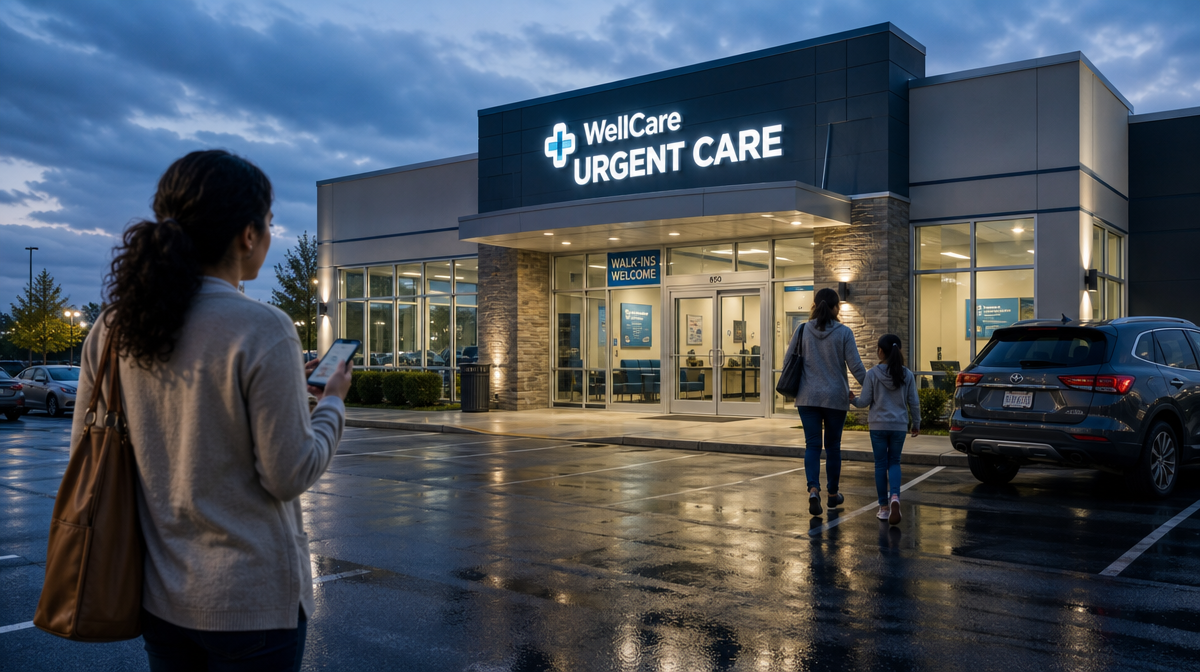
For urgent care clinics, local SEO is not one channel among many — it is the channel. When a patient opens Google and types “urgent care near me,” the three businesses that appear in the Map Pack capture the overwhelming majority of clicks. Everything below that is fighting for scraps.
Getting into that Map Pack requires coordinated optimization across four areas:
- Google Business Profile completeness: Set your primary category to “Urgent care center” — not “Medical clinic,” not “Health center.” Upload photos of your waiting room, exterior, and staff. Keep holiday hours current. Publish weekly Google Posts with service updates to signal an active, maintained profile.
- Dedicated location pages: Each physical address needs its own page with unique written content, an embedded map, local schema markup, and a list of services specific to that location. Copy-pasting the same page across multiple locations tells Google you have nothing original to say about any of them.
- NAP consistency across directories: NAP stands for Name, Address, and Phone number. If your suite number appears as “Ste 200” on Google and “Suite 200” on Healthgrades, that discrepancy erodes trust signals. Audit your listings on Yelp, Apple Maps, and Healthgrades and standardize every entry.
- Review velocity: The Map Pack rewards clinics that accumulate fresh reviews consistently, not those with a burst of reviews from two years ago. A steady stream of new patient feedback outperforms a static high score.
Your website is not a brochure — it is your front desk, your intake form, and your first impression, compressed into whatever a patient sees in the first five seconds on their phone. Most urgent care sites fail that test completely, and the patient is gone before the page finishes loading.
The standard your site needs to meet is ruthlessly functional. Aesthetic choices in your medical website design matter far less than whether a symptomatic parent can tap “call” or “check in” without scrolling, zooming, or hunting through a navigation menu. Four elements must be visible without a single scroll on any mobile screen:
- Click-to-call button — prominently placed, not buried in a header dropdown
- Current wait time or “Check In Now” button — real-time data that gives patients a reason to commit
- Address with a tap-to-navigate link — not a static text address, an actual maps link
- Today’s hours of operation — especially critical on holidays and weekends when patients are most uncertain
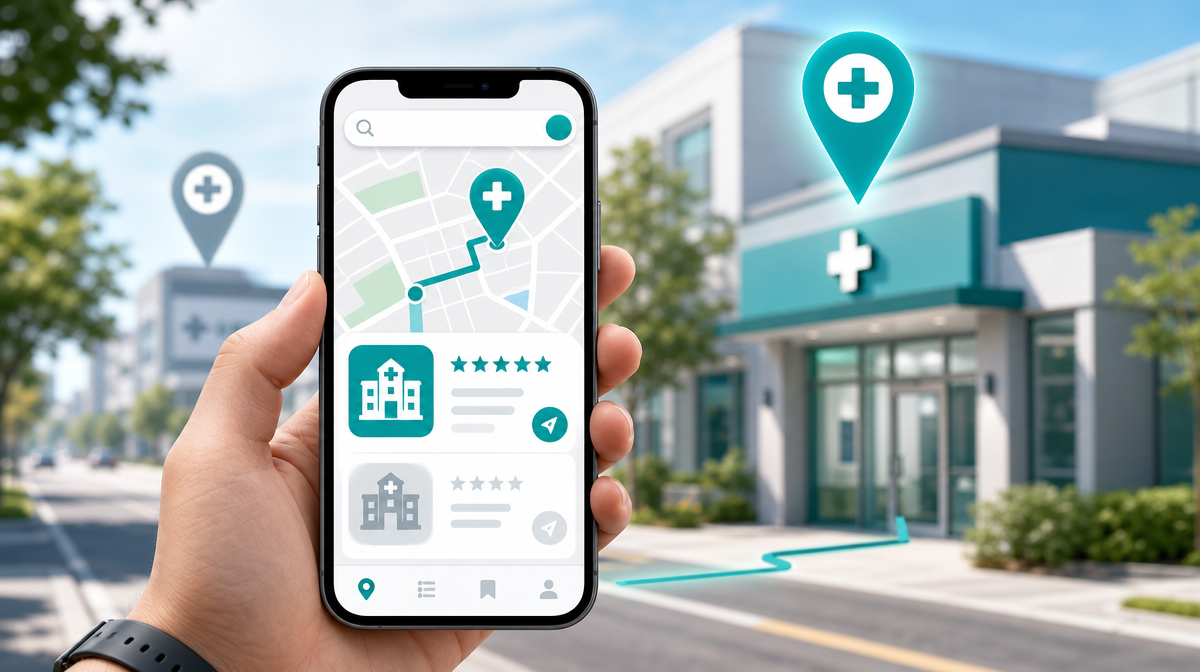
Online check-in deserves special attention because it does something no other feature can: it converts a passive browser into an arriving patient before they have a chance to reconsider. When integrated with your practice management system, it also reduces front-desk congestion and virtually eliminates the walk-in who shows up, sees a crowded waiting room, and walks back out.
Reviews are the closest thing urgent care has to a referral network, and they scale automatically around the clock. The problem most clinic owners face is not that patients are unwilling to leave reviews — it is that the request never reaches them at the right moment. Waiting days to follow up after a visit is the single biggest reason review velocity stalls. Automated post-discharge workflows solve this by sending a request via text within two to four hours of checkout, while the visit is still fresh and the patient’s relief at feeling better is at its peak. That timing window matters more than the platform you use to send it.
Responding to reviews introduces a compliance risk most clinic operators do not anticipate. Publicly confirming that someone visited your clinic — even in a thank-you reply — can disclose protected health information. A HIPAA-conscious response framework looks like this:
- Thank the reviewer without referencing any clinical interaction
- Avoid confirming or denying that they were ever a patient at your facility
- Invite offline conversation by providing a direct phone number or email for follow-up
Once you have built a strong review profile, put it to work on your own website. Review widgets that display aggregated ratings give undecided patients a credibility signal without requiring them to leave your site. For multi-location clinics, a reputation management system that filters reviews by individual location matters — otherwise a high-performing site masks a struggling one.
Local SEO builds your organic floor; paid search fills the gap while that floor is still being poured. For urgent care, Google Ads is not a brand awareness play — it is a patient acquisition switch you can flip on immediately, targeting people actively searching for care right now.
The keyword strategy matters more than the budget. The searches worth owning are transactional and geographically specific: “urgent care near me open now” for peak intent, “walk-in clinic [neighborhood]” for patients who already know what they want, and “urgent care X-ray near me” for service-specific need. Use phrase match and exact match. Broad match on “urgent care” will happily spend your budget on searches about urgent care staffing jobs and franchise investment opportunities — neither of which will ever walk through your door.
Two ad formats deserve priority on mobile. Location extensions surface your address directly inside the ad unit, so a patient sees your clinic before they even click. Call-only ads skip the website entirely and dial your front desk — which is exactly what a distressed patient wants to do at 8 PM on a Saturday.
One more structural feature separates urgent care from every other specialty: the demand curve isn’t flat. Respiratory season concentrates a disproportionate share of the year’s volume into a handful of months. Clinics that budget evenly across twelve of them are underspending exactly when patients are searching and overspending when they aren’t. Paid search should breathe with the season — scaled up when the volume is there to capture, pulled back when it isn’t. Organic and Google Business Profile work runs year-round, because the Map Pack position you want in January is earned in September.
It’s also worth being precise about who you’re actually competing with, because it isn’t only the urgent care across town. It’s the emergency room — slower, far more expensive, and still where a meaningful share of urgent-care-appropriate patients go by default. And it’s the patient who decides to wait until Monday and see if it clears up on its own. Both of those are losses, and neither appears in any competitive analysis. Messaging that positions urgent care as the right level of care — rather than merely as a nearby option — addresses a larger share of the addressable market than any Map Pack fight with the clinic three blocks away.
Running a single location is a marketing challenge. Running three, five, or ten is a different problem entirely — one where the instinct to manage everything from a central brand level quietly destroys individual location performance. Each location competes in its own micro-market with distinct demographics, competing clinics, and search dynamics. A brand-level strategy that averages performance across all locations will systematically under-invest in struggling sites and over-attribute success to thriving ones.
- Hub-and-spoke website architecture: Your main brand domain functions as the hub, accumulating domain authority that benefits all locations. Each location page — the spoke — carries unique content, a locally optimized service list, and schema markup specific to that address.
- One verified Google Business Profile per address: A single consolidated profile for multiple locations is not a shortcut — it is a disqualification from local Map Pack competition. Each clinic needs its own verified profile, managed by someone with proximity to that location who can respond to reviews and keep hours accurate.
- Location-level attribution reporting: Aggregated dashboards hide which locations are underperforming and which are carrying the network. Separate call tracking numbers, individual check-in volume, and per-location cost-per-patient metrics let you reallocate budget where it actually changes outcomes.
Digital marketing fills your waiting room when someone is already sick and searching. Community presence fills it before anyone gets sick — by making your clinic the first name that comes to mind when something goes wrong. School and athletic program partnerships put your name in front of parents before any injury happens: sponsor a jersey, set up at a registration day, and you’re the provider they call when their child rolls an ankle at Friday’s game. New resident outreach through apartment leasing offices reaches people who moved into your ZIP code last month with no doctor, no referral network, and no brand loyalty — at the exact moment they’re building a local support system. Neither tactic requires significant budget. They require consistency and someone willing to make the calls.
When a patient asks ChatGPT “what urgent care is open near me right now,” or Perplexity generates a summary about walk-in options in a specific city, your clinic either appears in that answer or it doesn’t. That binary outcome is becoming more consequential every month as AI-generated results capture a growing share of the healthcare queries that used to flow to Google’s blue links.
Generative Engine Optimization — GEO — is the practice of structuring your content so AI systems are more likely to cite your clinic when composing answers. The underlying logic differs from traditional SEO: these models favor content that is factual, clearly structured, and specific enough to function as a reliable source. Thin service pages and generic “comprehensive care” copy get ignored.
For urgent care operators, the practical implications are straightforward. FAQ-style content about your specific services — which conditions you treat, what imaging you have on site, which insurances you accept — is far more likely to be pulled into an AI answer than vague positioning language. Structured data markup helps AI crawlers understand your hours, location, and service categories without guessing. And consistently updated content signals that your clinic is a current, trustworthy source worth referencing.
Notice what that list has in common with everything else in this post: it’s your operational facts, published clearly. In urgent care, that keeps being the answer.
Which brings the whole thing to measurement — and here too, urgent care needs different nouns than the standard agency dashboard has. There are no “leads” to nurture and no “booked appointments” to track, because the patient decided and arrived inside of two minutes. What you have is visits. Your north-star metric is cost per new patient: total marketing spend divided by new patients acquired in that period. Everything else — impressions, sessions, follower counts — is context, not conclusion.
Track new patient volume, online check-in completions, inbound calls, and conversion by channel, weekly. Then add the two dimensions the standard dashboard misses: by hour, because a clinic that peaks at 7 PM should not be spending its budget at 10 AM; and by season, because a flat twelve-month average hides the only months that matter. If your reporting shows you reach but not visits, you are measuring the wrong things.
A healthcare marketing partner that works only in medicine starts from these constraints rather than discovering them on your budget. A generalist agency can build a website and run ads. What they cannot do is navigate the intersection of HIPAA-conscious tracking, healthcare schema markup, Google Business Profile categories for medical facilities, and the behavioral reality of a patient making a care decision in under two minutes. Those gaps show up in your visit counts, not in the monthly report.
A.L.I. 360 by Target Patients MD was built for exactly this kind of practice — one where the marketing has to work at the speed of the decision rather than across a funnel that doesn’t exist. It integrates search visibility, paid acquisition, GEO, and conversion tracking into a single coordinated system, so your clinic builds presence in traditional results and AI-generated answers at the same time, while patient communications stay in the systems the practice already owns.
- Why doesn’t standard marketing work for urgent care?
Because it assumes a funnel that doesn’t exist. Awareness campaigns, nurture sequences, and multi-week retargeting all depend on a consideration window. Urgent care has none — the research, consideration, and decision phases collapse into a single moment on a phone, usually under two minutes. Marketing built for a slow funnel is the wrong instrument for a business without one. - Why is local SEO so much more important for urgent care than other specialties?
Because the Map Pack is effectively the entire competitive set at the moment of decision. A patient searching “urgent care near me” sees three businesses and picks from them. If you’re not in those three, you don’t exist for that patient — no amount of content, social, or brand awareness reaches them in the ninety seconds they’re deciding. - How long does urgent care SEO take to show results?
Most clinics see measurable ranking movement within three to six months of consistent optimization. Google Ads can generate patient volume within the first week while organic visibility builds, which is why running both during the ramp-up period makes practical sense. - Should an urgent care clinic run TV or radio ads?
Traditional broadcast builds passive awareness but cannot intercept a patient at the precise moment they need care. Local SEO and paid search capture that moment, which is why digital consistently delivers better cost-per-visit outcomes for walk-in clinics. - How do I market a new urgent care before it opens?
Claim and verify your Google Business Profile immediately, publish your location page with full service details, and run geo-targeted awareness ads in the surrounding ZIP codes. Outreach to nearby school athletic departments can build referral familiarity before your doors open. - Does insurance participation affect urgent care marketing?
Yes. Patients frequently filter search results and directory listings by accepted plans, so displaying your insurance network prominently on both your website and Google Business Profile prevents losing qualified clicks from insured patients who assume you’re out of network.