


If you’ve ever Googled “how to get more patients” at 11pm between charting sessions, you already understand the problem medical marketing services are designed to solve. But the term itself gets thrown around loosely, so it’s worth being precise about what it actually means for a healthcare practice.
Medical marketing services are specialized patient acquisition and retention strategies built specifically for healthcare providers — not repurposed from e-commerce playbooks or adapted from what works for a local pizza shop. The distinction matters because healthcare runs on rules general marketing never has to navigate: HIPAA, medical-ethics advertising standards, and a trust-driven, hyperlocal decision process patients move through before they ever book. A generalist agency can run ads; a healthcare-focused marketing partner understands why a patient in your market searches the way they do — and builds campaigns around that behavior to put booked appointments on your schedule.
Target Patients MD operates as a done-for-you medical marketing services provider, meaning your team handles patient care while we handle every channel driving new patients through your door. Here’s what that looks like in practice:
- Medical SEO and Local SEO: We optimize your practice to appear when nearby patients search for your services — covering keyword targeting, Google Business Profile management, and citation building across directories. Local SEO specifically focuses on geographic search queries, so a patient searching “orthopedic surgeon in [your city]” finds you before your competitors.
- Search Engine Marketing and Google Ads: Unlike SEO, paid search delivers top-of-results placement from day one. We target high-intent queries like “LASIK near me” or “dental implants [city]” — patients who are actively ready to book, not just browsing.
- Social Media Advertising: Facebook and Instagram campaigns let us reach your ideal patient demographic by age, location, and health interests. Retargeting keeps your practice visible to patients who visited your site but haven’t yet scheduled.
- Medical Website Design and Development: Mobile-first builds with HIPAA-compliant intake forms and conversion-optimized layouts that turn visitors into booked appointments.
- Email and SMS Patient Outreach: Automated drip campaigns nurture leads, reduce no-shows, and re-engage patients who haven’t returned in months.
- Reputation Management: Systematic review generation across Google, Healthgrades, and Yelp — plus video testimonials that build the trust patients need before choosing a provider.
- A.L.I. 360 AI Patient Acquisition: Our proprietary AI technology continuously optimizes your campaigns across every channel in real time, improving conversion rates without requiring manual intervention from your team.

Not every specialty plays by the same patient acquisition rules. A bariatric practice competing for weight loss patients faces entirely different search behavior, conversion timelines, and messaging requirements than a dental office running implant promotions — which is exactly why applying generic medical marketing services across all specialties produces mediocre results for everyone.
We work across the full range of medical specialties — here are a few of the verticals where we’ve built the deepest patient-acquisition knowledge:
| Specialty | Key Services |
|---|---|
| Dental Practices | Implant marketing, new patient acquisition, review generation |
| Medical Spas | Botox and CoolSculpting campaigns, social advertising |
| Plastic Surgery | Procedure-specific PPC, before/after gallery strategy |
| Ophthalmology and LASIK | Refractive surgery lead generation, conversion optimization |
| Bariatrics and Medical Weight Loss | GLP-1 and Semaglutide marketing, patient education content |
| Cardiology, Orthopedics, Regenerative Medicine | Local search dominance, referral-based marketing |
That’s a representative slice, not the full list — we serve practices across many more specialties. You can browse the complete practitioner list to find yours.
Specialty-specific knowledge changes what gets built and how campaigns perform. A LASIK patient researches for weeks before requesting a consult. A medspa patient books Botox within days of seeing an ad. Treating those two acquisition cycles identically wastes budget and produces weak conversion rates across the board.
Hand a generalist agency your marketing budget and they’ll likely build you something that looks professional, tracks clicks, and produces a monthly report full of impressions. What they won’t do is flag that your contact form is collecting patient symptoms without a Business Associate Agreement in place — a problem affecting 41% of covered entities and a HIPAA violation that no bounce rate improvement can fix.
That regulatory layer is where healthcare marketing separates from every other vertical. Your campaigns aren’t just subject to platform policies and FTC advertising guidelines — they’re also governed by professional licensing boards, state medical advertising statutes, and federal privacy law. A Facebook ad promising a specific clinical outcome can trigger a board complaint. A testimonial used without proper disclosure can violate ethics rules. These aren’t edge cases; they’re routine hazards that a generalist agency simply isn’t trained to avoid.
Beyond compliance, the patient decision cycle operates on a fundamentally different timeline than consumer purchasing. Consider what’s actually happening when someone searches for a provider:

- Trust comes before conversion: 84% of patients check online reviews, vet credentials, and compare providers before making any contact
- Geography dominates intent: Distance and accessibility are primary filters — not price or brand awareness
- Condition sensitivity shapes messaging: Copy that works for a medspa reads as dismissive when applied to bariatric or cardiac care
- Compliance-aware content is non-negotiable: Outcome claims must be carefully qualified to avoid both regulatory and ethical exposure
Effective medical marketing services are built around these realities from the ground up — not retrofitted onto frameworks designed to sell software subscriptions or retail products.
Artificial intelligence has quietly rewritten the economics of patient acquisition — and most practices haven’t caught up to what that actually means in operational terms. The shift isn’t just about automation. It’s about prediction: AI medical marketing systems analyze search patterns, ad performance data, and conversion signals simultaneously to identify which campaigns are producing booked appointments versus which ones are burning budget on window shoppers.
For your practice, this plays out across several distinct functions that didn’t exist in traditional medical marketing services:
- Predictive campaign optimization: Rather than waiting for monthly reports to reveal underperforming ad sets, AI adjusts bids, audiences, and creative in real time — often catching performance drops before they cost you anything meaningful
- Generative Engine Optimization (GEO): When patients use AI-powered search tools like Google’s AI Overviews, they receive synthesized answers rather than a list of blue links — GEO ensures your practice gets cited within those AI-generated responses
- 24/7 patient engagement: AI-driven scheduling assistants and intake chatbots capture appointment requests outside office hours, eliminating the gap between a patient’s decision moment and your front desk’s availability
- Behavioral intent scoring: Machine learning identifies which website visitors are closest to booking — enabling follow-up sequences to activate at precisely the right moment
Our A.L.I. 360 platform runs this entire optimization layer continuously across SEO, paid search, and local rankings — so your campaigns compound in performance over time rather than plateauing after initial setup.

Choosing the right partner deserves its own scrutiny. The criteria that actually separate a real healthcare specialist from a generalist — documented HIPAA and Business Associate Agreement experience, results within your specific specialty rather than healthcare broadly, real patient-acquisition metrics instead of clicks and impressions, and in-house execution you can verify — are involved enough that we cover them in depth separately, in our guide to choosing the right medical marketing partner.
Timelines vary by service, and setting accurate expectations upfront is one of the most important conversations you can have before committing to any marketing investment. The short version: paid advertising moves fast, organic channels compound slowly, and a balanced mix delivers both immediate wins and durable long-term growth.
Here’s what the typical performance curve looks like across each service category:
- Paid advertising: Google Ads and social campaigns can generate inbound patient inquiries on the same day they launch, often within the first hours of a campaign going live
- SEO and local search: Organic rankings build over months as content authority and citation signals accumulate; practices that stay consistent typically see compounding traffic gains that paid channels alone can’t replicate
- Reputation management: Review volume and average star ratings improve steadily over 60–90 days as systematic outreach replaces the hit-or-miss approach most practices rely on
- Email and SMS automation: Re-engagement campaigns targeting dormant patients often produce bookings within the first send cycle — frequently the fastest ROI for practices with an existing patient database
The metric that ultimately matters across all of these isn’t click volume or impression share — it’s booked appointments attributed to specific campaigns. That’s the number your front desk confirms and your schedule reflects. Everything else is a leading indicator, not the outcome itself.
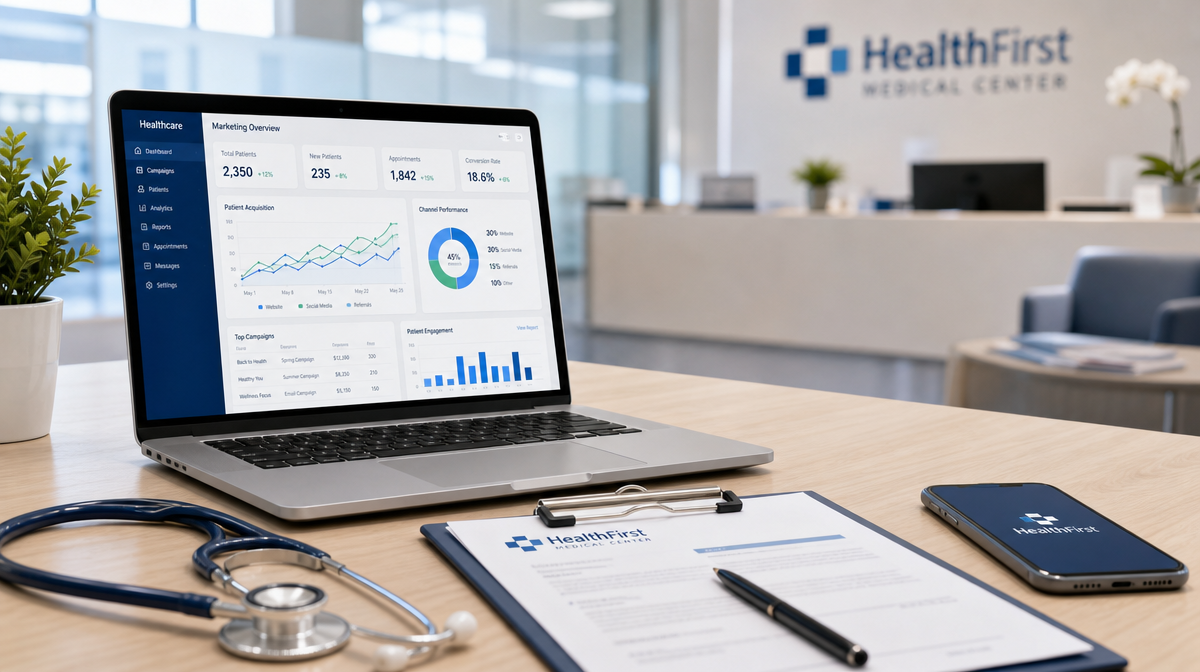
Practice owners evaluating medical marketing services tend to arrive with similar questions — and the answers shift depending on which stage of growth your practice is in. Here are the ones that come up most often:
- What does medical marketing do? It promotes your practice across digital channels — search, social, email, and reputation platforms — to attract new patients and keep existing ones returning, while staying within the compliance boundaries healthcare requires.
- What are the 4 P’s of healthcare marketing? Product (the clinical services you offer), Price (your fee structure and insurance acceptance), Place (your location and how accessible you are), and Promotion (the advertising and outreach you run to reach prospective patients).
- What are the 5 P’s of healthcare marketing? The four above, plus People — meaning your staff, providers, and the patient experience they create. In healthcare, the human element carries more weight than almost any other industry.
- What are the 7 types of digital marketing services? SEO, PPC/SEM, social media, content marketing, email marketing, affiliate marketing, and influencer marketing. For healthcare practices specifically, the highest-ROI channels are SEO, paid search, social advertising, email, and reputation management.
- How much do medical marketing services cost? Pricing varies based on practice size, market competitiveness, and how many channels you activate, so there’s no universal figure. The useful approach is to request transparent, itemized pricing tied to your specific goals before committing — and to weigh it against the patient acquisition cost your practice can sustain.
- How fast will I see results? Paid campaigns can produce inquiries the same week they launch. SEO takes longer — measurable organic gains typically emerge over three to six months of consistent effort.
Target Patients MD was built for one purpose: filling appointment slots at healthcare practices that have run out of patience with agencies that treat medicine like any other industry. Every service we offer — from AI-driven campaign optimization to specialty-specific ad creative — is designed and executed by a team that works exclusively in healthcare, not a generalist shop that picked up a few medical clients along the way.
Here’s what you get when you work with us:
- Healthcare-only focus: We don’t split attention between dental practices and e-commerce brands — your specialty gets the full benefit of deep vertical expertise
- A.L.I. 360 technology: Our proprietary AI platform runs continuous optimization across every active channel, compounding performance gains that manual management simply can’t match
- Done-for-you execution: Your staff handles patients; our in-house team handles everything from campaign builds to reputation monitoring to landing page performance
- Transparent accountability: You see the metrics that matter — new patient inquiries, booked appointments, and cost per acquisition — not a curated slide deck of vanity numbers
Whether you’re a single-location practice trying to dominate local search or a multi-location group needing a coordinated patient acquisition engine, the right medical marketing services partner should deliver measurable growth — not activity reports. Book a free consultation with Target Patients MD and find out what a practice like yours can realistically expect within the first 90 days.