


Run a Google Ads campaign in Topeka and you’ll pay $4–6 per click on “dentist near me.” Run the same campaign in Midtown Manhattan and watch that number climb past $25. That gap isn’t a rounding error — it’s the fundamental reason why a dental marketing agency NYC practices must work with needs a completely different playbook than what works anywhere else in the country.
New York City doesn’t function as a single dental market. It’s five boroughs with distinct demographics, income profiles, and search behaviors layered on top of each other. A campaign optimized for a cosmetic practice in the West Village will actively underperform for a family dentist in Jackson Heights — different languages, different insurance expectations, different patient journeys entirely.
Stacking pressure on top of that geography problem is the DSO footprint. Corporate dental chains — now affiliated with over 30% of U.S. dentists — have saturated high-foot-traffic corridors across all five boroughs, outspending independent practices on brand awareness and bidding up the most valuable keywords.
The NYC-specific challenges that sink most marketing programs include:
- Borough-level audience fragmentation: Queens alone — with a diversity score of 97 out of 100 per U.S. Census data — spans a wider demographic range than most mid-sized U.S. cities.
- Hyperlocal search intent: Patients search by neighborhood, not city — “dentist Astoria” and “dentist Flushing” are entirely different competitive landscapes.
- Multi-lingual patient bases: Spanish, Mandarin, Cantonese, Bengali, and Russian-speaking communities require language-specific targeting, not just translated ads.
- DSO brand saturation: Corporate chains own significant brand recall, forcing independent practices to compete on specificity and trust signals.
- CPC pressure on high-value treatments: Implant and cosmetic keywords in NYC regularly exceed $40 per click, making budget discipline non-negotiable.
Most NYC dentists evaluating their marketing performance are looking at the wrong scorecard. Impressions, website sessions, social media reach — these numbers feel like progress but tell you nothing about whether your schedule is filling up. The only metric that keeps the lights on is a booked appointment from a new patient who actually shows up.
Effective dental marketing strategies in a market this competitive have to be built backward from that single outcome. That means every channel, every dollar, and every campaign decision gets evaluated against one question: did it produce a confirmed appointment, or didn’t it?
The channels that consistently move the needle for NYC practices share a few common traits — they intercept patients at high-intent moments, they convert traffic rather than just generating it, and they operate with enough precision to survive in a market where wasted spend compounds fast. The core acquisition levers worth your attention break into five categories:
- Local SEO and Google Business Profile optimization tuned to neighborhood and ZIP-level search behavior
- High-intent paid search campaigns built around treatment-specific keywords with disciplined budget controls
- Conversion-focused website design that turns visitors into scheduled patients rather than just browsers
- Reputation management systems that generate reviews at scale and reinforce trust before a patient ever calls
- Email and SMS reactivation campaigns that recover lapsed patients and reduce no-show rates
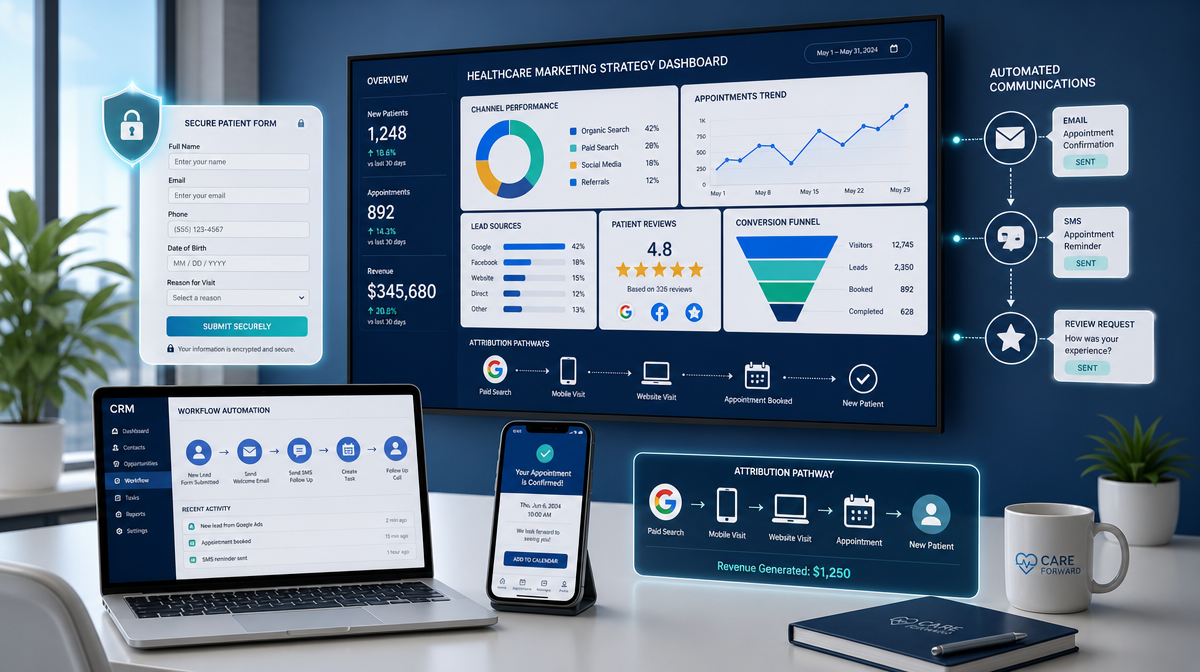
Each of these channels operates differently in NYC than anywhere else — and the details of how to execute them here are what separates agencies that understand this market from those that don’t.
Knowing which channels deserve your budget is half the battle — understanding how each one operates specifically inside NYC’s patient acquisition environment is the other half. A dental marketing agency NYC dentists should consider must demonstrate fluency in all five of these channels, not just one or two.
- Local SEO and Google Business Profile optimization: Local SEO for dentists in NYC isn’t a city-wide play — it’s neighborhood-by-neighborhood. Your GBP needs to be optimized at the ZIP-code level, citations must stay consistent across 50+ directories, and review velocity matters as much as review volume for map-pack rankings.
- High-intent dental PPC via Google Ads: Dental PPC captures patients mid-search, which is exactly where you want to be. In NYC’s competitive landscape, tight keyword targeting and aggressive negative keyword lists prevent budget from bleeding into irrelevant clicks. Dedicated landing pages — not your homepage — are what convert those clicks into consultation requests.
- Conversion-first dental website design: Dental website design that performs in NYC prioritizes mobile-first layouts, click-to-call buttons, online scheduling, sub-3-second load times, and HIPAA-conscious intake forms. A beautiful site that doesn’t book appointments is an expensive brochure.
- Dental reputation management: Reviews influence both local rankings and the 30 seconds a prospective patient spends deciding whether to call you — 84% of patients check online reviews before choosing a new provider. Dental reputation management means systematic review generation, professional responses to negative feedback, and displaying social proof where patients are already looking.
- Email and SMS patient campaigns: Reactivation sequences and appointment reminders reduce no-shows and recover lapsed hygiene patients — compliant, automated, and measurable against actual production numbers.
Before signing any contract, ask these questions — because the difference between an agency that fills chairs and one that burns your budget often comes down to five specific things you can verify before you write a single check.
| Criteria | Generalist Agency | Dental-Specialized | Healthcare-Only |
|---|---|---|---|
| HIPAA awareness | Rarely built in | Usually present | Core competency |
| NYC dental market experience | Generic local tactics | Varies widely | Specialty-specific |
| Reporting depth | Impressions, clicks | Leads, some CPL data | Booked appointments, ROI |
| Accountability model | Activity-based | Outcome-adjacent | Reporting-based |
| Senior team involvement | Account managers only | Mixed | Strategist-led |
The table above tells you what to expect from each agency type going in. What it can’t capture is the quality variance within each category — a specialized dental marketing agency needs to answer specifically for your market, your procedure mix, and your patient acquisition targets, not just their category average.
The five evaluation criteria below are the filters that separate agencies worth talking to from those worth avoiding.
The honest answer is that neither path is automatically right — it depends on where your practice sits right now in terms of revenue, growth stage, and internal bandwidth. What the decision usually comes down to is not passion for marketing but capacity to execute consistently without pulling your attention away from clinical work.

| In-House Hire | Freelancer/Consultant | Specialized Agency | |
|---|---|---|---|
| Monthly cost | $55K–$80K salary + benefits | $2K–$5K retainer | $3K–$10K retainer |
| Expertise depth | One generalist skill set | One or two channels | Full-stack, dental-specific |
| Scalability | Limited by headcount | Limited by individual capacity | Scales with ad spend and need |
| HIPAA exposure risk | High if untrained | High — rarely prioritized | Low if healthcare-specialized |
| Owner time investment | High — ongoing management | Medium — coordination required | Low — structured accountability |
Solo and two-chair practices with collections under $600K often do well starting with a freelancer to test channels before committing to a full retainer. Once you’re running multiple operatories, turning away new patients, or targeting high-production procedures like implants, the math shifts — the cost of a dental marketing agency NYC practices use at that stage is typically recovered within the first two to three new implant cases. Practices focused on that specialty should see our dedicated guide to dental implant marketing.
The freelancer gap that stings most in NYC specifically is compliance. A generalist contractor who doesn’t understand HIPAA-conscious form handling or Meta’s healthcare advertising restrictions can create liability exposure that costs far more than any retainer fee to resolve.
You can’t optimize what you don’t measure — and in a market as expensive as New York City, flying blind on marketing performance isn’t just inefficient, it’s genuinely costly. A dental marketing agency NYC practices rely on should be handing you a dashboard that tracks outcomes, not activities. Here’s what dental marketing ROI actually requires you to monitor:
- Cost per lead (CPL) vs. cost per acquired patient: These are not the same number. A lead is a phone call or form submission. An acquired patient is someone who showed up, sat in the chair, and generated production. NYC CPLs for high-value procedures typically run 30–50% above national benchmarks — knowing both figures tells you where the funnel is leaking.
- Booked appointment rate and show rate: What percentage of inbound leads convert to a confirmed appointment? Of those, how many actually arrive? These two numbers reveal whether your marketing is underperforming or your front desk is the bottleneck — a distinction that completely changes where you invest next.
- Patient lifetime value (LTV): A single implant patient who returns for hygiene, refers two family members, and eventually needs a second arch is worth $15,000–$30,000 over time. Knowing your LTV by procedure type tells you exactly how much you can afford to spend acquiring that patient profitably.
- Channel attribution: Call tracking, UTM parameters, and CRM integration reveal which specific campaigns produced booked patients — not just which ones generated clicks. Without attribution, budget decisions are guesswork.
Marketing ROI in dental is straightforward once you have clean data: divide revenue generated from new patients by total marketing spend. The challenge is getting the data clean in the first place.
Signing with the wrong agency doesn’t just waste money — it can actively set your practice back while competitors compound their head start. Here are the warning signs that separate trustworthy partners from budget traps, specifically in the NYC dental market:
- Red flag: They lead with vanity metrics. Agencies that open every report with impressions, reach, and follower counts are either hiding weak performance or genuinely don’t understand dental patient acquisition. A practice owner should be able to open a monthly report and immediately find how many new patients were booked — full stop.
- Red flag: The contract runs 18–24 months with no performance exit clause. Reasonable agreements in this space are typically 3–6 months with defined performance milestones. Any dental marketing agency NYC dentists are considering should be transparent about how progress is reported, not lock you into a long runway regardless of outcomes.
- Red flag: They’ve never worked with a dental or healthcare client before. Generalist agencies learning HIPAA requirements on your dime, guessing at patient journey nuances, and applying e-commerce tactics to a clinical service environment is a combination that burns budget fast and creates compliance exposure.
- Red flag: Your account is managed by someone offshore or by a junior coordinator with no strategy access. When you ask a direct question about your campaign, you should reach a strategist — not wait three days for a ticket response from someone who can’t explain why your implant campaign is underperforming in the Bronx versus Brooklyn.
- Red flag: “Guaranteed results” with no definition of what a result actually is. Guaranteed activity — posting twice a week, running ads, sending emails — is not the same as new patients. Demand specificity before you sign.

Search behavior for dental services in NYC is undergoing a structural shift that most practices haven’t fully registered yet. Google’s AI-powered search experiences — including AI Overviews and AI Mode — are increasingly answering patient queries with synthesized AI responses rather than a traditional list of blue links. If your practice content isn’t structured to feed those AI-generated answers, you’re invisible to a growing segment of searchers who never scroll to the organic results at all.
This is where Generative Engine Optimization (GEO) enters the picture. Unlike traditional SEO, which optimizes for ranking position, GEO focuses on structuring your content so AI systems can extract, cite, and surface it in generated responses. For NYC dentists competing across borough-specific queries — “best implant dentist in Astoria” or “Invisalign provider near Prospect Heights” — appearing in AI-generated answers is becoming as valuable as holding a map-pack position.
On the paid and conversion side, AI-driven patient acquisition tools are compressing the gap between ad spend and booked appointments. Systems like A.L.I. 360 by Target Patients MD apply machine learning to real-time bid optimization, audience scoring, and lead prioritization — identifying which inbound inquiries are most likely to convert before your front desk picks up the phone. Practices using AI-assisted acquisition infrastructure often see meaningful gains in patient volume compared to conventional campaign management.
Forward-looking NYC practices should ask any dental marketing agency NYC they evaluate three direct questions: Are you optimizing our content for AI-generated search results? Do you use predictive analytics for audience modeling? And how does your system distinguish a high-intent implant lead from a price-shopping inquiry in real time?
Marketing generates the lead. Your front desk determines whether that lead becomes a patient. In NYC’s high-volume, high-distraction environment, the average practice loses somewhere between 30% and 50% of inbound inquiries not because the marketing failed — but because the handoff did.
The conversion gap is rarely about effort. It’s about process. When a prospective patient calls after clicking a Google Ad at 11:47am and reaches a voicemail, that lead is gone within minutes. Studies on healthcare lead response consistently show that response time beyond five minutes drops contact rates by more than 80%. In a borough where three competing practices are running ads for the same keyword, speed isn’t a courtesy — it’s a competitive advantage.
Four improvements your practice can implement immediately to protect what your marketing budget is generating:
- Establish a live-answer protocol during peak inquiry hours — most inbound dental calls arrive between 8am and 12pm; staffing for that window pays for itself.
- Build a same-day callback system for any missed call or web form submission, with a defined script for the first touchpoint.
- Train front desk staff on case-specific language for high-value procedures — an implant inquiry handled like a cleaning appointment loses the case before the consult is even scheduled.
- Integrate your scheduling software with your lead tracking so every inquiry is logged, followed up, and attributed — eliminating the invisible drop-off that most practice owners never see.

The right dental marketing agency NYC practices work with should flag this conversion gap proactively, not just optimize ad spend while your front desk quietly bleeds the budget dry.
If you’ve read through everything above and you’re thinking “I just need someone to handle this so I can get back to treating patients” — that’s exactly the right instinct. The practices that grow fastest in NYC aren’t the ones with the most marketing knowledge. They’re the ones that found a partner accountable to actual patient numbers and then got out of the way.
Target Patients MD works exclusively with healthcare practices, which means no learning curve on HIPAA, no guessing at patient psychology, and no recycled e-commerce playbooks dressed up as dental strategy. The team brings borough-specific campaign experience across Manhattan, Brooklyn, Queens, the Bronx, and Staten Island — not a generic New York checkbox, but genuinely differentiated execution at the neighborhood level where patient acquisition actually happens.
Three things distinguish the right dental marketing agency NYC practices should commit to:
- Reporting tied to new patients, not activity. You should never be locked into a retainer that measures success by posts published or ads launched.
- Full-stack execution under one roof — local SEO, paid search, reputation systems, and conversion infrastructure working as a coordinated system rather than disconnected vendors.
- Senior-level strategist access from day one, not after you escalate a complaint three months into a failing campaign.
If your chairs aren’t as full as your clinical reputation deserves, Target Patients MD is worth a direct conversation before your next competitor beats you to the next patient searching your neighborhood.
Dental practices in NYC ask the same five questions before committing to a marketing partner. The answers reveal more about an agency’s fit than any sales deck ever will.
- What is a realistic cost per new patient for a NYC dental practice? There’s no universal number — a general dentistry patient acquired through local SEO carries a very different cost structure than an implant patient sourced via Google Ads in a high-competition ZIP code. What matters more than benchmarking against industry averages is calculating what your specific procedure mix and patient lifetime value can support. A practice generating $4,000 in average production per new patient can profitably spend far more per acquisition than one averaging $800.
- How long before a dental marketing agency delivers measurable results? Paid search campaigns can produce inbound inquiries within the first week of going live. Organic search improvements typically take three to six months to register meaningful ranking movement. Any dental marketing agency NYC dentists are considering should be transparent about which channels move fast and which ones compound over time — and structure expectations accordingly.
- Are pay-per-lead models worth considering in NYC? They reduce upfront financial risk but introduce lead quality risk. Always clarify whether leads are shared with competing practices in your area, and define in writing what constitutes a qualified lead before agreeing to any per-lead pricing.
- How do multi-location dental groups structure their NYC marketing? Each location needs its own Google Business Profile, location-specific landing pages, and neighborhood-targeted campaigns. A single citywide campaign consistently underperforms compared to borough-level execution.
- Can dental marketing stay HIPAA-conscious on Google and Meta? Yes — when agencies use encrypted forms, avoid health-condition-based retargeting, and follow each platform’s healthcare advertising policies. Request written documentation of compliance protocols before signing.