



Most practice owners chasing growth make the same mistake: they assume the problem is not enough marketing. So they bolt on another ad campaign, post more on Instagram, or hire a third vendor — and wonder why the schedule still has gaps. The truth is that most practices aren’t suffering from a traffic shortage. They’re losing patients at several points along the way without realizing it.
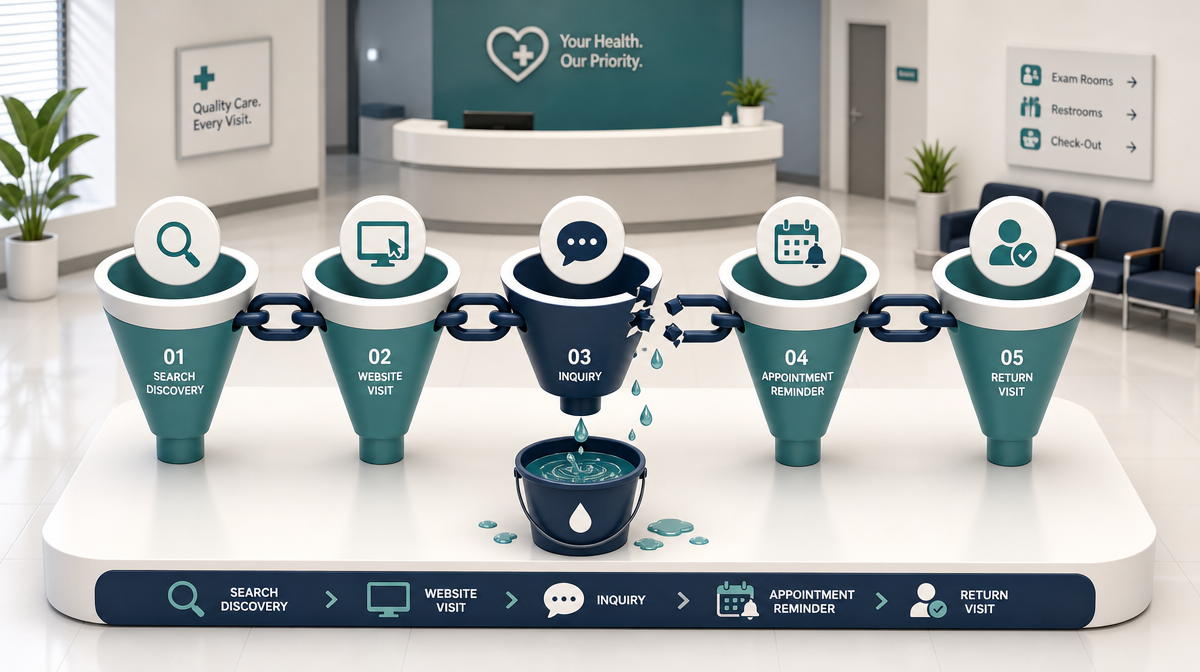
Think of your practice like a bucket. If the bucket has holes, pouring more water in doesn’t fill it — it accelerates the waste. The same logic applies to your marketing budget. Spending more to drive traffic into a broken funnel doesn’t get you more patients; it gets you a higher cost per disappointment. The smarter move is to diagnose before you spend: audit where potential patients are dropping off, fix the biggest hole first, and only then scale what’s already working. Two practices can spend identically on paid search and get wildly different results — not because one has a better ad, but because one has a functional system waiting on the other side of the click.
That’s the difference between the tactics approach and the leak approach. The first adds more ads, more posts, and more spend without knowing what’s already broken. The second audits the funnel, fixes the biggest hole, and scales what works. Figuring out how to get more patients starts with an honest look at where you’re already losing them.
A patient acquisition funnel is simply the path a stranger takes to become a scheduled, seated, paying patient. Every step of that journey is a place where you either win that person or lose them — permanently, and usually without ever knowing it happened. Our guide to the healthcare marketing funnel lays out those stages and the surface that decides each one; this post is about finding where yours leaks. There are five distinct stages where practices hemorrhage potential patients, and each one fails in a characteristic way.
Visibility comes first: a patient searches for care, and you don’t appear. Then the website: they reach your site and find no obvious way to book. Then speed to lead: they submit an inquiry and nobody follows up quickly enough. Then attendance: they book, and then no-show because nothing reminded them. And finally retention: they complete a visit and never come back, because no recall or re-engagement ever reached them.
What makes this framework useful is that each stage operates independently. A practice can have strong local search visibility but a website that confuses visitors into leaving. Another might book appointments efficiently but lose a meaningful share of them to no-shows every week. The leak is rarely everywhere at once — it’s usually one or two stages doing most of the damage. Identifying your specific break point is what separates practices that scale predictably from those that stay stuck despite spending more.
Before you start plugging leaks, though, be honest about one thing: who are you actually trying to attract, and why would they choose you? Without clear answers to those two questions, even a technically perfect funnel fills with the wrong patients — or with people who shop around and never commit.

An ideal patient profile isn’t a vague demographic sketch. It’s a specific picture of the patient type that is most profitable, most aligned with your care model, and most connected to the services you actually want to grow. A cosmetic dermatologist and a primary care physician serving the same zip code have completely different ideal patients, and their marketing should reflect that at every touchpoint. Your value proposition is the honest answer to why a patient should call you instead of the practice two miles away — and “compassionate care” and “experienced team” don’t count, because every competitor says the same thing. Think about what you genuinely do differently: same-week appointments, a specific subspecialty, bilingual staff, a particular technology, or a care model patients can’t find nearby.
Three questions are worth sitting with before any marketing dollar gets spent. Who is your most profitable patient type, and are you actively targeting them? Which services do you want to grow, and are those the ones you’re promoting? And what specific reason would a patient give for choosing you over the competition? Clarity here doesn’t just sharpen your messaging — it determines which leaks are worth fixing first. Some practices push that logic all the way to a capped panel, which is what concierge medicine marketing is built around.
You cannot convert a patient who never finds you. Visibility is the top of your funnel and, for most independent practices, the leakiest stage — because competitors are showing up in local search while you’re invisible to the exact people actively seeking care right now. The good news is that fixing visibility doesn’t require a massive budget. It requires precision, which is why private practice marketing works differently when you’re competing against a hospital system rather than another independent.
Start with your Google Business Profile, the free listing that powers your appearance in Google Maps and the local pack — those highlighted results that dominate the top of local searches. Google’s own guidance is unusually direct about what drives placement there: relevance, distance, and prominence, with complete business information and review volume feeding the first and last of those. A profile with current hours, accurate service categories, real photos, and answered questions signals that your practice is legitimate and active, and practices that treat it as a set-it-and-forget-it checkbox leave their highest-return visibility tool idle. For some specialties that profile is nearly the whole game — urgent care marketing is decided almost entirely in the map pack, where a patient searching at nine at night picks whichever clinic shows accurate hours and is open now. From there, rank for high-intent local terms: when someone types “family doctor accepting new patients” plus a city, or “dermatologist near me,” they’re ready to book rather than browse, and your page titles, headers, and service descriptions need to match the exact language those patients use, tied to your specific geography. Build consistent citations across directories too — every time your name, address, and phone number appear on Healthgrades, Yelp, or an insurance directory, Google uses that data to validate your local authority, and inconsistent listings suppress rankings. And publish content that answers real patient questions, because posts targeting searches like “how long does a root canal take” or “signs you need a knee replacement” pull in patients at the research stage and build the kind of organic authority a medical SEO agency compounds over months rather than weeks.
Getting found is only half the battle. The more frustrating leak happens right after — when a potential patient lands on your website, looks around for thirty seconds, and quietly leaves to call someone else. They were ready to book. Your site just didn’t make it easy enough. Most practice websites were built to look good in a demo rather than to convert a visitor at midnight when nobody is answering the phone, and that gap costs booked appointments every day.
Four fixes address the most common drop-off points. Build for mobile first rather than as an afterthought, because the majority of healthcare searches happen on a phone and a site that loads slowly or requires pinching and zooming has already lost that visitor. Add online appointment booking that works around the clock, since patients decide at ten at night and requiring a phone call during business hours hands them to whoever lets them schedule immediately. Prove credibility above the fold, because what a visitor sees before scrolling determines whether they stay — real provider photos, recognizable credentials, and a few standout reviews at the top of the page build the trust that turns browsers into bookers. And track what’s actually converting, since call tracking and form analytics reveal which sources produce appointments rather than just clicks. Taken together, these are the elements that separate medical website design that books patients from design that merely looks finished.
A completed inquiry form means nothing if your front desk doesn’t respond until the next morning. Patients searching for a new provider are usually contacting two or three practices at once, and whoever responds first tends to win the appointment — the odds of converting an inquiry fall sharply within the first several minutes of silence. This is where paid advertising and automation solve different halves of the same problem.
Paid search accelerates the top of that race by generating high-intent inquiries quickly. Unlike organic work, which builds over months, a properly structured campaign can put your practice in front of ready-to-book patients within days of launch, which is why Google Ads for doctors is usually the fastest lever available when the schedule needs filling now. Social advertising works differently — it interrupts a scroll rather than answering a search, which makes it better suited to promoting a specific service, re-reaching people who visited your site without booking, or building awareness for a new provider or location. Automation then covers the follow-up gap your staff physically cannot: an after-hours inquiry deserves an immediate acknowledgment rather than a voicemail, and an instant, personalized response to every inquiry — whether it arrives through a form, a chat window, or an ad landing page — meaningfully increases how many inquiries become appointments.
Your online reputation isn’t a vanity metric. It’s the decision point where most patients either pick up the phone or move on to the next result — Medical Economics reports that 84% of patients check online reviews before choosing a provider, which makes it a gate your practice passes or fails before a single conversation happens. The reviews leak is sneaky because it feels passive — patients either leave reviews or they don’t, the thinking goes. In practice, the opposite is true: practices that actively manage review generation outperform those that wait, because timing and process determine volume more than patient satisfaction alone.
Ask at the right moment rather than the convenient one — a text sent within a couple of hours of a positive visit converts far better than a generic email three days later, and building the request into your post-visit workflow means it happens automatically rather than depending on someone remembering. Respond to every review publicly, because future patients read your responses as closely as the reviews themselves; a thoughtful reply to criticism signals accountability, while silence signals indifference. And display your strongest reviews where they matter, embedding live ratings on your site so social proof reaches visitors before they go looking for it. A serious approach to reputation management doesn’t just help you get more patients — it lowers the cost of every other channel by lifting conversion across the board.
Acquiring a new patient costs substantially more than keeping an existing one, yet most practices pour nearly every marketing dollar into acquisition while letting their patient base quietly erode. The retention leak is the one that makes growth math permanently broken: add twenty new patients a month, lose fifteen to inactivity, and the schedule never actually fills. Some specialties live almost entirely on this — audiology marketing is built around a decision patients take years to make and a relationship that outlasts any single device. The patients most likely to come back are the ones who already trust you. They just need a reason and a reminder — our guide to patient retention strategies covers the recall, reactivation, and follow-up systems that deliver both.

Recall campaigns should reach patients before they go cold — someone who completed an annual visit eight months ago doesn’t know they’re overdue until you tell them, and automated sequences timed near the anniversary bring patients back on a predictable cycle rather than relying on memory. Reactivation goes further: pull everyone from your practice management system who hasn’t visited in twelve to eighteen months and run a dedicated win-back campaign, because a single well-timed message converts a surprising share of dormant records into booked appointments. Between visits, light-touch healthcare email marketing keeps your practice present without being promotional, so when that patient eventually needs care they think of you first. And automated appointment reminders address the last leak in this stage — a no-show doesn’t only waste a slot, it occupies one that a new patient could have filled, and reminders sent a couple of days out and again a few hours before consistently reduce them.
Paid ads bring in strangers. Referrals bring in pre-sold patients — people who already trust you before they call. The conversion rate on a referred patient is dramatically higher than any paid channel and the acquisition cost is a fraction of a click, yet most practices treat referrals as something that happens organically rather than something they engineer.
On the patient side, your happiest patients are usually willing to refer friends and family; they just need a prompt and an easy path. That means identifying the right moment to ask — typically right after a good outcome or an unprompted compliment — making the action simple with a link or a card, and tracking every referral back to its source so you know who is driving volume. Any recognition or incentive program has to be structured carefully within the rules that govern healthcare referrals, which is worth reviewing with counsel rather than improvising. On the physician side, other providers are often the single highest-volume source available, particularly for specialists. A cardiologist, orthopedic surgeon, or gastroenterologist who isn’t actively cultivating relationships with nearby primary care physicians is leaving a real pipeline untapped. This isn’t cold outreach — it’s making yourself the obvious, easy choice when a physician needs to send a patient somewhere, through consistent communication, streamlined intake, and timely case updates that make referring to you feel effortless rather than uncertain.
Most practices have a rough sense of how many new patients came in last month. Very few know what it cost to get each one, and that gap is where marketing budgets quietly disappear. Three numbers are worth tracking consistently. Cost per lead — total spend divided by inquiries generated — tells you how efficiently a channel produces interest, though it’s a starting point rather than a finish line. Cost per new patient — total spend divided by patients who actually completed a first visit — is the number that matters, because a channel with a low cost per lead but a high no-show rate can cost more per seated patient than a pricier source with stronger intent. And patient lifetime value, the average revenue a patient generates across their full relationship with the practice, gives you the ceiling: how much you can reasonably spend to acquire someone before the economics break.

Beyond those, distinguish between metrics that feel meaningful and metrics that drive decisions. Impressions, follower counts, and page views tell you something happened online. Booked appointments and completed first visits tell you whether your marketing is working. Attribution — understanding which touchpoint actually brought a patient through the door — is where most practices stop tracking entirely. A patient might see an ad, read an article two weeks later, then book after a reminder text. Knowing that sequence lets you invest in the channels doing real work rather than only the last click before a form submission. That visibility matters more every year, because patients increasingly get answers from an assistant before they ever reach a results page, and practices paying attention to AI in healthcare SEO are treating their whole digital footprint as one connected set of signals rather than separate campaigns.
There’s a specific moment when handling this yourself stops being scrappy and starts being expensive: when you’re spending time you don’t have on strategies you’re not sure are working, while the schedule stays unpredictable. Four signs mark that inflection point. You’ve plateaued despite trying multiple channels, which usually indicates a systems gap rather than a tactics gap. You can’t tell which marketing is working, which is a setup problem rather than a data problem. You’re managing vendors instead of patients, coordinating a developer, an SEO contractor, and a paid ads freelancer into fragmented results. Or your growth goal has a real deadline, and organic work alone compounds too slowly to meet it.
When evaluating help, prioritize whoever reports on booked appointments and new patient volume rather than impressions or click-through rates. Healthcare is a different category from e-commerce, and a generalist optimizing for traffic won’t understand why a middling star rating is quietly suppressing your conversion rate. That specialization is the entire argument for working with a healthcare-exclusive medical marketing agency rather than a generalist learning your field on your budget.
Every stage in this framework — visibility, website, speed to lead, reputation, retention, referrals, measurement — exists to answer one question: where specifically are you losing patients you should be keeping? The diagnostic lens is what makes the difference. Two practices running identical budgets can produce completely different results, not because one has better creative, but because one has a coherent system and the other has a collection of disconnected tactics.
The practices that grow predictably share a pattern. They identify their single biggest constraint, fix it with precision, confirm the improvement through actual booking data, and then move to the next stage. They don’t try to fix everything at once, and they don’t chase the newest channel before understanding why the current one is underperforming. That sequence — diagnose, fix, measure, scale — is the opposite of how most growth conversations start. Most start with “what should we add?” The better question is “what’s already breaking?”
If you’re serious about how to get more patients without spending another quarter on tactics that don’t connect, start with a clear-eyed audit of your own funnel. Which stage has the biggest drop-off? That’s your highest-leverage fix, and our guide to patient journey mapping walks through how to trace it using data you already have. Solve that one problem with the rigor you’d apply to a clinical diagnosis, and the economics of your practice change faster than any single tactic ever could. If you’d rather not run that audit alone, get in touch and we’ll help you find the leak.
Here are direct answers to the questions practice owners ask most often about patient growth.
How much does it cost to acquire a new patient? The range varies widely depending on your specialty, market, and channel mix — a rural family practice and a metropolitan cosmetic surgeon operate in completely different competitive environments. The number that actually matters is how your acquisition cost compares to the revenue that patient generates over their relationship with your practice. Track cost per booked appointment rather than cost per click and you’ll have a figure worth managing.
How long before marketing produces results? Targeted paid search can generate inquiries within days of launch. Local SEO and organic content typically require three to six months before rankings compound into consistent volume. Most practices running both channels together see measurable new patient growth within the first quarter.
Why isn’t my marketing bringing in patients? Usually because the leak is somewhere other than where the money is going. Practices commonly invest in visibility while losing patients at the website, the follow-up, or the retention stage — which is why diagnosing the specific drop-off point matters more than adding another channel.
What’s the fastest move available right now? Fully completing your Google Business Profile and launching a paid search campaign targeting high-intent local terms. Done together, those two steps can produce inquiries within a week, with no website rebuild required.
Is it cheaper to get new patients or keep existing ones? Keeping them, by a substantial margin. Reactivation and recall campaigns reach people who already trust you, which means they convert at higher rates and cost far less than acquiring a stranger through paid channels.