



Dermatology marketing has shifted from a “nice to have” into a genuine survival skill for independent practices. A decade ago, a steady stream of physician referrals and a decent Yellow Pages listing could keep your schedule reasonably full. That playbook is gone. Patients now weigh online reviews heavily, often alongside or ahead of a personal referral, and most prospective patients compare several options online before picking up the phone. Your practice needs to show up, stand out, and earn that click before a competitor does.
What makes dermatology specifically challenging is the unusual breadth of competition you’re now facing. You’re not just competing against the dermatologist across town. You’re competing against:
- Med spa expansion: Aesthetic injection suites and laser centers have proliferated in nearly every market, capturing cosmetic patients who might otherwise have booked with a board-certified dermatologist
- Patient research behavior: Most prospective patients evaluate provider credentials, read reviews, and browse before-and-after photos well before they ever contact your front desk
- AI search disruption: Generative search tools are changing which practices get surfaced, and a growing share of patients now use AI assistants to research providers. Practices without structured, authoritative content are being filtered out entirely
The result is a landscape where a strong clinical reputation alone no longer translates into a full appointment book. Effective dermatology marketing is now the connective tissue between exceptional patient care and the consistent new patient volume your practice needs to grow.
Growing patient volume comes down to executing the right mix of tactics, and knowing which ones to prioritize first. The eight strategies below form the core of an effective dermatology marketing plan, covering every stage of the patient acquisition funnel from first impression to booked appointment.
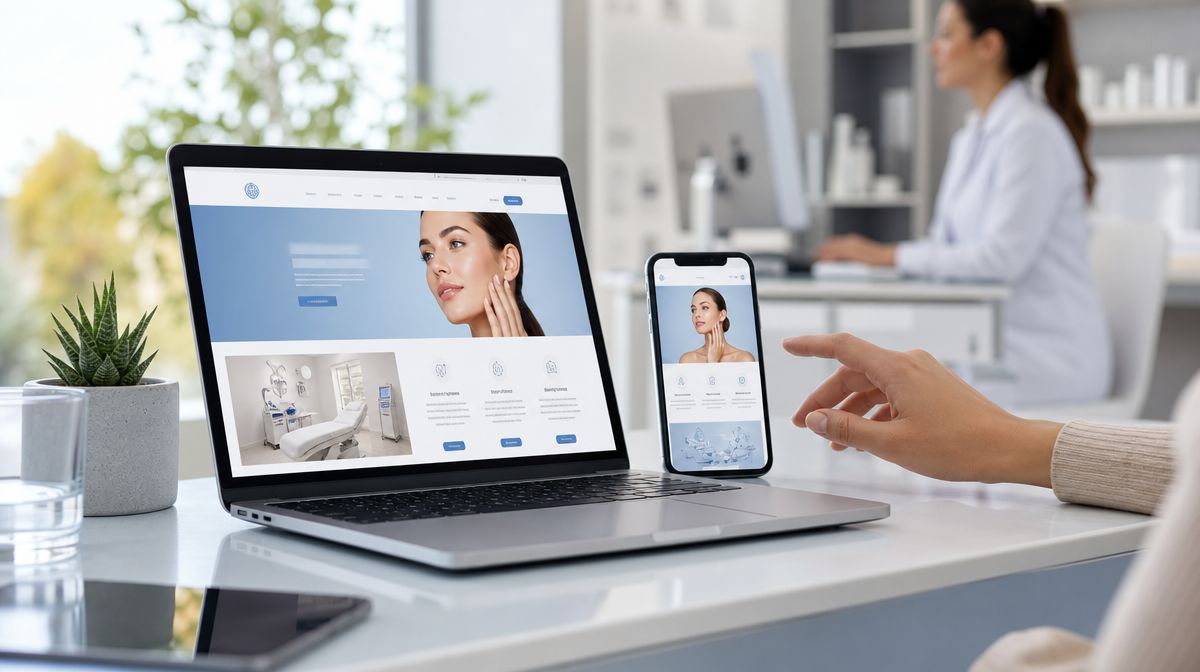
- Build a high-converting dermatology website: Your website is where first impressions become appointments. It needs to load fast, display correctly on mobile, and make it effortless for a visitor to request a consultation, or you’re handing that patient to a competitor.
- Rank locally with dermatology SEO: Search engine optimization determines whether your practice appears when someone searches “dermatologist near me.” Page one visibility drives a steady, compounding flow of new patients without paying for every click.
- Capture AI search with Generative Engine Optimization: GEO is the emerging discipline of structuring your content so AI assistants and Google AI Overviews cite your practice as a trusted answer.
- Run Google Ads for high-intent queries: Paid search puts your practice in front of patients actively searching for acne treatment, Mohs surgery, or Botox in your city, right now rather than months from now.
- Use paid social ads for cosmetic services: Facebook and Instagram let you target the exact demographics most likely to book aesthetic procedures based on age, location, and interest signals.
- Publish educational content and provider videos: Helpful content builds patient trust before they ever contact your office, while simultaneously strengthening your organic search rankings.
- Launch a patient review generation campaign: Systematically collecting reviews influences both Google rankings and the decisions of prospective patients comparing providers.
- Nurture patients with email and SMS outreach: Automated messaging fills canceled slots, promotes seasonal services, and keeps existing patients engaged between visits.
Most dermatology practice owners underestimate how much revenue a poorly built website is costing them. Design is the least of it. Patients abandon sites that load slowly, bury the booking button, or fail to answer the basic question: “Can I trust this provider with my skin?” Functionality and credibility signals, the foundations of effective medical website design, convert visitors into scheduled appointments. Aesthetics alone do not.
Speed and mobile performance are non-negotiable starting points. Most healthcare searches now happen on smartphones, and slow-loading pages lose a large share of mobile visitors before a single service is seen. A dermatology practice with a sluggish site is effectively turning away patients before the introduction.
HIPAA-conscious intake forms and SSL-secured hosting are equally critical. Any web form collecting patient information, whether contact requests, appointment inquiries, or symptom descriptions, should be built with appropriate privacy safeguards. Practices that skip this step expose themselves to compliance risk and signal to tech-savvy patients that their data isn’t taken seriously.
The most overlooked conversion lever is friction reduction at the booking stage. Every additional step between “I want an appointment” and “appointment requested” costs you patients. The highest-performing dermatology websites combine several trust-building elements:

- Before-and-after galleries for cosmetic procedures like Botox, fillers, and laser resurfacing, with written patient authorization for each image
- Visible board certifications and provider credentials prominently displayed on service pages
- Embedded patient review widgets pulling live ratings from Google and major health directories
These elements work together to close the credibility gap between a visitor landing on your site and a patient calling your front desk. Before-and-after images carry an obligation, though: the FTC’s guidance on health product claims treats testimonials and results imagery as claims that must be truthful and representative, so galleries should show typical outcomes rather than only the most dramatic ones.
SEO is the process of improving your practice’s online presence so Google surfaces your listing when nearby patients are actively looking for care. For dermatology practices specifically, local SEO is where the real opportunity lives: the map pack and “near me” results that appear before organic listings and capture the highest-intent searchers on the page.
Your Google Business Profile is the single most leveraged asset in local dermatology SEO. A complete, verified profile with accurate NAP data (name, address, phone number) syndicated consistently across the directories patients actually use signals geographic relevance to Google’s local ranking algorithm. Inconsistencies as small as an abbreviated street name can quietly suppress your map pack placement.
Beyond your profile, dedicated service pages for each treatment you offer are what drive organic rankings for specific procedure searches. A single generic “services” page won’t rank for “Mohs surgery [city]” or “psoriasis treatment near me.” Google rewards specificity: one optimized page per condition or procedure, with relevant headers and clinical detail. Spider-vein treatment is a good example of why: the same searcher may land on a dermatology office or a vein practice, and a practice doing vein clinic marketing is often competing for that cosmetic patient with its own dedicated page.
The keyword landscape in dermatology splits into two distinct search categories, and your SEO strategy needs to address both:
- Medical dermatology searches: Symptom-driven queries like “eczema treatment near me” or “skin cancer screening,” typically insurance-focused and urgency-motivated
- Cosmetic dermatology searches: Elective, price-sensitive queries like “Botox [city]” or “laser skin resurfacing cost,” driven by desire rather than diagnosis
Backlinks, essentially endorsements from other credible websites, strengthen the domain authority that determines whether your service pages outrank competitors. Guest contributions to health publications and partnerships with local organizations are two practical ways to earn them.
Traditional SEO gets your practice ranked on Google. Generative Engine Optimization, or GEO, determines whether your practice gets cited by AI. Those are two different problems, and right now most dermatology practices are only solving one of them.
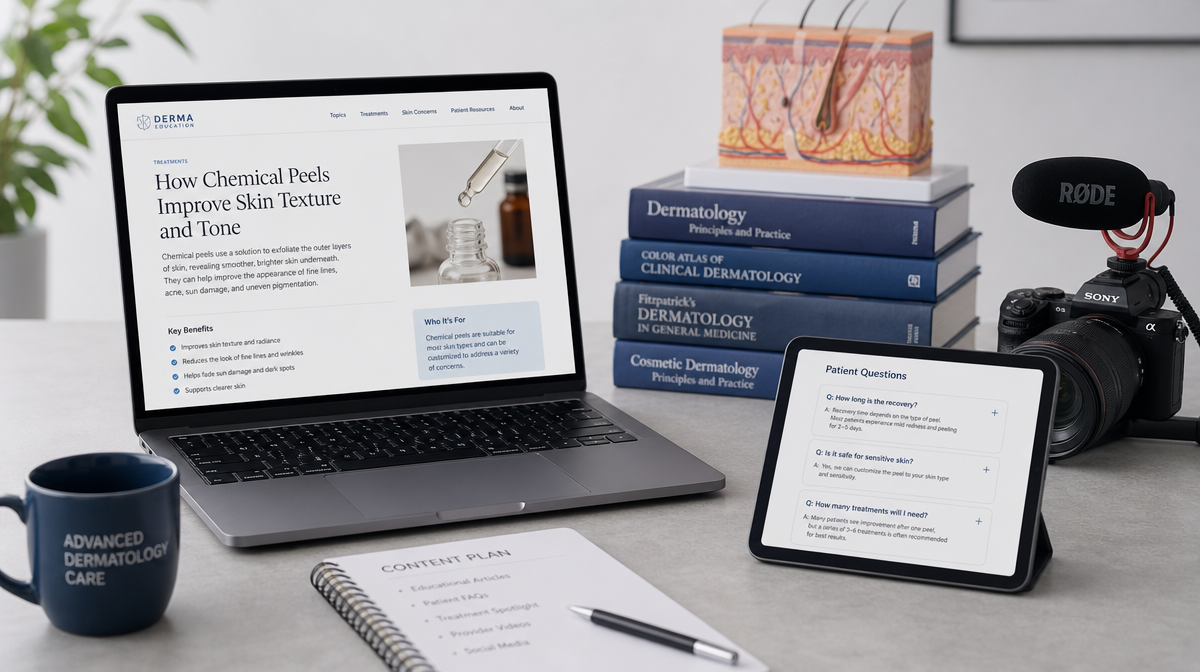
When a patient asks an AI assistant or triggers a Google AI Overview with “what’s the best treatment for cystic acne,” the AI doesn’t retrieve a ranked list of websites. It synthesizes an answer from content it can parse, trust, and quote directly. Practices whose content is structured for human readability but not machine interpretation simply don’t make it into that answer, regardless of where they rank organically. Google’s own documentation on AI features in Search is explicit that the fundamentals of helpful, well-structured content are what earn inclusion.
The tactical shift required is specific. Your content needs to be authoritative enough for AI to stake its credibility on, and structured enough for it to extract cleanly. Three adjustments move the needle fastest:
- Structured FAQ content: Answer the exact questions patients ask AI tools, such as “How many Botox units do I need?” or “Is laser resurfacing safe for darker skin tones?”, in clear, quotable language that an AI can lift verbatim
- Schema markup: Medical and local business schema tells AI crawlers what your practice does, where you’re located, and which conditions you treat, context that plain prose doesn’t reliably convey
- Authoritative sourcing: Linking to and citing recognized professional and government health sources signals that your content meets the credibility threshold AI systems use to evaluate medical information
This is where an integrated system provides a genuine edge, continuously optimizing your content architecture for both traditional search rankings and AI-driven search visibility simultaneously, so your dermatology marketing reach extends wherever patients are searching.
Paid advertising is where dermatology practices can buy speed. While organic visibility compounds over months, a well-structured Google Ads campaign can put your practice in front of patients searching for “skin cancer screening [city]” or “filler near me” quickly after launch, generating appointment inquiries while your organic presence builds.
Google Ads work specifically because of intent. A patient typing “acne dermatologist [your city]” into Google at night has already decided they want care; they’re choosing between providers, not deciding whether to seek treatment. Match types and negative keywords determine whether your budget reaches those high-intent searchers or gets burned on irrelevant clicks. Excluding terms like “free,” “jobs,” or “DIY” keeps your spend focused on patients who are ready to book.
Meta and Instagram serve a completely different function for cosmetic dermatology. These platforms don’t capture demand; they create it. A patient scrolling Instagram who sees a compelling reel about laser resurfacing wasn’t searching for the treatment, but now they’re thinking about it. Demographic and interest-based targeting lets you reach the specific audience most likely to convert on elective procedures.
The ad formats that consistently perform across both platforms for dermatology patient acquisition include:
- Search ads targeting active procedure and symptom queries on Google
- Display ads for retargeting visitors who browsed your site without booking
- Video ads on Instagram and YouTube that explain procedures and what to expect
- Lead generation ads with embedded booking forms that remove friction entirely
Online reviews are no longer a passive byproduct of running a good practice. Most patients check reviews before choosing a provider, which makes them an active patient acquisition channel. When a prospective patient narrows their choice to two dermatologists, the one with a steady stream of recent, strong reviews usually wins that appointment. Reputation management in dermatology marketing means owning that dynamic rather than leaving it to chance.
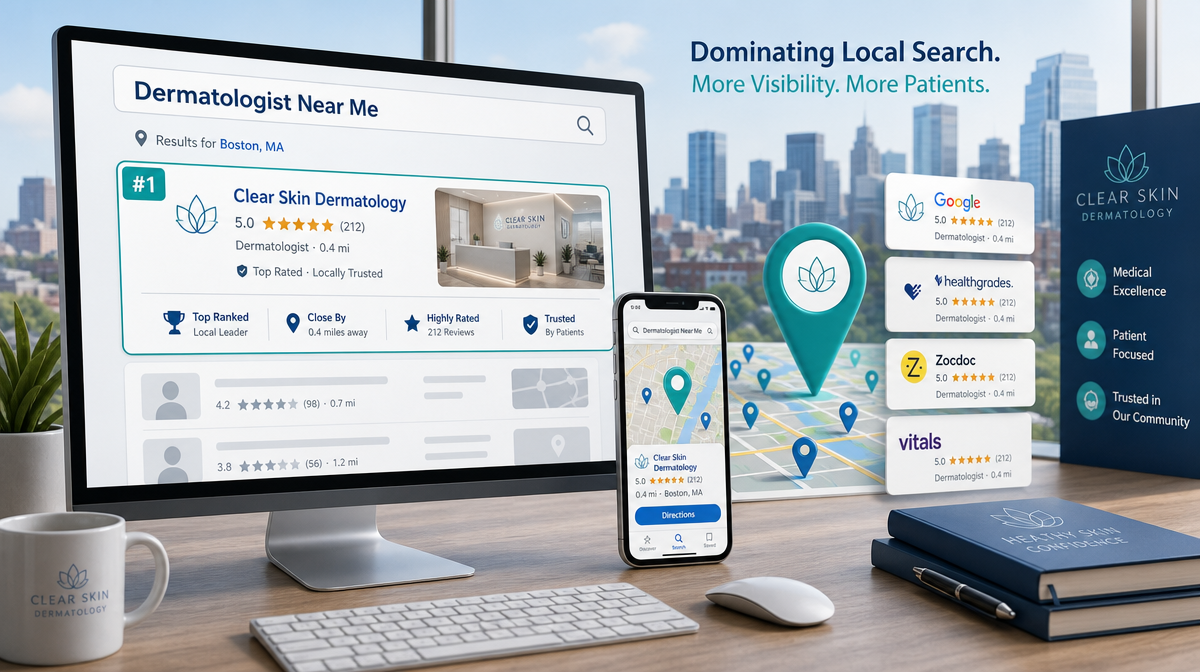
Timing matters when requesting reviews. Automated systems that send a review request by text shortly after the appointment consistently outperform manual requests made days later, because patients are more likely to share their experience while the visit is fresh. Send the request to every patient the same way, rather than only to those you expect to be pleased.
Negative reviews require a different discipline entirely. Responding publicly to criticism demonstrates accountability to every future patient reading that exchange, not just the one who complained. The HIPAA constraint here is real: your response cannot acknowledge that the reviewer is or was a patient, reference any treatment details, or confirm appointment information. A professionally worded, privacy-conscious response that invites the person to contact your office directly is both legally safer and reputation-positive.
Once you’ve built a strong review base, put it to work on your website. Embedding live review widgets from Google and major health directories directly on service pages means a patient researching your Botox offering or acne treatments sees social proof exactly where the booking decision happens. That proximity between credibility signal and conversion point tends to lift appointment request rates for practices that implement it.
Most dermatology practices measure the wrong things. Impressions, follower counts, and website sessions look impressive in a monthly report but tell you nothing about whether your marketing spend is generating revenue. KPIs, or key performance indicators, are only valuable when they connect directly to patient acquisition and practice income.
The metrics worth tracking fall into a clear hierarchy. Start with the numbers closest to revenue, then work backward to diagnose what’s driving or limiting them:
- Cost Per Lead (CPL): Your total ad spend divided by the number of inquiries received. A lead is any form submission, call, or chat initiated by a prospective patient; not yet a booked appointment, but the raw material of one.
- Cost Per Acquisition (CPA): Total marketing investment divided by confirmed new patients. This is the true cost of filling your schedule and the number that should anchor every budget conversation.
- Conversion Rate by Channel: The percentage of leads from each source, whether paid search, organic, social, or referral, who actually book. A channel generating high lead volume but low conversion often signals a website or follow-up problem, not a traffic problem.
- Patient Lifetime Value (PLV): The projected revenue a single patient generates across all visits over time. A cosmetic dermatology patient returning regularly for maintenance treatments is worth substantially more than a one-time visit, and knowing that number tells you how much you can rationally spend to acquire them.
Tracking these four metrics across every channel gives you a clear picture of where your dermatology marketing budget is working and where it’s leaking. Practices that optimize for PLV and CPA consistently outperform those chasing lower-funnel vanity numbers.
Not every marketing vendor who claims healthcare experience actually understands what it means to run a dermatology practice. The gap between a generalist agency with a stethoscope on its homepage and a partner who genuinely knows medical compliance, cosmetic patient psychology, and multi-service practice economics is enormous, and you’ll feel that gap in your results quickly.
Before signing anything, pressure-test any prospective partner against criteria that separate specialists from generalists:
- Healthcare specialization: Do they understand HIPAA advertising constraints, the difference between cosmetic and medical patient intent, and how Google’s health content quality standards affect dermatology rankings specifically?
- Transparent reporting: Will they hand you cost-per-patient and booked-appointment data, or bury your results in impressions and click-through rates that don’t connect to revenue?
- Full-service execution: A dermatology practice needs SEO, paid ads, web infrastructure, and reputation management working together. Fragmented vendors handling one piece each create coordination gaps that kill performance.
- Relevant dermatology or aesthetic experience: Ask how they have approached practices similar to yours and how they measure patient volume, not just for testimonials.
Agencies like Target Patients MD specialize exclusively in medical practice marketing, which means their entire methodology is built around the regulatory environment and patient behavior patterns that define healthcare, not retrofitted from e-commerce or B2B playbooks.
Implementing every tactic in this piece simultaneously, while running a full patient schedule, is how good intentions turn into abandoned marketing initiatives. Most dermatology practices don’t fail at strategy. They fail at execution, because building and managing interconnected systems across SEO, paid ads, reputation, and web infrastructure requires dedicated expertise that a front-office coordinator simply can’t absorb on the side.
Target Patients MD exists specifically for this scenario. The practice serves dermatologists and other medical providers across the U.S. and Canada who need a complete, functioning patient acquisition engine rather than another vendor relationship to manage.
A.L.I. 360 by Target Patients MD is a proprietary AI-powered patient-acquisition system for medical and dental practices. The name stands for Attract, Learn, and Influence. It drives the engine, optimizing across traditional and AI search to turn marketing activity into booked appointments rather than vanity metrics.
What separates this from a standard agency arrangement is the healthcare-only focus. Every process, every campaign template, every reporting dashboard was built for medical practices, not repurposed from retail or SaaS workflows and handed to a healthcare client. That specificity shows up in compliance handling, in how patient intent gets interpreted across channels, and in the metrics that actually appear in monthly reporting.
- AI-powered patient acquisition: AI-driven optimization across traditional and AI search simultaneously
- Healthcare-only focus: Exclusively serves medical practices, with no generalist clients and no competing priorities
- Measurable outcomes: Reporting centers on booked appointments and cost per acquisition, not vanity metrics
- Full-service execution: SEO, PPC, website design, reputation management, and patient outreach handled under one roof
If you want to see what a purpose-built dermatology marketing partnership looks like in practice, get in touch and we will walk through it with you.
Dermatology practice owners ask a lot of the same questions before committing to a marketing strategy. These answers cut straight to what matters.
- How much does dermatology marketing typically cost per month?
Monthly investment varies significantly by market size and service mix; a solo practice in a mid-sized city will spend differently than a multi-provider group competing in a dense metro. Most practices budget for both agency fees and direct ad spend together, since one without the other rarely produces meaningful patient volume. - How long does dermatology SEO take to show results?
Meaningful ranking improvements and organic traffic gains typically emerge over several months of consistent optimization. Paid advertising runs in parallel to generate appointment inquiries while organic visibility builds its foundation. - Should dermatology practices prioritize SEO or PPC advertising?
The strongest approach deploys both. New practices especially benefit from launching paid search immediately for near-term patient flow, then layering in SEO to reduce dependence on ad spend over time. - How do dermatologists compete with med spas for cosmetic patients?
Board certification, clinical depth, and the ability to manage both aesthetic goals and underlying medical skin conditions are advantages no med spa can replicate. Marketing should make those distinctions impossible to miss, and understanding the tactics behind effective medical spa marketing helps a dermatology practice counter them directly and keep cosmetic cases in-house. - What is the best marketing channel for attracting cosmetic dermatology patients?
Instagram and Facebook tend to perform well for aesthetic services because visual content drives interest in ways text-based search ads cannot. Pairing social campaigns with Google search ads captures patients at every stage of their decision process.