


The phrase hyperbaric oxygen therapy marketing sounds like one job. It is three. Under that single label sit three different businesses with different patients, different rules about what can be said, and different places those patients come from, and most hyperbaric marketing fails because it blurs them together. A center writes copy that borrows the clinical vocabulary of one business, the lifestyle imagery of another, and the pricing of a third, and then wonders why the chamber sits idle and the ad account keeps getting flagged.
The first business is clinical HBOT: accredited, physician-supervised treatment for a defined list of conditions that regulators have cleared, where patients mostly arrive with a diagnosis and a referral and where insurance coverage turns on the indication. The second is integrative or wellness HBOT: cash-pay sessions offered alongside regenerative and longevity services, where demand is generated by patient research and the marketing risk lives almost entirely in the claims. The third is mild or soft-chamber hyperbaric: lower-pressure chambers that do not meet the clinical definition of HBOT at all, yet are routinely marketed with clinical language borrowed from the first business.
Each of those businesses is legitimate on its own terms. Each also has a lane, and the practice that names which business it is and markets inside that lane earns something the others cannot buy: trust from the patients it can actually treat, and durable access to the channels that reach them. A clinical center that understands it runs on physician referral marketing stops spending on wellness ads that bring in people it will have to turn away. A wellness center that understands it sells an experience, not an outcome, stops writing copy that reads like a treatment claim. A soft-chamber studio that describes its equipment honestly stops competing with hospitals it cannot match.
Here is how the three lanes differ, what each can safely emphasize, and where each one tends to drift.
Three hyperbaric businesses, three marketing models
| Business type | Who the patient is | Where patients come from | What the marketing can safely emphasize | Where it goes wrong |
|---|---|---|---|---|
| Clinical HBOT (accredited, cleared indications) | A patient with a qualifying condition, often referred | Physician and specialist referrals, hospital and wound-care networks | Accreditation, supervising physicians, cleared indications, coverage guidance | Drifting into off-label promises to fill empty chamber time |
| Integrative / wellness HBOT (cash-pay) | A self-directed patient researching recovery or wellness options | Organic search, patient education content, local visibility | The experience, supervision, safety standards, what the session involves | Implying the therapy treats conditions it is not cleared for |
| Mild / soft-chamber hyperbaric | A consumer seeking a wellness session | Social, local search, memberships | Relaxation and wellness framing, honest description of the equipment | Borrowing clinical HBOT language and outcomes it cannot support |
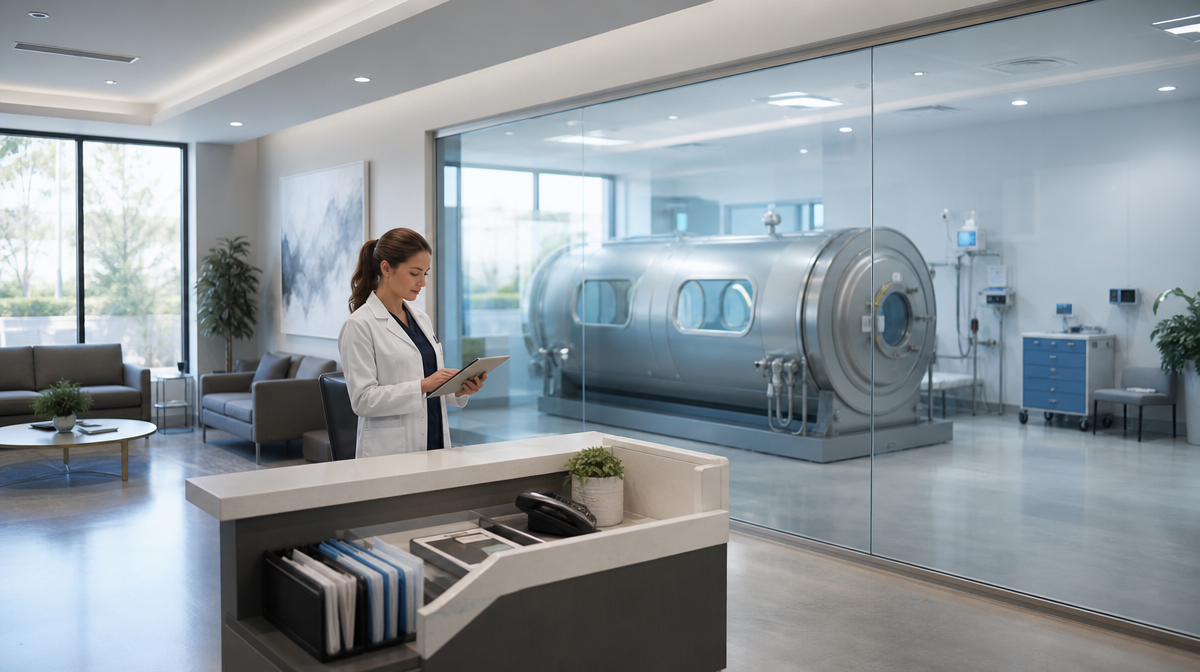
Start with the clinical lane, because it is the one the other two keep borrowing from. A clinical hyperbaric center treats patients whose condition appears on the list of indications for which regulators have cleared hyperbaric chambers, under the supervision of a physician, in a facility built and staffed for it. The patient rarely discovers this center through an ad. They discover it because a wound-care specialist, a surgeon, or a hospital discharge planner told them it exists and that their situation qualifies. By the time they search the center’s name, the decision has largely been made somewhere else.
That reshapes what marketing means for this business. The audience is not the public; it is the small number of clinicians in a region who see qualifying patients and decide where to send them. Those referrers care about things a consumer never thinks to ask: whether the facility is accredited, who supervises treatment, how the center handles the documentation that coverage depends on, how quickly a referred patient can start, and whether the referrer will hear back. A clinical center’s website exists mostly to reassure the referred patient and the referring office at the same time, which means plain language about the cleared indications it treats, the credentials behind the chamber, and what a first visit involves.
The failure mode in this lane is predictable and expensive. Chamber time is fixed and perishable, and when referrals run thin, the temptation is to fill the empty hours by advertising the chamber for uses that were never cleared. The FDA regulates hyperbaric oxygen therapy chambers as cleared medical devices and has reminded providers to follow device instructions and safety protocols closely, which is one more reason a center’s marketing should stay within the uses its equipment is actually cleared for. A clinical center that drifts into that territory does not just risk a warning. It undermines the one asset its referral network was built on, which is that it can be trusted to stay inside the evidence.
The wellness lane works in almost the opposite direction. Nobody refers a patient to a longevity clinic for a hyperbaric session; the patient finds it, usually after weeks of reading. This person is self-directed, curious, comparing options, and paying out of pocket. They are also the most valuable kind of prospect a cash-pay practice has, because they have already done the hard part of deciding that the category interests them. What they need from a center is enough plain, honest information to decide whether this center, specifically, is the one to try.

Most wellness centers do not offer hyperbaric sessions alone. The chamber sits on a menu beside other cash-pay services, and the marketing problem is the same across the menu: describing each service accurately without implying an outcome. A center that already does NAD therapy marketing has met this problem before, and the lessons transfer directly. The copy that works describes the session, the supervision, the safety standards, and what a patient can expect to feel during and after, and it stops there. The copy that fails reaches past the experience to name a condition and imply the chamber addresses it.
That restraint is not only a regulatory matter. The advertising platforms enforce their own health policies automatically, and their systems do not distinguish between a claim a clinic could defend and one it could not; they flag the language itself. A phrase that describes a recovery experience will generally clear review, while a phrase that names a diagnosis and promises a result will not, regardless of what the practice believes about the evidence. Integrative practices adding a chamber to an existing program face this most sharply, because their whole positioning rests on treating root causes, and the instinct to describe hyperbaric sessions in those terms runs straight into the policies. The discipline that already shapes functional medicine marketing, describing a philosophy of care without promising what any single service will do, is the discipline this lane requires.
Regenerative and longevity practices have a further complication: the chamber often sits beside services whose evidence base is thinner still. A practice that offers exosome therapy marketing alongside hyperbaric sessions has to hold both to the same standard, because a patient who finds one overclaimed will reasonably assume the other is too, and so will a platform reviewer. The most credible wellness centers in this space treat claim discipline as a house style rather than a per-service decision. Every service on the menu is described the same careful way, and the consistency itself becomes a signal that the center knows what it is doing.
There is a useful parallel in another emerging cash-pay service. Practices doing ketamine clinic marketing learned early that the practices which grew were the ones whose public language stayed matched to the evidence, describing supervision, screening, and the experience of treatment rather than promising outcomes. The ones that overreached lost ad accounts, drew regulatory attention, and spent their credibility on patients who arrived expecting something the clinic could not deliver. Hyperbaric wellness centers are a few years behind on the same curve, and the lesson is available to them now, for free.

The third lane is where the vocabulary problem is worst. Mild hyperbaric, usually delivered in a soft-sided chamber at pressures well below what a clinical chamber reaches, is a real business with real customers who enjoy the sessions. It is not, by the definition used in clinical medicine, hyperbaric oxygen therapy at all. The Undersea and Hyperbaric Medical Society defines the therapy as breathing near-pure oxygen inside a chamber pressurized above a specific threshold, and it notes that breathing oxygen at lower pressure does not constitute the therapy. A soft chamber that cannot reach that threshold is offering something else.
The marketing mistake in this lane is almost always the same: a studio buys a soft chamber, then writes its website from the clinical literature. It lists conditions, cites hospital research about equipment it does not own, and describes outcomes that were measured at pressures its chamber cannot produce. Some of that is innocent; the operator read about hyperbaric medicine and assumed the words applied. The consequence is not innocent. Patients with real conditions show up expecting clinical treatment, regulators notice the gap between the claims and the equipment, and the studio’s honest wellness customers get lost in copy that was never written for them. The studio ends up disappointing the patients it attracted and never reaching the ones it could have kept.
What works for a soft-chamber business is honesty about the equipment paired with confidence about the experience. Describe what the chamber is, what pressure it reaches, and what a session feels like. Frame it as relaxation and wellness, sell memberships and packages the way a sauna or float studio would, and reach customers through social and local search rather than through condition-based content the studio cannot back. A soft-chamber studio that markets this way is not competing with the hospital across town. It is running a different business, and it should look like one.
Across all three lanes, safety and accreditation deserve more space in the marketing than they usually get. Hyperbaric chambers are oxygen-rich, pressurized environments, and the practices that treat safety as a visible part of their identity, describing staff training, the rules about what comes into the chamber, and the supervision present during every session, are telling patients something true and reassuring that competitors leave unsaid. For a clinical center, accreditation is the credential referrers look for. For a wellness center, a plainly described safety protocol is what separates a serious operation from a spa with an unusual piece of furniture, and it is often the detail a hesitant first-time patient remembers. In a category where the regulator has publicly cautioned consumers to be careful, being visibly careful is a differentiator.
The right measurements follow from the lane as well. A clinical center should count referrals received by source, time from referral to first treatment, and the share of referred patients who complete their course, because those numbers tell it whether the referral relationships are working. A wellness center should count inquiries that become a first session and first sessions that become packages, because a chamber that produces single visits and no repeat business has a positioning problem, not a traffic problem. A soft-chamber studio should count memberships. What none of them should count as a success is impressions, followers, or the raw number of people who searched for hyperbaric therapy in the region, because those numbers include the patients of all three businesses at once and tell any single center almost nothing about its own.
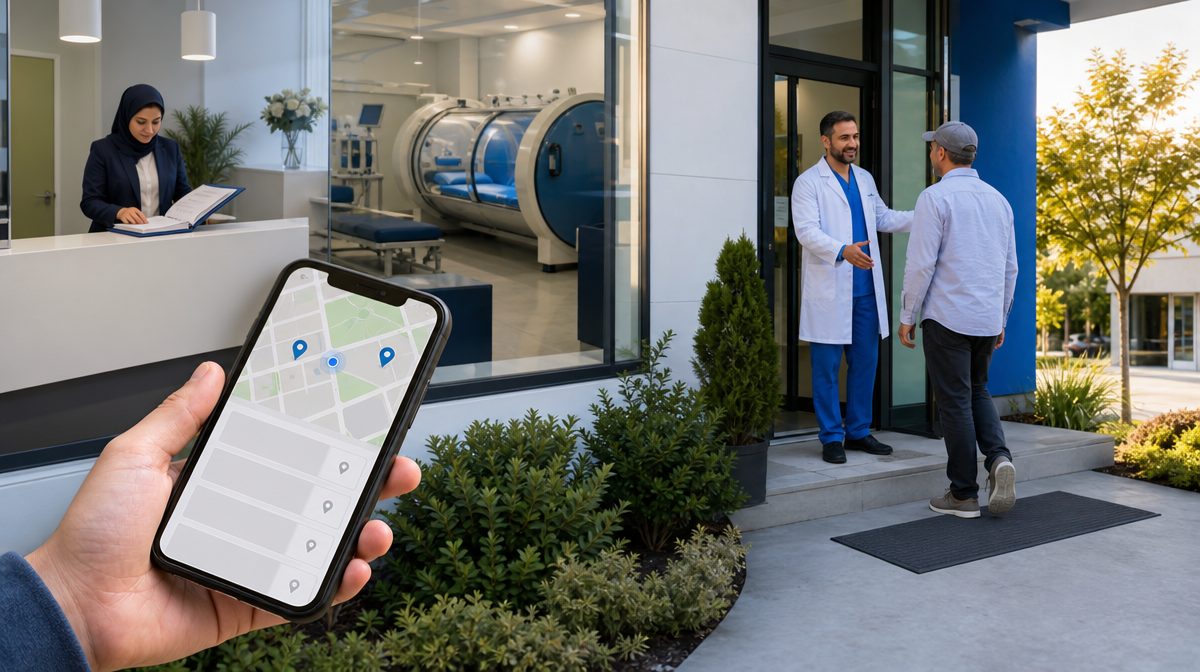
A newer input belongs on that list for every lane. A growing share of patients now ask an AI assistant what hyperbaric therapy is, whether it might help them, and where nearby they could try it, and the assistant answers from what it can find and verify. A center’s AI-driven search visibility depends on the same honesty the rest of this article has argued for: clearly stated facts about what the center is, consistent information across every listing, and content that answers a patient’s question plainly rather than promoting around it. Assistants tend to cite the source that describes itself most accurately. In hyperbaric care, that turns claim discipline into a visibility strategy as well as a compliance one.
Matching the message and the channel to the patient is the part most centers find hardest to do consistently, and it is the part A.L.I. 360 by Target Patients MD was built around. A.L.I. 360 by Target Patients MD is a proprietary AI-powered patient-acquisition system for medical and dental practices. The name stands for Attract, Learn, and Influence. For a hyperbaric center, the Attract stage does the work this article describes: reaching a clinical center’s referral sources and referred patients in one lane, and a wellness center’s self-directed researchers in another, with language and channels that fit each, so that the center is not paying to attract patients it cannot legitimately treat.
The centers that fill their chambers are not the ones that market hardest. They are the ones that decided, before writing a word, which of the three businesses they are, and then refused to borrow from the other two. That decision settles what the copy can say, where the patients will come from, which numbers matter, and how the center should describe itself to the assistants and search engines that increasingly make the first introduction. Everything after it is execution. Everything before it is hot air.
Practice owners setting this up tend to ask the same few questions.
- What is hyperbaric oxygen therapy marketing?
It is the work of attracting patients to a hyperbaric center in the lane that fits its business: referral relationships for clinical centers, patient education and local visibility for cash-pay wellness centers, and social and membership marketing for mild-chamber studios. The common thread is describing the service accurately. - What can a hyperbaric center claim in its marketing?
A clinical center can name the cleared indications it treats and its accreditation and supervision. A wellness center can describe the session, the safety standards, and the experience. No center should imply that hyperbaric sessions treat a condition the chamber has not been cleared to treat. - Is mild hyperbaric therapy the same as HBOT for marketing purposes?
No. Clinical hyperbaric oxygen therapy is defined by breathing near-pure oxygen above a specific pressure threshold. Soft chambers operating below it are offering a different service and should be marketed as a wellness experience, not with clinical language or outcomes. - How do clinical hyperbaric centers get patient referrals?
By building relationships with the clinicians who see qualifying patients, and by making it easy for those offices to refer: clear information on cleared indications, accreditation, coverage documentation, scheduling speed, and follow-up to the referring provider. - Can hyperbaric oxygen therapy be advertised online?
Yes, within platform health policies. Ads that describe the experience and the supervision generally clear review. Ads that name a condition and promise a result generally do not, and repeated rejections can restrict the account.