


You’ve probably experienced this: you post consistently on Instagram, rack up a few hundred likes, maybe even land some new followers — and then Friday rolls around with three empty appointment slots you can’t fill. That gap between social activity and actual bookings isn’t bad luck. It’s a structural problem with how most medical spas approach their marketing.
The core issue is that most med spa marketing is built around visibility rather than conversion. Getting eyeballs on your content feels productive, but impressions don’t pay your injector’s salary. A prospective patient who double-taps a before-and-after photo and keeps scrolling is not a booked appointment — she’s a missed opportunity with a warm interest that you never captured.
Three specific failure patterns show up repeatedly in underperforming medspa marketing:
- Vanity metrics trap: Likes and follower counts feel like progress, but neither one correlates reliably with appointment volume or revenue.
- Missing conversion paths: Potential patients arrive at your website or social profile and find no clear, frictionless way to book — so they leave.
- Generic messaging: When your ads and posts look identical to the three other medspas within five miles of you, price becomes the only differentiator — and that’s a race nobody wins.
The medical spa marketing ideas that actually move the needle share one thing in common: they’re engineered around patient acquisition, not brand awareness. That distinction changes everything about which tactics you prioritize and how you measure success.
Before any ad spend, social post, or Google Business Profile update produces meaningful results, three foundational decisions need to be in place. Skip them and you’re essentially pouring water into a bucket with holes — the tactics work, but the output leaks.
1. Sharpen Your Unique Value Proposition
Your UVP is the single, specific reason a patient chooses your practice over the medspa two miles away. It’s rarely price — patients booking Botox or CoolSculpting are making trust decisions, not bargain-hunting. Dig into what genuinely sets you apart: board-certified providers, proprietary treatment protocols, a specific technology no competitor in your zip code owns, or deep specialization in a treatment category. Once you can articulate that differentiator in one sentence, every downstream marketing decision gets dramatically easier to make.
2. Build a Detailed Ideal Patient Persona
Knowing exactly who you’re marketing to determines which channels you use, what language converts, and which treatments to lead with. Sketch out your ideal patient across three dimensions:
- Demographics: Age range, household income level, and realistic drive-time radius to your location
- Motivations: The specific trigger prompting them to seek treatment now rather than later
- Objections: The hesitations — cost, downtime, safety concerns — that stall their booking decision
3. Audit Three Local Medical Spa Competitors
Pull up the Google Business Profiles, websites, and Instagram accounts of your three closest competitors. Note what services they promote, how they position their providers, and where their reviews reveal patient frustrations. The gaps you find become your positioning opportunities — and they inform every medical spa marketing idea you implement after this point.
There’s no universal answer here, but industry benchmarks give you a solid starting point. Most established med spas invest 8% to 12% of gross revenue into marketing. New practices — or those pushing for aggressive growth — often climb to 15% to 20% in the early stages to build awareness and fill their patient pipeline fast.
Think of it this way: if your med spa generates $1 million annually, you should expect to spend somewhere between $80,000 and $120,000 per year on medical spa marketing to stay competitive. That breaks down to roughly $6,500 to $10,000 per month across paid ads, SEO, content, and retention campaigns.
Several factors push that number up or down:
- Practice stage: New med spas require higher investment to build brand awareness from scratch
- Market competition: Saturated metro markets demand more aggressive spending than smaller markets
- Service mix: High-margin treatments like CoolSculpting or laser resurfacing justify higher patient acquisition costs
- Growth goals: Wanting to add 50 new patients per month requires a proportionally larger budget than maintaining current volume
The biggest mistake med spa owners make is treating marketing as a fixed expense rather than a growth lever. When a channel delivers a strong return — say, $8 in revenue for every $1 spent on Google Ads — the right move is to scale it, not cap it at an arbitrary budget ceiling.
When a potential patient in your city types “Botox near me” or “laser hair removal [your city],” they’re not browsing — they’re ready to call or book. The Map Pack, those three local business listings that appear at the top of Google’s search results, captures 44% of clicks from those high-intent searches. If your practice isn’t showing up there, a competitor is collecting those appointments instead.
Local SEO is the discipline of optimizing your online presence so Google’s algorithm surfaces your practice for searches happening within your geographic area. For medical spas specifically, it’s one of the highest-ROI medical spa marketing ideas available because the searchers it reaches are already in decision mode.
Three specific tactics build Map Pack authority faster than anything else:
- Optimize your Google Business Profile for every treatment you offer: Complete every available field, add each service individually (Botox, CoolSculpting, microneedling — each one separately), upload before-and-after photos weekly, and post treatment updates at least once a week. Your GBP is often the very first thing a local patient sees before they ever reach your website.
- Build local citations across 70-plus directories: A citation is any online mention of your practice’s Name, Address, and Phone number. Consistent NAP data across directories like Healthgrades, RealSelf, and Yelp signals credibility to Google’s local algorithm and strengthens your ranking position.
- Create a dedicated service page for each treatment: This is the core of med spa SEO — a single page titled “Services” cannot rank for “CoolSculpting [city]” and “Botox [city]” simultaneously. One page per treatment, each targeting its own specific keyword, gives each service a genuine shot at appearing when that treatment is searched locally.
Paid search is the fastest lever you can pull when you need appointments on the calendar now — not in six months when your SEO starts gaining traction. The key distinction between paid advertising that generates bookings and paid advertising that burns budget is intent. Someone typing “Botox near me” or “CoolSculpting [city name]” into Google has already made the decision to explore treatment. Your job is simply to be the practice that intercepts that search with a compelling reason to call.
- Launch Google Search Ads for high-intent treatment keywords: Bid on procedure-specific terms rather than broad category terms like “medical spa.” A patient searching “lip filler consultation [city]” is worth ten times more per click than someone searching “skincare treatments.” Pair each ad group with a dedicated landing page that has one job: get the visitor to book or call.
- Run Meta Ads with compliant before-and-after creative: Instagram and Facebook’s visual format is uniquely suited to aesthetic results. Before running any patient imagery, secure written consent that explicitly covers social media advertising use. Meta’s ad platform lets you layer age, income, and zip code targeting so your creative reaches the exact demographic profile you mapped out earlier.
- Retarget visitors who left without booking: Most website visitors don’t convert on their first visit — they’re comparison shopping. Retargeting campaigns serve treatment-specific offers to people who already viewed your Botox or body contouring pages, bringing a warm audience back with a reason to finally commit.
- Host In-Person Events and Open Houses — Live demos and event-only pricing create urgency that digital channels rarely replicate.
- Layer in Direct Mail and Local Business Partnerships — Targeted mailers and cross-promotions with gyms, salons, and bridal shops reach high-intent prospects who may never see your digital ads.
- Sponsor local charities and community events — Sponsorships generate brand awareness and local press that paid ads can’t buy, and they position your practice as a genuine community stakeholder rather than just another advertiser.
The fastest-growing source of new aesthetic patients in 2026 isn’t searching for Botox — they’re already losing weight on a GLP-1 medication and discovering that rapid loss leaves loose skin and lost facial volume behind. Practices that build a deliberate bridge from GLP-1 weight loss into aesthetic services are capturing a high-intent patient pool their competitors haven’t noticed yet.
- Map the post-GLP-1 treatment pathway: Semaglutide and tirzepatide patients commonly develop skin laxity and facial volume loss after major weight loss — exactly what skin tightening, body contouring, and injectables address. Position those services as the natural next step, not a separate sell.
- Cross-sell inside the visit you already have: If you offer weight-loss management, those patients are already walking in on a recurring schedule. A single contouring or skin-tightening conversation during a routine check-in converts at a fraction of cold-acquisition cost.
- Capture the demand even if you don’t prescribe: Patients managing GLP-1 weight loss elsewhere are actively searching for what comes after. Content and ads addressing “loose skin after weight loss” or “facial volume after GLP-1” intercept that demand and route it to your aesthetic menu.
Social media’s actual job in your patient acquisition funnel isn’t awareness — it’s conviction. By the time someone is seriously considering Botox or a body contouring treatment, they’ve already heard of medspas. What they’re doing on Instagram is building enough trust in a specific practice to make that first call. That’s a fundamentally different goal than accumulating followers, and it requires a different approach to every decision you make about content.
- Pick one or two platforms and own them: Spreading content across TikTok, Instagram, Pinterest, Facebook, and LinkedIn simultaneously produces mediocre results everywhere. Your ideal patient demographic lives predominantly on one or two of those platforms — and your persona research from earlier tells you which ones. Concentrated effort on the right channel consistently outperforms diluted presence across all of them.
- Let real patient results carry the creative: Authentic before-and-after transformations — posted with proper written consent — generate more appointment inquiries than any stock photo or designed graphic. Carousel formats and short video reveals both perform well for treatment results. The consent documentation must be specific: it should name social media advertising explicitly, not just general photo release.
- Partner with local micro-influencers instead of chasing reach: A creator with 4,000 highly engaged local followers who genuinely books a treatment at your practice will drive more consultations than a regional influencer with 80,000 followers who has no geographic connection to your market.
- Amplify what already works organically: Before building new ad creative from scratch, identify your top three organic posts by saves and profile visits — not likes — and put modest paid spend behind them. You’re validating content the algorithm already confirmed resonates.
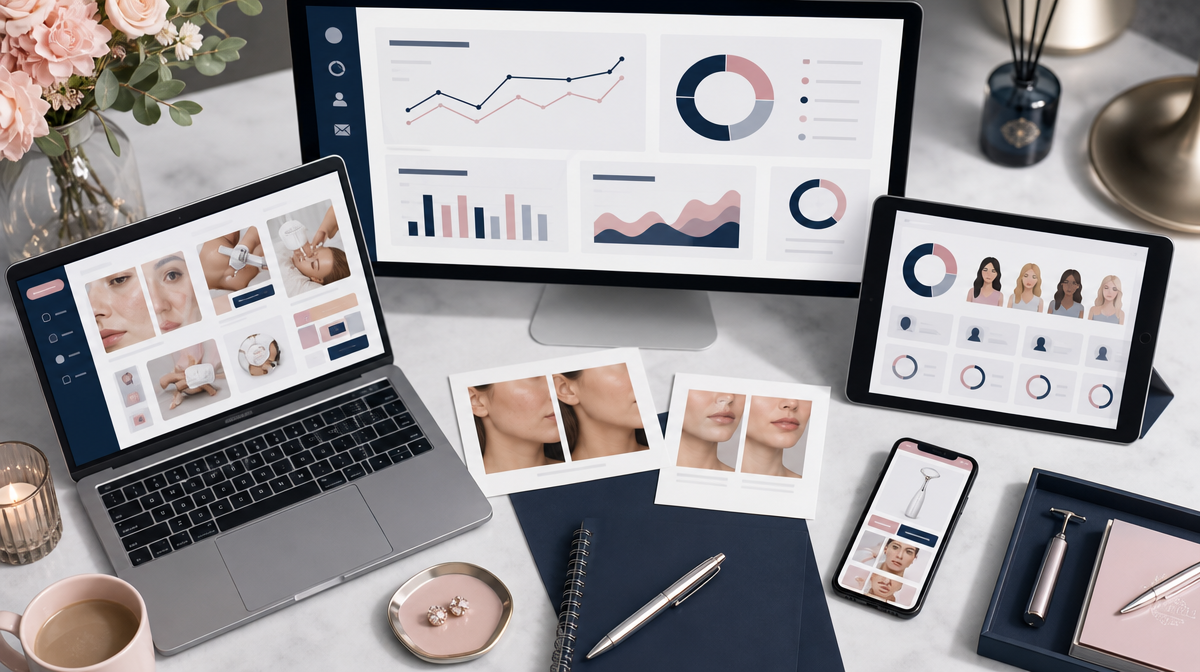
Getting traffic to your medspa website is only half the problem. The other half — the part that actually pays for your overhead — is what happens after someone lands on a page. Most medspa websites function like digital brochures rather than booking engines — a medical website design gap that quietly kills conversion every single day.
- Place your online booking button above the fold on every page: “Above the fold” means the portion of a webpage visible before any scrolling. If a prospective patient has to hunt for a way to schedule, you’ve already lost most of them. One prominent, high-contrast booking button visible immediately on load removes the single biggest friction point between interest and action.
- Install an AI chatbot to capture leads after hours: A significant portion of medspa appointment inquiries happen between 8 PM and midnight — when your front desk is unavailable. An AI-powered chat widget can handle pricing questions, confirm availability, and capture contact information from visitors who would otherwise leave without a trace. This is lead recovery you’re currently leaving on the table.
- Embed real patient video testimonials on your core service pages: Text reviews build credibility. Video testimonials build trust at a different level entirely — a 60-second clip of a real patient describing her CoolSculpting experience answers objections that no bullet point can address. Place them directly on the relevant treatment pages, not buried in a separate reviews section, and ensure your approach follows HIPAA-conscious consent protocols.
Your website isn’t a passive presence — it should be your hardest-working employee, converting curious visitors into confirmed appointments around the clock.
Acquiring a new patient costs five to seven times more than retaining one you already have — which makes your existing patient list one of the most underutilized revenue assets in your practice. Email and SMS give you a direct, owned channel to that list, completely independent of algorithm changes or ad platform policies.
- Send a monthly treatment-focused newsletter: Skip the generic “spa news” format. Each issue should center on a single treatment category — what it addresses, who it’s right for, and what results look like. Educational content positions your providers as the local authority while keeping your practice name front-of-mind between visits.
- Automate win-back campaigns for patients who’ve gone quiet: Set a trigger for any patient who hasn’t visited in 90 days or more. A simple three-message sequence — starting with a check-in, followed by a relevant treatment recommendation, then a limited reactivation offer — recovers a measurable percentage of lapsed patients who simply forgot to rebook rather than chose a competitor.
- Trigger appointment reminder texts to protect revenue: A single no-show in an injectable appointment can represent $400 to $800 in lost treatment revenue. A two-step SMS sequence — one reminder 48 hours out and one the morning of — combined with two-way texting that lets patients reschedule instantly, cuts no-show rates by 30–50%.
HIPAA wasn’t written with Instagram Reels in mind, but it absolutely applies to them — with civil penalties up to $2.19 million per violation. Medical spas occupy a regulated middle ground — clinical enough to handle protected health information (PHI), consumer-facing enough to run aggressive promotional campaigns. That combination creates real compliance exposure if you’re not deliberate about where marketing and patient data intersect.
The most common violations in med spa advertising aren’t intentional — they’re oversights. Posting a before-and-after photo without a signed written release, sending appointment reminders through a non-compliant email platform, or including any detail that could identify a patient in a testimonial can each trigger an HHS complaint or civil penalty. “She loved her results” is fine. “Our Tuesday 2pm client from Westside couldn’t believe her Botox outcome” is not.
Three non-negotiables for every med spa running any form of patient-facing marketing:
- Written consent is mandatory before any patient image or testimonial goes public — verbal agreement isn’t sufficient, and consent must specify exactly how and where the content will be used
- All patient communications require HIPAA-conscious platforms — standard Gmail, Mailchimp free tier, and generic SMS tools do not qualify; use vendors that offer a signed Business Associate Agreement (BAA)
- Strip all identifiable information from marketing materials — names, photos, appointment dates, treatment details, and geographic specifics can all constitute PHI in context
Compliance isn’t a creativity killer — it’s a liability shield. Build the consent workflow into your post-treatment process so collecting releases becomes routine rather than an afterthought.
If patient lifetime value is where medspa profitability lives, loyalty and referral programs are how you engineer it on purpose rather than hoping it happens. Both turn behavior you already want — repeat visits and word-of-mouth — into predictable, compounding revenue.
- Launch a tiered membership program: A recurring monthly fee in exchange for discounted services, complimentary add-ons, or treatment credits creates predictable revenue that stabilizes your calendar through slow months. Converting even 15–20% of active patients to membership measurably lifts both revenue consistency and average lifetime value.
- Build a two-sided referral reward: The most common referral mistake is rewarding only the referrer. When the new patient also gets a meaningful incentive — a first-visit discount or complimentary consultation — participation climbs sharply, because both people have a reason to act. One-sided programs feel transactional; two-sided ones feel generous.
- Reserve VIP bundles for your best patients: Exclusive packages for your highest-frequency patients — multiple treatments at a preferred rate, or early access to newly launched services — reinforce loyalty without the across-the-board discounting that devalues your standard pricing. For your top tier, scarcity motivates more than a percentage off.
Most patients read seven to ten reviews before booking an aesthetic treatment — and they’re not just counting stars. They’re reading the actual text, looking for someone who describes the same concern they have, and deciding whether your practice feels like a place they’d trust with their face. That decision happens entirely before they ever contact you.
Two execution gaps consistently separate practices that win on reputation from those that don’t:
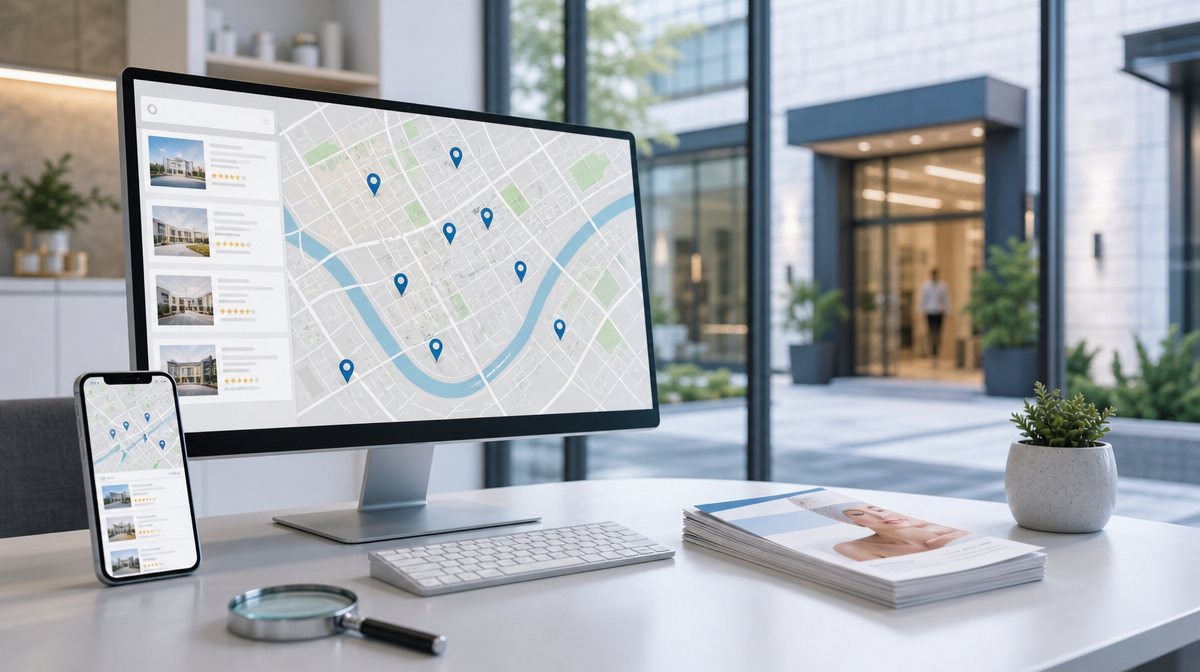
- Automate review requests within 24 hours of every visit: The window for capturing a genuine, enthusiastic review closes fast. A patient who leaves your practice satisfied on a Tuesday is significantly less likely to write that review by Thursday. Text-based review requests outperform email by a wide margin for response rate — and a direct link to your Google profile removes every possible step between intention and action. Practices that systematize this process generate review volume that compounds monthly rather than trickling in one at a time.
- Respond to every review within 24 hours, including the negative ones: Prospective patients read your responses as carefully as they read the reviews themselves — 40% have avoided a provider over negative reviews alone. A thoughtful, empathetic reply to a critical review demonstrates accountability in a way that five-star responses never can. Keep responses HIPAA-conscious — acknowledge the feedback without confirming appointment details or treatment specifics — and move the conversation offline for resolution.
One underappreciated dimension of review strategy: your star rating directly influences your Google Business Profile ranking. Higher review velocity and consistent response activity are both signals the local algorithm weighs when deciding which three practices appear in the Map Pack for treatment searches in your area.
Most practice owners think of AI marketing tools as something for enterprise-level businesses with dedicated tech teams. The reality in 2026 is that two specific AI-driven capabilities are now accessible to independent medspas — and they address the two biggest inefficiencies that drain revenue from practices at every stage of growth.
- Use predictive analytics to identify your highest-value patients before they leave: Predictive analytics software analyzes patterns in your existing patient data — visit frequency, treatment history, average spend, referral behavior — and surfaces which patients are statistically most likely to book high-ticket procedures or bring in new patients. Rather than sending identical promotions to your entire list, you direct premium offers toward the segment most likely to act on them. The ROI difference between blanket outreach and predictive targeting is measurable within a single campaign cycle.
- Optimize for Generative Engine Optimization alongside traditional SEO: When patients use AI-powered search tools like Google’s SGE or ChatGPT to ask questions like “best medspa for CoolSculpting near me,” the results surface differently than a standard search engine results page. GEO — Generative Engine Optimization — is the practice of structuring your website content so AI search engines cite your practice as an authoritative answer. Target Patients MD’s A.L.I. 360 technology is specifically built to address this shift, positioning medspa websites to appear in both traditional search results and AI-generated responses simultaneously.
Automation handles the operational side of these medical spa marketing ideas — scheduling follow-ups, triggering sequences, and running campaign logic — without adding headcount to your front desk.
Most med spa owners can tell you how many Instagram followers they have — far fewer can tell you their cost per acquired patient. That gap is expensive: you end up starving campaigns that are quietly working or feeding ones that are silently bleeding you dry. The fix isn’t more marketing — it’s knowing exactly which dollar produced which appointment. Focus on metrics tied to bookings and revenue, not vanity stats like impressions or page views.
These are the numbers that deserve a permanent spot on your monthly dashboard:
| Metric | What It Measures | Why It Matters |
|---|---|---|
| Cost per lead (CPL) | Spend divided by inquiries generated | Shows how efficiently each channel fills your pipeline |
| Booking conversion rate | Percentage of leads that become confirmed appointments | Separates a front-desk or follow-up problem from a marketing one |
| Cost per booked appointment | Spend divided by actual bookings | Reveals true conversion cost, not just lead cost |
| Patient acquisition cost (CPA) | Total spend per new patient who books and shows | Determines whether a campaign is actually profitable |
| Patient lifetime value (LTV) | Total revenue a patient generates over the relationship | Sets the ceiling on what you can afford to spend acquiring one |
| Return on ad spend (ROAS) | Revenue generated per dollar spent | Measures overall campaign profitability |
Three tools make these numbers trackable without requiring a full-time analyst:
- Call tracking: Assigns unique phone numbers to specific campaigns so you know whether that Botox inquiry came from your Google Ad, your GBP listing, or a direct mailer
- UTM parameters: Tags appended to your booking links that tell your analytics platform exactly which email, ad, or social post drove a completed appointment request
- CRM integration: Connects every marketing touchpoint to a named patient record, so you can trace a new CoolSculpting patient back to the precise campaign that introduced her to your practice
Tracking at this level transforms your medical spa marketing ideas from educated guesses into data-backed decisions you can defend — and optimize — every single month.
Twenty-five tactics on a single list can feel like standing in front of a buffet when you’re only hungry enough for one plate. The practices that gain consistent momentum from their medical spa marketing ideas don’t implement everything simultaneously — they sequence deliberately, stacking wins in an order that builds compound momentum rather than spreading thin across every channel at once.
Think of your implementation in three distinct phases, each one funding the next:
- Quick wins (weeks one through four): GBP optimization, review request automation, and booking button placement require no ongoing ad spend and produce measurable lift within the first billing cycle. These create the conversion infrastructure that makes every downstream tactic more efficient.
- Medium-investment plays (months two through four): Once your foundation converts, activate Google Search Ads targeting high-intent treatment terms and build out your email automation sequences. These channels produce bookings reliably enough to fund the longer-horizon work ahead.
- Long-term compounders (month five and beyond): Dedicated service page SEO, micro-influencer relationships, and AI optimization through tools like Target Patients MD’s A.L.I. 360 technology build durable patient acquisition infrastructure — the kind that keeps producing appointments even when you pause ad spend. Learn more about Target Patients MD and how fully managed implementation accelerates this entire sequence.
The sequencing principle is straightforward: fix what leaks before you pour more in. A practice running paid ads to a website with no clear booking path is paying to fill a broken funnel. Prioritize in the order that eliminates friction first, then scales acquisition.
Running a medspa means fielding the same questions from prospective patients week after week — and the same questions come up just as often from practice owners evaluating where to invest their marketing dollars. Here are direct answers to what gets asked most.
- How much should a medical spa spend on marketing each month? Established practices typically allocate 8–12% of gross monthly revenue to marketing. A practice generating $80,000 monthly should expect to invest $6,400–$9,600 to sustain growth. Newer locations in competitive markets often need to front-load that percentage higher during their first 12 months to build initial patient volume.
- How long before medical spa marketing produces booked appointments? Google Search Ads can generate consultation requests within 72 hours of a well-configured launch. Organic search and content-based strategies typically require four to six months before delivering consistent appointment volume — which is exactly why running both in parallel matters.
- What channel works best for a brand-new medspa? Google Ads targeting procedure-specific searches in your city, combined with a fully optimized Google Business Profile, gives new practices the fastest path to booked appointments while longer-term channels gain traction.
- Are paid ads or SEO the smarter investment? Neither outperforms the other in isolation. Paid ads produce immediate bookings; SEO builds an asset that generates appointments without ongoing spend. Practices that treat them as competing priorities rather than complementary ones consistently underperform against those that run both in tandem.
- How do you implement medical spa marketing ideas without HIPAA exposure? Obtain explicit written consent before using any patient image or story in advertising materials — consent language must name social media and paid advertising specifically. Avoid referencing treatment details in any public-facing response, including review replies.