




If you’ve tried running a standard healthcare marketing playbook for a regenerative medicine practice, you already know the frustration. The same tactics that fill appointment books for primary care or dermatology practices tend to fall flat — or worse, get your ads disapproved — when you’re promoting PRP, stem cell therapy, exosomes, or peptide treatments.
The reason is simple: regenerative medicine operates in a fundamentally different environment. These are emerging, often cash-pay treatments that patients don’t fully understand, regulators watch closely, and the internet has thoroughly confused with misinformation. That combination creates a marketing challenge unlike anything in conventional medical practice growth.
Effective regenerative medicine marketing has to solve three problems simultaneously before a single patient books a consultation:
- Patient education gap: Most prospective patients have heard of stem cell therapy or PRP but have no idea how these treatments actually work, what conditions they address, or why they cost what they do. Your marketing has to teach before it can sell.
- Regulatory complexity: FDA guidelines restrict specific claims about treatment outcomes, and advertising platforms like Google and Meta have their own overlapping restrictions on what regenerative clinics can promote and how.
- Trust deficit: Years of overpromising by “stem cell mills” and sensationalized media coverage have made patients genuinely skeptical. They’re researching hard before they ever pick up the phone.
Generic marketing tactics skip straight to conversion without addressing any of these barriers. That’s why a specialized approach isn’t optional — it’s the only approach that actually works.
The regenerative medicine industry isn’t a niche anymore — it’s a market. The global regenerative medicine sector was valued at over $30 billion and continues to expand rapidly, driven by an aging population, rising rates of chronic musculoskeletal conditions, and a growing patient demand for non-surgical alternatives. Orthopedics, sports medicine, and integrative health practices are all racing to add PRP, stem cell therapy, and exosome treatments to their service lines.
That growth creates a real opportunity — but only for practices that show up where patients are looking. More procedures being offered across more clinics means more competition for the same high-intent searches. Without a deliberate regenerative medicine marketing strategy, even the most clinically advanced practice can get buried beneath competitors with better digital visibility.
Patient Awareness and Misinformation
Here’s the uncomfortable truth: patients are searching for these treatments, but most of what they find online is either oversimplified or outright wrong. Stem cell therapy, in particular, has been plagued by predatory clinics making unsubstantiated claims — with an estimated 2,750 U.S. clinics offering unapproved stem cell injections — which has made a significant portion of the patient population skeptical, even of legitimate providers.
That skepticism is actually an opening. Clinics that invest in clear, accurate, medically grounded content can position themselves as the trustworthy alternative in a noisy, misinformation-heavy space. The practices winning new patients right now aren’t just offering better treatments — they’re doing a better job of educating patients before they ever pick up the phone.
Most regenerative medicine patients don’t start their search by typing “PRP therapy near me.” They start by typing “why does my knee hurt after 50” or “alternatives to knee replacement surgery.” That’s a critical distinction for any regenerative medicine marketing strategy — you’re not just competing for treatment searches, you’re competing for symptom searches long before a patient knows your treatments exist.
Understanding where patients enter the funnel determines what content you need and when. The journey typically moves through three stages:
- Awareness: Patients search symptoms or explore non-surgical options — “knee pain without surgery” or “natural alternatives to cortisone shots.” Content here should educate, not sell.
- Consideration: Patients start comparing options — “PRP vs. stem cell therapy,” “does PRP work for arthritis,” or “how long does PRP last.” This is where your treatment guides and FAQ pages earn trust and pull patients deeper into your funnel.
- Decision: Patients are ready to act — they’re searching for local providers, reading Google reviews, checking credentials, and looking for “regenerative medicine clinic near me.” This is where local SEO and your Google Business Profile close the deal.
The takeaway: most of the search volume in this space is informational, not transactional. Practices that only optimize for “book now” terms miss the majority of their potential patient pool. Matching your content to each stage of this journey is what separates clinics that generate consistent leads from those chasing cold traffic that never converts.
No single channel wins the patient acquisition game for regenerative medicine — you need a coordinated mix that meets patients at every stage of their research journey. The good news is that a well-structured regenerative medicine marketing strategy doesn’t require an unlimited budget. It requires the right channels working together.
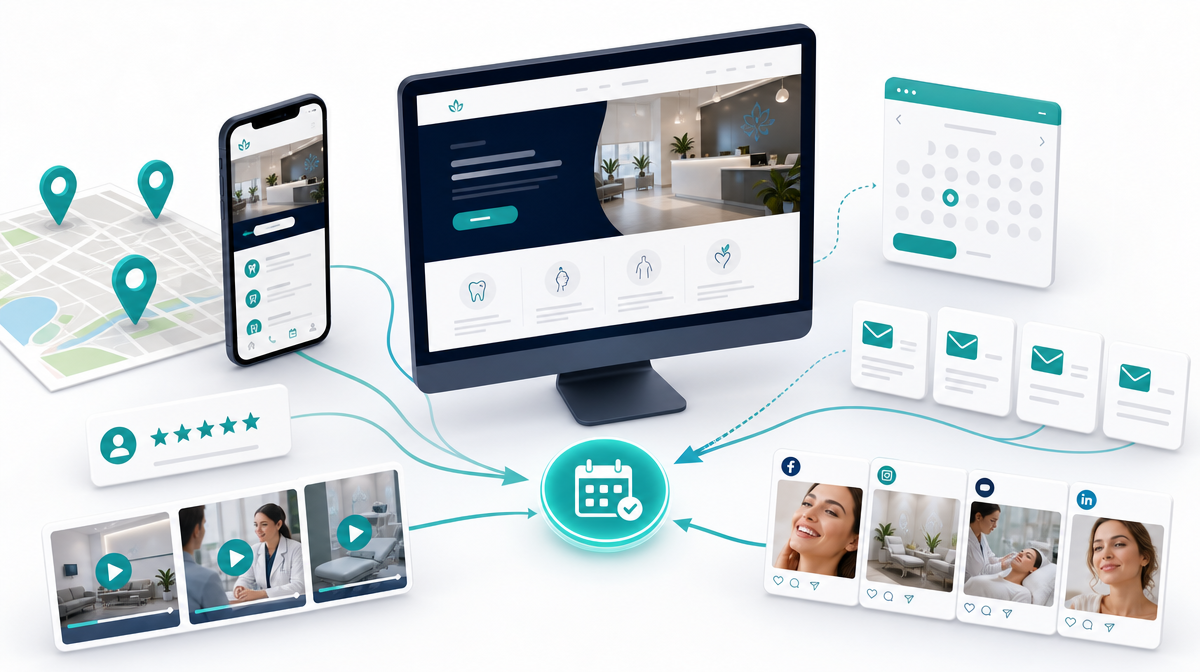
- SEO for regenerative medicine keywords: Ranking for treatment-specific terms like “PRP therapy for knee pain” and condition-specific terms like “non-surgical alternatives to rotator cuff surgery” puts your practice in front of patients who are already looking for what you offer. Strong on-page optimization paired with medical E-E-A-T signals — demonstrating real clinical experience and authoritative sourcing — is what separates practices that rank from those that don’t.
- Paid search and social advertising: Google Ads and Meta Ads can drive high-intent traffic quickly, but regenerative clinics face real restrictions on what they can promote. Compliant campaigns focused on educational angles and condition-based messaging tend to outperform direct treatment ads — and keep your account in good standing.
- Educational content marketing: Blog posts, treatment guides, and FAQ pages do double duty — they rank in search and actively combat the misinformation patients encounter before they ever contact your clinic.
- Email and text nurture campaigns: Most regenerative medicine patients don’t book on their first visit to your site. HIPAA-compliant drip sequences keep your practice top of mind while walking leads through the education they need to say yes.
- Social media engagement: Instagram works for visual before-and-after education, Facebook builds community and trust, and YouTube is where provider credibility gets established through long-form patient stories and procedure explainers.
This is one of the most common questions we hear from regenerative medicine practices, and the honest answer is: it depends on what you’re advertising and how you’re saying it.
Google’s healthcare and medicines policy draws a hard line between treatments that are FDA-approved and those that are considered experimental or speculative. Most stem cell therapies fall into the latter category, which means direct promotion is either restricted or outright prohibited. PRP sits in a slightly better position but still requires careful compliance with Google’s broader healthcare ad policies.
| Ad Type | Google Policy Status | Notes |
|---|---|---|
| PRP therapy | Generally allowed with restrictions | Must follow healthcare ad policies; no unproven outcome claims |
| Stem cell therapy | Restricted — requires certification | Varies by treatment claims; FDA-approved exceptions exist |
| Exosome therapy | Often prohibited | Unapproved treatments face the strictest restrictions |
The good news is that paid search isn’t your only lever. Clinics that get regenerative medicine marketing right use Google Display Ads to promote educational content, optimize their Google Business Profile for local visibility, and build organic SEO rankings that don’t carry the same platform restrictions. These channels keep you in front of high-intent patients without putting your ad account at risk.
The key rule: never let your ad copy or landing page make unproven efficacy claims, even if the ad itself looks compliant. Google reviews the full destination URL — and a single phrase like “stem cells eliminate arthritis” can get your entire account flagged.
The FDA doesn’t regulate your marketing directly the way it regulates drugs — but it absolutely regulates the claims you make about your treatments. For regenerative medicine clinics, that distinction matters enormously. Overpromising in your ads or on your website can trigger FDA warning letters, FTC scrutiny, and platform ad disapprovals all at once. Getting your messaging right isn’t just good compliance practice — it’s the foundation of effective regenerative medicine marketing.
One term worth clarifying immediately: FDA-cleared means a device or procedure has been reviewed for safety and substantial equivalence to an existing product. FDA-approved means a treatment has gone through full clinical trials proving safety and efficacy. Most PRP procedures fall into cleared or practice-of-medicine territory. Most stem cell therapies — unless they’re hematopoietic transplants — are neither. Calling an unapproved treatment “FDA-approved” is one of the fastest ways to earn a warning letter.
Here’s a practical framework for compliant messaging that still converts:
- Do say: “PRP uses your body’s own platelets to support the natural healing process”
- Don’t say: “Stem cells cure arthritis” or “guaranteed results”
- Do say: “Many patients report reduced pain and improved mobility following treatment”
- Don’t say: “This treatment reverses joint damage” or “FDA-approved stem cell therapy”
- Do say: “Results may vary — schedule a consultation to discuss whether this is right for you”
Compliant copy doesn’t have to be weak copy. Patient-outcome language, mechanism-of-action explanations, and provider credentials all build credibility without crossing regulatory lines.
In regenerative medicine marketing, trust is the currency that converts skeptical browsers into booked consultations. Patients considering PRP, stem cell therapy, or exosomes aren’t just researching a procedure — they’re trying to decide whether to believe it works. A polished service page won’t close that gap. A real patient talking on camera about getting back on the golf course after a knee PRP series? That will.
Video testimonials work because they’re harder to fake and easier to feel. Prospective patients watch someone who looked like them, hurt like them, and came out the other side — and suddenly the treatment feels possible rather than experimental. This is especially critical in a niche where misinformation runs rampant and the “too good to be true” alarm is always firing.
To collect and display testimonials compliantly, keep these practices in mind:

- Get written HIPAA authorization before filming or publishing any patient story — document it, store it, and never assume verbal consent is enough
- Avoid outcome guarantees in the edit — let patients describe their experience without scripting claims like “cured” or “100% better”
- Feature videos across multiple touchpoints — your website’s service pages, your Google Business Profile, Instagram Reels, and YouTube all extend the reach of a single testimonial
- Pair video with written summaries for SEO value and accessibility — a transcript or short patient story paragraph supports both search rankings and patients who prefer reading
Short-form video (60–90 seconds) performs best for social platforms, while longer-form stories work well embedded on dedicated treatment pages where patients are already in research mode.
Your website is your highest-leverage marketing asset — and for a regenerative medicine practice, it has to do more than look credible. It has to convert skeptical, research-heavy patients who are comparing you against three other clinics before they ever pick up the phone.
Most regenerative medicine websites fail at this because they rely on brochure-style layouts instead of conversion-focused medical website design. A high-converting site earns trust fast and makes it effortless to take the next step.
- Trust signals front and center: Provider credentials, board certifications, clinical training, and verified patient reviews should appear above the fold — not buried in a footer bio.
- Dedicated service pages: One page per treatment (PRP, stem cell therapy, exosomes, peptides) with plain-language explanations, FAQs, and condition-specific content. This is also where your regenerative medicine marketing SEO does its heaviest lifting.
- Conversion tools that remove friction: Online scheduling, click-to-call buttons, and live chat or AI chat capture patients who are ready to book right now — not during your office hours.
- Mobile-first design: Over 60% of healthcare searches happen on a smartphone. If your site loads slowly or forces users to pinch-zoom through your PRP page, they’re gone.
- Fast load times: Google’s Core Web Vitals directly affect your search rankings. A slow site costs you both traffic and conversions simultaneously.
Speed, clarity, and trust aren’t design preferences — they’re patient acquisition variables. Every element on your site either moves a prospect closer to booking or pushes them toward a competitor.
When a patient decides they want to explore PRP or stem cell therapy, there’s a good chance the first thing they do is type “regenerative medicine near me” into Google. If your practice isn’t showing up in the local map pack, you’re invisible at the exact moment that patient is ready to act.
Google Business Profile (GBP) is the single highest-leverage free tool in your regenerative medicine marketing stack. A fully optimized profile can drive appointment requests without spending a dollar on ads. The catch is that most clinics set it up once and forget it exists.
Here’s what an optimized GBP actually looks like for a regenerative clinic:
- Primary category: Choose the most specific category available (e.g., “Sports Medicine Clinic” or “Medical Clinic”) — this directly affects which searches trigger your listing
- Services listed: Add individual services like PRP therapy, stem cell therapy, and exosome treatments so Google understands exactly what you offer
- Weekly posts: Publish educational posts about treatments, patient outcomes, and provider credentials to signal an active practice
- Q&A section: Proactively answer common patient questions before they ask — this content appears directly in search results
- Photos: Upload clinic photos, provider headshots, and treatment area images; profiles with photos receive significantly more clicks
- Reviews: Consistently generate and respond to patient reviews — 84% of patients check reviews before choosing a provider, and review volume and recency are direct map pack ranking factors
Pair your GBP with consistent NAP (name, address, phone) citations across directories like Healthgrades, Zocdoc, and Yelp. Inconsistent information across listings confuses Google and suppresses your local rankings.
If you spend any time around search marketing right now, you’ve probably noticed something: patients are increasingly getting their answers directly from AI — without clicking a single link. Google’s AI Overviews — now appearing in over 82% of health-related searches — and tools like ChatGPT are reshaping how people research treatments like PRP, stem cell therapy, and exosomes. That shift has serious implications for regenerative medicine marketing.
Generative Engine Optimization (GEO) is the practice of structuring your content so AI systems pull from it when generating answers. Think of it as SEO — but optimized for the machine that’s summarizing results, not just the algorithm ranking blue links. If your clinic’s content isn’t formatted for AI consumption, you’re invisible in an increasingly AI-first search environment.
The good news: GEO tactics are concrete and actionable. Here’s what actually moves the needle:

- Structured content: Use clear headers, concise paragraphs, and direct answers to common patient questions — AI systems favor content that’s easy to parse and cite.
- Entity optimization: Establish your practice as a recognized entity by consistently publishing under your clinic name, linking to your Google Business Profile, and earning mentions on authoritative medical sites.
- Authoritative sourcing: Link to peer-reviewed research, FDA guidance, and credible medical organizations — AI models weight content that references trusted sources more heavily.
- FAQ formatting: Direct question-and-answer content is among the most frequently surfaced by AI — structure your service pages and blog posts accordingly.
Clinics that invest in GEO now are building visibility in a channel most competitors haven’t even noticed yet.
Most regenerative medicine marketing stops at getting the click. AI-driven systems go further — they analyze what happens after the click, using behavioral data and appointment patterns to figure out which prospects are actually ready to book and which ones need more nurturing before they’ll commit to a $3,000+ treatment.
Behavior and Appointment Data Analysis
AI tools can process signals like page visits, content downloads, email opens, and past appointment history to score leads by conversion likelihood. Instead of spending equal ad dollars on everyone who fills out a form, you focus budget on the patients most likely to show up for a consultation. That’s the difference between a $180 cost per lead and a $180 cost per booked patient.
AI Chatbots and Automated Booking
A prospective PRP patient researching at 10 PM isn’t going to call your front desk. An AI chatbot answers their questions in real time, qualifies their interest, and drops them directly into your scheduling system — no staff required. Practices using 24/7 AI chat capture leads that would otherwise disappear overnight.
Personalized Patient Follow-Up
Not every lead converts on the first touch. Automated follow-up sequences send the right educational content at the right time — condition-specific articles, provider credentials, financing options — keeping your clinic top of mind without your team manually chasing every inquiry. The result is an AI-powered follow-up system that scales without losing the personal feel patients expect from a healthcare provider.
If you can’t measure it, you can’t improve it — and that’s especially true in regenerative medicine marketing, where patient acquisition costs are high and treatments are almost always cash-pay. Tracking the right numbers tells you exactly which campaigns are pulling their weight and which ones are quietly draining your budget.
Here are the core KPIs every regenerative medicine practice should monitor:
- Cost per lead (CPL): What you’re paying for each inquiry — form fill, call, or chat. This is your first signal that a channel is working.
- Cost per acquisition (CPA): What you actually pay for each booked and completed consultation. A low CPL means nothing if leads aren’t converting.
- Conversion rate: The percentage of leads who become paying patients. If this number is low, the problem is usually your follow-up process or website experience — not your ads.
- Return on ad spend (ROAS): Revenue generated per dollar spent on paid campaigns. For high-ticket PRP and stem cell services, even a modest ROAS can represent strong profitability.
- Patient lifetime value (LTV): The total revenue a patient generates over time, including repeat treatments and referrals. This metric justifies higher acquisition costs for the right patients.
Benchmarks will vary depending on your market, competition, and service mix. The goal isn’t perfection out of the gate — it’s building a consistent data feedback loop so your regenerative medicine marketing strategy gets sharper every month.
Not every marketing agency is equipped to handle the complexity of regenerative medicine marketing. Generalist agencies often learn your niche on your dime — discovering mid-campaign that Google restricts stem cell ads or that the FDA takes a dim view of outcome guarantees. That’s an expensive education you shouldn’t have to fund.

When evaluating a potential partner, push past the pitch deck and ask hard questions. The right agency will have clear, specific answers. The wrong one will pivot to vague promises about “brand awareness.”
- Healthcare specialization: Do they understand medical compliance, HIPAA requirements, and FDA advertising guidelines — or are they figuring it out as they go?
- Regenerative medicine experience: Have they run campaigns for PRP, stem cell, or exosome practices specifically? Ask for examples.
- Transparent reporting: Can you see exactly where your budget is going, what’s converting, and what your cost per booked patient actually is?
- Proven results: Do they share real outcomes — patient counts, cost-per-lead benchmarks, ROAS — or just testimonials with no numbers attached?
- AI and GEO capabilities: As AI search reshapes how patients find providers, is the agency actively building for that future or still running 2019 playbooks?
The stakes are too high for trial and error. A specialized partner who already understands the regulatory landscape and patient psychology of regenerative medicine will outperform a generalist agency every time.
If you’ve made it this far, you already know that regenerative medicine marketing isn’t something you can hand off to a generalist agency and hope for the best. You need a partner who understands FDA compliance, knows how to structure content for AI search, and can actually move the needle on patient acquisition — not just impressions and clicks.
That’s exactly what Target Patients MD is built to do. Our proprietary A.L.I. 360 system — Attract, Learn, Influence — combines predictive analytics, Generative Engine Optimization, and HIPAA-compliant automation into one cohesive patient acquisition engine designed specifically for medical practices like yours.
Here’s what working with us looks like in practice:
- Attract: We drive high-intent traffic through regenerative medicine SEO, compliant paid campaigns, and GEO-optimized content that surfaces your practice in AI-generated search results.
- Learn: Our AI tools analyze patient behavior and appointment data to sharpen targeting and reduce wasted ad spend over time.
- Influence: Automated follow-up sequences, video testimonial strategies, and reputation systems convert curious searchers into booked consultations.
Practices using our platform have seen patient acquisition lifts of up to 377%, and we’ve helped more than 735 practitioners grow their patient base with measurable, transparent results. We don’t do vague promises — we do dashboards, data, and patients in your schedule.
Regenerative medicine marketing comes with a unique set of questions — and a few that come up over and over again. Here are direct answers to the ones practice owners ask most.
What is the biggest challenge with regenerative medicine marketing?
Building patient trust while navigating strict FDA and advertising platform regulations that limit what you can claim about treatment outcomes. It’s a narrow lane, but it’s workable with the right strategy.
How do the four P’s of healthcare marketing apply to regenerative medicine?
Product (your specific treatments), Price (transparent pricing or financing options), Place (your clinic location and online presence), and Promotion (compliant advertising and educational content) must all work together to attract and convert patients effectively.
How much should a regenerative medicine clinic budget for marketing?
Most practices allocate somewhere between 5–15% of revenue to marketing, though the right number depends on your growth goals, local competition, and current patient acquisition costs. Higher-ticket services like stem cell therapy often justify a larger investment.
Can regenerative medicine clinics advertise stem cell therapy on Facebook and Instagram?
Meta’s policies restrict certain regenerative medicine claims, so clinics need to lead with educational content and compliant messaging rather than direct treatment promotion. Think awareness, not hard sell.
How long does SEO take to generate patients for a regenerative medicine practice?
Typically several months before you see meaningful traction — longer in competitive markets. Less competitive local markets may show results sooner, which is why pairing SEO with paid and local strategies from day one makes sense.


