


Stem cell clinic marketing is a different animal from standard healthcare marketing—and if you’ve tried running it like a general medical practice, you already know that. The usual playbook (referral networks, insurance-panel visibility, maybe a few print ads) doesn’t move the needle when you’re selling a high-ticket, self-pay treatment that most patients have never heard of and half of them are skeptical about.
Most stem cell clinics operate on a direct-to-consumer model, which means you’re reaching patients before they’ve ever talked to a doctor about regenerative therapy. That changes everything. You’re not just competing for appointment slots—you’re competing for attention, trust, and belief in a treatment category that’s still emerging in the public consciousness.
The shift in the industry has been decisive: digital channels now dominate patient acquisition for regenerative medicine, with the vast majority of clinics relying on their website and social platforms as primary outreach tools. But simply having a website and a Facebook page isn’t a strategy. Effective stem cell clinic marketing today means running a coordinated system across multiple channels simultaneously.
The core pillars of that system look like this:
- SEO and local search: appearing when patients search for stem cell therapy near them
- Paid advertising: Google Ads and social media campaigns built around compliance guardrails
- Content marketing: patient education that builds trust long before a consultation is booked
- Reputation management: reviews and testimonials that overcome natural skepticism about emerging treatments
If you’ve spent any time browsing regenerative medicine websites, you’ve noticed they all start to blur together. “Cutting-edge stem cell therapy.” “Advanced regenerative treatments.” “Harness your body’s natural healing power.” Every clinic sounds identical, which means patients default to whoever ranks first or charges least—neither of which is a winning position for your practice.
Effective stem cell clinic marketing starts with a positioning decision, not a campaign. Before you write a single ad or publish a single blog post, you need a clear answer to one question: who do you help, and why are you the obvious choice for them?
The most effective way to differentiate is to go narrower, not broader. Clinics that specialize in a defined niche consistently outperform generalists because patients searching for solutions to a specific problem trust the specialist who speaks directly to their condition. Consider anchoring your positioning around one of these axes:
- Condition-specific expertise: knee osteoarthritis, chronic back pain, hair restoration, sexual wellness, or autoimmune conditions
- Treatment-specific specialization: PRP, adipose-derived therapies, exosomes, or Wharton’s jelly
- Outcome-focused messaging: lead with patient results and functional improvements, not equipment specs or science jargon
- Physician credentials and training: board certifications, fellowship training, and published research signal legitimacy in a space where skepticism runs high
Once you’ve identified your niche, that positioning should run through every element of your marketing—your homepage headline, your Google Business Profile description, your ad copy, and your content strategy. Consistency between what you say and who you actually serve is what converts skeptical researchers into booked consultations.
If there’s one area where stem cell clinic marketing gets clinics into serious trouble, it’s compliance. The regulatory environment around regenerative medicine is genuinely complex—and “I didn’t know” is not a defense the FDA or FTC will accept.
The good news: compliant marketing is still effective marketing. You just need to understand where the lines are before you write a single ad, landing page, or social post.
The FDA draws a meaningful distinction between a medical procedure and a drug. If your stem cell therapy involves more than minimal manipulation of cells or uses them for purposes other than their original function, the FDA may classify it as a drug—requiring clinical trials and formal approval before you can market it as a treatment.
The FTC—which launched a dedicated Healthcare Task Force in 2026—compounds this by requiring that any health claim in your marketing be substantiated by credible scientific evidence. In practice, this means avoiding language like “cures,” “eliminates,” or “reverses” in favor of softer, defensible phrasing like “may support” or “is being studied for.”
Specific phrases to remove from your marketing copy immediately:
- “FDA-approved stem cell therapy” — stem cell treatments are generally not FDA-approved
- “Guaranteed results” — unsubstantiated outcome claims violate FTC guidelines
- “Cure” or “reverse” — implies drug-level efficacy without the evidence to back it up
- “No side effects” — no medical procedure can make this claim compliantly
Both Google and Meta restrict stem cell therapy advertising under their healthcare and medicines policies. That doesn’t mean paid advertising is off the table—it means your strategy needs to be smarter than a straightforward “book your stem cell treatment” campaign.
Workarounds that actually work include:
- Condition-focused ad copy: target the patient’s pain point (“knee pain that won’t go away”) rather than the treatment name
- Branded search campaigns: bid on your clinic name so patients who already know you can find you easily
- Educational content promotion: run ads that drive traffic to informational articles or videos rather than direct booking pages
- Microsoft Ads: Bing’s ad policies are less restrictive and reach a valuable 45+ demographic actively researching health options

The table below summarizes what you’re working with across major platforms:
| Platform | Stem Cell Ad Policy | Workaround Options |
|---|---|---|
| Google Ads | Restricted/Limited | Educational content, branded terms |
| Meta (Facebook/Instagram) | Restricted | Organic content, retargeting website visitors |
| YouTube | Restricted | Educational videos, branded campaigns |
| Microsoft Ads | Less restrictive | Broader keyword options |
HIPAA compliance doesn’t stop at your front desk—it extends into every digital touchpoint where a patient shares personal health information. That includes your website contact forms, email campaigns, and SMS follow-up sequences.
A few non-negotiables for any stem cell clinic running digital marketing:
- Secure web forms: use HIPAA-compliant form builders (not standard Google Forms or unencrypted WordPress plugins) to collect patient inquiries
- Encrypted email platforms: standard Gmail or Outlook do not meet HIPAA standards for PHI transmission without additional configuration
- BAA agreements: any CRM, email platform, or marketing tool that handles patient data must sign a Business Associate Agreement with your practice
- Compliant SMS: text message campaigns require explicit patient consent and must be sent through a HIPAA-compliant messaging platform
Getting this right protects your patients and your practice. A HIPAA violation triggered by a marketing tool isn’t just embarrassing—it can result in fines starting at $100 per violation and climbing to $50,000 or more per incident category.
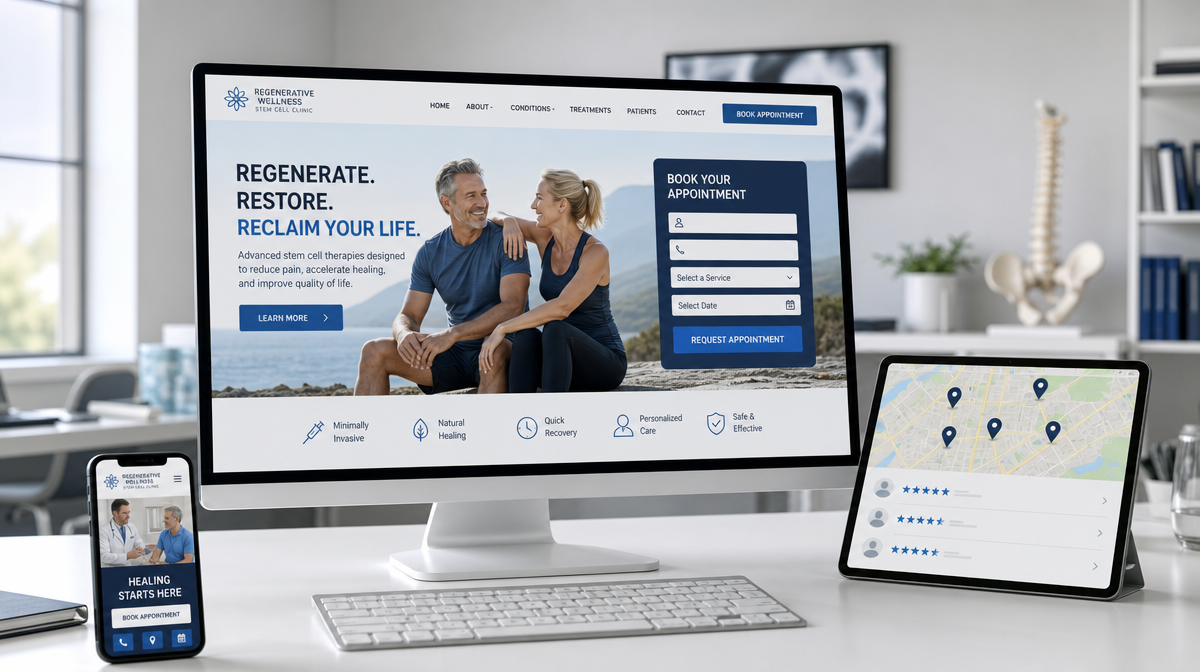
Your website is the hub of your entire stem cell clinic marketing strategy. Every ad you run, every piece of content you publish, and every review you collect eventually points back to it. If the site doesn’t convert visitors into consultation requests, the rest of your marketing spend is essentially a donation to Google.
Most stem cell clinic websites fail at the same handful of things. They bury the call-to-action below the fold, lead with scientific jargon instead of patient outcomes, and load slowly on mobile—where more than 60% of healthcare searches now happen. Fix those three problems alone and you’ll see measurable improvement in lead volume.
Here’s what a high-converting stem cell clinic website actually needs:
- Above-the-fold clarity: Within three seconds, a visitor should know what conditions you treat, who you help, and exactly how to book a consultation—no scrolling required.
- Trust signals front and center: Physician credentials, board certifications, professional affiliations, and patient testimonials should appear early and often. Skepticism is the default for regenerative medicine patients.
- Condition and treatment pages: Dedicated pages for knee pain, hair restoration, sexual wellness, or whatever you treat—written to answer real patient questions, not impress other clinicians.
- Frictionless conversion elements: Click-to-call buttons, a live chat widget, and a short contact form (name, phone, condition—that’s it) reduce the effort required to reach you.
- Technical fundamentals: SSL security, sub-three-second load speed, mobile responsiveness, and HIPAA-compliant form handling are non-negotiable baseline requirements.
Think of your website as a 24/7 patient coordinator. When it’s built right, it qualifies leads, answers objections, and books consultations while you’re seeing patients.
When paid ad platforms restrict your campaigns, organic search becomes your most reliable patient acquisition channel. SEO—search engine optimization—is the process of making your website rank higher when patients search for terms like “stem cell therapy for knee pain near me” or “regenerative medicine clinic in [city].” For stem cell clinic marketing specifically, a strong SEO foundation isn’t optional. It’s the backbone of your entire digital strategy.
The good news: most of your competitors are doing SEO poorly, which means there’s real opportunity to capture high-intent patients who are actively researching treatment options. Here’s where to focus your efforts.
Most stem cell patients search locally. They’re not browsing—they’re ready to find a clinic. Your Google Business Profile is the first thing they’ll see, and an unoptimized profile is leaving consultations on the table. Make sure your profile includes accurate categories, updated hours, treatment-specific service descriptions, and a steady stream of recent patient reviews. Local citation consistency across directories like Healthgrades, Yelp, and WebMD reinforces your geographic relevance to Google.
Broad keywords like “stem cell therapy” are dominated by national publishers and research institutions. The real wins come from condition-plus-treatment-plus-location combinations—think “PRP injections for hip pain in Austin” or “exosome therapy for hair loss Chicago.” These long-tail searches have lower competition and much higher conversion intent.
Google evaluates medical websites through its E-E-A-T framework—Experience, Expertise, Authoritativeness, and Trustworthiness. Physician-authored condition and treatment pages, citations from medical journals, and backlinks from reputable healthcare directories all signal that your clinic is the real deal. Guest articles on medical association sites and local press coverage also build the link equity that moves rankings.
Schema markup is structured code that helps search engines understand exactly what your site contains. For stem cell clinics, MedicalBusiness and Physician schema tell Google who you are, what you treat, and where you’re located—improving your chances of appearing in rich results. Pair that with fast load times, mobile responsiveness, and clean site architecture, and you’ve built a technical foundation that supports every other SEO effort you make.
Here’s the honest truth about paid advertising for stem cell clinics: the platforms that drive the most volume—Google and Meta—also have the most restrictions on what you can say and how you can say it. That doesn’t mean paid ads are off the table. It means your strategy has to be smarter than a clinic that sells, say, teeth whitening.
A multichannel paid approach is non-negotiable in stem cell clinic marketing. When one platform limits your reach, you compensate with others. When one ad type gets disapproved, you have a backup funnel already converting. Here’s how the channel mix breaks down:
- Google Ads: Focus on branded campaigns, condition-focused keywords (think “knee pain specialist near me” rather than “stem cell therapy”), and educational content promotion. Avoid treatment outcome claims in ad copy—they’ll get you flagged fast.
- Microsoft Ads (Bing/Yahoo): Less restrictive policies and a slightly older, higher-income demographic that skews well for high-ticket regenerative medicine. Often overlooked, consistently underpriced.
- YouTube and Performance Max: Video pre-roll ads featuring physician education content can run where standard display ads can’t. Performance Max campaigns let Google’s automation find converting audiences across its entire network.
- Display and Retargeting: Re-engage the 90%+ of website visitors who didn’t book a consultation. Retargeting is one of the highest-ROI tactics available because you’re advertising to people who already know you exist.
- Native and Programmatic Networks: Healthcare-specific ad networks like HealthLine Media or programmatic buys through DSPs give you compliant inventory when Google and Meta say no.
The clinics that win with paid advertising aren’t the ones spending the most—they’re the ones running the most coordinated campaigns across the right mix of channels.
Social media is both a goldmine and a minefield for stem cell clinic marketing. The goldmine: millions of patients researching regenerative treatments scroll Instagram, Facebook, and YouTube every day. The minefield: Meta and Google have restricted or outright blocked direct-response ads for stem cell therapy, which means you can’t just run a “Book Your Consultation” campaign and call it a day.
The clinics winning on social right now have shifted their strategy toward education and trust-building first, conversion second. That shift isn’t a workaround—it’s actually the right approach for a high-consideration treatment where patients spend weeks or months researching before they ever pick up the phone.
Within Meta’s restrictions, compliant stem cell ads focus on condition awareness rather than treatment promotion. Think “Living with chronic knee pain?” rather than “Try stem cell therapy.” Custom audiences built from website visitors and lookalike audiences modeled on existing patients give you targeting precision without triggering policy flags. Educational content—a physician explaining what PRP is, or a video walking through what a consultation looks like—tends to clear review queues more reliably than direct-offer creative.
Organic content is where stem cell clinics build the trust that converts later. The highest-performing content types include:
- Physician Q&A videos addressing common patient questions about safety, candidacy, and what to expect
- Treatment explainer content breaking down how PRP, exosomes, or adipose-derived therapies actually work
- Patient stories (with written consent) showing real outcomes without making prohibited claims
- Behind-the-scenes content that humanizes your clinic and builds familiarity before the first call
Posting three to five times per week across platforms keeps your clinic top of mind through a patient’s entire research cycle.
Here’s the thing about stem cell therapy that makes it fundamentally different from, say, marketing a teeth cleaning: your patients have never heard of most of what you offer, they’re skeptical of what they have heard, and they’re about to spend $5,000–$25,000 out of pocket on a treatment their insurance won’t touch. That’s not a quick Google search and a phone call. That’s a research journey—and content marketing is how you show up at every stop along the way.
Patient education isn’t a nice-to-have in stem cell clinic marketing. It’s the engine that moves someone from “I heard stem cells might help my knee” to “I’m booking a consultation with Dr. Smith.” The clinics winning in regenerative medicine right now are the ones publishing content that answers real questions before patients even think to ask them.
Here’s what a strong content library looks like for a regenerative medicine practice:
- Condition pages: Deep-dive content on specific conditions you treat—knee osteoarthritis, rotator cuff injuries, hair loss, erectile dysfunction—written for patients, not physicians.
- Treatment pages: Clear explanations of how each therapy works, what patients experience during and after, and who makes a good candidate.
- FAQ content: Direct answers to the objections your front desk hears every day (“Is this FDA-approved?” “How long until I see results?”).
- Physician video content: Short, on-camera explanations from your doctors that build trust in a way no blog post can replicate.
- Lead magnets: Downloadable guides—”The Patient’s Guide to Stem Cell Therapy for Joint Pain”—that trade useful information for an email address and start the nurture sequence.
Stem cell treatments typically run $3,000–$15,000 or more per procedure. Nobody pulls out a credit card after seeing one Facebook post. These are high-consideration decisions that require multiple touchpoints before a patient books a consultation—which is exactly why a structured email and CRM nurture system isn’t optional for serious stem cell clinic marketing. It’s the difference between a lead going cold and a patient showing up ready to move forward.
A CRM (customer relationship management) system is the software that tracks every lead—where they came from, what they’ve opened, whether they’ve responded, and where they are in the decision process. Without one, you’re essentially flying blind and hoping someone circles back on their own. They won’t.

A high-converting nurture sequence for stem cell patients typically moves through five stages:
- Welcome sequence: Immediate confirmation after form submission—acknowledge their inquiry, set expectations, and deliver something valuable like a treatment overview or FAQ guide
- Education sequence: A series of emails explaining the therapy, what to expect, candidacy criteria, and how the consultation works
- Social proof sequence: Patient testimonials, physician credentials, and outcome stories that build trust without making prohibited claims
- Consultation booking sequence: Direct, urgency-driven emails with a clear call-to-action and easy scheduling link
- Post-consultation follow-up: Re-engagement emails for leads who attended a consult but haven’t committed to treatment
The goal is to stay present and helpful throughout a patient’s research process—not to pressure them, but to make sure your clinic is the obvious choice when they’re ready to say yes.
If there’s one thing patients do before booking a stem cell consultation, it’s read reviews—84% of patients check online reviews before choosing a healthcare provider. We’re talking about a treatment category where skepticism runs high, price points run higher, and a single five-star review from someone who got their knee back can be worth more than any ad you’ll ever run. Reputation management isn’t a nice-to-have in stem cell clinic marketing—it’s a core patient acquisition channel.
The clinics pulling in consistent five-star ratings aren’t getting lucky—they have a system. The best time to ask for a review is immediately after a positive outcome or follow-up visit, when patient sentiment is at its peak. Automate review requests via text and email using a compliant CRM, and direct patients to Google Business Profile first (highest SEO value), followed by Healthgrades and Yelp.
Negative reviews will happen. How you respond is what prospective patients actually judge. Keep responses HIPAA-compliant—never confirm or deny a patient relationship publicly. Acknowledge the concern, express that you take feedback seriously, and invite them to contact your office directly. A calm, professional response signals to every reader that your clinic handles problems like adults.
Text reviews build credibility. Video testimonials build trust. A 90-second clip of a real patient describing their experience with your clinic is more persuasive than a paragraph of copy. Get signed consent, keep the language outcome-neutral to stay compliant, and place these videos prominently on your homepage, treatment pages, and social profiles.
If you spend any time around digital marketing in 2026, you’ve heard the term Generative Engine Optimization (GEO)—and if you haven’t, your competitors probably have. GEO is the practice of structuring your content so that AI-powered search tools like Google’s AI Overviews, ChatGPT, and Perplexity actually cite your clinic when patients ask questions like “what’s the best treatment for knee arthritis?” or “how does stem cell therapy work?”
This matters enormously for stem cell clinic marketing right now. Patients researching high-ticket regenerative treatments are increasingly getting their first answers from AI search rather than traditional blue-link results, with 26% of patients reporting AI-driven influence on their provider choice by mid-2025. If your clinic isn’t showing up in those AI-generated responses, you’re invisible to a growing segment of your most motivated prospects.
The good news: GEO rewards exactly the kind of content that builds trust anyway. Here’s what moves the needle:
- Structured, question-based content: Write clear answers to specific patient questions using descriptive headers—AI systems pull from well-organized, concise responses.
- Entity optimization: Establish your clinic and physicians as recognized entities by maintaining consistent NAP data, earning mentions on authoritative medical sites, and building a complete Google Business Profile.
- Authoritative source citations: Link to peer-reviewed research and reputable medical organizations—AI systems trust content that references trusted sources.
- FAQ schema markup: Structured FAQ data helps AI engines extract and surface direct answers from your pages.
Clinics that invest in GEO now are building a compounding visibility advantage that paid ads simply can’t replicate.
Most stem cell clinic owners track the wrong things. Impressions, follower counts, website visits—these feel like progress, but none of them pay the bills. The metrics that actually matter in stem cell clinic marketing are the ones directly tied to patient volume and revenue.
Think of your marketing funnel in four stages: traffic turns into leads, leads turn into consultations, consultations turn into booked treatments, and treatments determine your return. A KPI (key performance indicator) lives at each stage, and a drop at any point tells you exactly where to fix the system.
Here are the KPIs worth tracking every single month:
- Cost Per Lead (CPL): Total marketing spend divided by leads generated. This tells you how efficiently your campaigns are attracting interest.
- Cost Per Acquired Patient (CPA): Total spend divided by new patients who paid for treatment. This is your real acquisition cost—not just inquiries.
- Consultation Booking Rate: The percentage of leads who actually schedule. A low rate usually signals a follow-up or lead quality problem, not a marketing problem.
- Consultation-to-Treatment Rate: How many consultations convert to booked procedures. If this is low, the issue is your sales process, not your ads.
- Patient Lifetime Value (LTV): Total revenue per patient over time. For high-ticket regenerative treatments, LTV justifies aggressive acquisition spending that might look expensive at first glance.
When you know these numbers, you stop guessing and start making decisions based on data—which is the only way to scale a stem cell practice predictably.

Most general marketing agencies will confidently pitch your stem cell clinic, take your retainer, and then spend three months figuring out why Google keeps disapproving their ads. Specialized experience isn’t a nice-to-have in this space — it’s the difference between a campaign that generates consultations and one that generates headaches.
The first question to ask any prospective agency is how many regenerative medicine or stem cell clinics they’ve worked with — and ask for specifics, not a vague “we work with healthcare clients.” Stem cell clinic marketing operates under a distinct set of FDA, FTC, and platform-level restrictions that generic healthcare marketers routinely get wrong. You need a partner who already knows which ad copy triggers a Google disapproval and which claims cross the FTC’s substantiation line.
Vanity metrics — impressions, clicks, follower counts — don’t pay your overhead. A credible agency reports on cost per lead, cost per acquired patient, consultation booking rate, and return on ad spend. If they can’t tell you those numbers on day one of onboarding, that’s a red flag.
Before signing any contract, get clear answers to these questions:
- How many regenerative medicine or stem cell clinics have you worked with?
- How do you handle FDA and FTC compliance in ad copy and content?
- What platforms do you recommend given stem cell ad restrictions?
- What metrics do you report on, and how often?
- Do you guarantee results, and what does that guarantee actually include?
An agency that hesitates on any of these — especially the compliance question — probably isn’t the right fit for a high-stakes, tightly regulated category like stem cell therapy.
If you’ve made it through this guide, you already know that stem cell clinic marketing isn’t something you can hand off to a generalist agency and hope for the best. It requires healthcare-specific compliance knowledge, platform workarounds, and a patient acquisition system built for high-ticket, high-consideration treatments.
That’s exactly what Target Patients MD was built to deliver. We work exclusively with medical practices—including regenerative medicine and stem cell clinics—so our team understands the FDA and FTC guardrails, the ad platform restrictions, and the patient education funnel that converts skeptical prospects into booked consultations.
Our proprietary A.L.I. 360 technology powers every campaign we run. The Attract–Learn–Influence framework combines AI-driven patient acquisition with compliance-aware SEO, paid search, and content marketing to put your clinic in front of the right patients at the right moment—across search engines, social platforms, and AI-powered tools like ChatGPT and Perplexity.
Here’s what you get when you partner with us for stem cell clinic marketing:
- Healthcare-exclusive agency with deep regenerative medicine experience
- A.L.I. 360 AI-powered patient acquisition built to drive meaningful gains in patient volume
- Compliance-aware campaigns across SEO, PPC, social, and GEO
- Transparent reporting tied to revenue outcomes, not vanity metrics
Over 735 medical practitioners have trusted Target Patients MD to grow their practices. Learn more about Target Patients MD or book a free consultation to map out a growth strategy built specifically for your clinic.
These are the questions we hear most often from clinic owners exploring stem cell clinic marketing for the first time — or trying to figure out why their current approach isn’t working.
How much should a stem cell clinic budget for marketing each month? Most established clinics allocate between 8–12% of monthly revenue to marketing. Newer practices building patient volume from scratch often invest more aggressively — sometimes 15–20% — because the cost of an empty schedule is higher than the cost of a well-run campaign.
Can stem cell clinics run Google Ads legally? Yes, with the right strategy. Google restricts direct stem cell therapy ad copy, but compliant approaches — branded campaigns, condition-focused keywords, and educational landing pages — can still drive high-intent traffic without triggering disapprovals.
How long does SEO take to generate patients for a stem cell clinic? Organic rankings typically take four to six months to build meaningfully. However, Google Business Profile optimization can produce local visibility and inbound calls within weeks of implementation.
What is the most effective lead generation channel for regenerative medicine clinics? There’s no single winner. The most successful clinics combine SEO, paid search, and content marketing to reach patients at every stage of their research journey — because a patient who finds you three different ways is far more likely to book.
How do stem cell clinics market without making prohibited medical claims? Focus on education, physician expertise, and the consultation process. Use language like “may support” rather than “will cure,” and let properly disclaimed patient testimonials carry the social proof weight.