



Walk into any general medical practice and the marketing playbook is straightforward: build trust, communicate credentials, show up in local search. Med spas need all of that — and then some. Unlike a primary care office where patients come because they have to, your prospective clients are choosing to spend discretionary income on treatments like Botox, laser resurfacing, and body contouring. That distinction changes everything about how you market.
When a purchase is optional, desire has to be manufactured. You’re not just competing with the med spa two ZIP codes over — you’re competing with a vacation, a new wardrobe, or simply doing nothing at all. Effective medical spa marketing ideas have to move people from vague curiosity to a booked appointment, which requires a very different combination of channels and messaging than traditional healthcare advertising.
Three factors set med spa marketing apart from the rest of the healthcare world:
- Elective purchasing decisions: Clients self-select and self-schedule, so your marketing must create desire and urgency, not just inform.
- Visual proof drives conversion: Transformation imagery carries more persuasive weight here than a physician’s bio or a list of certifications ever could.
- Hyperlocal competition: In most markets, several med spas are fighting for the same pool of aesthetics-interested consumers within a tight geographic radius.
That combination — elective spending, visual decision-making, and dense local competition — is exactly why a generic healthcare marketing strategy falls flat for med spas.

The ten tactics below are ordered by speed-to-revenue — the ideas most likely to put patients in your chair within days appear first, while longer-burn strategies that compound over time come later. Together they form a complete med spa marketing playbook, not a menu of disconnected experiments.
- Optimize Your Google Business Profile for Local Search — Most patients searching “Botox near me” or “CoolSculpting [city]” never scroll past the map pack. Birdeye research shows 86% of profile views come from category-based searches, so a fully built-out profile with current hours, service categories, weekly photos, and active Google Posts captures those clicks before a competitor does.
- Generate and Showcase Patient Reviews — Reviews are the modern word-of-mouth — 61% of patients now prioritize reviews over personal referrals. A post-appointment text with a direct link to your Google or RealSelf review page turns satisfied clients into a passive acquisition engine.
- Run Targeted Google and Meta Ads for Botox and CoolSculpting — Paid ads are the fastest path to a full schedule. Geo-targeted campaigns linked to dedicated treatment landing pages — plus remarketing to visitors who browsed but didn’t book — deliver measurable ROI within days.
- Build a Mobile-First Med Spa Website That Converts — Your website is your hardest-working salesperson. Slow load times and buried booking buttons send prospects directly to your competition.
- Launch a Client Referral and Loyalty Program — Existing happy clients cost far less to activate than cold prospects. A simple double-sided incentive — a discount for both the referrer and the new client — turns your patient list into a growth channel.
- Post Before-and-After Content on Instagram and TikTok — Authentic transformation content with proper patient consent builds trust faster than any written testimonial.
- Send Email and SMS Campaigns That Rebook Clients — Segmented campaigns tied to treatment history keep your calendar full between new-patient pushes.
- Host In-Person Events and Open Houses — Live demos and event-only pricing create urgency that digital channels rarely replicate.
- Use AI and Generative Engine Optimization to Win in AI Search — Structuring content for AI-generated answers positions your practice ahead of competitors still optimizing only for traditional search — a rater8 survey found 26% of patients already credit AI tools with influencing their provider choice.
- Layer in Direct Mail and Local Business Partnerships — Targeted mailers and cross-promotions with gyms, salons, and bridal shops reach high-intent prospects who may never see your digital ads.
You can run every tactic in this article and still lose money if you’re not connecting spend to outcomes. Tracking is what separates practices that scale from ones that stay stuck in a cycle of guessing which channel deserves next month’s budget.
Start with these three metric pairs — each one tells a different part of the story:
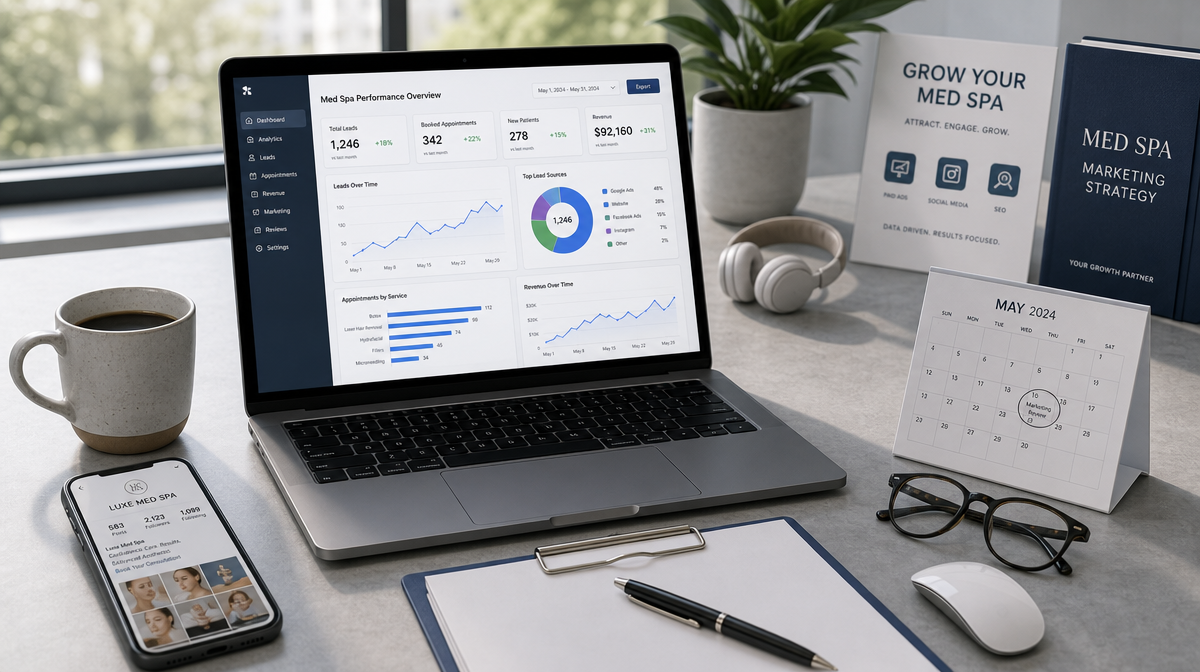
- Cost Per Lead (CPL) vs. Cost Per Booked Patient (CPA): CPL measures what you spend to generate an inquiry; CPA measures what you spend to convert that inquiry into a confirmed appointment. A low CPL with a high CPA signals a front-desk or follow-up problem, not a marketing problem — and conflating the two leads to cutting the wrong thing.
- Booking Conversion Rate vs. Patient Lifetime Value (LTV): Conversion rate is the percentage of leads that become booked appointments. LTV is the total revenue a client generates across all visits over time. A client who returns quarterly for injectables and adds on skincare products every visit is worth far more than her first appointment fee suggests — which means you can justify a higher acquisition cost to win her initially.
- Attribution and Call Tracking: Attribution answers the question every med spa owner should be asking: which specific channel drove this booking? Call tracking software assigns unique phone numbers to individual campaigns, so a patient who calls after seeing a Google Ad gets logged differently than one who found you through a Facebook post. Without it, phone bookings — which are still common in aesthetics — vanish from your data entirely.
Review these numbers monthly. Quarterly reviews are too slow to catch a campaign that’s quietly draining budget.
HIPAA wasn’t written with Instagram Reels in mind, but it absolutely applies to them — with civil penalties up to $2.19 million per violation. Medical spas occupy a regulated middle ground — clinical enough to handle protected health information (PHI), consumer-facing enough to run aggressive promotional campaigns. That combination creates real compliance exposure if you’re not deliberate about where marketing and patient data intersect.
The most common violations in med spa advertising aren’t intentional — they’re oversights. Posting a before-and-after photo without a signed written release, sending appointment reminders through a non-compliant email platform, or including any detail that could identify a patient in a testimonial can each trigger an HHS complaint or civil penalty. “She loved her results” is fine. “Our Tuesday 2pm client from Westside couldn’t believe her Botox outcome” is not.
Three non-negotiables for every med spa running any form of patient-facing marketing:
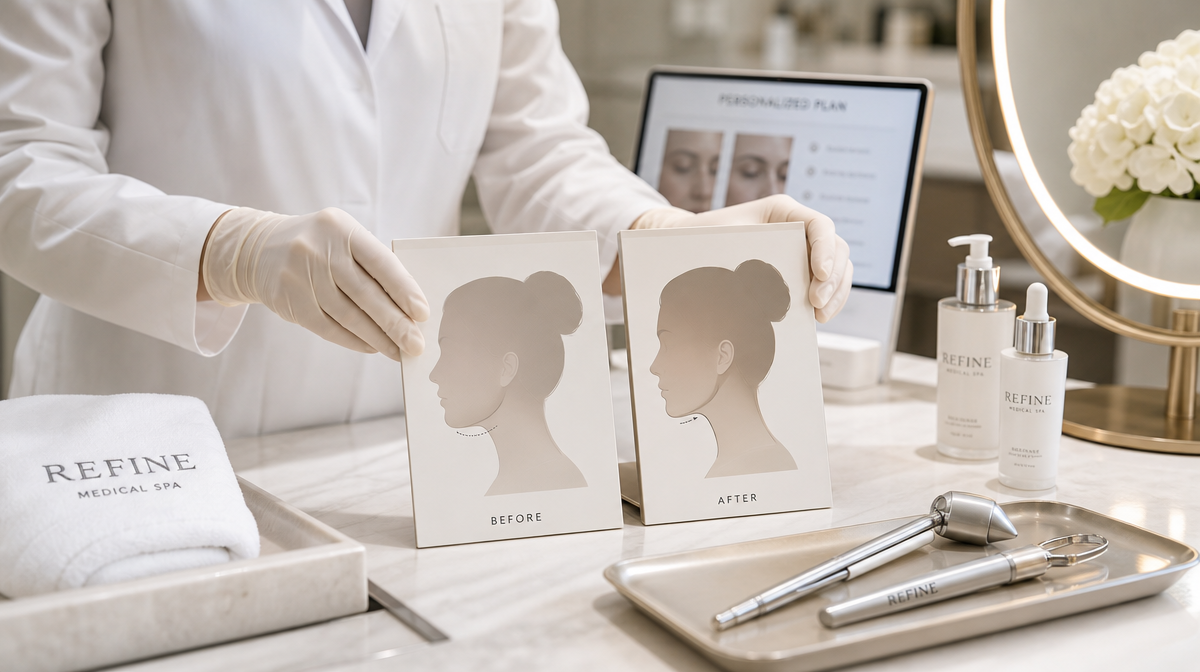
- Written consent is mandatory before any patient image or testimonial goes public — verbal agreement isn’t sufficient, and consent must specify exactly how and where the content will be used
- All patient communications require HIPAA-compliant platforms — standard Gmail, Mailchimp free tier, and generic SMS tools do not qualify; use vendors that offer a signed Business Associate Agreement (BAA)
- Strip all identifiable information from marketing materials — names, photos, appointment dates, treatment details, and geographic specifics can all constitute PHI in context
Compliance isn’t a creativity killer — it’s a liability shield. Build the consent workflow into your post-treatment process so collecting releases becomes routine rather than an afterthought.
- What is the best way to advertise a medical spa?
- The most effective approach combines an optimized Google Business Profile, geo-targeted paid ads on Google and Meta, and a steady cadence of before-and-after social media content. Layering in patient reviews, a referral incentive, and email marketing keeps appointment slots filled consistently rather than in bursts.
- What are the 5 P’s of healthcare marketing?
- The 5 P’s are Product, Price, Place, Promotion, and People. For med spas specifically, Promotion and People carry extra weight — visual social proof and the trust clients place in your clinical team are often the deciding factors between booking with you or a competitor down the street.
- How much should a med spa spend on marketing each month?
- Most established med spas allocate somewhere between 5% and 12% of monthly revenue to marketing, though the right number depends heavily on local competition and growth targets. Practices in their first one to two years typically invest at the higher end of that range to build brand awareness, while mature practices shift more budget toward retention and premium-service campaigns.
- How long does it take to see results from med spa marketing?
- Paid search and social campaigns can generate qualified inquiries within 48 to 72 hours of launch. Organic search rankings and online reputation growth operate on a longer timeline — typically three to six months before meaningful traction appears. A blended strategy produces near-term bookings while building compounding visibility over time.
- How do I attract new customers to my med spa fast?
- The quickest lever is geo-targeted Google and Meta ads pointed at dedicated landing pages for high-demand treatments like Botox or body contouring. Pairing that paid push with a referral incentive for existing clients accelerates word-of-mouth simultaneously, so you’re working two acquisition channels at once without doubling your budget.
Running a med spa means splitting your attention between clinical excellence and business development — and most owners find that one of those two things suffers. Treatments get better; marketing gets neglected. Or marketing ramps up, and the patient experience quietly slips. Neither outcome is acceptable when your reputation and revenue depend on both.
That’s exactly the problem a healthcare-specialized patient acquisition partner solves. Target Patients MD was built specifically for medical practices — not restaurants, not e-commerce brands, not law firms. Every system, every campaign, and every optimization is designed around one outcome: getting qualified patients into your treatment rooms.
What a full-service partnership actually covers:
- Local SEO and directory presence across 70+ platforms so patients find you first
- Paid search and social campaigns targeting high-intent prospects in your service area
- Reputation management aggregating reviews across 20+ platforms into a single dashboard
- AI-powered patient acquisition through the A.L.I. 360 system, which has delivered up to 377% lifts in new patient volume
- Automated outreach including text and email sequences that handle follow-up without adding front desk workload


