


Healthcare marketing is the coordinated use of digital channels — search, paid advertising, social media, email, and reputation platforms — to attract new patients, keep existing ones engaged, and position your practice as the trusted choice in your neighborhood. In New York City specifically, that definition carries more weight than it does anywhere else in the country.
Most markets reward a decent website and a modest Google Ads budget. NYC is not most markets. Healthcare marketing NYC operates at a different level of precision because your competition isn’t one or two practices across town — it’s dozens of credentialed providers within walking distance, many of them already investing heavily in the same channels you’re considering.
At its core, a well-built healthcare marketing program for an NYC practice covers three interconnected functions:
- Patient acquisition: paid ads, local SEO, and lead generation designed to fill your schedule with qualified new patients
- Patient retention: email, SMS, and automated outreach that keeps your existing patients coming back instead of drifting to a competitor down the block
- Reputation building: a steady stream of reviews, verified testimonials, and trust signals that influence how patients decide before they ever call your front desk
These three functions don’t work in isolation. A practice that acquires patients but doesn’t retain them is running in place. One that retains patients but has a thin review profile loses prospective patients to a competitor with a stronger online presence. Effective healthcare marketing in NYC ties all three together into a system that compounds over time.
Running a practice in New York City means competing inside a market that has no real equivalent in American healthcare. The density alone is staggering — Manhattan has more physicians per square mile than almost any geography in the country, and that saturation extends into Brooklyn, Queens, and the Bronx in ways that make borough-wide thinking insufficient. Your actual competition is hyper-local, measured in subway stops and ZIP codes.
That geography shapes how patients search. A prospective patient in Astoria isn’t typing “dentist in New York” — they’re typing “dentist near Ditmars” or checking what’s accessible from their commute. Generic campaigns that target the city broadly burn through budget reaching people who will never book with you because you’re four boroughs away.
The financial stakes compound the challenge. Healthcare-related Google Ads CPCs in NYC run significantly above the $5.64 national average, meaning every poorly targeted click costs more here than it would in any mid-sized market.
Then there’s the demographic reality. According to the NYC Public Advocate’s Language Access Report, nearly half of all city residents speak a language other than English — making the patient population multilingual, multicultural, and distributed unevenly across neighborhoods. Messaging that resonates in one ZIP code can fall completely flat in the next. The four factors that separate healthcare marketing NYC from anywhere else:
- Hyper-competitive market: more licensed practices per square mile than almost anywhere in the U.S.
- Neighborhood-specific search behavior: patients search by borough, ZIP code, and subway accessibility
- Higher ad costs: Google Ads CPCs run well above national healthcare benchmarks
- Diverse patient demographics: multilingual content and culturally relevant messaging directly affect conversion
A full-service healthcare marketing NYC program is built from several distinct service categories, each targeting a different stage of how patients find, evaluate, and book with your practice. No single channel carries the whole load — the practices that grow consistently are the ones running coordinated systems, not isolated tactics.
- Local SEO for New York City doctors: Optimizes your practice to appear in Google’s local map pack when patients search by neighborhood or specialty. Google Business Profile management is the foundation, but neighborhood-level landing pages and citation building are what separate visible practices from invisible ones.
- Google Ads and paid search: Puts your practice at the top of search results immediately, without waiting months for organic rankings to build. NYC’s competitive PPC environment demands precise geo-targeting and tight budget controls — broad campaigns here bleed money fast.
- Social media and retargeting: Facebook and Instagram campaigns reach patients by demographics, interests, and location. Retargeting re-engages visitors who checked out your site but didn’t book — particularly effective for elective and aesthetic procedures where patients comparison-shop before committing.
- Conversion-focused website design: A site that looks polished but doesn’t generate appointment requests is just an expensive brochure. Mobile-first design, fast load speeds, clear calls-to-action, and HIPAA-compliant intake forms turn traffic into scheduled patients.
- Reputation management: NYC patients — 84% of whom check online reviews before choosing a provider — cross-reference Google, Healthgrades, Zocdoc, and Yelp before making a single call. Systematic review generation and response management across all platforms is non-negotiable in this market.
- Email, SMS, and EHR-integrated outreach: Automated recall campaigns, appointment reminders, and promotional messaging delivered through your practice management system reduce no-shows and reactivate patients who’ve gone quiet.
Not every specialty wins patients the same way — and a campaign architecture built for a primary care practice will underperform badly if you copy it into a med spa or a plastic surgery clinic. Specialty-specific strategy isn’t a nice-to-have in NYC’s market; it’s the difference between a campaign that fills your schedule and one that generates clicks with nothing to show for them.
- Medical spa marketing in New York City: Botox, fillers, CoolSculpting, and laser services are visually driven and impulse-adjacent. Effective med spa marketing in this space leans on Instagram and Facebook ads with strong before-and-after creative, and Manhattan’s concentration of competitors means seasonal promotions and urgency-based messaging are essential to stand out.
- Dental and dental implant marketing: General dentistry runs on proximity and availability — local SEO wins most of these patients. High-value services like implants require a different approach: trust-building content, financing messaging, and Google Ads targeting patients actively comparing treatment options.
- Plastic surgery and cosmetic practice marketing: Decision timelines here stretch weeks or months. A strong plastic surgery marketing program built around credential-forward reputation signals, video testimonials, and nurturing email sequences keeps your practice visible during the long research window between initial interest and consultation booking.
- Ophthalmology and LASIK marketing: Procedure-specific PPC for LASIK, PRK, and cataract services competes in one of the most expensive keyword environments in NYC healthcare. Strong credibility content paired with targeted paid campaigns is the combination that converts.
- Primary care, dermatology, and specialty clinics: Insurance acceptance and appointment availability drive decisions here more than aesthetics. Neighborhood-level visibility and clear messaging about accepted plans convert searchers into booked appointments faster than any other approach.
New York City doesn’t behave like a single search market — it behaves like fifty of them stacked on top of each other. Winning local visibility for your practice means building a presence that registers at the neighborhood level, not the city level, because that’s exactly how your prospective patients are searching.
The process works in four sequential steps:
- Map patient demand by borough and ZIP: Before a single page gets built or a profile gets touched, you need to know where search volume actually lives for your specialty. Some ZIP codes are saturated with competition. Others have strong demand and weaker incumbent rankings — those gaps are where practices gain ground fastest.
- Optimize Google Business Profiles for each location: Every field filled out, photos updated, services accurately listed, and reviews actively responded to. Multi-location practices need individual profiles per address — a single consolidated profile won’t capture neighborhood-level searches the way separate optimized listings will.
- Build neighborhood landing pages with local schema: Dedicated pages targeting searches like “cardiologist Flushing Queens” or “dermatologist Upper West Side” give Google a clear geographic signal that a generic homepage can’t provide. Local schema markup reinforces that signal for search crawlers.
- Earn citations and maintain NAP consistency: Your Name, Address, and Phone number must match exactly across Healthgrades, Vitals, Zocdoc, and every local directory where patients search. A single inconsistency quietly suppresses your rankings without any visible warning.
Each step builds on the last. Skip one, and the others underperform.
Manual campaign management worked fine when your practice had three local competitors and Google Ads CPCs were manageable. Neither of those conditions describes NYC healthcare today. What AI brings to patient acquisition isn’t a gimmick — it’s the operational capacity to process signals across every active channel simultaneously and respond faster than any human team can act.
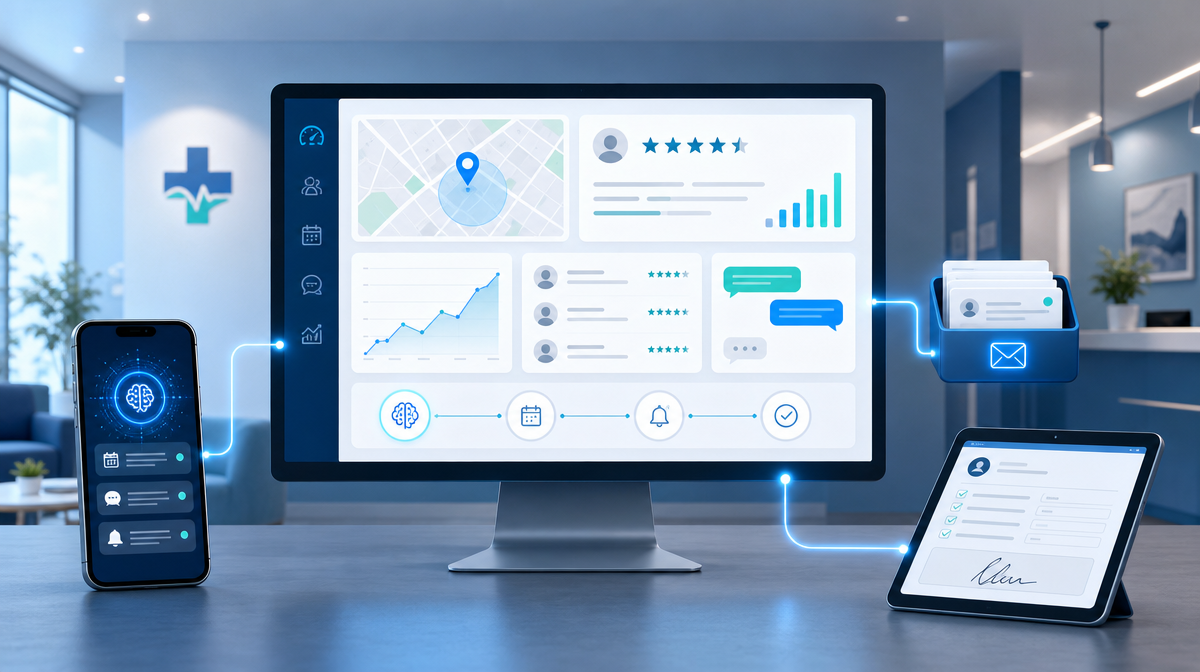
Target Patients MD’s A.L.I. 360 technology applies this layer across your entire marketing footprint at once, which is what separates a system that compounds over time from one that plateaus after the first few months. Here’s where the impact shows up most directly for your practice:
- AI-powered keyword and competitor analysis: Continuously identifies which search terms are driving booked appointments for competing practices in your specific neighborhood — not just citywide trends, but ZIP-code-level intelligence.
- Automated bid and budget optimization: Adjusts ad spend in real time based on which patient segments are actually converting, so your budget concentrates on the searches most likely to put someone in your chair.
- AI chatbots and virtual assistants: Capture and qualify patient inquiries around the clock — critical in a city where prospective patients research providers late at night and expect an immediate response rather than a voicemail.
- Predictive analytics: Scores incoming leads by conversion likelihood so your front desk focuses follow-up energy where it will actually move the needle.
In a healthcare marketing NYC environment where every misallocated dollar costs more than it would in any other market, having a system that self-corrects in real time isn’t a competitive advantage — it’s a baseline requirement.
Every healthcare advertising campaign you run in New York touches patient data in some form — and that’s where a lot of practices quietly create legal exposure without realizing it. Generic marketing vendors build contact forms, set up tracking pixels, and configure retargeting audiences without any awareness of what HIPAA actually prohibits in a marketing context. The result is campaigns that technically function but carry real regulatory risk.
The compliance requirements aren’t optional, and they’re more specific than most practice owners expect. Four areas where your advertising infrastructure must be built correctly from the start:
- Secure lead capture forms: Every form a prospective patient fills out — whether it’s a consultation request or a callback form — requires SSL encryption and storage within a HIPAA-compliant environment. Routing submissions to a standard Gmail inbox doesn’t qualify.
- Compliant ad targeting: Building retargeting audiences from health-condition-related page visits is a HIPAA violation, even when ad platforms technically allow the setup. Audience lists must be constructed without using protected health information as a signal.
- Privacy-safe analytics: You still need accurate ROI data — you just need it collected through tracking configurations that don’t expose patient identifiers. This is solvable, but it requires deliberate setup rather than default platform settings.
- Business Associate Agreements: Any marketing vendor accessing or handling patient data on your behalf must sign a BAA. Most general agencies have never been asked for one, which tells you everything about their familiarity with healthcare-specific requirements.

Penalties for HIPAA violations in advertising can reach up to $2,190,294 per violation category. A healthcare marketing NYC partner worth working with treats compliance as an engineering requirement, not an afterthought.
Choosing a healthcare marketing NYC partner is less like hiring a vendor and more like adding a specialist to your practice operations — one whose performance directly affects how many patients walk through your door each month. The wrong fit doesn’t just waste a retainer; it costs you the patients you never knew you were losing to the practice two blocks away.
Four attributes separate the right medical marketing agency from ones that look credible until they don’t:
- Deep NYC market and specialty knowledge: Your agency should be able to name your top three competitors by ZIP code before the engagement starts. Borough-level awareness isn’t enough — the competitive dynamics in Williamsburg are nothing like those in Bay Ridge, and a partner who treats Brooklyn as a monolith will price and target accordingly.
- Dedicated account team with in-house execution: When your campaign needs a same-day adjustment, you should reach a strategist who knows your account — not a support queue where someone new reads your brief every time you call. Outsourced execution fragments accountability and slows response times in a market where speed matters.
- Transparent ROI dashboards and monthly reporting: You should be able to see exactly how many new patient inquiries arrived, at what cost per lead, and which channels drove them. Impressions and clicks are not practice growth metrics.
- Continuous optimization over set-and-forget campaigns: NYC’s competitive landscape shifts constantly. An agency running the same campaign configuration from month three through month twelve isn’t managing your marketing — they’re collecting a retainer while your competitors pull ahead.
The shift from scattered, reactive marketing to a structured patient acquisition program produces a specific set of changes in how your practice operates — and the contrast is measurable within the first few months.
Target Patients MD backs that with a reporting model built around the metrics that reflect actual practice growth — new patient inquiries, cost per booked appointment, and revenue by channel. That kind of accountability changes the dynamic entirely. You’re not buying marketing activity — you’re buying measurable outcomes.
Here’s what that outcome difference looks like in practice:
| Without Strategic Marketing | With a Healthcare Marketing Partner |
|---|---|
| Inconsistent patient flow | Predictable new patient volume month over month |
| High cost per lead | Optimized ad spend and lower acquisition costs |
| Weak local search presence | Top rankings in neighborhood-level searches |
| Few online reviews | Steady stream of positive patient reviews |
| Generic website with low conversion | High-converting, mobile-optimized site |

Beyond the numbers, practices running a coordinated healthcare marketing NYC strategy report something less obvious but equally valuable: their front desk spends less time chasing down unqualified inquiries. When targeting is precise and campaigns are built around actual patient intent, the leads that arrive are further along in the decision process — which shortens the path from first contact to booked appointment.
Questions about healthcare marketing NYC tend to cluster around the same practical concerns: cost, timing, terms, and whether a specialized agency actually thinks differently than a general one. Here are direct answers.
- How much does healthcare marketing cost for a New York City medical practice? Investment varies based on your specialty, the boroughs you’re targeting, and which service mix makes sense for your goals. Most NYC practices combine SEO, paid search, and reputation management, with options ranging from monthly retainers to performance-based pay-per-lead models.
- How quickly can a New York medical practice see new patients from marketing? Paid campaigns can generate inbound inquiries within the first few days of going live. Organic search rankings take longer — typically several months before meaningful movement — but many practices receive their first new patient inquiries within the opening week of a paid campaign.
- How do NYC medical practices compete against large hospital systems on Google? Hospital systems optimize broadly and rarely dominate at the neighborhood keyword level. Independent practices consistently win by targeting procedure-specific and hyper-local searches — terms like “LASIK surgeon Midtown East” — that large institutions overlook in favor of brand volume.
- What should a New York medical practice expect from a marketing engagement? A strong partner ties their reporting to outcomes that matter — new patient inquiries, cost per booked appointment, and revenue by channel — and reviews performance with you regularly so you can see exactly what your investment is producing as the engagement progresses.
- What separates a healthcare marketing agency from a general NYC agency? Healthcare-specific agencies understand HIPAA compliance, patient decision psychology, and regulated advertising restrictions. General agencies frequently create compliance exposure or build campaigns that ignore how medical patients actually evaluate and choose providers.
If you’ve read this far, you already know the problem is real — NYC’s patient acquisition environment is unforgiving, and the gap between practices that grow predictably and ones that stagnate often comes down to who’s running their marketing engine.
Target Patients MD was built specifically for this. Not as a generalist agency that added a healthcare division, but as a practice growth operation focused exclusively on getting doctors more patients. That specialization shows up in the specifics: A.L.I. 360, our proprietary AI platform that runs continuous optimization across every channel your practice uses — search, paid ads, reputation, and outreach — without requiring you to manage any of it.
What makes the engagement different for practice owners is the accountability structure. You’re not paying for a strategy deck or a monthly deliverables report. The model is outcome-based: our reporting ties directly to booked appointments and new patient volume, not impressions or activity metrics. That’s a level of accountability most agencies won’t commit to because they can’t back it up.
- AI-powered acquisition with A.L.I. 360 — built for the complexity of NYC’s multi-borough, multi-specialty market
- Done-for-you execution — every channel managed in-house, no outsourced handoffs
- Accountability tied to booked appointments — reporting built around new patient volume, not activity metrics
- Flexible engagement terms — structured around results, so the partnership earns its renewal
Learn more about Target Patients MD and find out what a patient acquisition program built for your specific specialty and NYC neighborhood actually looks like.