




Walk into any city right now and you’ll find three IV therapy clinics within five miles of each other, all offering Myers’ cocktails, all claiming to be “the best.” That’s the problem. When every clinic leads with the same drip menu and vague wellness language, patients can’t tell you apart — so they default to whoever shows up first in search results or charges the least. Neither is a winning strategy.
The clinics consistently filling their appointment books take a fundamentally different approach to IV therapy marketing. They stop trying to appeal to everyone and start owning a specific position in the market. That positioning is built on three concrete pillars:
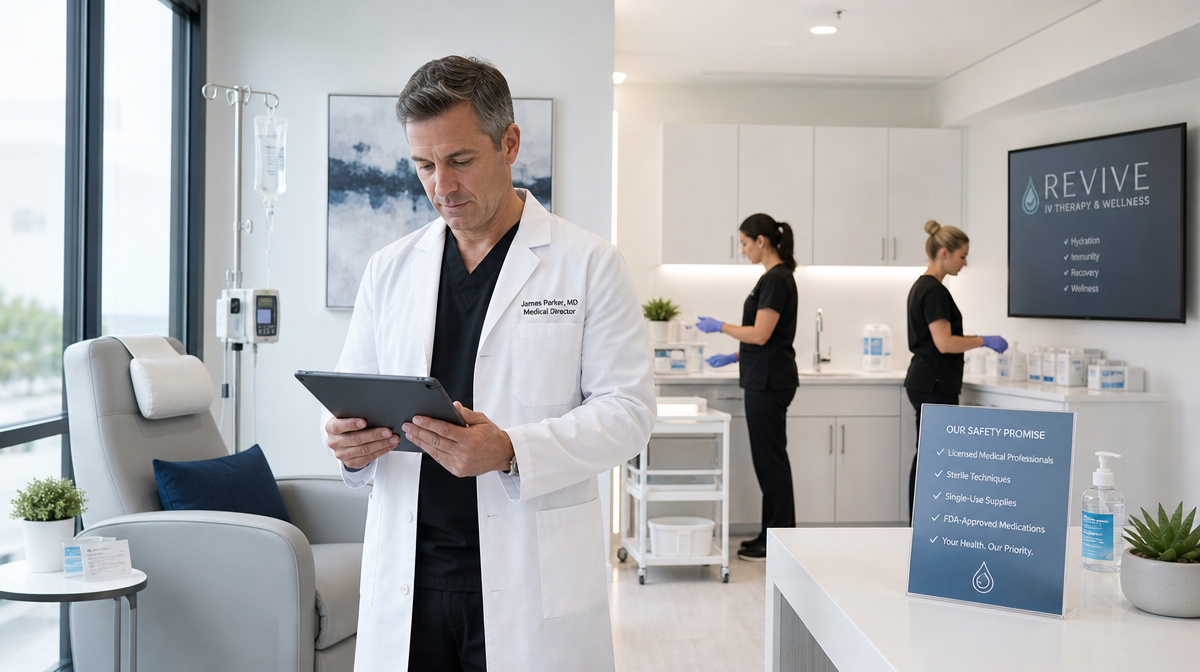
- Clinical credibility: Board-certified medical directors, licensed nursing staff, and documented safety protocols aren’t just operational requirements — they’re marketing assets. Patients choosing an injection-based service want proof that someone qualified is in charge. Clinics that lead with credentials convert skeptical prospects into booked patients faster than those that lead with aesthetics alone.
- Service specialization: Clinics that focus on a defined treatment niche — athletic recovery, NAD+ optimization, immune support — communicate expertise. Being everything to everyone signals that you’re nothing in particular. A narrower focus actually drives more bookings because patients self-identify and trust that you understand their specific need.
- Patient experience: From the first click to the post-treatment follow-up text, every touchpoint either builds or erodes trust. Clinics that map and optimize this full journey — not just the drip itself — generate the kind of word-of-mouth referrals that no ad budget can replicate.
Generic wellness messaging fails IV clinics precisely because it treats a clinical service like a commodity spa treatment. Differentiation isn’t a branding exercise — it’s the engine behind sustainable patient growth.
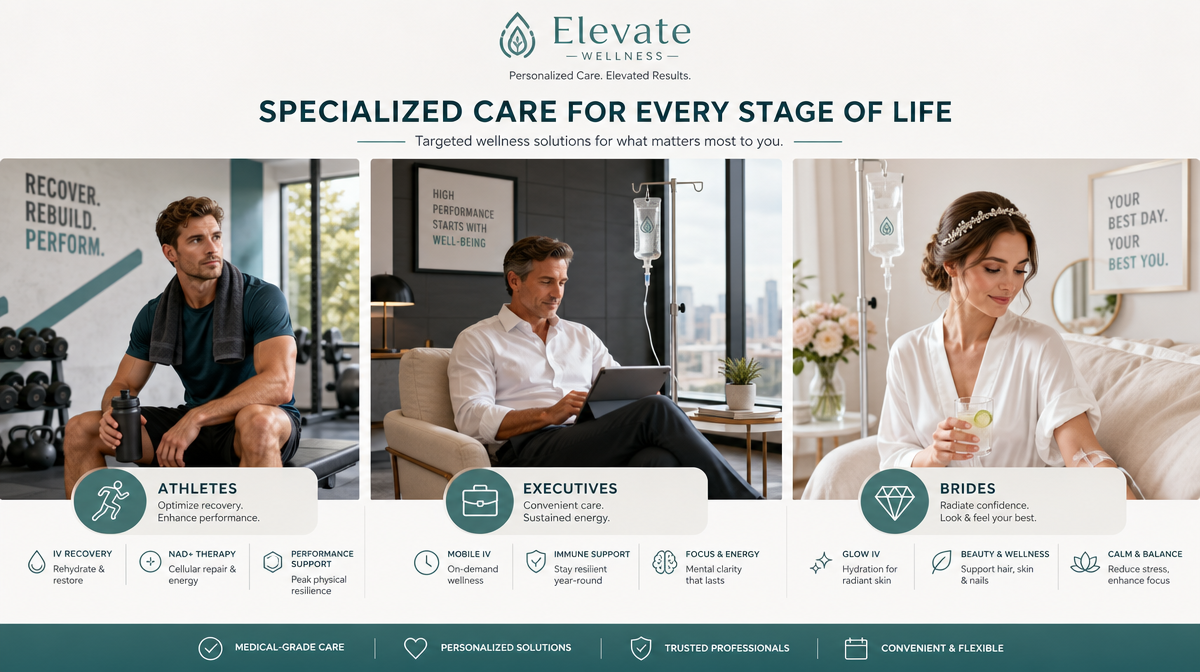
Sending the same message to every prospective patient is one of the fastest ways to waste your IV therapy marketing budget. A triathlete training for an Ironman and a bride six days out from her wedding both want IV therapy — but for completely different reasons, and they respond to completely different messages. Segmentation is how you stop broadcasting and start converting.
- Athletes and fitness enthusiasts: This group is driven by performance metrics, not wellness aesthetics. They want faster muscle recovery, electrolyte replenishment, and peak output on race day. Reach them where they train — gym partnerships, fitness influencer collaborations, and sponsorships at local sporting events tend to deliver qualified traffic that’s already primed to book.
- Busy executives and high performers: Convenience is the deciding factor here. These patients aren’t searching for relaxation — they’re trying to reclaim productivity and sustain energy through demanding schedules. Mobile IV services command a premium with this audience, and LinkedIn or podcast advertising often outperforms traditional social channels for reaching them.
- Wellness, beauty, and anti-aging seekers: Glutathione, high-dose vitamin C, and NAD+ formulations speak directly to this segment’s priorities around skin quality and longevity. Instagram and educational content marketing are your highest-leverage channels — this audience researches ingredients obsessively before booking.
- Brides, travelers, and event-driven clients: These patients have a hard deadline and a specific outcome in mind. Pre-wedding glow packages, jet lag recovery drips, and hangover IVs generate urgency-based bookings that respond well to seasonal promotions and partnership marketing with hotels, wedding venues, and travel companies.
Each segment requires its own messaging, its own channel mix, and its own offer structure. Treating them as one audience means none of them feel spoken to.
Your unique value proposition (UVP) is the one-sentence answer to the question every prospective patient is silently asking: “Why should I come to you instead of the clinic down the street?” Most IV therapy practices never actually answer it — they describe what they do rather than why it matters. That’s a booking problem disguised as a branding problem.
Crafting a UVP that converts requires three decisions made before you write a single ad or social post:
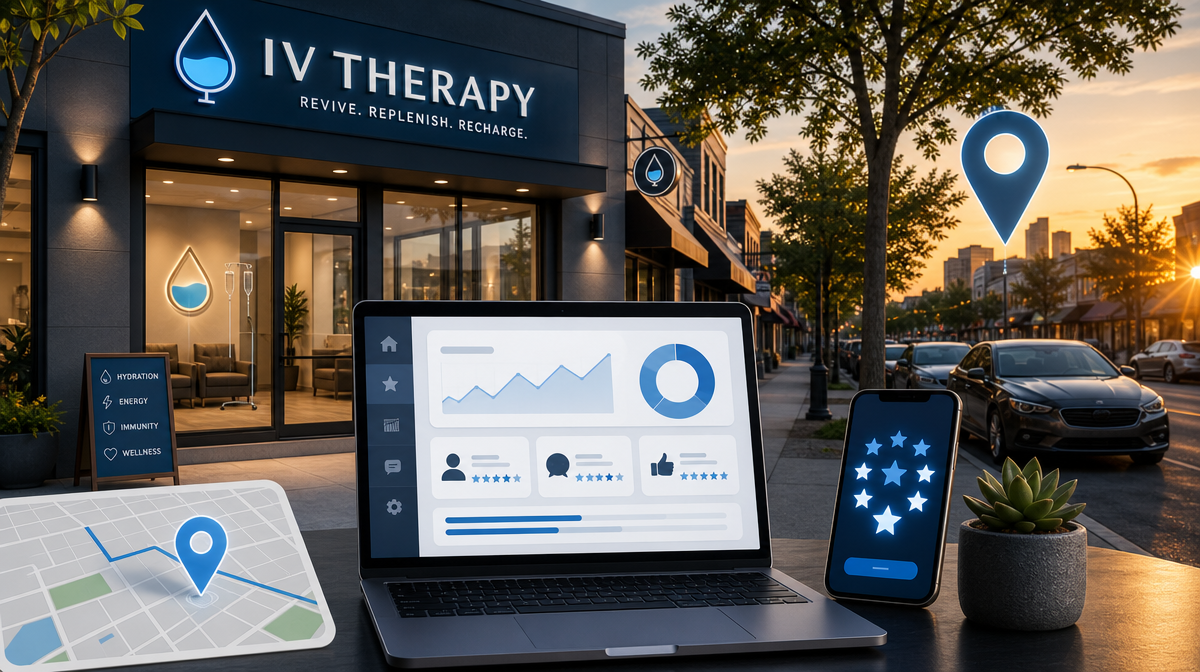
- Define your specialty: Pick the treatment category or patient outcome you execute better than any competitor in your market. “We offer IV therapy” is a menu description. “Houston’s only clinic built exclusively around NAD+ longevity protocols” is a position. The narrower the claim, the more memorable — and the more it filters in the right patients.
- Communicate clinical trust: Credentials, board certifications, sterile compounding partnerships, and documented protocols belong in your marketing copy, not buried in a footer. Patients weighing a $300 drip against a competitor’s $199 option will pay the premium when they can see exactly who’s administering it and why the environment is safe.
- Create a consistent brand identity: Your clinic name, visual palette, tone of voice, and in-office experience should all tell the same story. Inconsistency signals a practice that hasn’t figured out who it is — and patients notice, even if they can’t articulate why they chose someone else.
A sharp UVP doesn’t just improve your IV therapy marketing materials — it sharpens every downstream decision, from which patients you target to how you price your packages.
Most patients who land on your IV therapy clinic website make their booking decision within the first 30 seconds — and the majority of them are doing it from a phone while standing in line somewhere. If your site isn’t built around that reality, you’re losing appointments before a single word gets read.
A high-converting IV therapy website isn’t about looking impressive. It’s about removing every possible obstacle between a curious visitor and a confirmed appointment. That means engineering each page with one goal in mind: get the patient to book. Here are the structural elements that separate clinics with full schedules from those watching their analytics with confusion:
- Mobile-first design: Over 70% of healthcare searches happen on smartphones. A desktop-first layout that technically “works” on mobile will quietly bleed bookings every single day.
- Dedicated service pages: Each IV treatment — Myers’ cocktail, NAD+, glutathione, hydration drip — deserves its own page with its own keyword focus, ingredient explanation, and booking path. One generic “services” page helps no one.
- Friction-free online scheduling: Every additional click between “I’m interested” and “appointment confirmed” costs you patients. Embedded scheduling tools that don’t redirect to a third-party portal outperform everything else.
- Visible trust signals: Staff credentials, Google review scores, and before/after outcomes should appear above the fold — not buried at the bottom where skeptical patients never scroll.
- HIPAA-compliant intake forms: Secure digital intake isn’t just a legal requirement; it signals professionalism to patients who are handing over sensitive health information before their first visit.
Specialized medical website builders understand these compliance requirements out of the box — a general web designer typically doesn’t, which creates liability exposure you don’t want to discover after launch.
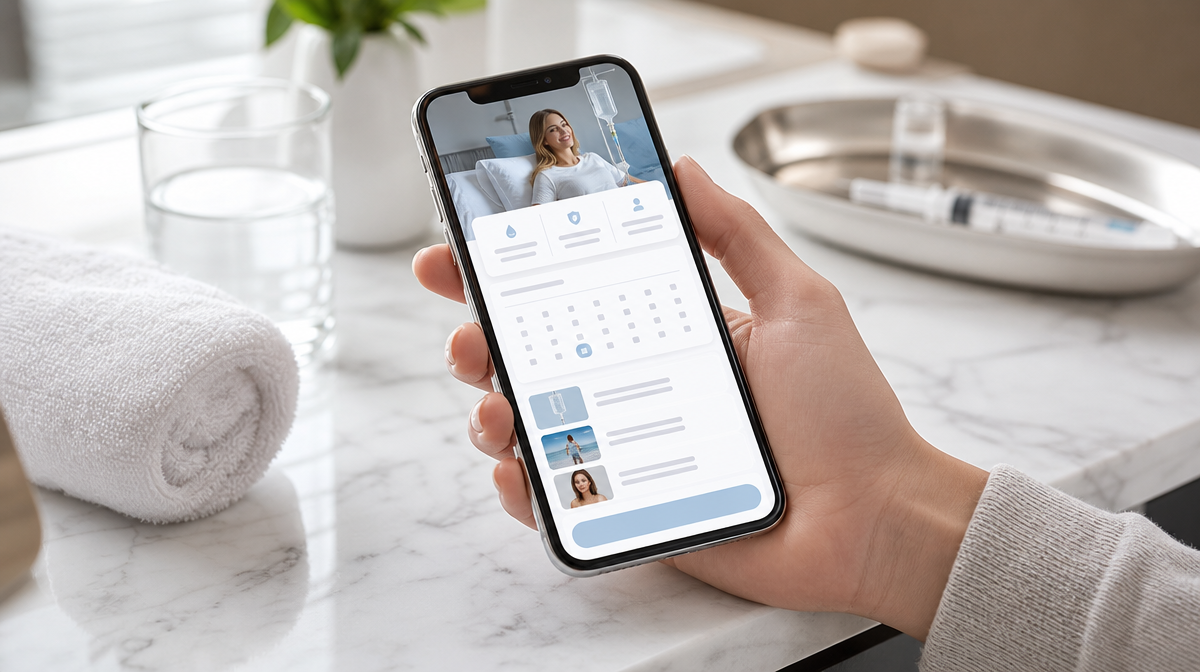
Local SEO is the practice of optimizing your online presence so that patients in your geographic area find your clinic when they search for services you offer. For IV hydration clinics, this is where the majority of new patient acquisition actually happens — not from national visibility, but from ranking when someone three miles away types “IV drip near me” into Google at 11am on a Tuesday.
Getting that visibility requires deliberate, consistent work across four areas:
- Google Business Profile optimization: Your GBP listing is often the first thing a prospective patient sees before they ever reach your website. With GBP signals accounting for 36% of local ranking factors, accurate categories, updated service descriptions, regular photo uploads, and active Q&A responses directly affect where you rank in local map results.
- Hyper-local keyword targeting: Generic terms like “IV therapy” are dominated by national directories. Pages optimized around “IV hydration [your city]” or “mobile IV therapy [your neighborhood]” face far less competition and attract patients with genuine booking intent.
- Educational blog content: Patients researching whether NAD+ therapy is right for them, or what’s actually in a Myers’ cocktail, are pre-qualifying themselves. Content that answers these questions builds trust before your first interaction — and it compounds over time in ways paid ads never do.
- Citation consistency: Your clinic’s name, address, and phone number must appear identically across every directory — Yelp, Healthgrades, Zocdoc, and beyond. Inconsistencies confuse search engines and quietly suppress your local rankings.
Done correctly, local SEO becomes your most cost-efficient patient acquisition channel over a 12-to-18-month horizon.
Paid ads work for IV therapy because the demand already exists — you’re just deciding whether your clinic captures it or your competitor does. When someone searches “IV hydration near me” or “NAD+ drip [city],” they’ve already made the mental leap from curiosity to intent. That’s a fundamentally different prospect than someone you’re interrupting on social media, and it changes what you should expect from each channel.
- Google Search ads for high-intent patients: Bidding on procedure-specific terms like “hangover IV drip,” “Myers cocktail [city],” or “mobile IV therapy near me” puts your clinic in front of patients who are minutes away from booking. Ad copy that leads with a clinical credential — “RN-administered, same-day appointments” — outperforms generic price-first messaging because it answers the trust question before the patient even clicks.
- Facebook and Instagram ads for wellness audiences: These platforms excel at generating demand from people who haven’t searched yet. Scroll-stopping treatment visuals, lifestyle-forward creative, and lookalike audiences modeled on your existing patient list can dramatically lower your cost per new booking compared to broad demographic targeting alone.
- Retargeting campaigns that recapture lost leads: Retargeting means showing follow-up ads specifically to people who visited your website but left without booking. For a $200–$400 service, most patients don’t convert on the first visit — they compare options. A retargeting sequence that reinforces your credentials and offers a direct booking link recovers a meaningful percentage of that lost traffic at a fraction of new-acquisition cost.
Clinics running all three channels in a coordinated system consistently see lower cost-per-booked-appointment than those running any single channel in isolation.
Organic social strategy is a different game from paid advertising — and conflating the two is how clinics end up with expensive ad campaigns running alongside ghost-town Instagram accounts that undermine the credibility those ads are trying to build. Your social presence is where prospective patients quietly vet you before they ever book.
The platform you prioritize should match where your target patient actually spends time, not where you personally feel comfortable posting. Here’s how each channel earns its place in a well-structured IV therapy marketing approach:
- Instagram: Visual documentation of your treatment environment, staff credentials, and real patient transformations builds the ambient trust that converts browsers into first-time patients. Behind-the-scenes content — showing your sterile prep process or a nurse explaining an ingredient — does more credibility work than any polished promotional graphic.
- TikTok: Short educational clips that bust common IV therapy myths or walk through what a typical appointment looks like can generate thousands of organic views from people who didn’t know they were interested until they watched. Authenticity outperforms production value here by a wide margin.
- Facebook: Community-building and event promotion still drive meaningful engagement for local clinics. Reviews posted directly to your Facebook page also factor into how seriously prospective patients take your practice.
- Content mix to rotate through: Ingredient spotlights (what does glutathione actually do?), hydration education, staff introductions, and patient milestone posts keep your feed active without requiring a full-time content team.
Consistency matters more than perfection. A clinic that posts three times a week with genuine clinical insight will outperform one that disappears for six weeks and then drops a polished promotional video.
IV therapy sits in a uniquely vulnerable trust position compared to most wellness services. Patients aren’t buying a supplement they can return — they’re agreeing to have a needle placed in their arm by someone they met 20 minutes ago. With 84% of patients checking reviews before selecting a provider, your review profile isn’t just a nice-to-have — it’s doing active sales work before your front desk ever picks up the phone.
The clinics that consistently win new patients treat reputation management as a structured system, not a passive hope that satisfied patients will say something nice. Four components make that system work:
- Automated review requests: A post-appointment email or SMS sent within two hours of treatment — while the experience is still fresh — dramatically outperforms manual follow-up. Most patients who had a positive experience will leave a review if asked at the right moment through the right channel.
- Multi-platform monitoring: Google is the priority, but Yelp, Facebook, and Healthgrades all influence patient decisions. Centralizing review tracking across platforms means you catch negative feedback before it compounds unaddressed.
- Response strategy for every review: Thanking positive reviewers reinforces the relationship and signals to prospective patients that your practice is attentive. Responding professionally to negative reviews — without becoming defensive — often matters more to undecided prospects than the complaint itself, given that 40% of patients have cancelled appointments based on negative reviews.
- On-site social proof placement: Reviews embedded on your service pages and booking confirmation screens reduce last-minute hesitation at the exact moment patients are deciding whether to follow through.
Strong IV therapy marketing is only as effective as the trust infrastructure supporting it. Reviews are that infrastructure.
A first-time patient is worth $200. A patient who comes back six times a year — for seasonal immunity drips, monthly NAD+ maintenance, and post-travel recovery — is worth $1,200 or more, with near-zero acquisition cost after the initial booking. That math is why CRM (customer relationship management) strategy deserves as much attention as any paid channel in your IV therapy marketing mix.
CRM refers to the systems and workflows you use to manage ongoing patient relationships after the first appointment. Most IV clinics treat patient communication as reactive — they respond when someone calls. High-performing clinics treat it as a scheduled revenue driver. The difference shows up in monthly booking volume within 90 days of implementation.
- Email drip campaigns: A post-treatment sequence that delivers ingredient education, seasonal drip recommendations, and limited-time package offers keeps your clinic top of mind between visits — without requiring your staff to manually follow up with anyone.
- SMS appointment reminders: No-show rates for elective wellness services can run 15–25%. Automated text reminders sent 48 hours and 2 hours before an appointment cut that number significantly without adding front-desk workload.
- Membership and package programs: Monthly drip memberships convert one-time patients into predictable recurring revenue. Patients who pre-commit financially visit more frequently and refer more aggressively than pay-per-visit patients.
- Personalized milestone outreach: A birthday offer or a six-month patient anniversary message costs almost nothing to automate and generates bookings from patients who had simply drifted away rather than churned intentionally.
Retaining an existing patient costs roughly five times less than acquiring a new one. Every dollar your retention system earns is a dollar you didn’t have to spend on ads to replace someone who left quietly.
You can’t scale what you can’t see. Most IV therapy clinics running active marketing programs have a rough sense that “things are working” — but rough senses don’t help you decide whether to double your ad spend, cut a channel, or fire an agency. Measurement transforms gut feeling into a decision-making framework.
The three numbers that actually tell you whether your IV therapy marketing is working — and where to push harder or pull back:
- Cost per lead vs. cost per booked appointment: These are not the same metric, and confusing them is expensive. A lead is a form submission or phone call. A booked appointment is revenue on the calendar. If your cost per lead looks healthy but your booking rate is low, the problem is in your follow-up process or your offer — not your ad targeting.
- Patient lifetime value (LTV) and repeat visit rate: LTV is the total revenue a patient generates across all visits, not just the first one. A clinic optimizing purely for first-appointment volume while ignoring LTV is essentially running a churn machine. Track what percentage of new patients return within 90 days — that number reveals whether your clinical experience is reinforcing or undermining your marketing investment.
- Channel-level conversion rate: Conversion rate measures how often a specific traffic source produces an actual booking. Comparing conversion rates across Google ads, organic search, and social media tells you which channels earn their budget and which ones just generate activity without revenue.
Clinics that review these metrics monthly — not quarterly — catch underperformance before it compounds into wasted spend.
Generic agencies understand marketing. Specialized IV therapy marketing partners understand why a patient hesitates before booking a $350 drip — and that distinction is where revenue gets won or lost. A generalist firm optimizing your budget has never had to navigate healthcare advertising compliance, explain the difference between a Myers’ cocktail and a NAD+ protocol, or structure messaging around clinical trust signals that move a skeptical first-timer off the fence.
That gap in domain knowledge has real financial consequences. Broad-market agencies routinely run wellness ad copy that triggers platform policy flags, build websites without HIPAA-compliant intake workflows, and report on impressions and clicks rather than actual booked appointments. You end up paying for activity that looks like progress until you reconcile it against your actual schedule.
What niche expertise delivers instead:
- Done-for-you execution: Your clinical team focuses on patient care while a specialized partner manages every channel — ads, SEO, reputation, CRM — without requiring you to project-manage a roster of disconnected vendors.
- Healthcare-native compliance knowledge: Platform policies for medical services change frequently. A partner who works exclusively in this space stays current so your campaigns don’t go dark at the worst possible moment.
- Performance tied to real outcomes: Reporting built around booked appointments and patient acquisition cost — not vanity metrics — tells you exactly what your marketing investment is returning.
- Month-to-month flexibility: Long-term contracts benefit the agency, not your practice. The right partner earns continued engagement by delivering measurable results every single month.
Learn more about Target Patients MD and how specialized IV therapy marketing expertise translates directly into a fuller patient schedule.
- How much should an IV therapy clinic budget for marketing each month?There isn’t a universal figure, because the right budget depends on your margin structure, patient capacity, and how aggressively you want to expand. A useful planning benchmark is to separate spend by job to be done: acquisition, retention, and local visibility. For example, a clinic with a strong referral base may need only modest paid search spend but should still invest in review generation and local landing pages. The goal is not to hit a percentage for its own sake; it’s to fund the channels that close your specific growth gap.
- How long does it take to see results from IV therapy digital marketing?Paid search campaigns can generate booked appointments within the first week of going live — sometimes within 48 hours if your landing page and offer are dialed in. SEO and content work on a longer timeline: expect three to six months before organic rankings build meaningful visibility, with compounding returns from month nine onward. Clinics that treat these as competing channels miss the point — they solve different problems on different timelines and work best running together.
- Do IV therapy marketing agencies typically require long-term contracts?Many do, and that structure protects the agency far more than it protects your practice. Performance-focused partners operate month-to-month because their continued engagement is justified by actual results — not contractual obligation. Before choosing a partner, ask specifically how performance is reported and what happens if booked appointment volume doesn’t materialize.
- Can IV therapy clinics advertise on Google and Facebook without violating healthcare ad policies?Yes — IV therapy advertising is permitted on both platforms when campaigns follow healthcare and wellness ad guidelines, avoid unsubstantiated medical claims, and never incorporate patient health data in targeting or retargeting without proper consent. The policies aren’t obstacles; they’re guardrails that experienced healthcare marketers navigate routinely.


