

Before you spend a dollar on laser hair removal marketing, you need a clear picture of exactly who you’re trying to reach — because the channel mix, the creative, and the offer that books a 28-year-old woman training for her wedding looks nothing like what converts a 40-year-old male athlete tired of shaving his back.
Demographics and buying behavior set the foundation. The core patient base and how they make decisions shape every downstream choice:
- Age and gender: The core patient base skews female, ages 22–45, though male patients now represent a fast-growing segment that most local clinics still underserve — ISAPS data shows non-surgical cosmetic treatments for men rose 116% between 2018 and 2024. If your competitors aren’t marketing to men, that gap is yours to own.
- Income and willingness to pay: Laser hair removal is a cash-pay, elective service with no insurance offset. Your patients are typically middle-to-upper income earners who’ve already done the math — they know six to eight sessions beats a lifetime of waxing appointments and shaving supplies.
- Research behavior: Most patients find you on a phone, not a desktop — 82% of “near me” searches happen on mobile. They search, skim Google reviews, tap through Instagram before-and-afters, and either book immediately or disappear. The entire discovery-to-decision cycle often happens in under 20 minutes.
Top motivations and objections decide your messaging. Patients come in motivated by convenience, confidence, and long-term cost savings. They’re done with ingrown hairs, razor burn, and the monthly waxing calendar. But they hesitate over three things: perceived pain, upfront cost, and — especially for patients with deeper skin tones — legitimate safety questions about whether a clinic’s equipment and expertise can treat them without risk.
Your marketing wins when it speaks directly to those hesitations rather than pretending they don’t exist.
The market is growing fast, and so is the competition for it. The laser hair removal market was valued at $1.42 billion globally in 2025 and is projected to reach $6.58 billion by 2034 — an 18.73% compound annual growth rate that tells you exactly where patient demand is heading. That growth isn’t going unnoticed. Franchise chains like Milan Laser and Ideal Image have spent years and tens of millions of dollars locking up brand recognition in major markets, while independent med spas and dermatology practices are left competing for the same local search results with a fraction of the budget.
The supply side has exploded to match. More than 10,000 med spas now operate across the United States, and a significant percentage of them have added laser hair removal to their service menus in the last three years — which is why a strong med spa marketing strategy matters more than ever. When every clinic in a five-mile radius offers the same treatment at similar price points, the patient doesn’t automatically choose the best provider — they choose the most visible one.
What’s changed most sharply is where that visibility is won or lost. Patients no longer flip through directories or rely on a friend’s referral as their primary discovery method. Google searches, Instagram feeds, and increasingly AI-generated answers in tools like ChatGPT and Google AI Overviews are now the first touchpoints. Clinics that built their reputation on word-of-mouth alone are watching their schedules thin out because they simply don’t appear where patients are actually looking.
- Franchise competition: National chains are running always-on paid campaigns in your local market right now
- Market saturation: More providers mean patients have more options and less urgency to commit
- Digital-first discovery: Absence from search and social is functionally invisible to the modern patient
Seven distinct tactics separate clinics with full schedules from those running last-minute promotions to fill gaps. Each one below targets a specific point in the patient journey — from first search to booked appointment — so you’re not just generating awareness, you’re generating revenue.
1. Build a conversion-focused website with online booking. A website that looks great but buries the booking button is just an expensive brochure. A conversion-focused medical website has every page element engineered to move a visitor toward scheduling — fast load times, a prominent “Book Now” button above the fold, and an integrated scheduler that doesn’t require a phone call to complete. Patients who hit friction abandon. Full stop.
- Mobile-first design: The majority of laser hair removal searches happen on phones during commutes, lunch breaks, or late evenings — and a site that’s slow or hard to navigate on mobile is quietly losing patients before they ever see your booking button
- Online booking integration: Same-day scheduling capability consistently outperforms “call us” prompts because it captures patients at peak intent
- Trust signals: Star ratings, verified before-and-after galleries, and provider credentials displayed prominently reduce the hesitation that kills conversions
2. Rank locally with SEO and Google Business Profile. Local SEO determines whether your clinic appears when someone nearby searches “laser hair removal near me.” Your Google Business Profile is the fastest lever — complete every field, upload treatment photos weekly, and actively solicit reviews after each session. Key ranking factors include review volume, profile completeness, and consistent business information across the web.
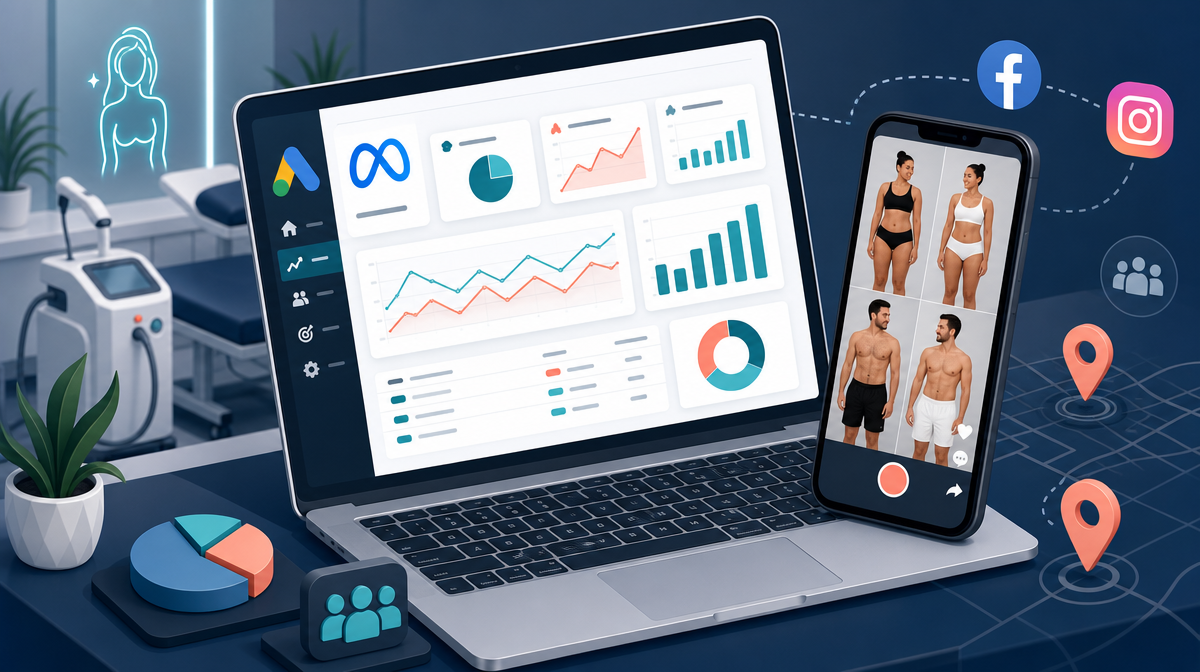
3. Run targeted Google and Meta ads. Paid advertising compresses the patient acquisition timeline from months to days. Google Search captures patients already hunting for treatment; Meta ads let you reach people who match your ideal demographic before they’ve even started searching. Location radius, age range, and interest targeting keep your budget from bleeding into irrelevant clicks. A dedicated section below covers campaign structure in greater depth.
4. Use video and before-and-after content on social media. Aesthetic services sell on proof, not promises. Instagram Reels, TikTok videos, and YouTube Shorts showing real patient journeys — especially across diverse skin tones — do more conversion work than any written ad. Patients are evaluating whether your results look like their results, so inclusive visual content isn’t just ethical practice, it’s smart laser hair removal marketing.
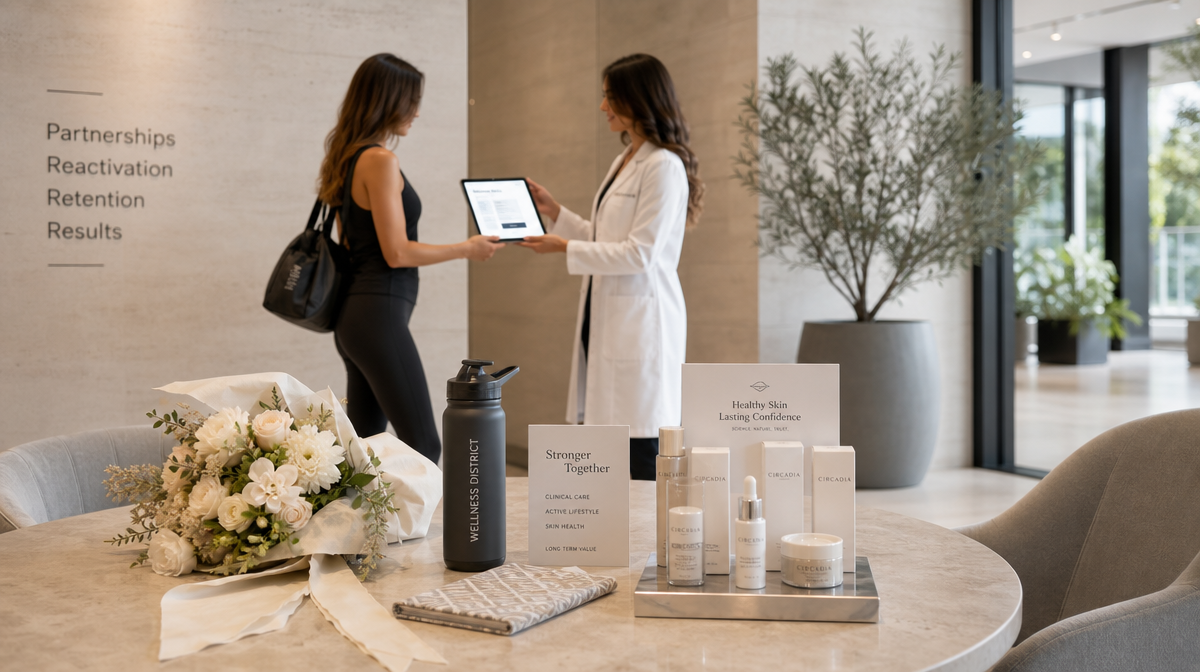
5. Partner with local influencers and businesses. Micro-influencers — local creators with 5,000 to 50,000 engaged followers — carry more trust with your target audience than national celebrities because their recommendations feel personal. Cross-promotions with complementary businesses extend your reach without additional ad spend:
- Bridal boutiques and wedding planners: Brides actively preparing for their wedding are high-intent, high-value patients
- Gyms and athletic studios: Fitness-focused audiences already value body confidence and grooming results
- Salons and estheticians: Service providers who can’t perform laser treatments make natural referral partners
6. Launch email and SMS reactivation campaigns. Your existing contact list — past patients, consultation no-shows, and unconverted leads — is the most underutilized asset in most clinics. Reactivation sequences re-engage these contacts with targeted messaging: seasonal promotions timed to spring and summer, package upgrade offers sent mid-treatment series, or a simple “it’s been a while” reminder with a one-click booking link. All outreach requires proper opt-in compliance, but when done correctly, reactivation campaigns routinely deliver the lowest cost per booked appointment of any channel.
7. Generate and showcase patient reviews. Reviews influence both your Google ranking and every prospective patient who finds you — 75% of patients won’t book below 4.0 stars. The ask is simple: send an automated text or email within 24 hours of a positive appointment with a direct link to your Google review page. Then close the loop by displaying those reviews prominently on your website and in your social content — turning each five-star rating into a patient acquisition asset that compounds over time.
Not all paid platforms work the same way, and spending budget on the wrong one for the wrong goal is how clinics burn through their marketing budget without filling a single appointment slot. The table below maps each platform to its actual strength so you can allocate spend strategically rather than by gut feel.
| Platform | Best For | Targeting Options | Ad Format |
|---|---|---|---|
| Google Search | High-intent patients actively searching | Keywords, location, demographics | Text ads |
| Google Display | Retargeting and awareness | Audiences, placements | Image/banner ads |
| Meta (Facebook/Instagram) | Demographic targeting and visual storytelling | Interests, behaviors, lookalikes | Image, video, carousel |
Campaign structure matters as much as budget. Running a single broad campaign typically produces murky data and mediocre results. Instead, separate campaigns by treatment area — legs, full body, face — and match each landing page exactly to the ad that sent the patient there. Misaligned landing pages quietly kill conversion rates.
Ad copy for laser hair removal has a short window to earn a click. Make it count by following these principles:
- Lead with the outcome, not the process: “Permanently smooth skin” outperforms “state-of-the-art laser technology” every time
- Address the cost objection head-on: Financing options or package pricing mentioned in the ad itself pre-qualifies patients and reduces sticker shock at the front desk
- Create genuine urgency: Seasonal availability or limited new-patient slots gives prospects a reason to book now rather than bookmark and forget
- Retarget website visitors who didn’t book: Display ads following warm prospects across the web typically convert at a fraction of the cost of cold acquisition
Showing up in the Google local pack — that three-listing cluster that appears before organic results — is worth more to a laser hair removal clinic than almost any other digital real estate. Most patients searching locally never scroll past it. Your Google Business Profile is the engine behind that placement, and most clinics treat it like a set-and-forget directory listing when it should function as an active marketing channel.
Start with the fundamentals that Google weighs most heavily for local rankings:
- NAP consistency: Your Name, Address, and Phone number must appear identically across every directory, citation site, and social profile — even minor formatting differences between listings erode Google’s confidence in your location data
- Category selection: Choose “Medical Spa” or “Laser Hair Removal Service” as your primary category, not a generic alternative — this signals exactly what treatments you provide to both Google and prospective patients
- Photo cadence: Profiles with regularly updated photos receive significantly more direction requests and website clicks — upload treatment room images, equipment photos, and staff headshots on a consistent schedule
- Google Posts: Weekly posts announcing seasonal promotions, new patient offers, or treatment education keep your profile active and give Google fresh signals that your practice is open and engaged
- Review velocity: A steady stream of new reviews outperforms a large volume of old ones — recency matters to the algorithm and to patients comparing you against competitors
- Citation building: Listings across 70+ authoritative healthcare and local directories strengthen your geographic authority and support ranking across broader search variations
Two of the most underleveraged patient segments in laser hair removal marketing are men and patients with Fitzpatrick skin types IV through VI. Most clinics default to imagery and messaging built around lighter-skinned women in their 30s — which means they’re actively signaling to everyone else that this service isn’t for them. That’s a significant revenue gap hiding in plain sight.
- Male-focused messaging: Men seeking laser treatments most commonly target the back, chest, shoulders, and neck — areas where shaving is impractical and waxing is uncomfortable. Privacy is a real concern for male patients; ads that emphasize discreet booking, a professional clinical environment, and male-specific treatment protocols consistently outperform generic copy when targeting this demographic
- Diverse skin tone marketing: Patients with deeper skin tones have historically encountered providers using equipment that wasn’t appropriate for their complexion, and many carry that skepticism into their research. If your clinic uses Nd:YAG or other long-wavelength technology designed for higher melanin concentrations, say so explicitly in your ads and on your website — that specificity converts skeptical patients where vague reassurances fail
- Content that dismantles myths: Educational short-form video addressing who qualifies for treatment, what modern laser technology can safely handle, and what realistic results look like across different skin tones builds the kind of trust that generic promotional content never reaches

Inclusive visual representation isn’t a checkbox — it’s a direct signal to underserved patients that your practice was built with them in mind. Clinics that reflect their full potential patient population in their creative see measurably broader appointment demand as a result.
Lifetime value — the total revenue a single patient generates across all visits and purchases — is the number that separates thriving laser hair removal practices from ones that are perpetually chasing new faces. A patient who completes one session and disappears is worth a fraction of one who finishes a full treatment series, adds a second body area, and refers two colleagues. Your pricing and retention structure determines which outcome is more likely.
The most effective promotion architecture moves patients through a deliberate value ladder rather than competing on price alone:
- Introductory single-area offer: A discounted first package on a small treatment zone (underarms, upper lip) lowers the commitment barrier while getting patients through the door and experiencing results firsthand
- Multi-session bundles: Pre-paid series of six to eight sessions at a structured discount reward commitment upfront and dramatically reduce mid-treatment dropout — your highest churn risk
- Area expansion upsells: Patients who see results on one zone almost always want to treat another; a standing offer presented at session three or four captures this impulse at the right moment
- Referral incentives: Credits toward future sessions for each referred patient who books converts satisfied patients into an active acquisition channel at near-zero cost
- Membership tiers: Monthly fee models that bundle touch-up sessions with priority scheduling create predictable recurring revenue and raise switching costs significantly
One firm warning: heavy reliance on third-party deal platforms attracts volume without loyalty. Patients acquired through deep-discount aggregators rarely convert to full-price repeat clients, which inflates your session count while suppressing the lifetime value metrics that actually sustain a practice.
Search behavior is shifting underneath your feet, and most laser hair removal clinics haven’t noticed yet. When a patient asks ChatGPT “where can I get laser hair removal in Austin” or triggers a Google AI Overview with a treatment question, the answer they see isn’t a list of paid ads or blue links — it’s a synthesized response pulled from structured, authoritative content that AI systems have already decided to trust. If your practice isn’t the source being cited, you simply don’t exist in that answer.
This is where Generative Engine Optimization (GEO) enters the picture. GEO is the practice of structuring your web content — FAQs, service pages, treatment explanations — so that AI-powered search tools can parse, summarize, and surface it in generated responses. It’s distinct from traditional SEO, which optimizes for a human clicking through results. GEO optimizes for a machine deciding whose information is credible enough to quote.
Clinics using AI-driven marketing systems like Target Patients MD’s A.L.I. 360 are already operating at this intersection — combining structured content architecture with continuous campaign intelligence to place your practice inside the AI-generated answers that patients encounter before they ever visit a search results page. The practices winning new patients aren’t just ranking on Google; they’re becoming the trusted source that AI tools recommend when someone asks about permanent hair removal options near them.
- AI Overviews: Google’s AI-generated summaries appear above organic results for treatment-related queries
- Conversational AI tools: ChatGPT and Perplexity are increasingly used for healthcare research and local provider discovery
- Structured content wins: Clearly organized service pages and Q&A content are preferentially cited in AI-generated answers
Running laser hair removal campaigns without tracking the right numbers is like performing treatments without a consultation — you’re operating blind. The metrics that actually tell you whether your laser hair removal marketing is working go deeper than clicks and impressions, and understanding each one changes how you allocate budget.
Cost per lead and cost per appointment tell different halves of the story. Cost per lead (CPL) measures what you spend to generate a single inquiry — a form fill, phone call, or DM. Cost per appointment (CPA) measures what you spend to get that inquiry onto your schedule. A CPL of $18 sounds great until you discover your front desk is converting only 15% of those leads into booked sessions, which pushes your true CPA above $120. Both numbers matter; neither one tells the full story alone.
Booking conversion rate exposes what advertising can’t fix. Your booking conversion rate is the percentage of inbound leads that become confirmed appointments. This metric exposes problems that advertising can’t solve — slow follow-up response, a phone team that struggles with objections, or an online booking flow that creates unnecessary friction. Improving conversion rate by even 10 percentage points can double your return on the same ad spend without touching your budget.
Patient lifetime value and retention set your true ceiling. Patient lifetime value (LTV) captures total revenue across every session, package, and referral a single patient generates. Because laser hair removal naturally requires multiple sessions, your LTV ceiling is high — but only if patients complete their series and return for additional treatment areas. Loyalty programs and reactivation sequences directly support LTV growth, which is why retention strategy and marketing ROI are inseparable measurements.
Most laser hair removal clinics come to Target Patients MD with the same underlying problem: marketing activity that generates noise but not appointments. Clicks, impressions, follower counts — they accumulate while the schedule stays half-full. Our work is built around a different standard: booked patients, measurable revenue, and a system that runs without demanding hours of your attention each week.
We specialize exclusively in healthcare and medical aesthetics, which means the team handling your campaigns already understands the compliance requirements, patient psychology, and competitive dynamics specific to your space. We’re not a generalist agency that added a med spa client last quarter.
Our A.L.I. 360 technology operates as the intelligence layer behind every campaign — continuously analyzing performance data, adjusting targeting, and optimizing spend allocation across channels so your budget is always concentrated where it’s generating patient bookings rather than vanity metrics. The result is accountability tied to booked appointments, not a smarter-looking dashboard.
The done-for-you model matters for practice owners specifically. You don’t have time to audit Google Ads dashboards between patient appointments or troubleshoot why your Meta campaign stopped converting. Our team handles the full execution — website optimization, local SEO, paid campaigns, reputation management, and GEO-ready content — while you receive clear reporting on what’s actually driving revenue.
- Healthcare-only specialization: No learning curve on your industry’s rules and patient behavior
- Full-funnel execution: From first search impression to confirmed appointment
- Performance accountability: Reporting tied to appointments booked, not activity logged
Book a free consultation to see what an accountability-first laser hair removal marketing partnership looks like for your practice.
Laser hair removal marketing questions come up constantly among practice owners weighing whether to invest, how much to spend, and which channels actually deliver patients. Here are the answers to what clinics ask most.
- How much does it cost to market a laser hair removal clinic? Budget varies considerably based on your local competitive landscape and which channels you activate — most clinics allocate somewhere between 8% and 15% of monthly revenue toward marketing, with higher percentages typical during launch phases or when entering saturated markets.
- Is a laser hair removal business profitable? Yes — equipment is a fixed overhead cost spread across thousands of sessions, and because patients naturally purchase multi-session packages rather than single treatments, revenue per patient is structurally higher than most elective services.
- How long does laser hair removal marketing take to show results? Paid search and social campaigns can generate consultation requests within the first week of launch, while organic local search rankings typically require three to six months of consistent effort before producing meaningful appointment volume.
- What is the fastest way to get more laser hair removal clients? Combining targeted paid ads with a website that converts visitors into booked appointments — rather than just informing them — delivers the shortest path from ad spend to a patient on your table.
- Should laser hair removal clinics run promotions on Groupon? Groupon can fill appointment slots quickly, but the patients it attracts are predominantly price-driven with low retention rates; direct-channel promotions to your own audience consistently produce higher-value, longer-term patients.