



If your practice added semaglutide or tirzepatide to its service menu in the last two years, you already know the landscape shifted fast. What used to be a relatively quiet corner of outpatient medicine — physician-supervised weight management — is now one of the most searched, most competitive, and most scrutinized categories in all of healthcare marketing.
The trigger was the mainstreaming of GLP-1 receptor agonists — a class now representing a $66 billion global market. Semaglutide (sold as Ozempic and Wegovy) and tirzepatide (Mounjaro and Zepbound) turned a clinical conversation into a cultural moment. Patient search behavior followed: terms like “semaglutide near me” and “weight loss injections” saw search volume surge to levels that rival some of the most competitive elective procedure categories in medicine.
But surging demand doesn’t automatically translate into a full schedule. Three forces are working against local clinics right now:
- National telehealth platforms with nine-figure ad budgets are competing for the same keywords your clinic is targeting locally.
- Direct-to-consumer compounding pharmacies are undercutting on price and flooding social feeds with aggressive offers.
- Patients are doing far more research before committing — reading reviews, comparing pricing, and vetting credentials before they ever fill out a contact form.
That combination is exactly why working with a specialized medical weight loss marketing agency has gone from a nice-to-have to a genuine competitive necessity. Generic marketing approaches weren’t built for this environment — the compliance requirements, the patient psychology, and the competitive pressure all demand something purpose-built.
A medical weight loss marketing agency is a specialized firm that manages the full patient acquisition pipeline for weight loss clinics — from the moment someone types a search query to the moment they walk through your door for a consultation. That’s a meaningfully different scope than what most clinic owners expect when they first engage a marketing vendor.
Here’s what a purpose-built agency actually handles on your behalf:
- Strategy development: Building a market-specific growth plan based on your service mix, geographic competition, and target patient profile — not a recycled template from a different specialty.
- Campaign execution: Running paid search, social advertising, and organic content with healthcare-compliant creative that platforms won’t flag or reject.
- Lead management: Capturing inquiries, routing them to your front desk, and triggering automated follow-up so no prospective patient goes cold while your staff is with another patient.
- Website optimization: Ensuring your site converts traffic into booked consultations — not just generates visits that bounce.
- Reputation building: Systematically generating and managing patient reviews across Google, Healthgrades, and other platforms that weight loss patients check before choosing a provider.
What separates a specialist from a general digital agency is the combination of healthcare compliance knowledge and deep familiarity with the weight loss patient journey. A generalist can run ads. A specialist understands why a GLP-1 patient takes six to eight weeks to convert — and builds every touchpoint around that reality.

Here’s a question worth sitting with: if a general digital agency can run Google Ads for a dental practice, a law firm, and a weight loss clinic simultaneously, what does that tell you about how deeply they understand any of those verticals?
The gap between a generalist and a specialist shows up in the details that directly cost you money. Consider the comparison:
| Factor | Generalist Agency | Medical Weight Loss Specialist |
|---|---|---|
| GLP-1 patient journey knowledge | Treats it like any other service purchase | Accounts for 6–8 week consideration cycles and emotional decision-making |
| Compliance knowledge | Learns platform rules reactively — after disapprovals | Builds FDA- and platform-compliant creative from day one |
| Lead qualification | Optimizes for volume; quality is secondary | Filters for patients with demonstrated purchase intent and clinical fit |
| Industry benchmarks | No weight loss-specific cost-per-patient data to reference | Sets realistic CPL and conversion targets based on weight loss vertical norms |
| CRM integration | Generic CRM with no weight loss intake logic | Purpose-built workflows for weight loss consultations, follow-up, and no-show recovery |
Specialization isn’t a branding claim — it’s the mechanism that closes the gap between ad spend and actual booked patients. A medical weight loss marketing agency that lives in this vertical already knows what converts, what triggers ad rejections, and what your patients need to see before they trust you with their health. That institutional knowledge is what a generalist simply cannot replicate, regardless of how polished their pitch deck looks.
Think of the services your agency delivers as the infrastructure your practice runs on — not individual tactics you can swap in and out, but an interconnected system where each component feeds the next. A strong medical weight loss marketing agency doesn’t hand you a menu of options and let you pick; it architects the full stack and owns accountability for how it performs together.
- High-converting website design: Your digital front door needs to do more than look professional — it must load instantly on mobile, speak directly to patients weighing whether GLP-1 treatment is right for them, and make booking a consultation feel frictionless. Every medical website design decision should move hesitant visitors toward action.
- SEO for GLP-1 and weight loss keywords: Ranking organically for terms like “semaglutide near me” or “medical weight loss [your city]” puts your clinic in front of patients who are already past the awareness stage and actively comparing providers.
- Google Ads and paid search: Paid campaigns let your clinic appear at the top of search results the day a campaign launches — critical when you’re introducing a new GLP-1 program or entering a competitive market.
- Facebook and Instagram advertising: Social platforms reach patients who haven’t started searching yet, building awareness and warming audiences before they ever type a query into Google.
- Email and SMS nurturing: Most weight loss inquiries don’t convert on the first touchpoint. Automated follow-up sequences keep your clinic visible during the weeks a prospect is quietly making their decision.
- Reputation and review management: In a category as personal as weight loss, verified patient reviews are often the final factor — 84% of patients check online reviews before choosing a provider — and a specialist agency builds systems to generate them consistently.
Choosing the right channels isn’t just a tactical decision — it’s where your patient acquisition budget either compounds or evaporates. Each channel serves a distinct role in the patient decision cycle, and deploying them strategically is what separates clinics that grow predictably from those that chase results month to month.
- Local SEO and Google Business Profile: When a prospective patient searches “weight loss clinic near me,” your Google Business Profile is the first thing they see — before your website, before your ads. Clinics with complete profiles, consistent name/address/phone data across directories, and a steady stream of recent reviews win that moment disproportionately. This channel rewards consistency over time.
- High-intent Google Search Ads: Use paid search when speed matters — a new GLP-1 program launch, a competitive market entry, or a slow booking period that needs immediate correction. These patients are already decision-ready; they just need to find you before they find someone else.
- Meta Ads for awareness and conversion: Facebook and Instagram reach patients who haven’t started comparing providers yet. This is where you interrupt the scroll of someone who has been quietly thinking about their weight for months but hasn’t taken action. Creative testing and audience segmentation are non-negotiable here — what works for a 38-year-old woman in a suburban market differs from what converts in a dense metro area.
- Retargeting campaigns: Most website visitors leave without booking. Retargeting keeps your clinic visible across the web as those prospects continue their research — a low-cost, high-leverage channel that a skilled medical weight loss marketing agency should be running automatically on your behalf.

Not every person searching “semaglutide near me” is the right patient for your practice — and spending your ad budget reaching the wrong audience is one of the fastest ways to inflate your cost per acquisition without filling your schedule. The most effective medical weight loss marketing agency doesn’t just drive traffic; it helps you define exactly who you’re trying to reach before a single dollar goes toward campaigns.
Building a precise patient profile starts with three distinct layers of targeting data:
- Demographics: Your highest-converting patients typically fall within specific age brackets (commonly 35–60), hold household incomes that support a cash-pay program, and live within a drivable radius of your location. These parameters directly shape where and how your ads are served.
- Psychographics: Income and zip code don’t tell you whether someone is ready to invest in physician-supervised treatment. Motivational profile matters — patients driven by a specific health milestone (a wedding, a cardiac diagnosis, a failed diet history) convert at meaningfully higher rates than general curiosity browsers.
- Behavioral signals: Search history, content consumption patterns, and engagement with health-related media all indicate where a prospect sits in their decision process. Someone who has watched three tirzepatide explainer videos and visited two clinic websites this week is a fundamentally different lead than someone who clicked a single awareness ad.
A specialist agency layers these signals together to build audience segments that your campaigns can actually target — rather than casting a wide net and hoping the right patients self-select.
GLP-1 advertising sits in a uniquely treacherous regulatory zone — and the penalties for getting it wrong go beyond a rejected ad. A single non-compliant campaign can trigger a Meta account suspension, a Google Ads policy strike, FTC scrutiny, or worse, state medical board attention directed at your license. A qualified medical weight loss marketing agency understands this landscape before the first creative brief is written.
The violations that catch clinics off guard most often include:
- Unapproved efficacy claims: Statements like “lose up to 30 pounds guaranteed” violate FTC guidelines regardless of how common they look in competitor ads — as the FTC’s action against NextMed demonstrated. The FTC holds healthcare advertisers to a stricter substantiation standard than consumer brands.
- Before-and-after imagery without proper disclaimers: Both Meta and Google restrict before/after photos in weight loss contexts. Using them without mandated disclosures — or using them at all on certain placements — can get your entire ad account flagged.
- Compounded GLP-1 advertising: Promoting compounded semaglutide or tirzepatide carries distinct risks tied to FDA’s proposed 503B exclusions and platform policy updates that shift frequently. What ran cleanly six months ago may not clear review today.
- HIPAA exposure in retargeting: Using pixel-based audience data tied to health-related page visits can create HIPAA liability if not structured correctly — a detail generalist agencies routinely overlook.
Compliant campaigns aren’t just about avoiding trouble — they actually perform better. Educational creative that explains how GLP-1 programs work and who qualifies consistently outconverts hard-sell copy while staying on the right side of every regulator involved.
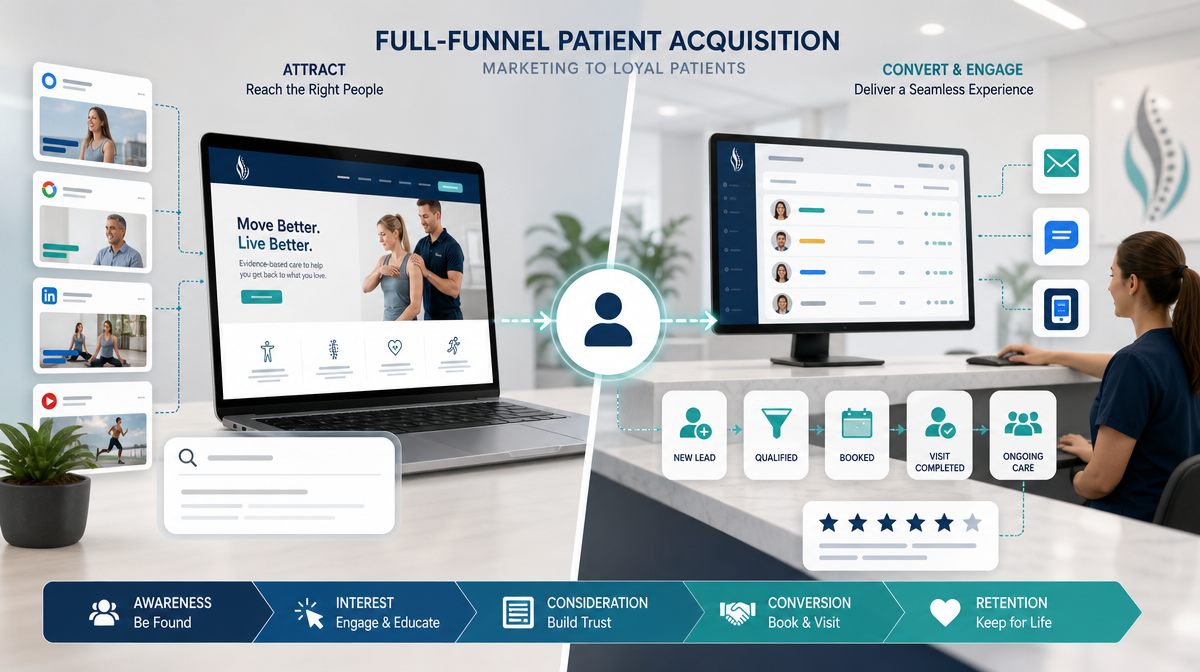
Most clinics lose patients not at the advertising stage — but in the 47 minutes after a lead submits a form. Research consistently shows that contacting a new inquiry within five minutes increases conversion likelihood by up to 9x compared to a 30-minute response. Yet the average medical practice takes over two hours to follow up. That gap is where your marketing spend quietly bleeds out.
The technology layer a qualified medical weight loss marketing agency brings to your practice closes that gap automatically, without adding headcount. Here’s what a purpose-built lead handling system delivers:
- Instant SMS follow-up: The moment a prospect submits an inquiry, an automated text fires — introducing your practice, answering common questions, and prompting the patient to confirm their interest before a competitor even sees the lead.
- Instant quotes with financing options at inquiry: Weight loss patients comparison-shop on price more aggressively than almost any other elective patient type. Delivering a program quote and a monthly payment option within the first touchpoint removes the friction that sends prospects to the next clinic on their list.
- Call recording for front desk optimization: Recorded calls reveal exactly where your staff loses booked appointments — objection patterns, pricing hesitation, missed follow-through — turning every conversation into a training asset.
- 1-click intake forms: Simplified intake sequences reduce the drop-off that happens when patients hit a lengthy form mid-funnel. Fewer fields, faster completion, more consultations booked.
Target Patients MD builds this entire infrastructure into every engagement — not as an add-on, but as the operational backbone connecting your marketing to your front desk.
Knowing your campaigns are “doing well” is not a financial strategy. The clinics that scale their GLP-1 programs predictably are the ones that tie every marketing decision to three specific numbers — and hold their agency accountable to all three simultaneously.
- Cost per lead (CPL): Your total monthly marketing spend divided by the number of new patient inquiries generated. This is your efficiency gauge — it tells you whether your campaigns are attracting interest at a sustainable rate. In the medical weight loss vertical, CPL benchmarks vary significantly by market density and channel mix, which is why a specialist agency can set a realistic target where a generalist is simply guessing.
- Cost per acquired patient (CPA): The more honest number. CPA accounts for every lead that didn’t convert — the no-shows, the price shoppers, the people who booked and cancelled. If your CPL looks great but your CPA is unsustainable, something in your intake or follow-up process is leaking revenue.
- Patient lifetime value (LTV): GLP-1 patients are not single-visit transactions. A patient who stays on a supervised tirzepatide program for 12 months represents substantially more revenue than their first consultation fee suggests. An agency that reports only on acquisition costs without factoring LTV into your ROI calculation is giving you an incomplete — and often pessimistic — picture of campaign profitability.
Beyond the numbers themselves, demand real-time dashboard access. Monthly PDF summaries that arrive two weeks after the period ends are not reporting — they’re archaeology. You should be able to log in, see current spend, active lead counts, and conversion rates at any point in the month.
Choosing the wrong agency doesn’t just waste budget — it costs you the window of opportunity while GLP-1 demand is at its peak. Before you sign anything, run every candidate through these five filters:

- Verify GLP-1 and weight loss industry expertise: Ask for specific examples of semaglutide and tirzepatide campaigns they’ve run — not general healthcare clients. A portfolio that features dental offices and urgent care doesn’t demonstrate the niche fluency your program requires. Generic healthcare experience is a starting point, not a qualification.
- Demand data-driven strategy and personalization: If an agency presents a proposal before asking detailed questions about your market, service pricing, and competitive positioning, that’s a red flag. Cookie-cutter playbooks underperform in a vertical where patient psychology and local competition vary dramatically by geography.
- Confirm proprietary tools and lead management: Ask exactly what happens the moment a patient submits an inquiry. Agencies with purpose-built CRM infrastructure — like the weight loss-specific system inside Target Patients MD — can demonstrate a structured follow-up sequence. Agencies without it will describe a manual process that your front desk is expected to execute.
- Require transparent reporting and real benchmarks: Ask to see a sample report. If it doesn’t include cost per lead, cost per acquired patient, and channel-level attribution, the agency isn’t tracking what actually drives your revenue.
- Avoid long-term contracts and hidden fees: Reputable agencies earn continued engagement through results. Insist on a complete cost breakdown — management fees, ad spend, platform fees, and any setup charges — before committing to anything.
The GLP-1 window is open right now — but it won’t stay this wide forever. As telehealth platforms mature, compounding regulations tighten, and local competition intensifies, the clinics that built a systematic patient acquisition engine early will have a structural advantage that latecomers simply can’t buy their way into overnight.
That’s the practical argument for partnering with a medical weight loss marketing agency that works exclusively in this space. Not because generalists are incompetent, but because the cumulative knowledge of running hundreds of GLP-1 campaigns — knowing which ad angles get flagged, which patient segments convert fastest, which follow-up timing rescues cold leads — compounds into a performance edge that no amount of general marketing talent can replicate from scratch.
Target Patients MD was built specifically for this moment in medical weight loss. The engagement model is designed around what practice owners actually need:
- No long-term contracts — continued partnership is earned through measurable patient volume, not enforced by fine print
- GLP-1 campaign expertise backed by a track record across 735+ medical practitioners
- A fully integrated system connecting advertising, lead management, and front-desk follow-up into one accountable pipeline
If your practice is ready to compete for the patients actively searching for semaglutide and tirzepatide programs in your market, the next step is a direct conversation about what that looks like specifically for your location and service mix.
- How much does a medical weight loss marketing agency cost?Most specialist agencies charge a monthly management fee ranging from roughly $1,000 to $3,000, separate from your advertising budget. Ad spend sits on top of that figure and scales with your market size and patient volume goals. The total monthly investment varies considerably based on how many channels you’re running — a clinic launching Google Ads alongside SEO and reputation management will invest more than one running a single paid channel.
- How quickly will a weight loss clinic see new GLP-1 patients after working with an agency?Paid campaigns on Google and Meta can generate qualified inquiries within the first two to four weeks of launch. Organic search rankings build over three to six months. Running both simultaneously is the practical approach — paid results fund the practice while organic authority compounds in the background.
- Can a marketing agency advertise compounded semaglutide or tirzepatide?Yes, but the regulatory terrain shifts frequently. FDA enforcement posture on compounded GLP-1s has tightened, and both Meta and Google update their pharmaceutical ad policies independently. A medical weight loss marketing agency with active experience in this space keeps campaigns within current guidelines — something a generalist agency typically discovers only after an account suspension.
- Should a weight loss clinic build an in-house marketing team or hire an agency?An in-house team makes financial sense once a practice reaches significant patient volume. Until then, an agency delivers immediate access to channel specialists, compliance expertise, and purpose-built tools that would take years and considerable payroll to replicate internally.
- Do medical weight loss marketing agencies require long-term contracts?Reputable agencies don’t need lengthy contracts to retain clients — results do that work. Ask any prospective partner for a month-to-month arrangement and a complete fee breakdown before committing.