



If you’ve ever handed your marketing budget to a generalist agency and watched it disappear into generic Facebook posts and templated Google Ads, you already know the problem. Medical weight loss marketing isn’t a subcategory of healthcare marketing — it’s an entirely different game with its own rules, its own landmines, and its own patient psychology.
Most marketing channels were simply not designed with your clinic in mind. Google and Meta have built specific policy frameworks around weight-related advertising that can get your campaigns rejected or suspended before a single patient ever sees them. Meanwhile, the patients you’re trying to reach are deeply skeptical — they’ve tried the diets, they’ve seen the influencer promotions, and they’re doing serious research before they ever pick up the phone to call a clinic like yours.
Add to that the competitive pressure from well-funded telehealth startups running national campaigns at scale, and you’re operating in one of the most contested patient acquisition environments in medicine. Three forces define this challenge:
- Ad platform restrictions: Google and Meta impose strict limitations on claims tied to weight loss drugs and prescription treatments
- Patient trust gap: Prospects invest significant time evaluating providers before committing to a supervised program
- Telehealth saturation: Direct-to-consumer GLP-1 companies dominate paid channels with aggressive, low-cost messaging
Generic healthcare marketing tactics — the kind built for dermatology or primary care — don’t address any of these dynamics. Winning patients in this category requires a strategy built specifically for how weight loss patients search, evaluate, and decide.
The numbers behind current patient demand are hard to ignore. The global anti-obesity medication market sat at roughly $6 billion in early 2023 — and Goldman Sachs projects it could reach $100 billion by 2030. Eli Lilly’s Zepbound alone generated $175.8 million in initial sales within its first reporting period. Patients aren’t just curious about these treatments; they’re actively searching for a local provider who can prescribe and monitor them safely.
What’s driving that search volume toward brick-and-mortar clinics specifically? Several converging forces:
- FDA approvals expanding GLP-1 indications: Semaglutide and Tirzepatide have received approvals beyond Type 2 diabetes, opening the door to a much larger eligible patient population
- Celebrity and media normalization: Mainstream coverage has removed the stigma around medically supervised weight loss, shortening the patient consideration cycle
- Insurance coverage shifts: 43% of large employers and growing numbers of commercial payers now cover obesity treatments, prompting patients to seek in-network, credentialed providers
- Preference for physician oversight: After the FDA’s warning letters to 30 telehealth companies over compounded GLP-1 products and unmonitored prescribing, a meaningful segment of patients is actively looking for supervised, in-person care
The opportunity is real — but so is the competition. Every independent clinic competing for GLP-1 patients is also competing against national telehealth platforms with eight-figure ad budgets. Capitalizing on this demand window requires a medical weight loss marketing approach that reaches high-intent local patients before those platforms do.
Targeting “everyone who wants to lose weight” is the fastest way to burn through ad spend without booking a single qualified consultation. The patients searching for Semaglutide injections have completely different objections, timelines, and decision triggers than someone exploring a medically supervised nutrition program — and your messaging needs to reflect that distinction before they ever land on your website.
Start by segmenting your potential patients into treatment-based groups rather than broad demographic buckets. Each segment has a distinct psychology that shapes which channels reach them and which messages convert them:
| Patient Segment | Primary Motivation | Preferred Channel | Key Objection |
|---|---|---|---|
| GLP-1 seekers | Fast, medication-assisted results | Google search, social ads | Cost and side effects |
| Bariatric candidates | Long-term solution after failed diets | SEO, educational content | Surgery fear, recovery time |
| Lifestyle program patients | Non-medication approach | Email, referrals | Skepticism about sustainability |
Knowing which segment you’re speaking to determines everything downstream in your medical weight loss marketing — from which keywords you bid on to how your front desk handles the first inquiry call. A bariatric candidate who finds generic GLP-1 content feels unseen and moves on. Segment-specific messaging signals that your practice understands their specific situation, which is the first step toward earning their trust.
Every channel in your marketing mix serves a different patient at a different moment in their decision process. The seven tactics below represent the core of a high-performing medical weight loss marketing system — not because they’re trendy, but because each one addresses a specific gap between where patients are looking and where most clinics are showing up.
Think of these as layers that build on each other. Traffic means nothing without a website that converts. Leads mean nothing without a follow-up system that actually responds. And all of it means nothing if you can’t measure which dollars are producing which patients.
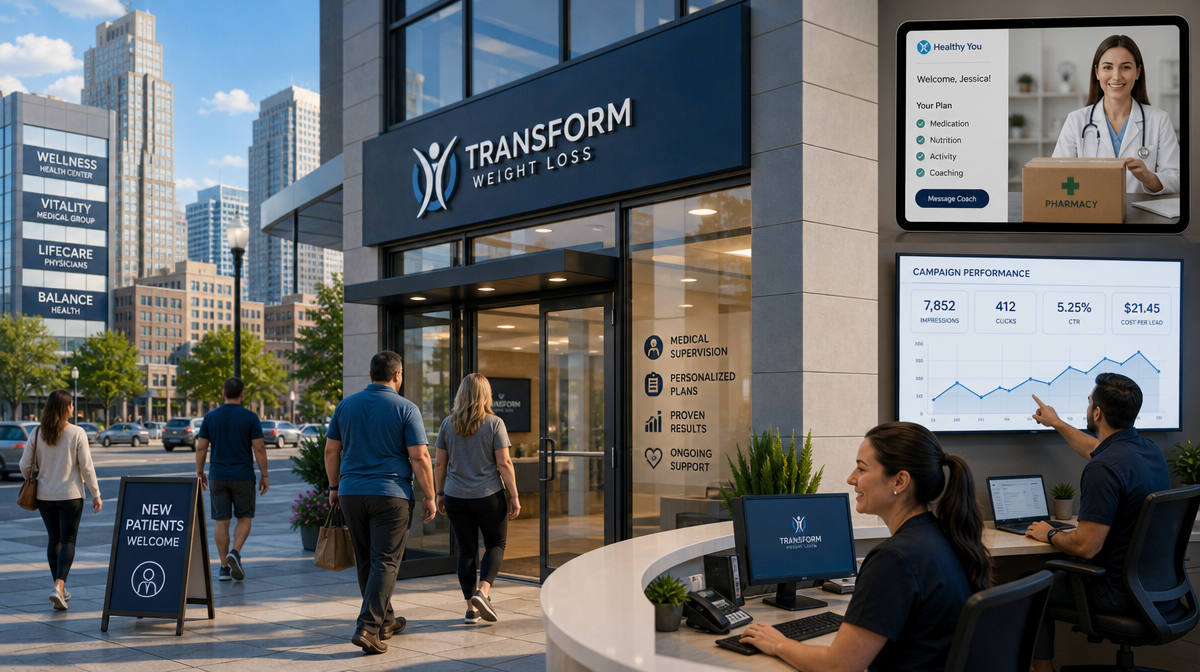
- Website performance: Your medical website design needs to load fast, establish credibility immediately, and make booking frictionless — especially on mobile where most weight loss searches originate
- Local SEO: High-intent searches like “Semaglutide clinic near me” need to find your practice before they find a national telehealth brand
- Google Ads: Paid search captures patients who are actively ready to book — but only if your campaigns are structured to meet compliance requirements
- Meta Ads: Facebook and Instagram reach patients earlier in the consideration phase, with creative built around platform-specific ad restrictions
- SMS and email nurture: Most weight loss prospects don’t book on the first touchpoint — automated follow-up sequences close that gap
- Reviews and testimonials: Social proof directly influences both local search rankings and consultation conversion rates
- AI-powered optimization: Continuous performance improvement across every channel, without requiring your staff to manually manage it
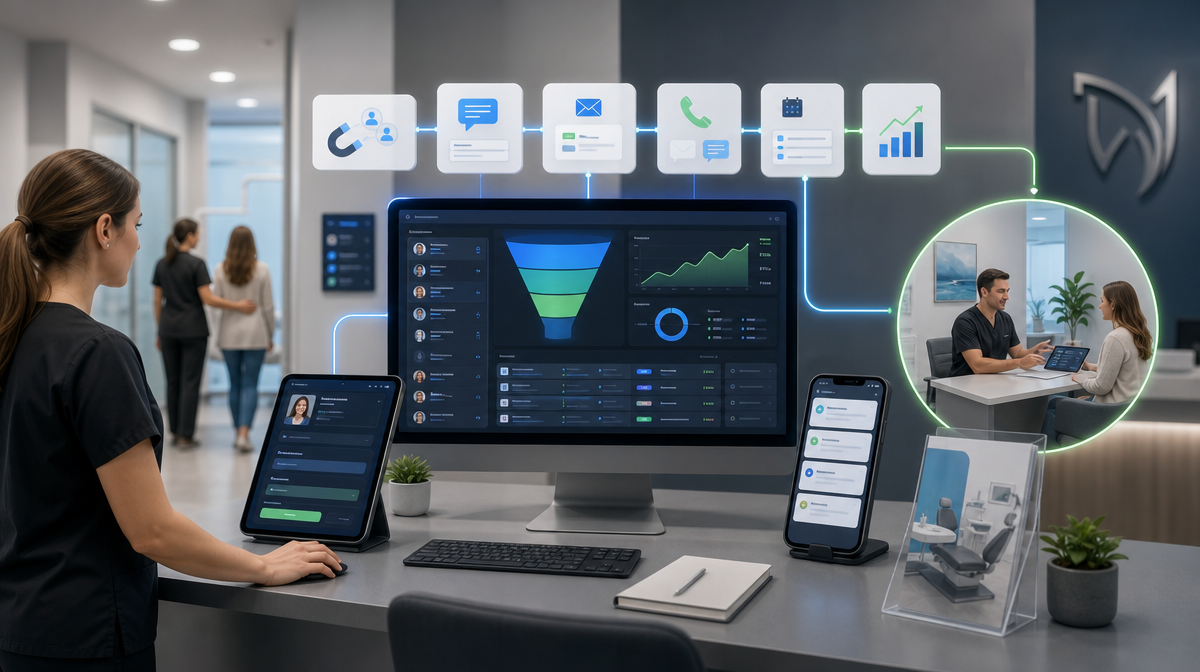
Most weight loss clinics are losing patients between the inquiry and the consultation — not because the marketing failed, but because the tools managing those leads were never designed for this specialty. A generic CRM built for real estate or e-commerce doesn’t know the difference between a GLP-1 inquiry and a bariatric consultation request, and it certainly can’t present financing options automatically when cost objections surface mid-conversation.
A purpose-built weight loss CRM changes the operational reality of your front desk. Instead of manually triaging incoming inquiries and guessing at follow-up timing, your team works inside a system where every lead enters a workflow calibrated to their specific treatment interest from the moment they submit a form.
- Lead capture forms: Integrated directly with your website and ad platforms so no inquiry falls through the cracks during handoff
- Automated follow-up: Pre-built sequences that treat a GLP-1 inquiry differently than a bariatric consultation request — because the patient psychology and objections are completely different
- Pipeline visibility: A real-time view of every prospect from first contact through completed treatment, so nothing disappears into a spreadsheet
- Financing integration: Payment options surfaced automatically at the right moment in the conversation, removing the cost barrier before it kills the booking
Target Patients MD’s weight loss-specific CRM is built with exactly these workflows in place. For a category where medical weight loss marketing generates consistent inquiry volume, the system that handles those inquiries determines how many of them actually become patients.
Most weight loss clinics track leads. Very few track what happens to those leads afterward — and that gap is exactly where marketing budgets quietly hemorrhage without anyone noticing. Measurement in medical weight loss marketing matters more than in almost any other specialty because patient lifetime value swings dramatically depending on treatment type, and the acceptable cost to acquire each patient swings with it.
A GLP-1 patient on a monthly injection protocol might represent $4,800 or more in annual revenue with strong retention. A bariatric surgery patient might generate a larger single transaction but minimal recurring revenue. If you’re calculating acquisition cost the same way across both, you’re either overspending on surgical candidates or leaving GLP-1 patients on the table by bidding too conservatively.

Three metrics every weight loss practice owner should monitor at the campaign level:
- Cost per lead (CPL): The raw cost to generate an inquiry, calculated by dividing total campaign spend by the number of inbound leads — tracked separately for each channel and treatment type
- Cost per acquisition (CPA): What you actually paid to convert a lead into a paying patient — the number that determines whether a campaign is profitable, not just active
- Consultation-to-treatment conversion rate: The percentage of booked consultations that result in a started treatment program — often a bigger lever than generating additional lead volume
When these numbers live in separate systems — your ad platform, your EHR, your front desk spreadsheet — you’re operating blind. Connecting them into a single view is what separates practices that scale predictably from those that chase leads without knowing which ones were ever worth chasing.
Hims, Ro, and a growing wave of compounding pharmacies have one significant advantage over your clinic: they can spend millions on national ad campaigns and absorb patient acquisition costs that would bankrupt a single-location practice. What they cannot do is sit across from a patient, review their labs, and make a clinical judgment call. That distinction is the foundation of every differentiation strategy worth building.
Patients who started with a telehealth GLP-1 script and experienced inadequate monitoring, side effect mismanagement, or a sudden supply disruption are actively looking for something better. Your medical weight loss marketing should speak directly to that experience — not by attacking competitors, but by making the depth of your clinical program impossible to miss.
- In-person monitoring: Baseline lab panels, ongoing vital assessments, and body composition tracking give your patients a safety net that a remote prescriber sending a 90-day supply cannot replicate
- Comprehensive programming: Pairing GLP-1 therapy with nutritional counseling and behavioral support produces outcomes that standalone prescription services structurally cannot offer
- Physician continuity: Patients see the same provider across their treatment journey — a named doctor who knows their history, not a rotating telehealth queue
- Contraindication management: Proper screening before prescribing protects patients and protects your practice, and communicating that process builds trust with patients who’ve been burned by shortcuts elsewhere
Position these capabilities in your messaging as clinical standards, not selling points. Patients who are ready for supervised care recognize the difference immediately — and those are exactly the patients most likely to stay long-term.

Running a medical weight loss practice means decisions rarely come with a clean instruction manual. The questions below come up constantly among clinic owners evaluating their patient acquisition strategy — answered directly, without the fluff.
- How much should a medical weight loss clinic spend on marketing each month?
There’s no universal number, but most growing clinics allocate somewhere between 8% and 15% of their target monthly revenue toward patient acquisition. A clinic aiming for $80,000 in monthly GLP-1 and bariatric revenue should generally plan for a multi-channel budget that covers paid search, social, and local SEO simultaneously — single-channel approaches rarely move the needle in a market this competitive. - Can you advertise GLP-1 medications like Semaglutide on Google and Facebook?
Yes — but both platforms have gatekeeping requirements your campaigns must clear first. Google requires LegitScript Healthcare Certification before any weight loss ads go live. Meta prohibits direct weight loss claims and before-and-after imagery in ad creative, which means compliant campaigns lean on lifestyle outcomes and physician-supervised program messaging rather than medication-specific promises. - How long does it take to see results from medical weight loss marketing campaigns?
Paid search and social ads can start generating consultation requests within the first week of launch when campaigns are structured correctly. Organic search rankings for competitive terms like “Semaglutide clinic [city]” typically require three to six months of consistent SEO work before producing reliable inbound volume. - What is the average cost per lead for a medical weight loss clinic?
Cost per lead varies significantly by market density and channel mix. Paid search leads in competitive metro areas routinely run $60–$150 per inquiry, while referral-driven and organic leads carry substantially lower acquisition costs — which is why a blended strategy outperforms any single channel over time.
Building a medical weight loss practice that consistently fills its schedule requires more than running ads — it requires a partner who has solved this exact problem before, specifically in this specialty. Target Patients MD works exclusively with practices in the weight loss, GLP-1, and bariatric space, which means the campaigns, workflows, and optimization strategies your practice gets aren’t adapted from a dental playbook or a cosmetic dermatology template. They were built for your patient acquisition challenges from the ground up.
The centerpiece is A.L.I. 360, a proprietary AI-driven system that continuously improves campaign performance across every channel — adjusting targeting, spend allocation, and messaging in real time rather than waiting on a monthly agency review call. Clinics using A.L.I. 360 have seen patient acquisition lifts of up to 377%, with results that compound as the system learns from conversion data unique to your market.
What separates this from a standard agency relationship is the operational infrastructure that comes with it. The weight loss-specific CRM, done-for-you campaign management, and GLP-1-compliant creative production are all included — so your staff isn’t managing a stack of disconnected vendors while trying to run a clinic.
- GLP-1 and bariatric expertise: Every campaign is built around weight loss patient acquisition, not repurposed from another specialty
- A.L.I. 360 AI optimization: Continuous performance improvement without requiring manual oversight from your team
- Purpose-built CRM: Lead management workflows designed specifically for weight loss clinic operations
- No long-term contracts: Month-to-month engagement — results justify the relationship, not a signed agreement
Learn more about Target Patients MD and how the platform supports medical weight loss marketing for growing practices.