



A medical spa marketing agency in NYC is a fundamentally different animal from the generalist shop that might also be running campaigns for a law firm and a roofing company down the hall. It’s a firm built exclusively around growing aesthetic practices — one that arrives already fluent in the language of neurotoxins, body contouring cycles, and the specific compliance requirements that govern how medical services can be advertised in the first place.
The distinction matters because elective aesthetic patients don’t behave like typical consumers. Someone researching their first Botox appointment or a CoolSculpting package is running a weeks-long evaluation process — comparing providers, reading clinical credentials, and making judgment calls about trust before they ever submit a contact form. A generalist agency has no framework for that decision cycle. A medspa-focused agency has already mapped it.
Three core capabilities define what a true NYC medspa marketing agency actually delivers:
- Aesthetic specialization: The agency works exclusively with medspas, cosmetic clinics, and aesthetic providers — not a rotating roster of unrelated industries.
- Patient-focused strategy: Every campaign is built around how medspa patients actually move from initial curiosity to confirmed appointment, not generic lead-generation logic.
- Compliance-aware execution: Ad copy, intake forms, landing pages, and retargeting pixels are all built with HIPAA and healthcare advertising standards embedded from the start — not retrofitted after something goes wrong.
For practice owners in New York, that combination isn’t a nice-to-have. It’s the baseline requirement for competing in a market where the wrong agency can quietly drain your budget for months before anyone notices the calendar isn’t filling up.
New York City has more medspas per square mile than virtually any other market in the country — and that density creates a competitive environment that exposes every weakness in a generalist agency’s playbook. When you’re operating in a ZIP code where four competitors are within a five-minute walk, broad digital campaigns built for suburban markets simply don’t move the needle.
The structural challenges NYC practice owners face are specific enough to demand specific solutions:
- Intense local competition: Hundreds of aesthetic clinics cluster within the same neighborhoods, often targeting identical patient demographics with identical treatment menus. Winning requires granular differentiation, not category-level visibility.
- Punishing cost per click: NYC paid search for aesthetic keywords runs 200–400% above national averages. An agency without medspa-specific bidding benchmarks will burn through your monthly budget before your phone rings.
- Sophisticated patient expectations: A patient weighing a $2,000 laser treatment in Manhattan is cross-referencing providers, reading clinical bios, and evaluating brand presentation before making contact. Weak positioning loses these patients before you ever know they visited.
- Neighborhood-level targeting requirements: NYC patients search with borough and neighborhood precision — “filler Tribeca” and “Botox Upper East Side” are entirely different competitive landscapes. A medical spa marketing agency NYC specialists build campaigns around these micro-geographies rather than metro-wide targeting that dilutes every dollar you spend.

Generalist agencies learn these dynamics at your expense. A specialized agency arrives already knowing them.
Every agency in this space will tell you they specialize in healthcare. The ones that actually do reveal it through operational specifics — not pitch decks. When you’re evaluating what separates a genuinely top-tier medical spa marketing agency NYC from the crowded field of pretenders, five differentiators consistently determine whether your calendar fills or your budget evaporates.
- Healthcare-only focus and aesthetic specialization: Agencies that work exclusively with medical and aesthetic practices have already solved the problems you’re facing — treatment-specific conversion funnels, the longer decision window for high-ticket procedures, and the clinical credibility signals that actually move an aesthetic patient toward booking. That institutional knowledge doesn’t exist at a generalist shop.
- ZIP code and neighborhood-level local SEO: Ranking for “medspa NYC” is nearly meaningless. Ranking for “Botox Upper East Side” or “CoolSculpting Williamsburg” puts you directly in front of patients who are geographically ready to book. Top agencies build neighborhood-specific pages and optimize your Google Business Profile to dominate the local map pack at the block level.
- AI-driven patient acquisition technology: Platforms like A.L.I. 360 optimize bids, audiences, and ad creative in real time — adjusting faster than any manual process can match and identifying which patient segments are most likely to convert before you’ve spent a dollar chasing the wrong ones.
- HIPAA-compliant ads and landing pages: Every intake form, retargeting pixel, and ad asset must handle patient data within federal compliance standards. Agencies that treat this as an afterthought expose your practice to real regulatory liability — with penalties up to $2.19 million per violation category.
- Guaranteed bookings and month-to-month engagement: Confidence in a system shows up as a performance guarantee — not a 12-month contract that protects the agency regardless of results.
The service stack a qualified medical spa marketing agency NYC practices rely on should function as an integrated system — not a menu of standalone options you mix and match hoping they connect. Each channel closes a specific gap in the patient journey, and when they run in coordination, the compounding effect on appointment volume is measurable.
| Service | What It Does for Your Medspa |
|---|---|
| SEO & Local SEO | Improves organic rankings for treatment and location searches |
| Google Ads & Paid Social | Drives immediate traffic from high-intent searchers |
| Website Design | Converts visitors into booked appointments |
| Reputation Management | Builds trust through reviews and testimonials |
| Email & SMS Outreach | Nurtures leads and retains existing patients |
What separates a purpose-built medspa system from a generic digital package is how these services hand off to each other. Your organic rankings surface patients who haven’t found you yet. Your paid campaigns intercept them when purchase intent peaks. Your website closes the gap between interest and confirmed booking. Your email sequences recapture the patients who weren’t ready on the first visit.
The treatment economics built into each service matter as much as the service itself. A practice running Morpheus8 packages at $3,500 requires fundamentally different funnel architecture than one focused on $300 injectable appointments — and an agency that can’t distinguish between those two conversion paths will underperform on both.
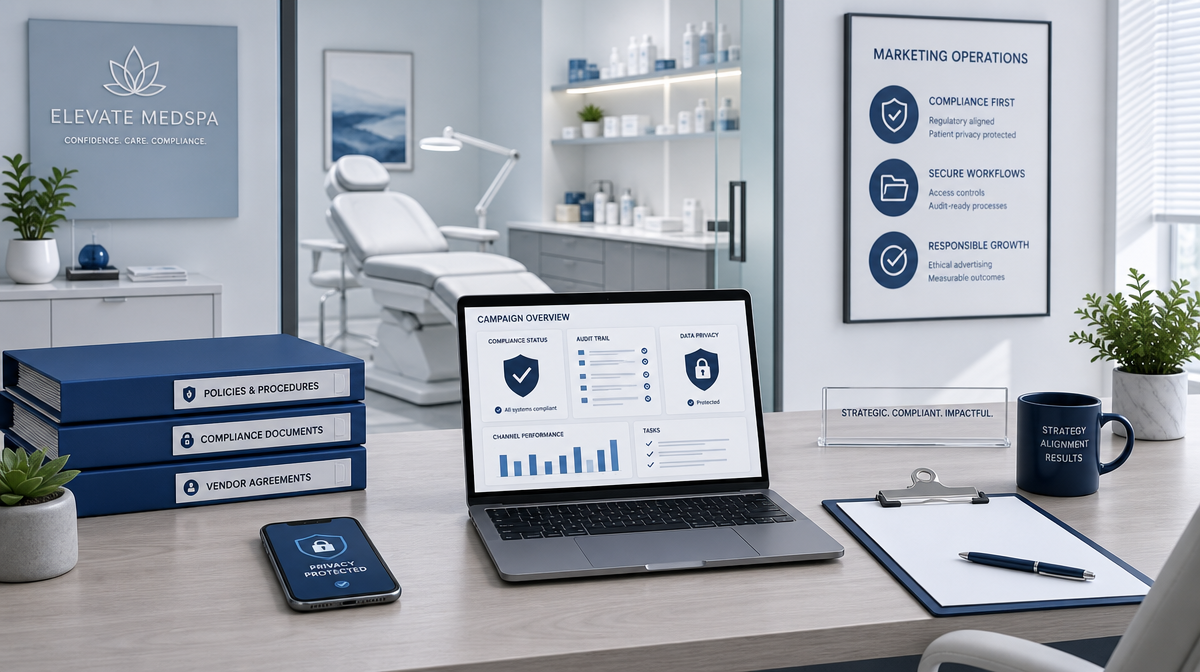
Winning patients in specific NYC neighborhoods requires a fundamentally different tactical approach than broad metro-wide campaigns. When someone in Park Slope searches “microneedling near me,” they’re not comparing your practice to one in Midtown — they’re comparing you to the three clinics within a 10-minute walk. A top medical spa marketing agency NYC practices trust will structure every campaign around that geographic reality from day one.
The mechanics of hyperlocal acquisition break into three distinct execution layers that compound over time:
- Borough and ZIP code targeting: Paid campaigns are geofenced to specific neighborhoods — Upper East Side, Tribeca, Williamsburg, Astoria — with ad copy and offers calibrated to the income levels and treatment preferences of each area’s patient population. A CoolSculpting campaign that converts in Flatiron uses entirely different messaging than one running in Forest Hills.
- Localized landing pages: Dedicated pages built for searches like “Botox Tribeca” or “laser hair removal Astoria” capture neighborhood-level intent that a generic homepage never will. Each page mirrors the search query precisely enough that Google treats it as the most relevant result in that geographic cluster.
- Google Business Profile optimization: Accurate NAP data, geo-tagged treatment photos, and weekly GBP posts signal active local relevance to Google’s ranking algorithm — directly influencing your placement in the map pack that appears before organic results for neighborhood searches.
These tactics work together rather than independently. A patient who finds your GBP listing, clicks to a neighborhood-specific landing page, and sees locally relevant creative completes a trust sequence that generic campaigns simply cannot replicate at the ZIP code level.
Manual campaign management has a hard ceiling — and in NYC’s paid search environment, where aesthetic CPCs rose 60% year-over-year, that ceiling gets hit faster than most practice owners expect. What changes when AI enters the picture isn’t just efficiency; it’s the entire decision-making rhythm that governs where your budget goes and which patients it reaches.
Purpose-built AI platforms like A.L.I. 360 apply machine learning specifically to medspa patient acquisition — analyzing conversion signals across thousands of data points to make optimization decisions in hours rather than weeks. The practical result for your practice:
- Real-time bid optimization: Rather than waiting for a weekly check-in, AI redistributes your ad spend continuously toward the hours, devices, and audience segments that are actively generating booked appointments — not just clicks.
- Predictive audience targeting: Machine learning identifies behavioral and demographic patterns from your existing patient base, then finds new prospective patients who mirror those signals before they’ve even typed a search query.
- Continuous content optimization: Headlines, creative, and offer language are tested in live conditions and refined automatically — eliminating the guesswork that typically burns budget during a campaign’s early months.
For NYC medspas specifically, this speed advantage is commercially significant. The local ad auction shifts daily, and practices whose campaigns adapt in real time consistently outperform those relying on monthly manual reviews. Practices using AI-driven systems have seen patient acquisition improve by up to 377% — a gap that widens over time as the algorithm accumulates practice-specific performance data.
Most agencies will hand you a monthly report full of impressions, click-through rates, and follower growth — metrics that feel meaningful until you realize none of them appear on your revenue statement. The only numbers worth tracking are the ones that tell you whether your marketing investment is generating more revenue than it costs.
A qualified medical spa marketing agency NYC practices can trust will anchor every monthly conversation around five outcome-based indicators:
- New patient bookings: The raw count of confirmed appointments generated by marketing activity — not inquiries, not form fills, but patients who actually showed up with a treatment on the schedule.
- Cost per lead: What you paid, on average, for each inbound inquiry. This number should decline as campaign data matures and targeting sharpens around your highest-converting patient profiles.
- Cost per acquisition: The true expense of booking a new patient from first contact through confirmed appointment — the figure that actually connects marketing spend to treatment room occupancy.
- Return on ad spend: Revenue generated relative to what you invested in paid media. A well-structured campaign targeting high-ticket treatments like laser resurfacing or body contouring should produce a measurable multiple of its cost within the first quarter.
- Review volume and rating trajectory: Growth in verified patient feedback across Google, Yelp, and RealSelf — a leading indicator of organic search performance and the trust signal that converts undecided patients, given that 84% check online reviews before choosing a provider.
If your current agency leads monthly reviews with reach and engagement data, that’s a structural problem — not a reporting style preference. Vanity metrics don’t fill treatment rooms.
Choosing the wrong agency in a market this unforgiving isn’t just a budget problem — it’s a months-long opportunity cost you can’t recover. Four concrete checkpoints will separate the agencies worth your time from the ones worth avoiding.
- Verify healthcare and medspa specialization first: Ask how many active medspa clients the agency currently manages — and push for specifics about treatment categories and patient acquisition challenges they’ve already solved. An agency with genuine aesthetic depth answers without hesitation. One that pivots to generalities about “healthcare experience” is signaling that medspas are a small slice of a much broader client base.
- Ask for NYC case studies and booking numbers: Traffic reports and keyword ranking screenshots don’t pay your overhead. Request outcome data from comparable NYC practices — specifically how many new patients were generated per month, what cost per booked appointment looked like, and how revenue moved over the engagement. If an agency can’t produce this, they’ve never measured it.
- Confirm HIPAA compliance and in-house execution: Ask directly whether strategy, campaign management, and content are handled internally — or handed off to overseas contractors after the contract is signed. HIPAA-compliant execution requires accountability at every step, which is impossible to enforce across an outsourced production chain.
- Demand transparent reporting and flexible terms: Monthly dashboard access showing cost per acquisition and booking volume should be a baseline expectation, not a premium add-on. Any medical spa marketing agency NYC practitioners should seriously consider will offer month-to-month terms — because an agency confident in its results doesn’t need a long contract to protect its revenue.

Target Patients MD is built for exactly one type of client: medical and aesthetic practices that need a predictable, measurable flow of new patients — not promises dressed up in marketing language. We don’t take on law firms, e-commerce brands, or restaurant groups. Every system we’ve developed, every campaign template we’ve refined, and every optimization insight we’ve accumulated comes from working exclusively within healthcare and aesthetics across 735+ practitioners.
For NYC medspas specifically, that concentrated experience translates into a shorter path from campaign launch to booked appointments. We already know which neighborhoods in Manhattan convert on body contouring offers, which boroughs respond to injectable promotions during pre-holiday windows, and what it takes to rank in the Google local pack for Williamsburg versus the Upper East Side.
What you get when you work with us:
- A.L.I. 360 AI technology purpose-built for medical patient acquisition, not adapted from a general marketing platform
- Full in-house execution across every channel, with a named account owner who knows your treatment menu
- Month-to-month terms because our confidence is demonstrated through results, not contract length
- HIPAA-compliant processes embedded at every stage, protecting your patients and your license
If your current approach isn’t generating consistent, trackable new patient bookings each month, that’s a solvable problem. Learn more about Target Patients MD and schedule a free consultation to find out what a dedicated medical spa marketing agency NYC can do for your practice’s growth.
Practice owners evaluating a medical spa marketing agency NYC tend to arrive with the same handful of practical questions — ones that don’t always get straight answers during a sales conversation. Here are the honest responses.
- How much does a medical spa marketing agency in NYC cost? Most NYC medspa agencies charge a monthly retainer ranging from roughly $1,000 to $3,000 or more, depending on which services are active and how competitive your neighborhood is. Performance-focused agencies may also offer pay-per-patient models where fees are tied directly to booking outcomes.
- How quickly can a NYC medical spa see results from a marketing agency? Paid campaigns can surface inbound inquiries within the first few days of going live. Organic search rankings build more gradually — typically three to five months before meaningful movement — but practices that launch paid and SEO simultaneously often see measurable new patient activity within the first 30 days.
- Is SEO or social media advertising better for marketing a NYC med spa? They serve different roles. SEO captures patients who are already searching for specific treatments; social media builds awareness and reaches patients who haven’t started searching yet. High-performing practices run both rather than choosing between them.
- Do medical spa marketing agencies in NYC offer performance guarantees? Some do — specifically, a guarantee that new patient bookings will be delivered or fees are refunded. Always ask for guarantee terms in writing before signing anything.
- Is HIPAA compliance required for medspa marketing campaigns? Yes. Any marketing that involves patient data, testimonials, or intake forms must comply with HIPAA guidelines. Non-compliance carries real financial penalties and puts your license at risk.


