



A medical marketing agency is a specialized firm that handles the digital work of attracting new patients and filling your appointment calendar — so you can stay focused on delivering care instead of chasing leads.
The core distinction from a general agency comes down to context. A generalist can run ads and build websites. What they cannot do is navigate healthcare advertising restrictions, speak credibly about clinical procedures, or understand why a patient researching LASIK behaves completely differently from one searching for a primary care physician. That context gap is where practices lose money and time.
A healthcare-focused agency covers three interconnected functions for your practice:
- Patient acquisition: Driving new inquiries and booked appointments through channels like paid search, medical SEO, and social media advertising — targeting people who are actively searching for the services you offer.
- Brand visibility: Making sure your practice appears prominently when prospective patients search online, whether on Google Maps, review platforms, or AI-powered search tools that are increasingly shaping where people go for care.
- Retention and engagement: Keeping your existing patient base connected through follow-up communications, reactivation campaigns, and appointment reminders — because a lapsed patient costs far less to re-engage than a brand-new one costs to acquire.
Done right, these three functions work together to create predictable, measurable growth — not just a spike in website traffic that never translates to a fuller schedule.
Hiring a generalist agency to market your medical practice is a bit like asking a general contractor to perform your roof surgery — technically, they work with structures, but the stakes and the skill set are completely different. The regulatory landscape alone separates healthcare marketing from every other industry.
When a generalist runs ads for your practice without understanding FDA advertising guidelines or HIPAA restrictions on retargeting, you’re not just leaving performance on the table — you’re exposing your practice to compliance risk, with penalties up to $2,190,294 per violation in 2026. A true medical marketing agency has those guardrails built into every campaign from day one.
Beyond compliance, the conversion gap is where specialist expertise pays off most visibly. Healthcare buyers don’t behave like consumers shopping for shoes. A patient weighing bariatric surgery may research for six months before submitting a single inquiry. A prospective LASIK patient needs fear-of-the-unknown addressed before they’ll ever click “Request a Consultation.” Generalist agencies optimize for clicks. Specialist agencies optimize for the psychology behind the click.
The key differentiators that separate healthcare-focused agencies from everyone else:
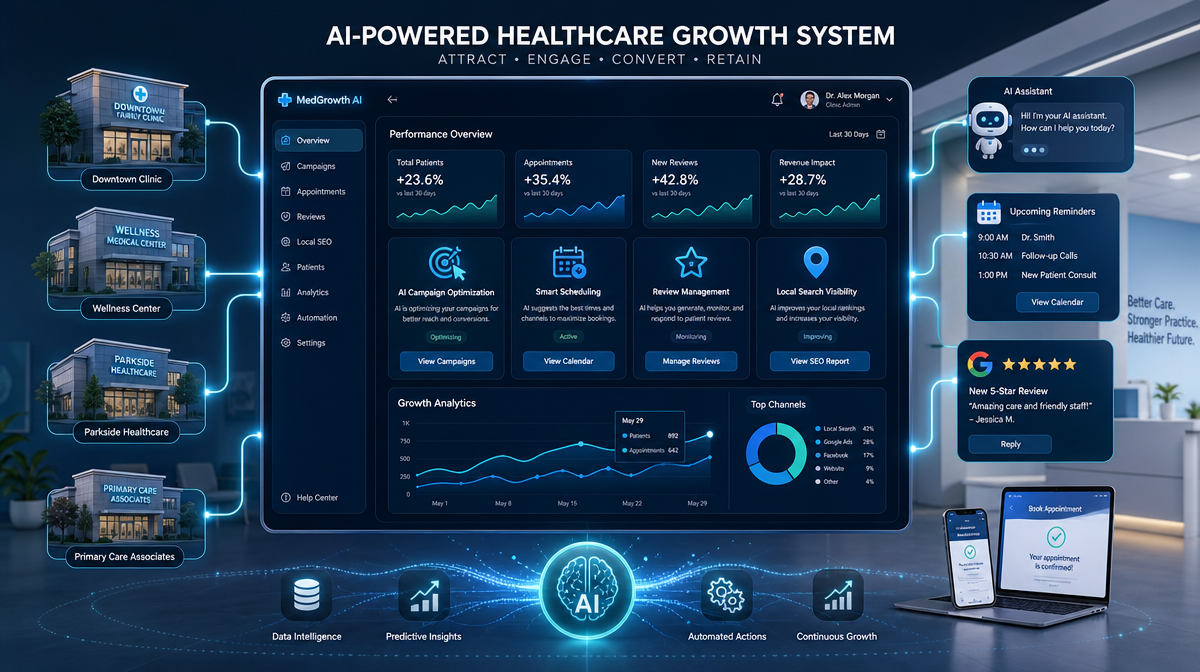
- Compliance built-in: HIPAA-compliant lead handling, ad targeting that avoids protected health information, and messaging that stays within FDA promotional guidelines — without you having to audit every campaign yourself.
- Patient journey expertise: Deep familiarity with how patients evaluate providers, compare credentials, and move from symptom search to scheduled appointment across days or weeks.
- Medical terminology fluency: Copy that uses accurate clinical language builds immediate credibility with prospective patients and signals that your practice is the real thing — not a generic landing page.
The marketing services a healthcare-focused agency brings to your practice cover the full arc from “patient hasn’t heard of you yet” to “patient is booked and showing up.” Each channel serves a different stage of that journey, which is why a single tactic — running Google ads, say, without the rest of the infrastructure — tends to underperform.
- Medical SEO and local search: Search engine optimization gets your practice ranking in Google’s local pack when nearby patients search for the exact procedures you offer. That means a fully optimized Google Business Profile, location-specific content, and the technical groundwork that determines whether you appear on page one or page five.
- Paid search and social media advertising: Google Ads and Facebook/Instagram campaigns generate appointment inquiries quickly by placing your practice in front of high-intent searchers and demographically matched audiences — often within days of launch rather than months.
- Conversion-focused website design: A mobile-first site built with clear booking pathways, trust signals like credentials and reviews, and fast load times converts the traffic you’re paying to attract into actual scheduled appointments — Google’s Core Web Vitals thresholds set the bar at 2.5 seconds for main content to load, and pages that miss it lose visitors before they ever reach a booking button.
- Email and text patient outreach: Automated sequences — appointment reminders, seasonal promotions, reactivation messages for patients who haven’t visited in over a year — keep your schedule full without requiring your front desk to manually follow up with every lapsed contact.
- Reputation and review management: Systematically generating fresh Google and Healthgrades reviews, monitoring feedback across platforms, and responding professionally to negative comments directly affects how many searchers click your listing over a competitor’s — 84% of patients check online reviews before choosing a provider.
Not every specialty responds to the same marketing playbook, and a medical marketing agency that understands this distinction will structure your campaigns around the specific patient mindset driving decisions in your field — not a recycled template borrowed from a completely different practice type. The same holds for practice size: private practice marketing works differently when you’re an independent competing against a hospital system rather than a multi-location group.
- Medical spa marketing: Aesthetics patients are highly visual and comparison-driven. Effective campaigns lean on aspirational imagery, procedure-specific targeting, and seasonal promotions timed to demand cycles — think body contouring pushes ahead of summer.
- Plastic surgery marketing: High-ticket elective procedures require extended trust-building. Effective plastic surgery campaigns emphasize surgeon credentials, board certifications, and patient transformation stories to support decision cycles that can stretch over several months.
- Dental and dental implant marketing: Dense local competition and insurance complexity demand hyper-local targeting paired with procedure-specific messaging — implants, Invisalign, and cosmetic whitening each attract different searchers with different objections.
- Ophthalmology and LASIK marketing: Fear of elective eye procedures runs high, so the most effective campaigns lead with education and outcome data before ever asking for a consultation request.
- Bariatric and medical weight loss marketing: Sensitivity around body image requires carefully framed messaging, and GLP-1 medication demand has reshaped what prospective patients are actively searching for right now.
- Regenerative medicine marketing: Emerging therapies require significant patient education upfront — establishing clinical credibility and countering misinformation before a prospect ever considers booking.
Manual campaign management has a ceiling. A human media buyer can test a handful of audience segments, review weekly performance reports, and make adjustments — but they cannot simultaneously process thousands of behavioral signals across every active campaign, every hour of every day. AI does exactly that, and the difference shows up directly in your cost per booked appointment.
A medical marketing agency that runs AI-powered patient acquisition isn’t just automating routine tasks — it’s running a system that continuously learns which ad creative, audience segment, time of day, and search query combination produces actual scheduled patients versus people who click and disappear. That feedback loop tightens targeting faster than any manual process can match.
- Predictive targeting and smart budget allocation: AI identifies the demographic and behavioral profiles most likely to convert into booked appointments, then automatically shifts budget toward those high-probability audiences — cutting wasted spend on clicks that never become patients.
- Generative Engine Optimization for AI search: Tools like Google’s AI Overviews and ChatGPT are now answering patient questions directly — often before a user ever visits a website. Generative Engine Optimization structures your practice’s content so it gets cited inside those AI-generated answers, putting your name in front of patients at the exact moment they’re forming a decision.
- Automated patient engagement and scheduling: AI chatbots and virtual scheduling assistants handle inquiries and appointment requests around the clock — capturing leads at 11 PM on a Sunday without adding a single hour of front-desk labor.
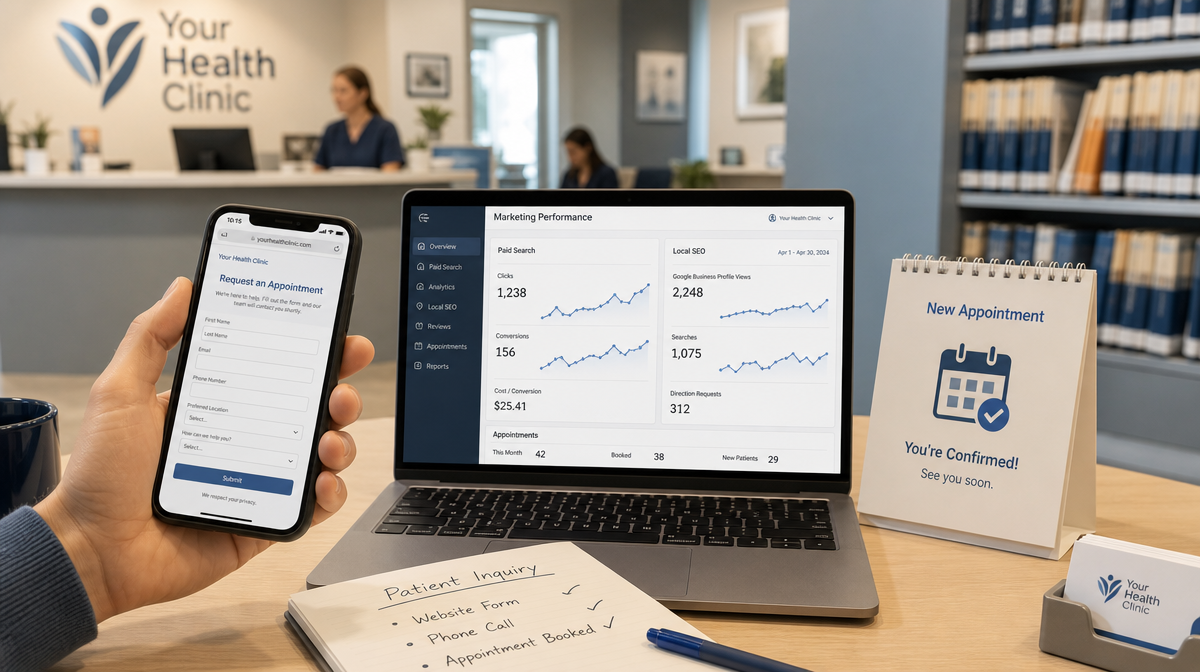
HIPAA — the Health Insurance Portability and Accountability Act — sets strict rules around how patient information can be collected, stored, and used. Most practice owners know HIPAA governs clinical records. Fewer realize it extends directly into your marketing operations, and the consequences of getting it wrong range from OCR fines to reputational damage that no ad campaign can undo.
The danger zone isn’t obvious. Standard marketing tools that work perfectly for a restaurant or law firm can create serious exposure for a medical practice. Using Google Analytics without a Business Associate Agreement, running Facebook retargeting pixels that inadvertently capture condition-related browsing behavior, or routing appointment requests through a non-encrypted contact form — each of these is a potential HIPAA violation hiding inside an otherwise normal digital marketing setup.
A qualified medical marketing agency builds compliance into the infrastructure before a single campaign goes live. The specific areas that require HIPAA-safe architecture:
- Secure lead capture forms: Encrypted intake and contact forms that protect submitted patient information from interception or unauthorized access.
- Encrypted patient communications: Email and SMS outreach conducted through platforms that carry a signed Business Associate Agreement and meet HIPAA transmission standards.
- Compliant ad targeting (no PHI in retargeting): Audience segments built without exposing protected health information to ad platforms — a common failure point with standard pixel-based retargeting.
- HIPAA-compliant CRM and email tools: Lead tracking and patient communication managed inside systems purpose-built for healthcare, not retrofitted general-purpose software.
If your agency sends a monthly PDF showing impressions and click-through rates, that’s not reporting — that’s decoration. The numbers that actually matter for your practice are the ones that connect marketing spend directly to revenue, and most practice owners have never seen them presented clearly.
Three metrics tell the complete financial story of your marketing investment:
- Cost per lead: Your total ad spend divided by the number of appointment inquiries received. This tells you what you’re paying to get someone to raise their hand — but it’s incomplete on its own, because leads aren’t patients.
- Cost per patient acquired: Your total marketing investment divided by new patients who actually showed up and received care. This is the number that determines whether your campaigns are profitable, and it’s the one most agencies quietly avoid putting in front of you.
- ROI: The revenue generated from new patients minus your total marketing cost. A campaign producing $18,000 in new patient revenue against $3,000 in spend is a 500% return — that’s the conversation you should be having with any medical marketing agency you evaluate.
| Metric | What It Measures |
|---|---|
| Cost per lead | Ad spend divided by number of inquiries |
| Cost per patient | Total marketing spend divided by new patients booked |
| ROI | Revenue from new patients minus marketing cost |
A credible agency gives you a live dashboard showing all three figures — updated continuously, not summarized quarterly. If you cannot see where every dollar went and what it produced, you do not have attribution. You have a guess.
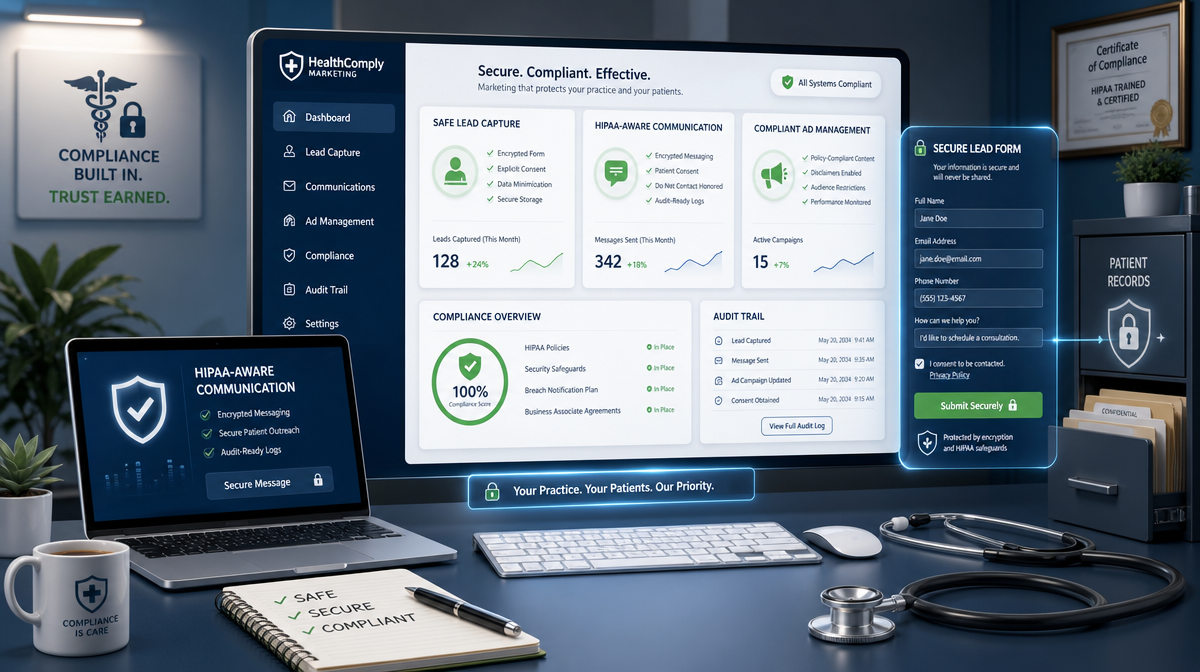
Most agencies will tell you they work with healthcare clients. That’s a very different claim from working exclusively with healthcare practices — and that gap matters more than most practice owners realize when evaluating their options.
Use these four criteria to cut through the sales pitch and identify agencies that will actually move your schedule:
- Verify healthcare-only specialization: Ask directly what percentage of their active clients are medical practices. An agency splitting time between dental offices, e-commerce brands, and restaurant chains has divided institutional knowledge. You want a team whose entire playbook was built inside healthcare.
- Review reporting and attribution transparency: Before signing anything, request a sample dashboard. It should show lead sources, cost per acquisition, and revenue attribution — not just traffic graphs. If they cannot connect a specific campaign dollar to a specific new patient, that’s a red flag worth taking seriously.
- Confirm in-house execution: Ask whether your SEO, paid ads, and creative work will be handled by employees of the agency or subcontracted to freelancers. In-house teams have accountability structures and institutional knowledge about your account that outsourced vendors simply do not.
- Ask about guarantees and contract terms: A confident agency backs its work with performance commitments and doesn’t require you to sign a 12-month lock-in before demonstrating results. Flexible terms signal that the agency earns your continued business month over month — which is exactly the relationship you want.
The right medical marketing agency will welcome every one of these questions without hesitation.
Signing a contract with a medical marketing agency is day one, not launch day. Most practices underestimate how much groundwork happens before a single ad goes live or a single page gets optimized — and having realistic expectations for that ramp-up period prevents frustration when the calendar doesn’t fill overnight.
A typical engagement moves through four distinct phases:
- Discovery and audit: The agency reviews your existing digital footprint — website, Google Business Profile, current ad accounts, review standing, and competitor positioning. This baseline determines where the biggest gaps and fastest wins exist before any work begins.
- Strategy development: Based on the audit, your team maps channel priorities, sets target cost-per-patient benchmarks, and builds campaign architecture specific to your specialty and market.
- Campaign setup and launch: Ads, landing pages, tracking infrastructure, and automation sequences get built and tested. Expect two to four weeks here — cutting corners on setup is where most underperforming campaigns go wrong.
- Ongoing optimization: This is where the compounding value lives. Paid campaigns typically show measurable lead volume within the first few weeks; medical SEO builds momentum over three to six months as rankings climb and organic traffic grows.
Throughout every phase, communication cadence matters as much as execution quality. Weekly check-ins or a live performance dashboard should keep you informed without requiring you to chase your account manager for updates. If you find yourself asking what’s happening with your campaigns, something is already off.

If you’ve read this far, you already know what separates a capable medical marketing agency from one that just cashes retainer checks. The next question is whether you’re working with the right partner right now — and if you’re not, what a better option actually looks like in practice.
Target Patients MD works exclusively with private practices — no e-commerce accounts, no restaurants, no SaaS companies diluting the team’s attention. Every system, every campaign template, and every optimization playbook was built specifically for the patient acquisition challenges you face as a practice owner.
The engine powering results for Target Patients MD clients is A.L.I. 360 — a proprietary AI-driven patient acquisition system that integrates paid search, medical SEO, reputation management, and automated follow-up into one coordinated platform. Rather than stitching together five separate vendors and hoping they talk to each other, you get a done-for-you infrastructure managed by a team that only knows one industry.
What this means for your schedule:
- Healthcare-only focus — zero learning curve on your specialty, your compliance requirements, or your patient decision cycle
- AI-powered optimization running continuously across every active campaign, not just during monthly review calls
- Done-for-you execution — no internal marketing hire required, no vendor coordination on your end
- Performance-backed terms — flexible agreements built around results, not lock-in
Book a free consultation with Target Patients MD and find out exactly what patient volume growth looks like for your specific practice type and market.
Practice owners evaluating a medical marketing agency tend to have the same handful of questions before they’re willing to sign anything. Here are direct answers to the ones that come up most often.
- How much does a medical marketing agency typically charge? Pricing structures vary considerably — monthly retainers, tiered packages by practice size, and pay-per-lead arrangements all exist in the market. Most full-service healthcare agencies fall somewhere between $1,000 and $3,000 per month depending on the channels involved and how competitive your local market is.
- How quickly can a medical practice expect new patients from marketing? Paid advertising can generate inbound inquiries within days of launch. Organic search growth operates on a longer timeline, typically three to six months before rankings produce meaningful volume. The mix of services you activate determines how quickly momentum builds.
- Can a medical marketing agency manage multiple practice locations? Yes — most agencies with genuine healthcare experience structure campaigns at the location level, with separate local SEO profiles, market-specific ad targeting, and individual performance tracking for each office.
- Do medical marketing agencies require long-term contracts? Terms vary widely. Some agencies require annual commitments before they’ll invest in setup; others operate month-to-month. Always ask for explicit cancellation terms in writing before you sign, regardless of what you’re told verbally.
- What is the difference between a medical marketing agency and an in-house marketer? An agency brings a full team — paid media specialists, SEO strategists, designers, and compliance-aware copywriters — for a fraction of what hiring and equipping all those roles internally would cost. An in-house hire offers proximity but rarely the depth of channel-specific expertise a practice needs to compete effectively.