



Medical website design is a specialized discipline — and “specialized” is doing a lot of work in that sentence. It’s not just about picking a color palette or uploading a headshot. It’s the process of building a digital presence specifically engineered for healthcare practices, where the stakes include HIPAA compliance, patient privacy, and the very real possibility that a poorly designed intake form could expose your practice to a federal audit.
What separates medical website design from general web development comes down to three things your typical freelance designer won’t think about until it’s too late:
- Patient-focused UX: Every page, button, and form is architected around one goal — getting a prospective patient from “I found this practice online” to “I have an appointment booked.” That’s a fundamentally different design brief than building a portfolio site or an e-commerce store.
- Compliance-first architecture: Healthcare regulations like HIPAA govern how patient data is collected, transmitted, and stored. A compliant site isn’t a bonus feature — it’s the foundation the entire build sits on.
- Conversion-optimized structure: Every element, from service pages to contact forms, is designed to move high-intent visitors toward becoming booked patients rather than just passive browsers.
Think of it this way: a generic website tells people your practice exists. A properly built medical website actively works to fill your schedule — and does it without putting you at legal risk in the process.
Here’s a number worth sitting with: 77% of patients use search engines before booking an appointment, according to research from Google and Compete Inc. That means before a single phone call is made, your website has already won or lost that patient. Not your front desk staff. Not your reputation in the community. Your website.
The problem most practices run into is treating their site like a digital business card — something that confirms you exist and lists your phone number. That approach costs you patients every single day. High-intent searchers — the ones actively typing “knee pain specialist near me” or “LASIK surgeon in [city]” — are comparing you to two or three competitors simultaneously. They’re making trust decisions in under eight seconds based on what they see on screen.
- First impressions determine trust: Patients judge your professionalism, competence, and quality of care based on your site before they’ve ever spoken to anyone at your practice.
- Mobile searchers expect instant answers: Over 60% of healthcare searches happen on a smartphone. A slow, unresponsive site sends those patients straight to your competitor’s booking page.
- SEO-ready design increases visibility: Effective medical website design ensures you actually appear when patients search — traffic you never capture can’t convert into appointments.
Generic websites underperform because they weren’t built around how patients actually make healthcare decisions. Professional medical website design closes that gap by turning your online presence into an active patient acquisition channel.

Most web design agencies will hand you a beautiful site and disappear. A healthcare-specialized agency operates on a completely different model — because your website isn’t a branding exercise, it’s a healthcare marketing asset that needs to perform on day one and keep improving from there.
The difference shows up in the details that generic designers simply don’t prioritize. When a healthcare-only agency builds your site, they’re thinking about which procedure pages drive consultation requests, how your Google Business Profile connects to your local search rankings, and whether your intake form will survive a HIPAA audit. That’s a fundamentally different scope than “make it look professional.”
Here’s what separates a top medical website design agency from the generalists:
- Healthcare-only expertise: Agencies that work exclusively with medical practices understand the patient decision cycle, specialty-specific trust signals, and the compliance requirements that non-healthcare designers routinely overlook.
- Custom builds around your growth goals: No recycled templates shared across dozens of competing practices — your site is architected around the specific services and patient demographics you want to grow.
- Compliance and marketing handled together: HIPAA, ADA accessibility, and SEO aren’t bolted on after the fact — they’re engineered into the build from the start, which saves you costly retrofits later.
- Ongoing optimization, not a one-time handoff: The best agencies treat your website as a living asset, refining performance with AI-powered optimization based on real conversion data rather than leaving you with a static site that ages out.
Your website’s feature set is the difference between a patient who books and one who bounces. Not every practice needs every possible bell and whistle — but there’s a core set of capabilities that separates a high-performing medical website from a digital placeholder that collects dust.
- Mobile-first responsive design: More than 60% of healthcare searches originate on a smartphone. Mobile-first means the site is engineered for small screens from the ground up, then scaled up to desktop — not the other way around. Google’s ranking algorithm now uses mobile performance as a primary signal, so this isn’t optional.
- HIPAA-compliant forms and email: HIPAA — the Health Insurance Portability and Accountability Act — governs how patient health information is handled digitally. Any contact form, intake form, or appointment request that collects patient details must encrypt that data in transit and at rest. Non-compliant forms expose your practice to penalties that start at $145 per violation.
- Built-in SEO and local SEO: Schema markup, location-specific service pages, and Google Business Profile integration help your practice surface when patients in your area search for the care you provide.
- Call tracking and analytics dashboards: These tools connect every inbound phone call and form submission to the specific page or campaign that generated it — so you know exactly what’s working and where to invest.
- Secure cloud hosting and SSL encryption: SSL is the padlock icon patients see in their browser bar. It encrypts data between their device and your server. Cloud hosting ensures fast load times and uptime reliability — both of which affect patient trust and search rankings.
- Lead capture and patient communication tools: Chat widgets, appointment request buttons, and CRM integrations convert passive visitors into scheduled appointments rather than letting them leave empty-handed.
A technically sound website can still quietly hemorrhage patients if the design decisions behind it aren’t grounded in how healthcare consumers actually behave. These principles apply whether you’re launching a new practice site or evaluating why your current one isn’t converting at the rate it should.
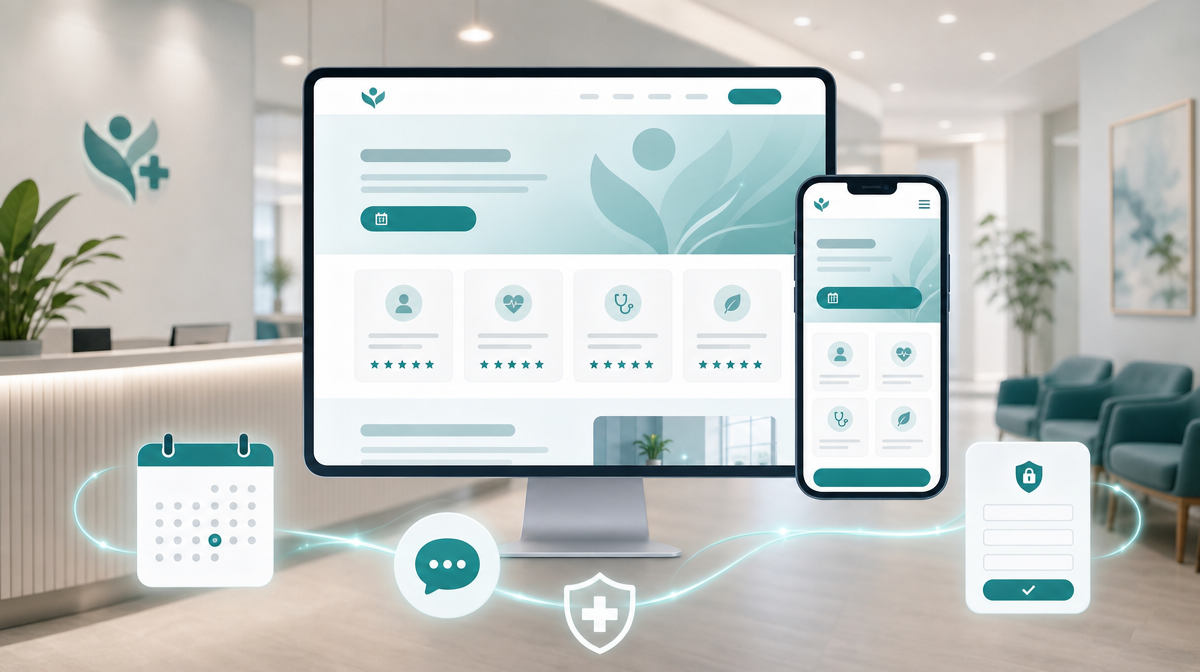
- Lead with trust and credibility: Board certifications, hospital affiliations, professional associations, and verified patient reviews belong above the fold — not buried on an “About” page. Healthcare decisions are trust decisions, and patients need social proof before they’ll pick up the phone.
- Keep navigation simple and intuitive: A confused patient is a lost patient. Services, locations, and contact options should be reachable in one or two clicks from anywhere on your site. Menus with 15 items competing for attention create friction, not engagement.
- Prioritize patient education content: Condition pages, procedure explanations, and FAQ sections serve two purposes simultaneously — they help prospective patients make informed decisions, and they signal topical authority to search engines. Both outcomes directly support new patient growth.
- Design for conversion, not just aesthetics: Every page your practice owns should carry a clear, unmissable call to action. A visually impressive site that doesn’t prompt visitors to book an appointment or request a consultation is essentially an expensive brochure.
- Optimize for speed and Core Web Vitals: Google’s Core Web Vitals measure real-world page experience — loading speed, visual stability, and interactivity. Compressed images, lean code, and quality hosting keep your scores competitive and your bounce rates low — a 100-millisecond delay can cut conversions 7%.
Building a medical website without a defined process is like performing surgery without a pre-op checklist — technically possible, frequently disastrous. The practices that end up with sites that actually generate new patients follow a deliberate sequence, not a “we’ll figure it out as we go” approach.
- Step 1. Define your patient acquisition goals: Start by identifying which services or procedures you want to grow and who your ideal patient is. A bariatric practice chasing self-pay weight loss surgery patients needs a completely different site architecture than a family dental office targeting insurance-based cleanings. Your goals dictate everything downstream.
- Step 2. Plan site architecture and patient journey: Map every page before a single pixel gets designed. Identify your highest-revenue service lines, build clear pathways from landing to booking, and ruthlessly cut any page that doesn’t serve a patient decision.
- Step 3. Build a mobile-first custom design: Resist the template shortcut. Custom visuals built for your specific brand — designed for small screens first — signal professionalism and differentiate you from the three other practices competing for the same search query.
- Step 4. Integrate compliance and security: Before launch, HIPAA-compliant forms, SSL certificates, ADA accessibility features, and secure hosting must all be in place. Compliance retrofitted after launch costs significantly more than compliance built in from the start.
- Step 5. Launch with SEO and conversion tracking: Going live without configured analytics and active call tracking means flying blind. You need performance data from day one to understand what’s working and where patients are dropping off.
Compliance isn’t a checkbox you tick before launch — it’s an ongoing legal obligation with real financial consequences for your practice. The two frameworks that matter most for your website are HIPAA and the ADA, and most practices either misunderstand what they require or discover gaps only after receiving a complaint.
- HIPAA-compliant forms, email, and hosting: Any web form that collects a patient’s name alongside a health concern — even something as simple as “I’d like to discuss my back pain” — qualifies as Protected Health Information under HIPAA. That data must be encrypted both in transit and at rest, stored on servers that meet federal security standards, and transmitted only through HIPAA-compliant email platforms. Standard Gmail or a default WordPress contact form won’t cut it. Your hosting environment needs to meet the same security bar, which means a Business Associate Agreement with your host is required.
- ADA and WCAG accessibility standards: The Americans with Disabilities Act extends to digital properties, and the Web Content Accessibility Guidelines (WCAG) define the technical standard courts use to evaluate compliance. Your site needs to support screen readers, enable full keyboard navigation, and maintain sufficient color contrast ratios throughout. Practices that skip this face an increasingly active plaintiffs’ bar — ADA website lawsuits have risen sharply, with over 5,000 filed in 2025.
- SSL, HTTPS, and data encryption: HTTPS encrypts every data exchange between a visitor’s browser and your server. Any page collecting personal information — insurance details, contact data, appointment requests — legally and ethically requires it. Google also uses HTTPS as a ranking signal, so an unencrypted site loses ground in search results and in patient confidence simultaneously.
Not every specialty plays by the same rules when it comes to medical website design — and a one-size-fits-all approach leaves patient revenue on the table. The design priorities for a med spa are genuinely different from those of a bariatric surgery program, and patients in each specialty are in completely different emotional and decision-making states when they land on your site.
- Medical spa: Medspa patients expect a premium, aspirational experience before they ever walk through your door. Luxury aesthetics, high-resolution treatment galleries, transparent service menus, and frictionless online booking are non-negotiable. If your site feels clinical rather than indulgent, you’re losing cosmetic patients to competitors whose med spa marketing strategies match the experience patients expect.
- Plastic surgery: Elective procedure patients conduct longer research cycles than almost any other specialty, making plastic surgery digital marketing especially dependent on trust signals. Surgeon credentials, before-and-after galleries, and authentic patient testimonials carry disproportionate weight here — financing options and clear consultation pathways close the gap between interest and booked consult.
- Dental: Family dental patients want simplicity: what services you offer, whether you accept their insurance, and how fast they can get an appointment. Approachable design with immediate access to scheduling outperforms elaborate visual presentations every time.
- Ophthalmology: LASIK and cataract patients research extensively before committing. Procedure education pages, technology differentiators, and strong consultation CTAs are the design levers that convert researchers into booked evaluations.
- Bariatric: Weight loss surgery patients need both information and reassurance across a longer decision journey, making bariatric practice websites uniquely demanding to build well. Seminar registration tools, success stories, and educational content addressing common fears support conversion at each stage of that process.

Picking the wrong agency is an expensive mistake that goes beyond wasted budget — a bad build can actively suppress your rankings, expose your practice to compliance liability, and cost you months of lost patient revenue while you start over. Choosing the right medical marketing agency upfront pays for itself.
- Healthcare-only experience and track record: Agencies that split their time between medical practices, restaurants, and law firms have divided expertise. Look for a partner whose entire portfolio lives inside healthcare — they’ll recognize specialty-specific patient behavior patterns and compliance landmines that generalists simply won’t anticipate.
- Proof of patient acquisition results: Impressive-looking portfolios are table stakes. Ask for evidence that connects the work to measurable outcomes — new patient volume, consultation request rates, or appointment growth. If an agency can only point to traffic metrics, that’s a red flag.
- In-house design, development, and marketing: When agencies outsource pieces of the project offshore or to subcontractors, quality control breaks down and timelines slip. An in-house team means one accountable partner, faster problem resolution, and no telephone-game communication failures.
- Area exclusivity and design ownership: Confirm in writing that you’ll own the finished website outright — domain, code, and content — and that the agency won’t build an identical site for a competing practice in your market. Both protections are standard with reputable partners and non-negotiable for your investment.
- Transparent reporting and ongoing support: Monthly performance reporting, proactive strategy input, and responsive communication after launch are what separate a long-term growth partner from a vendor who cashes your check and moves on.
Cost is usually the first question practice owners ask and the last one that gets answered clearly. So here’s the honest version: medical website design pricing varies widely based on what you actually need, and the cheapest option almost never delivers the patient volume that justifies the investment.
Four variables drive most of the cost difference between proposals you’ll receive:
- Template vs. custom build: Pre-built templates carry lower upfront costs but limit how distinctly your practice can stand out — and they’re frequently shared across multiple providers in overlapping markets. Custom design costs more initially but functions as a proprietary asset rather than a commodity.
- Feature complexity: A basic informational site and a site with HIPAA-compliant intake workflows, EHR integrations, and automated appointment reminders are different products at different price points. The features that drive patient conversion are the ones that add cost.
- Ongoing services: The build price rarely covers what keeps the site performing — hosting, security updates, SEO maintenance, and content development are typically recurring costs that should factor into your annual budget, not afterthoughts.
- Agency specialization: Healthcare-specific agencies command higher rates than general web shops, and the premium is generally justified by the outcome. An agency that understands patient acquisition builds toward measurable revenue, not just deliverables.
The right framing isn’t “how much does this cost” — it’s “what does a new patient generate in lifetime revenue for my practice, and how many does this site need to book to pay for itself?”
Your practice has one shot at a digital first impression, and the margin for error is exactly zero. Patients who can’t find you, don’t trust what they see, or can’t figure out how to book an appointment within seconds are gone — and they’ve already moved on to a competitor whose site made it easy.

That’s the problem a healthcare-specialized agency solves. Not just design, but a complete patient acquisition system: the technical infrastructure, the compliance framework, the conversion architecture, and the ongoing optimization that keeps your pipeline full month after month.
At Target Patients MD, we’ve built our entire practice around one outcome — getting you more patients. We serve 735+ medical practices across the US and Canada and work exclusively in healthcare — measuring our work by one thing: new patients booked, not activity metrics.
When you’re evaluating your options, the question worth asking isn’t which agency has the nicest portfolio. It’s which partner understands your specialty, owns every piece of the build in-house, protects your market with area exclusivity, and can show you a direct line between their work and booked appointments.
If you’re ready to stop leaving patients on the table and start treating your website as the revenue-generating asset it should be, learn more about how Target Patients MD approaches medical website design — and what a practice built to convert actually looks like.
Answers to the questions practice owners ask most often before committing to a medical website design project.
- How long does it take to build a medical practice website?
Most custom medical websites take four to six weeks from kickoff to launch, depending on how complex your service offerings are and how quickly your team can supply content, imagery, and provider information. Template-based builds move faster but sacrifice the differentiation and performance that custom architecture delivers. - Will I own my medical website design after launch?
With a reputable agency, yes — you should own the domain, the code, and every piece of content outright. Confirm this in your contract before signing, because some agencies retain ownership as leverage to prevent you from switching partners. - Can an existing medical website be redesigned without losing SEO rankings?
Yes, provided the agency executes a proper SEO migration — including redirect mapping, preserved URL structures where possible, and reindexing protocols. Done correctly, a redesign can actually improve your rankings rather than disrupt them. - Do medical practice websites require ongoing maintenance?
Absolutely. Security patches, plugin updates, content refreshes, and Core Web Vitals monitoring are ongoing requirements — not optional extras. A site left untouched after launch degrades in both performance and search visibility over time. - Why is SEO important for a medical practice website?
A well-designed site that patients can’t find organically depends entirely on paid advertising to generate appointments. Local SEO ensures your practice surfaces when nearby patients search for the specific services you offer — making organic visibility a core revenue driver, not an afterthought.