


Most marketing agencies will tell you they can grow any business. Ophthalmology practice marketing makes a different demand: it has to work exclusively within eye care, building patient pipelines specifically for LASIK, PRK, SMILE, cataract surgery, and general ophthalmology practices. That narrow focus is the entire point.
The distinction matters because eye care patient acquisition operates nothing like marketing a restaurant, law firm, or even a general medical practice. Refractive surgery patients spend weeks or months researching before they ever request a consultation. Cataract patients often need education before they recognize the procedure is even an option. A generalist approach treats both audiences identically — and that’s where budget disappears without results.
At its core, effective ophthalmology practice marketing handles four interconnected functions:
- Patient acquisition campaigns: Driving qualified leads for specific procedures — not generic “eye doctor” traffic — through paid search, social advertising, and SEO built around refractive and medical eye care intent.
- LASIK and refractive surgery targeting: Reaching patients at the precise moment they’re comparing vision correction providers in your market, rather than at the top of a funnel they’ve already moved past.
- Reputation and review management: Building credibility across Google, Healthgrades, and Yelp, where 84% of patients check reviews before they ever visit your website.
- Conversion-focused digital assets: Designing websites and landing pages with one measurable goal — turning visitors into booked consultations, not just passive browsers.
Every one of these functions requires ophthalmology-specific knowledge to execute correctly. Without it, you’re paying for activity, not outcomes.
Think about what happens when a generalist team takes on your LASIK marketing. They research the keyword, build a campaign, and launch ads that look reasonable on paper. What they don’t know is that a LASIK prospect moves through many online touchpoints before booking — comparing surgeon credentials, reading procedure explainers, watching patient testimonials, and checking financing options. A campaign built without that behavioral map burns through budget chasing clicks that were never going to convert.
You need a partner who understands the full decision architecture of elective eye care, and that requires years of category-specific experience that no generalist can shortcut. Four dynamics make ophthalmology practice marketing genuinely different:
- Patient education requirements: LASIK and PRK candidates self-educate extensively before contacting a practice. Campaigns that skip the awareness and consideration stages produce expensive, unqualified leads.
- HIPAA obligations across every touchpoint: Patient data touchpoints — from intake forms to retargeting pixels — carry regulatory obligations that standard advertising platforms don’t enforce automatically.
- High-value elective procedures: A single booked refractive procedure represents meaningful revenue. Understanding that margin shapes how much you can responsibly spend per consultation and still generate positive returns.
- Competitive local markets: Several established refractive surgery centers compete for the same search queries in most metro areas, which means positioning and targeting precision determine who wins the appointment — not just who spends more.
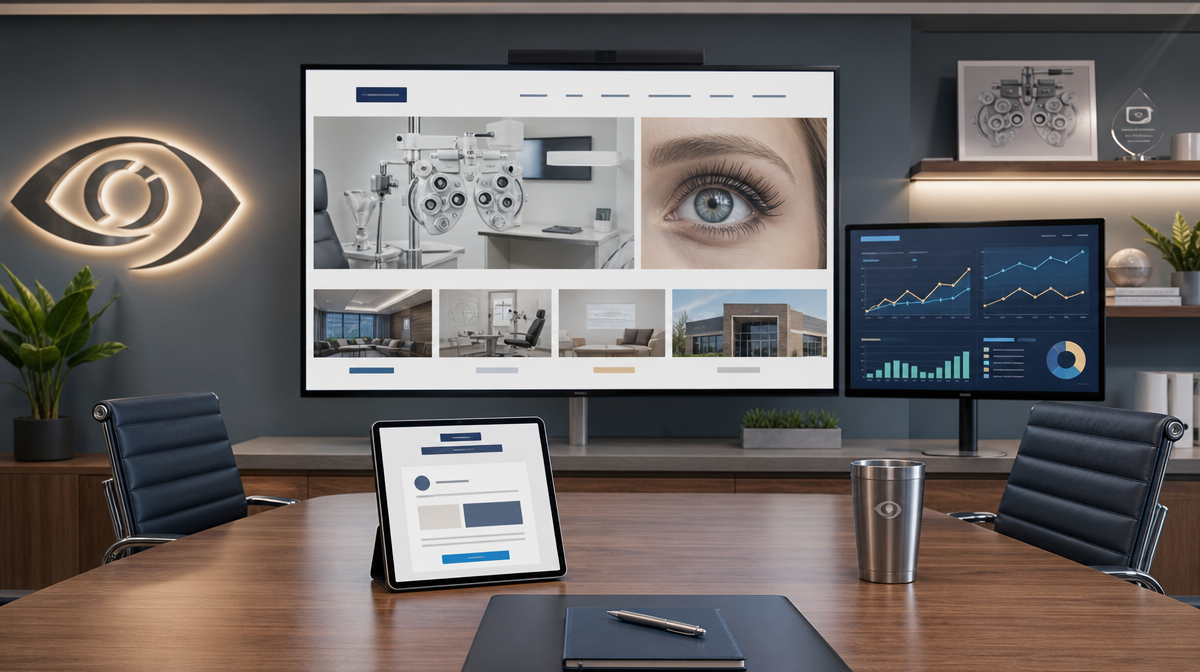
A specialist in ophthalmology marketing arrives with this knowledge already built in, which means your campaigns start from an informed baseline rather than an expensive learning curve.
The failure pattern is almost always the same: a team that markets everything markets nothing well. When a practice owner hands their budget to a team that splits attention between dental offices, dermatology clinics, and ophthalmology, the eye care campaigns get built on assumptions rather than category knowledge. The results look active on paper — impressions climbing, click-through rates reported weekly — while the consultation calendar stays half-empty.
Here’s what that failure actually looks like inside your practice:
- One-size-fits-all campaigns: A cataract candidate in their fifties and a LASIK prospect in their thirties have completely different triggers, timelines, and objections. Campaigns that treat them as interchangeable produce leads that don’t convert — because the message never matched the patient.
- Vanity metric reporting: Reporting focused on impressions and session counts measures activity, not your revenue. Booked consultations and procedure conversions are the only numbers that pay your overhead.
- No grasp of patient financing: Many qualified LASIK candidates hesitate at the out-of-pocket cost. Ophthalmology practice marketing that doesn’t build financing messaging into the funnel is leaving a predictable conversion gap open at exactly the wrong moment.
- Outsourced campaign execution: When your ads are subcontracted to a generalist freelancer with no eye care background, the institutional knowledge that drives precision targeting simply doesn’t exist in the workflow.
Each of these gaps compounds. A mismatched message produces unqualified leads; unqualified leads inflate your cost per acquisition; inflated costs make returns impossible to defend — and the cycle repeats until you change partners.
Knowing what separates capable ophthalmology practice marketing from a forgettable version comes down to six specific capabilities — and most practices discover which ones their partner lacks only after months of subpar results.
- Healthcare-only specialization and HIPAA-conscious infrastructure: Teams that work exclusively with medical practices have already built the pixel configurations, form handling, and patient communication workflows that reduce exposure — without you having to audit them yourself.
- Refractive and LASIK patient targeting expertise: The LASIK patient has a distinct demographic profile, a predictable search trajectory, and a decision window measured in weeks rather than days. Specialists map campaigns to that timeline precisely; generalists guess.
- AI-driven acquisition and conversion optimization: A.L.I. 360 by Target Patients MD is a proprietary AI-powered patient-acquisition system for medical and dental practices — the name stands for Attract, Learn, and Influence — and it continuously tests ad copy, landing page elements, and bidding strategies in real time, adjusting at a speed static campaign management cannot match. Automated scheduling tools and chatbots then capture leads the moment intent peaks, rather than losing them to a voicemail.
- Conversion-focused website design: A site that loads slowly on mobile or buries the “Book a Consultation” button is functionally broken, regardless of how polished it looks. The strongest programs build pages with medical website design engineered to drive a single action.
- Multi-platform reputation management: Systematic review generation across Google, Healthgrades, and Yelp — combined with active monitoring and response — directly influences whether a prospect chooses your practice over the one two miles away.
- Transparent reporting tied to booked consultations: The right partner hands you a dashboard showing cost per booked consultation and procedure revenue attributed to each channel — not a PDF celebrating click volume.

When you’re vetting an ophthalmology marketing agency, the service menu tells you a lot about whether they actually understand eye care patient acquisition — or whether they’ve simply added “ophthalmology” to a generic healthcare package. Here’s what a genuinely qualified partner should bring to the table:
- SEO for LASIK, PRK, SMILE, and general ophthalmology: Ranking for procedure-specific searches like “SMILE surgery near me” or “best LASIK surgeon in [city]” requires keyword mapping, local citation building, and content structured around how refractive patients actually search — not just broad “eye doctor” terms that attract unqualified traffic.
- Paid search and social advertising for elective eye procedures: Google Ads and Meta campaigns built specifically for refractive surgery use procedure-aware audience segments, financing-forward messaging, and retargeting sequences calibrated to the multi-week decision window typical of LASIK and PRK candidates.
- Custom website development built around consultation bookings: Mobile-first, fast-loading, and HIPAA-conscious — with scheduling integrations and trust signals (surgeon credentials, patient outcome data, financing options) positioned where they influence conversion decisions.
- Email marketing for lead nurture and patient reactivation: Drip sequences that move undecided prospects toward a consultation, plus reactivation campaigns targeting past patients who may be candidates for additional procedures or referral programs.
- Automated review generation and reputation monitoring: Systematic post-appointment review requests, multi-platform aggregation across Google and Healthgrades, and website widgets that surface patient testimonials at the exact moment a prospect is evaluating your practice against a competitor.
| Service | What It Does | Why It Matters for Eye Practices |
|---|---|---|
| SEO | Ranks your practice for LASIK/PRK searches | Captures high-intent patients actively researching |
| PPC | Immediate visibility on Google and social | Fills consultation calendar quickly |
| Website Design | Converts visitors to bookings | First impression drives trust |
| Email Marketing | Nurtures leads and reactivates patients | Increases lifetime patient value |
| Reputation Management | Builds and protects online reviews | Patients trust reviews like personal referrals |
Choosing who runs your ophthalmology practice marketing is a vendor decision with real financial stakes — a wrong hire costs you months of wasted spend and a stalled patient pipeline. A structured vetting process protects you from that outcome.
- 1. Verify healthcare-only industry focus. Ask directly: what percentage of your clients are medical practices? A team that also manages campaigns for restaurants, retailers, or law firms is dividing its attention across industries with nothing in common. You want people whose entire institutional knowledge lives inside healthcare.
- 2. Review quantifiable patient outcomes, not just traffic reports. Ask for documented results expressed in new patient volume, cost per booked consultation, and revenue impact. Anyone leading with website traffic or social follower counts is measuring their own comfort metrics, not your business results.
- 3. Audit reporting transparency before signing anything. Confirm you will have direct, ongoing access to campaign data — not a monthly summary email. The right partner gives you a live dashboard showing exactly where your budget is going and what it is producing.
- 4. Confirm in-house execution with specialty knowledge. Ask who specifically will manage your campaigns day-to-day. If the answer involves subcontractors or white-label partners, the ophthalmology expertise you are paying for may not actually be present in the workflow.
- 5. Ask how they define and report a result. A partner should be able to tell you, before you sign, exactly which number they will be judged on and how often you’ll see it. Vagueness here is the tell — anyone who can’t name the metric isn’t planning to be measured by one.
Your partner sends you a report every month. The real question is whether that report contains any information that helps you run a better practice — or whether it’s a collection of numbers that look impressive and mean nothing.
Serious ophthalmology practice marketing measures performance through four metrics that connect directly to your revenue:

- Cost per lead and cost per booked consultation: Divide total channel spend by the leads generated, then separately by consultations actually scheduled. These two figures tell you where your funnel is healthy and where it leaks. A low cost per lead paired with a high cost per booked consultation signals a qualification problem — your ads are attracting the wrong people.
- New patient volume and booked procedures: Monthly consultation count and procedure volume are the ultimate scorecards. Everything upstream — clicks, impressions, landing page visits — exists only to move these two numbers.
- Conversion rate lift and return on ad spend: Conversion rate measures the percentage of leads who become scheduled patients. Return on ad spend tells you how many dollars of procedure revenue each marketing dollar generated. For high-margin elective procedures like LASIK, even a modest improvement compounds significantly over a quarter.
- Organic rankings and local search visibility: Holding a top-three position for searches like “LASIK surgeon near me” or “cataract surgery [city]” generates patient inquiries without a per-click cost — lowering your blended acquisition cost as SEO matures alongside paid campaigns.
If your current partner cannot show you these numbers on demand, you are not being held accountable to outcomes — and neither are they.
Getting ophthalmology practice marketing wrong doesn’t just waste money — it costs you months of stalled growth while a competitor fills their consultation calendar. Knowing the warning signs before you sign a contract is worth more than any pitch deck.
- Long-term contracts with no defined reporting standard: A 12- or 24-month agreement that locks in your retainer while leaving “success” undefined is a red flag, not a standard business practice. Teams confident in their ophthalmology expertise are specific about what they’ll report and how often.
- Vanity metrics dressed up as progress: If your monthly report celebrates follower growth and page views while your phone isn’t ringing, you’re paying someone to look busy. Impressions and clicks don’t cover staff salaries or equipment financing.
- Campaigns recycled from unrelated industries: Ad copy and landing page frameworks built for a home services brand or a retail chain carry none of the trust signals, procedure education, or compliance considerations that eye care patients require. Repackaged templates produce repackaged results.
- Outsourced execution with no ophthalmology context: Some agencies win the account and hand the work to offshore freelancers or white-label partners who have never heard of PRK or SMILE. The strategy you were sold and the campaign that actually launches are two different things.
Ask any prospective partner who specifically handles your account, what their reporting covers, and how progress will be measured. Vague answers to direct questions are their own kind of answer.
Every practice owner reading this has sat through at least one presentation that promised transformation and delivered a spreadsheet of excuses. The pattern is familiar enough that skepticism is the rational default when evaluating a new partner.
What breaks that cycle isn’t a better pitch — it’s clearer measurement. Ophthalmology practice marketing done properly doesn’t ask you to trust a process; it reports against the outcomes your practice actually needs. Filled consultation slots. Scheduled procedures. Revenue that shows up in your books, not in someone’s impression report.

Three things separate practices that achieve predictable patient growth from those perpetually chasing it:
- Integrated strategy across every channel: SEO, paid advertising, reputation management, and website performance working from a unified patient acquisition plan — not four disconnected vendors pulling in different directions.
- Ophthalmology-native execution: Campaigns built by people who know the difference between a SMILE candidate and a cataract patient before they write a single line of ad copy.
- Reporting on revenue, not activity: Monthly reporting that answers one question — did your marketing investment produce more booked procedures than last month?
That combination is what Target Patients MD delivers for eye care practices. If your current marketing relationship can’t demonstrate all three, it may be time to find one that can.
Ready to see what specialized ophthalmology practice marketing can do for your practice?
Pricing varies based on your market size, the procedures you prioritize, and the channels you activate. Most specialists build custom packages — a solo refractive surgery practice in a mid-size market has different needs than a multi-location group competing in a major metro — so expect a scoping conversation before any numbers appear.
- How much does ophthalmology practice marketing typically cost? Monthly retainers for specialized eye care marketing generally range from a few thousand dollars for foundational SEO and reputation work to significantly more for full-service campaigns combining paid search, social, website management, and AI-driven optimization. Ad spend is typically budgeted separately on top of agency fees.
- How long does it take to generate new patients? Paid campaigns — Google Ads and Meta — can put your practice in front of qualified LASIK and cataract candidates within days of launch. Organic search rankings build over three to six months as content and local authority accumulate.
- Agency versus in-house marketing team? Building an in-house team capable of handling SEO, paid media, reputation, and web development requires multiple hires, platform subscriptions, and months of onboarding. A specialized partner arrives with that infrastructure already operational.
- How do HIPAA obligations affect digital marketing? Patient data collected through contact forms, scheduling tools, and ad pixels has to be handled carefully — compliance ultimately depends on how a practice configures and operates its own systems, but a healthcare-only team builds those considerations into its standard workflow rather than discovering them mid-campaign.
- Can one team handle both LASIK and general ophthalmology? Yes. Qualified specialists run distinct campaign tracks for refractive surgery and medical eye care simultaneously, with messaging and targeting calibrated separately for each patient type.