




If you’ve been running a medical spa for more than a few years, you’ve probably noticed that what worked in 2021 barely moves the needle today. The landscape has shifted—and not gently. The number of medspas operating in the U.S. has grown by over 70% in the past decade, according to the American Med Spa Association, which means your local market almost certainly has more direct competition than it did when you opened your doors.
That competition is expensive to fight. Cost-per-click on Google for high-value aesthetic treatments like Botox and CoolSculpting has climbed sharply, and Meta ad costs for the 35–55 female demographic—the core medspa buyer—have followed the same upward trajectory. You’re paying more to reach the same pool of patients.
Meanwhile, patient behavior has changed in ways that punish passive marketing. Prospective patients now research treatments across multiple platforms before picking up the phone—reading reviews on Healthgrades, watching provider Reels, comparing before-and-after photos on RealSelf, and checking Google ratings—all before a single consultation request. The average decision cycle for elective aesthetic services can stretch weeks.
And then there’s the search visibility problem that most practice owners don’t see coming. Google’s AI Overviews now answer common patient questions—”how long does Botox last?” or “what is microneedling?”—directly in the search results, reducing organic clicks by 38% on queries where they appear. Ranking on page one no longer guarantees the clicks it once did. Effective medical spa marketing ideas today have to account for all of these headwinds simultaneously, not just one at a time.
Most practice owners treating marketing as a series of disconnected campaigns—a promotional email here, a Facebook ad there, a Google listing that hasn’t been updated since the Obama administration—share a common frustration: unpredictable patient flow. Busy one month, thin the next. The problem isn’t effort. It’s architecture.
An effective medical spa marketing strategy functions as a system with three interdependent components working simultaneously rather than independently:
- Acquisition: The channels that introduce new patients to your practice—organic search, paid ads, referral networks, and local visibility. These fill the top of your pipeline.
- Conversion: The mechanisms that turn an interested prospect into a booked appointment—your website experience, consultation process, follow-up speed, and offer clarity. A leaky conversion stage means you’re paying to generate leads you never capture.
- Retention: The programs that bring existing patients back and motivate them to refer others. Retention is where the real economics of a medspa live, because repeat patients spend more and cost far less to serve than first-timers.
What separates high-performing practices from the rest isn’t access to better medical spa marketing ideas—it’s that every tactic they deploy connects back to one of these three pillars. A new Instagram Reel is only valuable if it feeds acquisition. A loyalty program only pays off if it measurably improves retention. The moment you start evaluating each marketing decision through this lens, you stop chasing tactics and start building something that compounds over time.
Patient behavior is shifting faster than most practice owners realize, and the medspas winning new bookings in 2026 are the ones who spotted these shifts early and adjusted their medical spa marketing ideas accordingly. Four specific trends are rewriting how patients discover and choose providers right now.
- AI Search and Generative Engine Optimization (GEO): Google’s AI Overviews don’t just summarize search results—they synthesize answers from content that’s structured to be cited. Practices investing in generative engine optimization—formatting their web pages with clear definitions, FAQ-style headers, and authoritative treatment explanations—are the ones getting pulled into AI-generated responses. If your content isn’t structured this way, you’re essentially invisible to a growing share of search traffic. Google’s own documentation confirms AI Overviews are expanding across health-related queries.
- Video-First Social Content: Patients researching injectables or body contouring want to see real procedures performed by real providers—not stock photography. Short-form video on Reels and TikTok consistently outperforms static imagery for aesthetic services, and practices that show the actual treatment experience build trust before the consultation request even arrives.
- GLP-1 Cross-Sell Opportunities: The explosion of GLP-1 weight loss medications (semaglutide, tirzepatide) has created a new patient pathway directly into aesthetic services. Patients losing significant weight are actively seeking skin tightening, body contouring, and injectable consultations—often within the same practice visit.
- Hyperlocal and Zero-Click Search: Patients searching “Botox near me” frequently call directly from the Google Maps result—42% of profile conversions happen without a website visit. Your Google Business Profile is now a patient acquisition channel in its own right, not just a directory listing.
Standing out in a crowded local aesthetic market isn’t about outspending competitors on ads—it’s about giving patients a reason to choose you before price ever enters the conversation. The practices that consistently win new bookings have done the hard work of understanding exactly where their local competition is weak, then built their positioning around those gaps.
Start by running a deliberate audit of your top three to five local competitors. Search your highest-revenue treatments combined with your city name, then document what you find across four dimensions:
- Website design and messaging: Does their site communicate a clear reason to choose them, or does it read like a generic service menu?
- Google reviews and rating: How many reviews do they have, and what do patients consistently praise or criticize?
- Service menu and pricing transparency: Are they hiding pricing, or are they confident enough to publish it?
- Social media content and engagement: Are they posting real provider content, or recycled stock imagery?
Once you know where competitors fall short, define your unique value proposition—the one-sentence answer to “why should a patient choose your practice over the medspa two miles away?” Strong UVPs tend to cluster around a specific differentiator: medical-grade supervision, proprietary treatment protocols, exclusive device access, or a luxury consultation experience competitors simply don’t offer.
Signature treatment bundles reinforce that differentiation further. Branded packages—combinations no competitor has named or marketed—give patients something distinctive to book and give you a natural anchor for all your medical spa marketing ideas across channels.
Digital channels give you something offline tactics never can: the ability to reach a patient the exact moment they’re actively searching for what you offer. The seven tactics below are sequenced intentionally—starting with your foundational infrastructure and moving toward the channels that amplify it.
- Build a conversion-focused medspa website: Speed, mobile responsiveness, and frictionless booking aren’t optional upgrades—they’re medical website design table stakes. HIPAA-compliant intake forms and call tracking tell you which marketing dollars actually produced a phone call versus which just generated traffic.
- Run Google Search Ads for high-intent treatments: Someone typing “lip filler [your city]” is closer to booking than any social media scroller. Dedicated landing pages for each treatment—not your homepage—are what turn that intent into a scheduled consultation.
- Launch Meta Ads with lookalike audiences: Upload your existing patient list and let Facebook build an audience of people who statistically resemble your best-paying patients. Layering retargeting on top catches the visitors who browsed your site but didn’t book.
- Create a personalized treatment quiz: An interactive quiz—”Which skin treatment is right for you?”—captures email opt-ins while educating prospective patients, making every follow-up sequence feel relevant rather than generic.
- Partner with nano-influencers: Creators with fewer than 10,000 local followers consistently outperform celebrity accounts on engagement rates. Gift a treatment in exchange for authentic content—no scripted talking points.
- Publish educational Reels and Shorts: Myth-busting videos, recovery timeline walkthroughs, and provider introductions build the kind of pre-appointment trust that shortens decision cycles significantly.
- Add online booking and AI live chat: Patients who can’t book instantly at 10 p.m. will find a competitor who lets them. AI chatbots handle FAQs and capture contact details around the clock without adding staff hours.
Digital channels get most of the attention in medspa marketing conversations, but the practices with the most consistent new-patient flow tend to have one thing in common: they’re also visible in the physical world. Offline tactics reach a different kind of prospect—neighbors who haven’t searched for your treatments yet but are exactly the right candidate for them.
- Host VIP and open house events: Invite-only evenings where prospective patients tour your facility, meet your injectors, and receive exclusive first-visit offers convert warm leads at a rate no cold ad campaign can match. People who walk through your door before booking arrive with trust already built.
- Co-market with local fitness and wellness studios: Your ideal patient is likely already spending money at a yoga studio or boutique gym nearby. A cross-promotional arrangement—shared flyers, reciprocal discounts, co-branded giveaways—puts your name in front of health-conscious locals who haven’t discovered you yet, at minimal cost to either party.
- Mail targeted direct mail offers: A well-designed postcard with a specific treatment offer and a QR code linking to a dedicated booking page still works, especially when mailed to demographically matched households within a defined radius of your practice. The physical format stands out precisely because everyone else is competing digitally.
- Sponsor local charity and community causes: Community sponsorships generate both brand awareness and local press coverage—two outcomes that paid ads can’t replicate. Practices that show up as genuine community stakeholders build a reputation that outlasts any single promotional campaign.
None of these tactics require a large budget. They require showing up consistently in the places your future patients already spend time.
When a prospective patient searches “microneedling near me” or “lip filler [your city]” on a mobile device, the decision of whether to call your practice or scroll past it often happens before they ever reach your website—88% of local mobile searchers visit or call within a day. Local SEO is the infrastructure that determines your visibility in that moment—and for medspas, it’s frequently the highest-ROI investment in the entire marketing mix.
- Optimize your Google Business Profile completely: An incomplete profile is a ranking handicap. Verify your NAP (name, address, phone) is exact and consistent everywhere, populate your service menu with individual treatment listings, upload fresh photos monthly, and publish weekly Google Posts promoting seasonal offers or new services. Practices with fully built-out profiles consistently outrank competitors in the local pack.
- Audit and correct local citations: Every directory listing where your business name, address, or phone number differs from your primary Google listing is quietly suppressing your local rankings. Run a citation audit through a tool like BrightLocal and correct discrepancies across Yelp, Healthgrades, RealSelf, and the major data aggregators.
- Earn hyperlocal backlinks: A link from your city’s Chamber of Commerce, a local news feature, or a neighborhood wellness blog carries more local ranking weight than dozens of generic directory submissions. Community sponsorships and local PR efforts often produce these links as a natural byproduct.
- Build neighborhood-level landing pages: If patients regularly drive from surrounding suburbs to visit your practice, dedicated pages targeting those ZIP codes and neighborhood names capture search demand your main city page never will—extending your local footprint without additional ad spend.
Medspas are inherently visual businesses, which makes social media less of a marketing option and more of a competitive requirement. The practices pulling consistent bookings from Instagram and TikTok aren’t the ones with the biggest budgets—they’re the ones posting content patients actually want to watch and share.
- Before-and-after galleries: Transformation imagery remains the most persuasive format in aesthetic marketing. Authentic, minimally edited photos outperform polished composites because prospective patients are trying to calibrate realistic expectations—not admire graphic design. Always secure proper HIPAA-compliant consent before publishing identifiable patient images.
- Provider spotlights and behind-the-scenes content: Patients choose injectors and aestheticians as much as they choose treatments. \”Meet the injector\” posts and day-in-the-life content humanize your team and reduce the anxiety that keeps fence-sitters from booking a first consultation. A familiar face converts better than an anonymous brand.
- Educational Q&A sessions and Instagram Lives: When your medical director or lead injector answers patient questions live—covering topics like \”how many units do I actually need?\” or \”what’s the difference between Dysport and Botox?\”—it positions your practice as the trusted clinical authority in your local market, not just another provider running promotions.
- Patient testimonial video clips: A 30-second genuine reaction from a satisfied patient carries more persuasive weight than three paragraphs of written copy. Short clips focused on the patient’s specific experience and outcome—filmed with a phone, not a production crew—consistently outperform polished branded content in engagement and saves.
Consistency across these formats matters more than production value. A practice posting two or three authentic pieces of content weekly will outperform one posting sporadically with expensive creative.
Paid media is where speed meets intent. While SEO builds visibility over months, a well-configured paid campaign can put your practice in front of patients who are actively pricing treatments before your next appointment slot opens. The challenge most practice owners face isn’t whether to run ads—it’s knowing which platform to deploy for which outcome.
- Google Search for bottom-funnel keywords: Queries like “Botox cost [city]” or “best CoolSculpting provider near me” signal a patient who has already decided to book—they’re just picking a provider. Tight match types combined with a robust negative keyword list (excluding terms like “DIY,” “training,” and “certification”) prevent your budget from subsidizing unqualified clicks that never convert.
- Meta retargeting and lookalike audiences: Someone who spent four minutes reading your filler page and then left without booking is a warmer prospect than any cold audience you can buy. Retargeting campaigns keep your practice visible to those high-intent visitors while lookalike audiences expand your reach to new patients who statistically mirror the ones who already booked.
- YouTube pre-roll for treatment awareness: A 15-second non-skippable ad introducing a body contouring treatment to someone watching fitness content costs a fraction of search CPCs and plants the consideration seed before the patient ever types a query. This is top-of-funnel work—don’t expect direct bookings, expect search volume to follow.
- Treatment-specific landing pages: Every ad pointing to your homepage is a conversion rate problem waiting to happen. A dedicated page for each treatment—matching the exact language of the ad, with a single clear call to action—is what separates practices achieving 8–12% conversion rates from those stuck at 2%.
Acquiring a new patient costs five to seven times more than keeping an existing one booked—which makes your email and SMS list one of the most underutilized revenue assets in your practice. The patients who have already experienced your results and trust your providers are far easier to convert than anyone seeing your name for the first time. The question is whether your follow-up infrastructure is actually capturing that opportunity.
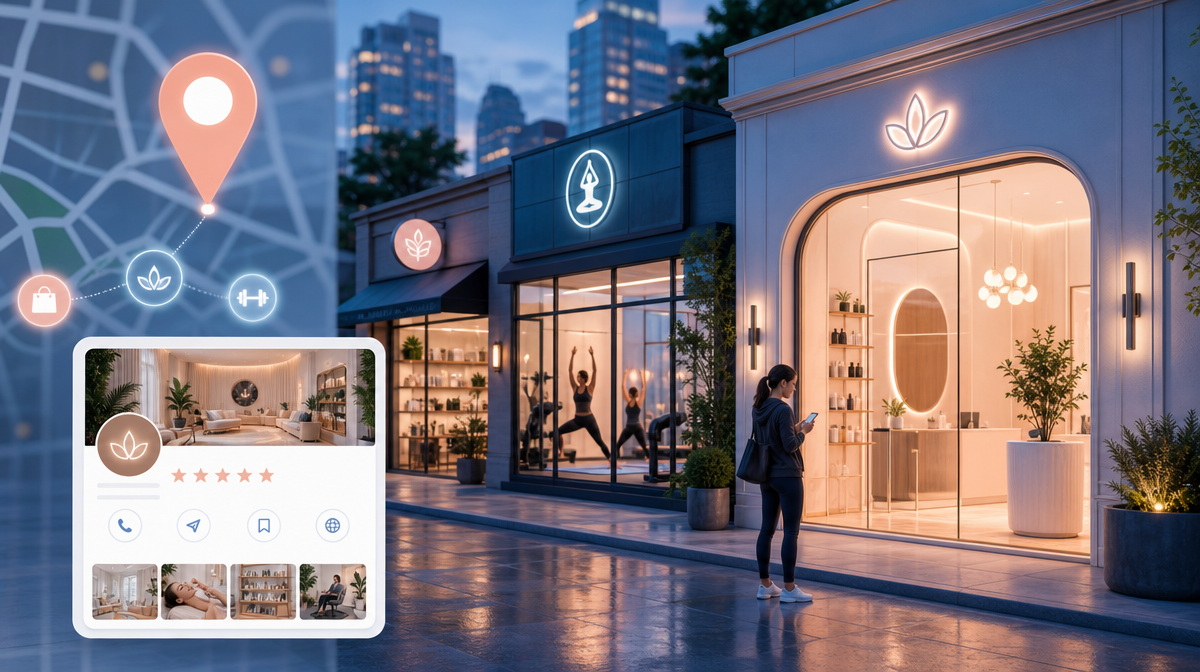
- Welcome and consultation follow-up sequences: The window between a consultation and a booking decision closes fast—often within 48 hours. An automated three-touch sequence (immediate confirmation, a day-two educational follow-up, and a day-five soft nudge with a specific offer) keeps your practice top of mind during the exact period when patients are most likely to go cold or choose a competitor.
- Reactivation campaigns for lapsed patients: Any patient who hasn’t visited in 90 days or more represents recoverable revenue. A targeted campaign—acknowledging the gap, highlighting a new service or seasonal offer, and making rebooking frictionless—routinely outperforms cold acquisition campaigns on cost per booked appointment.
- Birthday and membership anniversary offers: Milestone-triggered messages feel personal rather than promotional, which is why they convert at significantly higher rates than broadcast promotions. Automation handles the delivery; the perceived personalization does the selling.
- Pre- and post-treatment care reminders: Automated prep instructions before a procedure and aftercare check-ins following it reduce no-shows, improve outcomes, and generate the kind of patient satisfaction that produces organic referrals—without adding a single task to your front desk team.
SMS open rates consistently exceed 90%, compared to roughly 20–25% for email. Running both channels in parallel—email for longer educational content, SMS for time-sensitive offers—maximizes reach across your entire patient database.
Online reviews function as the most persistent sales team your practice will ever employ—87% of consumers read online reviews for local businesses—answering the unspoken question every prospective patient carries: can I trust this place with my face? Yet most medspa owners treat review generation as an afterthought rather than a structured program with defined processes and measurable targets.
- Automate review requests by text and email: Satisfaction peaks within two hours of a successful treatment—that’s your collection window. An automated text triggered by appointment completion, containing a direct link to your Google review page, captures feedback at precisely the moment patients are most enthusiastic. Practices that systematize this step typically see review volume multiply within 60 days without any manual outreach from staff.
- Monitor across every platform patients actually use: Your prospective patients aren’t checking just Google—they’re reading Yelp, RealSelf, Healthgrades, and Facebook before deciding whether to call. A negative review sitting unanswered on RealSelf for six months is actively costing you consultations. Monitoring tools that consolidate all platforms into a single dashboard make response management practical rather than overwhelming.
- Embed video testimonials directly on treatment pages: Written reviews confirm satisfaction. Video testimonials demonstrate it. A 45-second clip of a real patient describing her experience with your injector—placed on the relevant treatment landing page—gives hesitant prospects the social proof they need at the exact moment they’re evaluating whether to book. Collect consent carefully and display only HIPAA-compliant content.
Review velocity matters as much as average rating. A competitor with 4.7 stars and 800 reviews will consistently outrank a 5.0-star practice with 40—because volume signals trust to both patients and search algorithms simultaneously.
The most overlooked revenue lever in most medspa businesses isn’t a new ad platform or a trending treatment—it’s the patients already in your database who aren’t coming back as often as they could be, and the friends they haven’t referred yet. Structured loyalty and referral programs directly address both gaps, and the economics are hard to argue with: a patient on a membership plan visits more frequently, spends more per visit, and is statistically less likely to price-shop competitors.
- Tiered membership programs: Monthly membership models—where patients pay a recurring fee in exchange for discounted services, complimentary add-ons, or treatment credits—create predictable recurring revenue that stabilizes your calendar during slower months. Practices that convert even 15–20% of their active patient base to membership status often report measurable improvements in both revenue consistency and average patient lifetime value.
- Two-sided referral rewards: The most common referral program mistake is rewarding only the person doing the referring. When the new patient also receives a meaningful incentive—a first-visit discount, a complimentary consultation, or a product credit—participation rates climb significantly because both parties have a reason to act. One-sided programs feel transactional; two-sided programs feel generous.
- VIP treatment bundles for loyal patients: Exclusive packages reserved for your highest-frequency patients—combining multiple treatments at a preferred rate, or offering early access to newly launched services before they’re marketed broadly—reinforce loyalty without requiring a discount that devalues your standard pricing. Scarcity and exclusivity are more motivating than percentage-off promotions for your best patients.
The common thread across all three approaches is that they reward behavior you already want—repeat visits and warm referrals—rather than trying to manufacture it through discounting alone.
Guessing whether your marketing is working is expensive. The practices that scale predictably aren’t necessarily spending more—they’re measuring the right things and cutting what doesn’t convert. Four KPIs separate a data-driven medspa from one that’s flying blind.

- Cost per lead vs. cost per booked appointment: These are not the same number, and confusing them is one of the most costly mistakes practice owners make. A campaign generating $25 leads sounds efficient until you discover only 10% of those leads ever schedule a consultation—making your real cost per booked appointment $250. Always track both, but optimize for the latter.
- Lead-to-patient conversion rate: Divide total booked appointments by total inbound inquiries over any given period. A healthy benchmark for medspas running structured follow-up processes typically falls between 30–45%. If yours is below 20%, the problem usually isn’t your ad targeting—it’s your response speed or consultation process, and fixing conversion is almost always cheaper than generating more volume.
- Patient lifetime value (LTV): The average medspa patient who stays engaged across multiple treatment categories over 24 months spends dramatically more than a one-visit Botox patient. Knowing your LTV tells you exactly how much you can rationally invest to acquire a new patient without eroding margin—a number every media buying decision should anchor to.
- Review velocity and average rating trend: Track how many new reviews you’re earning monthly, not just your current star rating. A practice gaining 30 new Google reviews per month while maintaining a 4.8 average is building compounding trust—while a static 5.0 with no recent activity signals dormancy to both algorithms and prospective patients.
Running every channel covered above—SEO, paid ads, reputation management, email sequences, social content, and local citations—as a coordinated system is a full-time job. Most practice owners who attempt it in-house discover the same thing within three months: something always slips. The ads run but the follow-up sequences stall. The Google Business Profile gets optimized once and then ignored. Reviews accumulate without responses. The whole engine sputters because no single person on your staff owns all of it.
Target Patients MD was built specifically to solve that coordination problem for medical spas and aesthetic practices. The A.L.I. 360 platform uses AI-driven optimization to run acquisition, conversion, and retention channels simultaneously—adjusting campaign performance continuously rather than waiting for monthly reporting cycles to reveal what’s not working.
What that looks like in practice for your medspa:
- SEO and Local SEO: Rank for high-intent treatment searches in your market
- Google and Meta Ads: AI-optimized campaigns with continuous performance improvement
- Reputation Management: Automated review generation and multi-platform monitoring
- Website Development: Conversion-focused, HIPAA-compliant medspa sites built to book
- Email and SMS: Patient outreach sequences that drive repeat bookings and reactivations
Target Patients MD works with over 735 practitioners and backs its work with a guaranteed new-patient commitment—meaning the accountability runs both directions. Results begin appearing within the first day of launch, not after a six-month ramp-up period that most agencies use as a buffer against underperformance.
Owners searching for practical medical spa marketing ideas tend to hit the same knowledge gaps regardless of how long they’ve been running their practice. These are the questions that come up most consistently—and the answers that actually move the needle.
- How much should a medical spa spend on marketing each month? Most established medspas allocate between 8–12% of gross monthly revenue to marketing, scaling toward the higher end during launch phases or when entering a newly competitive local market. The right number is ultimately determined by your target patient volume, current occupancy rate, and how aggressively you need to grow—not by a universal rule.
- What is the 3-3-3 rule in medical spa marketing? It holds that a prospective patient typically needs to encounter your brand at least three times, across three separate channels, within a three-week window before they’re psychologically ready to book. It’s the practical argument for running search, social, and email simultaneously rather than rotating channels one at a time.
- How long does it take to see results from medspa SEO? Organic rankings for competitive aesthetic keywords generally take four to six months to show meaningful movement. Paid search campaigns, by contrast, can generate booked consultations within the first week of going live—which is why most growth-focused practices run both in parallel rather than treating them as alternatives.
- Is influencer marketing worth the investment for a medical spa? Nano-influencers with tightly local audiences—under 10,000 followers concentrated in your metro area—routinely outperform larger accounts on actual booking conversions because geographic proximity and audience trust align with where your appointments actually happen.
- How do HIPAA rules affect medical spa advertising? Any patient photo, testimonial, or identifying detail used in marketing materials requires documented written consent. All intake forms, booking confirmations, and digital communications must route through HIPAA-compliant platforms—standard email and generic contact forms do not qualify.


