


If you’ve been running a medical weight loss practice for more than a few years, you already know that the marketing playbook you used in 2020 is essentially worthless today. The reason: GLP-1 receptor agonists — specifically semaglutide (the active ingredient in Ozempic and Wegovy) and tirzepatide (found in Mounjaro and Zepbound) — didn’t just introduce new treatment options. They fundamentally rewired how patients search for weight loss care.
Before GLP-1 medications dominated headlines, patients typically searched for broad terms like “weight loss program near me” or “diet doctor.” Today, those same patients are arriving at Google with highly specific, medication-driven intent. Search interest in “semaglutide” increased by over 3,000% between 2020 and 2024, and that demand surge pulled an entirely new competitive landscape into your market.
The competitors entering your space aren’t other local clinics. They’re well-funded telehealth platforms and direct-to-consumer compounding pharmacies with eight-figure ad budgets and nationwide reach. Traditional medical weight loss marketing — a decent website, some local ads, maybe a few Facebook posts — doesn’t move the needle when you’re competing against that kind of infrastructure.
Here’s what the data consistently shows, though: patients who want physician-supervised, in-person GLP-1 care still exist in significant numbers, and they’re actively looking for local providers. The trust gap between a faceless telehealth app and a credentialed physician in their community is real — and it’s your single most exploitable competitive advantage. The question is whether your marketing is structured to capture that demand before a competitor does.
The typical GLP-1 candidate walking into your clinic today looks different from the weight loss patient of five years ago. Demographically, they skew toward adults between 35 and 65 with a BMI of 30 or higher — a threshold that 40.3% of U.S. adults now meet — often carrying at least one comorbidity like type 2 diabetes or hypertension. Many have already tried commercial programs — Weight Watchers, Noom, calorie-restriction diets — without lasting success. What drives them to seek physician-supervised care now is a specific combination of clinical credibility and access to injectable medications they’ve seen discussed on social media or mentioned by their primary care doctor.
Understanding where these patients search is just as important as knowing who they are. The discovery journey typically spans multiple channels before a consult is ever booked:
- Google Search: High-intent queries like “semaglutide near me,” “tirzepatide weight loss doctor,” and “medical weight loss clinic [city]” dominate initial discovery — these are bottom-funnel patients ready to act.
- TikTok and Instagram: Patients in the awareness phase are consuming GLP-1 content from creators and other patients, forming opinions about treatments before they ever search for a provider.
- Primary care referrals: A meaningful percentage of your inbound patients arrive because their internist or family physician recommended supervised weight management.
- Pricing and financing pages: Out-of-pocket cost is a primary decision filter — patients who reach your website frequently navigate directly to pricing before contacting your office.
Effective medical weight loss marketing starts by mapping your channels to these specific behaviors, not guessing where patients might be looking.
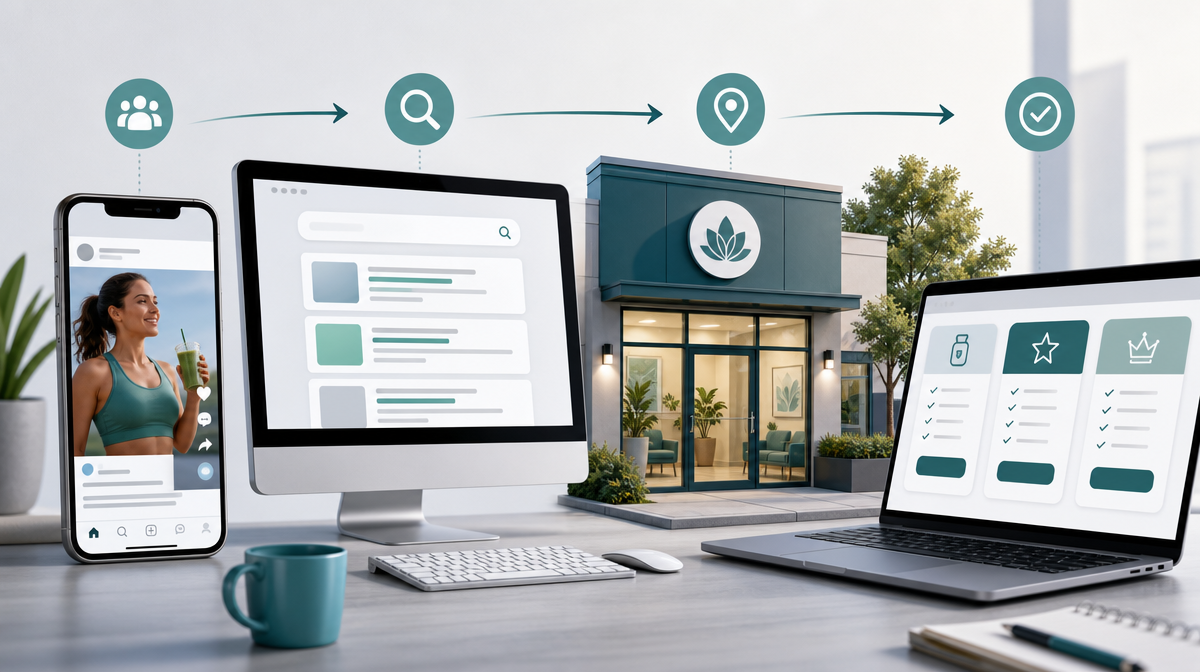
Most weight loss clinic owners think about marketing as a single event — run an ad, get a patient. In reality, the path from “I’ve heard of GLP-1” to “I just booked a consult” moves through three distinct psychological stages, and each one demands a completely different type of marketing response.
Map your channels to these stages before spending a dollar:
| Funnel Stage | Patient Mindset | Primary Channels |
|---|---|---|
| Awareness | “Is GLP-1 right for me?” | SEO, social content, video |
| Consideration | “Which clinic should I trust?” | Google Ads, reviews, website |
| Decision | “I’m ready to book” | Landing pages, SMS, retargeting |
The mistake most practices make is pouring budget into decision-stage channels — Google Ads, call-now landing pages — while neglecting the top of the funnel entirely. That works fine when demand is organic and steady. In the GLP-1 era, where patients are actively being educated by social platforms and national telehealth brands before they ever reach your ads, showing up only at the bottom means you’re competing for a patient who’s already half-committed to someone else.
The clinics winning at medical weight loss marketing right now are running all three stages simultaneously — building awareness through content and video, converting consideration through trust signals and targeted ads, and closing decisions with fast, frictionless follow-up systems. Think of it as a pipeline, not a campaign.
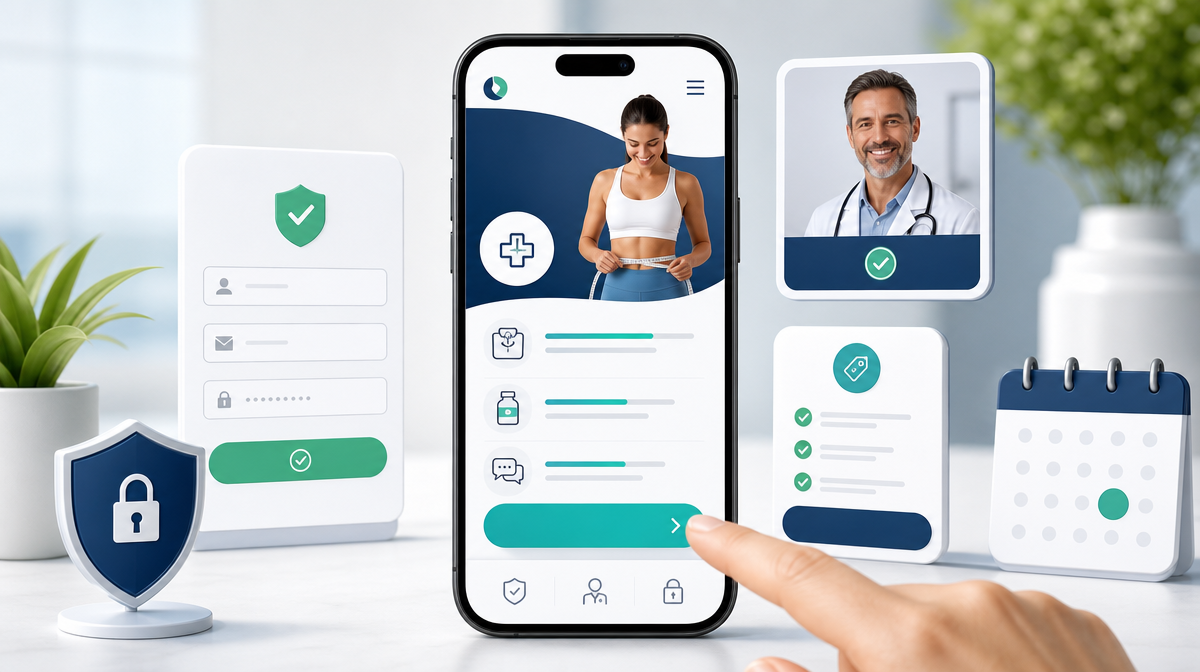
Your website is where a GLP-1 patient makes their first real judgment call about your practice — and in most cases, that judgment happens in under eight seconds on a smartphone. Getting your medical website design right isn’t a nice-to-have — it’s the difference between a visitor who books and one who bounces to a competitor’s page.
Four non-negotiables define a high-converting weight loss website in today’s market:
- Mobile-first design and sub-three-second load times: The majority of GLP-1 searches originate on mobile devices. A slow, desktop-optimized site bleeds conversions before a patient ever reads your headline.
- Dedicated landing pages per treatment: A single page for “weight loss” won’t cut it. Patients searching for tirzepatide need a tirzepatide page — complete with physician credentials, real patient reviews, and one clear call to action. Mixing treatments on a generic page dilutes trust and tanks conversion rates.
- HIPAA-compliant intake forms and encrypted hosting: HIPAA — the Health Insurance Portability and Accountability Act — governs how patient health data is collected and stored. Any form collecting name, weight, or medical history must sit behind SSL encryption, with your hosting environment built to handle protected health information. Non-compliance isn’t just a legal liability; it’s a patient trust issue.
- Upfront pricing with financing integration: GLP-1 program costs are a primary search query in their own right. Patients who can’t find pricing quickly assume the worst and leave. Instant quote tools and visible financing options — ideally integrated directly into your intake flow — dramatically reduce drop-off at the consideration stage.
Treat your website as a 24-hour intake coordinator, not a digital brochure.
SEO — search engine optimization — is the process of earning consistent, unpaid visibility in Google search results. For a medical weight loss clinic, it’s the one marketing channel that compounds over time: every well-optimized page you build today generates patient inquiries six months from now without an ongoing ad spend attached to it. That long-term ROI is why organic search typically outperforms every other channel on a cost-per-acquisition basis once it matures.
Three distinct areas drive SEO performance for weight loss practices:
- Local SEO and Google Business Profile: The “local pack” — those three map listings that appear at the top of location-based searches — captures a disproportionate share of clicks for queries like “semaglutide clinic near me.” Claiming and fully optimizing your Google Business Profile with accurate categories, current photos, weekly posts, and answered Q&A entries is the fastest path to appearing there. Practices with complete profiles receive significantly more direction requests and calls than those with thin or outdated listings.
- Treatment-specific service pages and location content: One dedicated page per treatment — semaglutide, tirzepatide, supervised programs — paired with city and neighborhood landing pages gives Google a clear map of what you offer and where you serve. Generic “weight loss” pages rank for nothing competitive.
- Authority through backlinks and physician-authored content: Backlinks are links from other websites pointing to yours — Google treats them as votes of credibility. Physician bylines on health publications, features in local press, and citations from medical directories build the domain authority that pushes your pages above competitors in organic rankings.
Organic search rewards consistency. Clinics that publish authoritative content and maintain their local presence month after month build a patient pipeline that paid channels simply cannot replicate.
Paid search delivers something organic rankings can’t: immediate patient visibility while your SEO strategy is still building momentum. The catch with GLP-1 campaigns specifically is that Google treats prescription drug advertising differently from nearly every other healthcare category — and clinics that ignore that reality burn through budget on disapproved ads and suspended accounts.

Four steps separate a profitable GLP-1 paid search program from an expensive mistake:
- Audit your account against GLP-1 ad policy first. Google requires LegitScript certification before you can run ads referencing prescription medications. Without it, campaigns referencing semaglutide or tirzepatide by name get flagged instantly. Compounded formulations face additional scrutiny. Pull your certification before writing a single ad, not after your first disapproval.
- Build search campaigns around bottom-funnel intent. Phrases like “GLP-1 weight loss doctor near me” and “physician supervised semaglutide program” signal patients who are ready to call — not just browse. Avoid broad match keywords that drain budget on irrelevant searches. Tight keyword lists with exact and phrase match controls keep your cost per consultation predictable.
- Add Performance Max only after search campaigns prove ROI. Performance Max lets Google’s AI distribute your ads across Search, Display, YouTube, and Gmail simultaneously. It works well once the algorithm has conversion data to optimize against — launching it cold, before you have a track record, typically inflates costs without improving quality.
- Track calls and form fills with server-side conversion data. Standard pixel-based tracking misses a significant percentage of conversions in healthcare due to browser restrictions and HIPAA-related tag limitations. Server-side conversion tracking routes attribution data directly, giving your campaigns accurate signals to optimize against. You cannot improve what you aren’t measuring correctly.
Facebook, Instagram, and TikTok intercept GLP-1 patients months before they ever type a search query — which makes paid social a fundamentally different tool than Google Ads. Where paid search captures demand that already exists, social advertising creates it. That distinction matters for how you structure your budget and what you expect each channel to deliver.
The first thing most practice owners learn the hard way: Meta has strict creative restrictions for weight loss content. Before-and-after photos are prohibited in ad creatives. Claims implying guaranteed outcomes will get your ads rejected. The workaround isn’t a loophole — it’s a reframe. Ads centered on physician expertise, program education, and the clinical supervision angle consistently clear policy review while outperforming promotional-style creative anyway.
Short-form video on TikTok and Instagram Reels is where trust actually gets built at scale. Patients watching a provider explain how tirzepatide dosing works — in plain language, on camera — develop a level of familiarity that no banner ad can manufacture. The content that performs best isn’t polished production; it’s brief, authentic, and clinician-forward.
The highest-ROI use of your social ad budget, though, is retargeting. This means showing tailored ads specifically to people who already visited your website or engaged with your content but didn’t book. Rather than spending to reach cold audiences repeatedly, retargeting puts a specific offer — a free consultation, a program overview, a financing option — in front of someone who already raised their hand. That warm-audience pool converts at a fraction of the cost of cold traffic.
Most of your patients aren’t clicking ten blue links anymore. When someone types “is tirzepatide safe for someone with high blood pressure” into Google, they’re increasingly getting a synthesized answer directly in the search results — no click required. That’s Google’s AI Overview in action, and it’s reshaping how patients discover weight loss providers before they ever visit a clinic’s website.
Generative Engine Optimization (GEO) is the practice of structuring your digital content so AI systems — Google’s AI Overviews, ChatGPT, Microsoft Copilot — cite your practice as a source when generating those answers. It’s an emerging layer of visibility that most local weight loss clinics haven’t touched yet, which means the window to establish early positioning is genuinely open right now.
Three content decisions move the needle on GEO performance for medical weight loss practices:
- Structure content in direct question-and-answer format: AI systems pull from content that clearly states a question and answers it concisely. FAQ sections built around real patient queries — “Who qualifies for a GLP-1 program?” or “How is physician-supervised treatment different from telehealth?” — are prime citation candidates.
- Add FAQ and MedicalClinic schema markup: Schema is code that labels your content for search engines and AI models. Properly tagged clinical content signals medical authority in a way that unformatted text simply cannot.
- Demonstrate E-E-A-T signals visibly: Physician credentials, board certifications, and clinical experience should appear explicitly on every treatment page — AI models prioritize content from verifiable medical experts when generating health-related summaries.
For clinics investing in medical weight loss marketing for the long term, GEO isn’t optional — it’s where patient discovery is heading.
Generating leads is the easy part to brag about. What actually determines whether those leads become paying patients is what happens in the first 15 minutes after someone submits a form — and most clinics are hemorrhaging revenue right there, in that gap between inquiry and follow-up.
Studies consistently show that response time is the single biggest predictor of lead conversion in healthcare. A prospect who fills out a weight loss intake form at 7pm and hears nothing until the next morning has already browsed three competitor sites by the time your front desk calls. Speed-to-lead isn’t a nice operational improvement — it’s a direct revenue lever.
A complete lead management system for a weight loss clinic covers four distinct functions:
- One-click intake forms: Simplified mobile forms with pre-filled field logic reduce abandonment dramatically. Every additional field you require cuts completion rates — ask only what you need to qualify the lead, nothing more.
- Automated instant quote delivery: GLP-1 patients want program pricing before they’ll commit to a phone call. Automated quoting with built-in financing options sends that information within seconds of form submission, keeping prospects engaged instead of searching elsewhere.
- Multi-touch SMS and email drip sequences: A single auto-response isn’t a follow-up strategy. Effective nurture runs five to seven touchpoints over several days — educational content, social proof, and a clear next step — while staying compliant with opt-in requirements.
- Lead scoring and call recording: Not every inquiry deserves the same urgency. Scoring leads by engagement signals lets your staff prioritize high-intent prospects for immediate outreach, while call recordings create a feedback loop for coaching and conversion improvement.
The practices seeing the strongest results from their medical weight loss marketing aren’t just driving more inquiries — they’ve built the infrastructure to close them.
Weight loss patients are skeptical in a way that patients seeking other medical services simply aren’t. They’ve been burned before — by supplements that didn’t work, programs that didn’t last, and before-and-after photos that turned out to be marketing fiction. That accumulated skepticism means your social proof has to work harder than in almost any other specialty.
Three reputation channels carry the most weight in medical weight loss marketing specifically:
- Automated review requests across multiple platforms: A single post-appointment SMS or email asking satisfied patients to share their experience — triggered automatically through your CRM — builds review volume across Google, Facebook, Healthgrades, and Yelp simultaneously. Practices managing reviews from a unified dashboard respond faster and maintain consistency across every platform where prospective patients are checking.
- HIPAA-compliant before-and-after photo galleries: Written patient authorization is non-negotiable before displaying any identifiable results. Beyond consent, the display itself matters — galleries embedded directly on your treatment pages, attributed to real patients with brief outcome descriptions, convert significantly better than stock imagery or vague testimonial quotes.
- Short-form video testimonials: A 60-second clip of a real patient describing their experience with your program outperforms paragraphs of written praise every time. Authenticity beats production value here — patients trust slightly imperfect, candid accounts far more than scripted testimonials filmed in professional studios.
The operational piece most clinics overlook: review generation shouldn’t depend on staff remembering to ask. When the request is automated and timed correctly — typically within 24 to 48 hours of a positive patient interaction — volume compounds month over month without adding a single task to your front desk’s workload.
Let’s address the elephant in the room: Hims, Ro, Calibrate, and their well-capitalized peers aren’t going away — compounded GLP-1 prescriptions continue rising despite regulatory scrutiny. They’re spending tens of millions annually on national ad campaigns, celebrity partnerships, and frictionless app-based prescribing. Trying to outbid them on the same keywords is a losing game — and frankly, it’s not the game you should be playing.
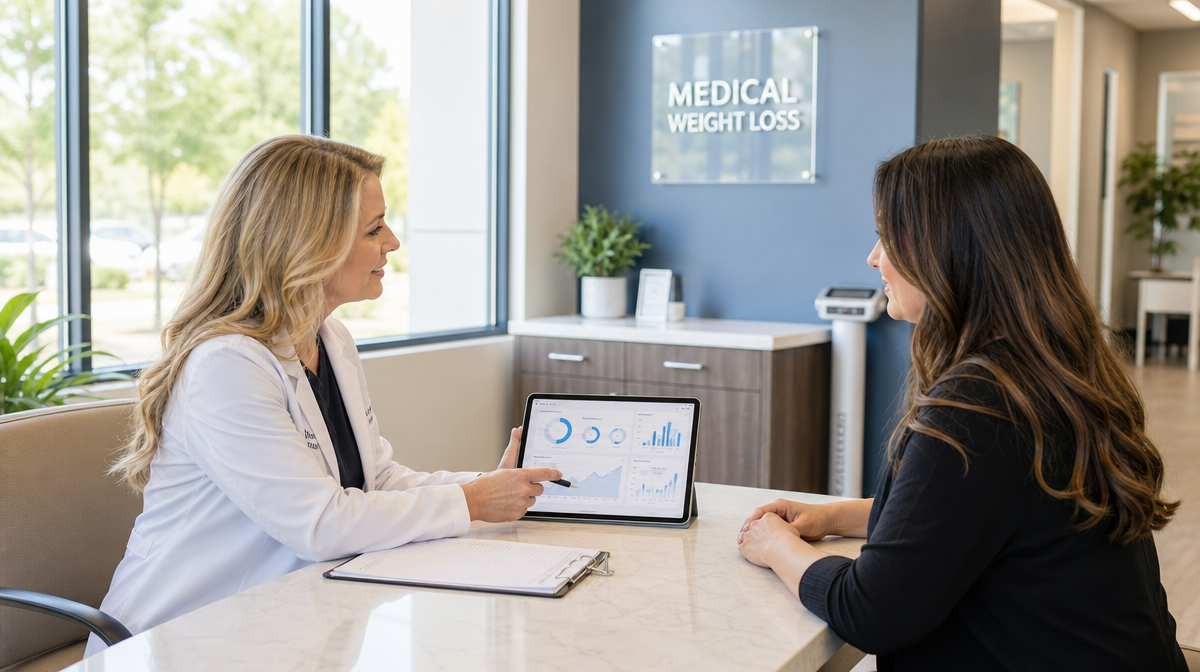
Your actual competitive advantage lives in the specific limitations of the telehealth model itself. Those platforms cannot order labs, perform physical examinations, administer injections, or adjust a protocol based on how a patient looks and feels in the room. When a patient on a telehealth GLP-1 program develops side effects, they submit a ticket. When your patient does, they call your clinic and speak to someone who knows their chart.
Position your medical weight loss marketing around three differentiators telehealth cannot replicate:
- Physician-led, in-person care: Baseline metabolic panels, body composition assessments, and supervised injection training aren’t optional extras — they’re what separates a clinical program from a prescription delivery service.
- Community credibility: A patient in your city can read your Google reviews, recognize your physician’s name, and walk into your office. That proximity converts skeptical patients that national brands routinely lose.
- Continuity of care: Telehealth platforms optimize for subscriber volume. You optimize for outcomes. Patients who’ve experienced the transactional nature of app-based prescribing often become your most loyal — and most vocal — referral sources.
The clinics growing fastest right now aren’t trying to compete on price or convenience. They’re winning on the care experience that a smartphone app structurally cannot deliver.
Every channel covered in a comprehensive medical weight loss marketing strategy — SEO, paid search, paid social, GEO, lead management, reputation — generates compounding returns only when the outputs feed each other. Your Google Ads campaigns produce the patient data that sharpens your landing page messaging. Your review volume strengthens your local SEO rankings. Your SMS follow-up sequences convert the leads your social retargeting warmed up. Treat any one of these as a standalone tactic and you’re leaving significant revenue on the table.
The clinics that measure ROI correctly aren’t tracking impressions or click-through rates — they’re connecting marketing spend directly to revenue per patient cohort. That means knowing your cost per booked consultation, your show rate, your program enrollment rate, and your average patient lifetime value across a 12-month GLP-1 treatment cycle. Those four numbers tell you exactly which channels deserve more budget and which ones need to be restructured.
If building and managing that integrated system in-house sounds like a second full-time job layered on top of running a clinical practice, that’s because it is. The practices scaling fastest in this market aren’t doing it alone — they’re partnering with a medical marketing agency that understands the specific compliance landscape, patient psychology, and platform dynamics of medical weight loss.
Target Patients MD’s A.L.I. 360 platform combines AI-powered patient acquisition, HIPAA-compliant lead management, paid media, local SEO, and reputation management into a single done-for-you system built specifically for medical practices. Learn more about Target Patients MD and what a fully integrated patient acquisition engine looks like for your clinic.
Running a physician-supervised weight loss program generates specific operational and marketing questions that don’t have clean, universal answers — costs vary by market, timelines shift with competition, and platform rules change faster than most clinics can track. The questions below address the gaps that practice owners most frequently encounter when building or scaling their medical weight loss marketing programs.
- How much should a medical weight loss clinic spend on marketing each month? Most clinics allocate between 8% and 12% of gross revenue to marketing, scaling that investment as patient volume grows. Your local competitive density matters significantly — a clinic in a mid-size market with few GLP-1 competitors can grow on a leaner budget than one in a major metro where telehealth brands are actively bidding on the same keywords.
- Can I advertise Ozempic, Wegovy, or compounded semaglutide on Google? Advertising branded GLP-1 medications requires LegitScript certification through Google’s Healthcare and Medicines program. Compounded semaglutide and tirzepatide face additional scrutiny following FDA regulatory changes, so review Google’s current policy documentation before structuring any campaign around compounded formulations.
- How long does medical weight loss SEO take to produce results? Meaningful organic ranking improvements typically emerge within four to six months of consistent optimization. Paid search fills that gap — clinics running both channels simultaneously avoid the revenue dead zone while organic authority builds.
- What is a realistic cost per lead for a GLP-1 clinic? While healthcare search ads average $66.02 per lead according to LocaliQ benchmarks, raw lead cost is the wrong metric to optimize. Track cost per booked consultation instead — a $40 lead that never shows up is more expensive than an $85 lead that enrolls in a 12-month program.
- Do I need a separate website for my weight loss program? A dedicated landing page or microsite consistently outperforms a buried subpage on a multi-specialty practice site, particularly when your primary site covers unrelated services. Conversion testing will confirm what works for your specific patient audience.