


Run a practice in Manhattan, Brooklyn, or Queens, and you already know your competition isn’t a handful of local clinics — it’s dozens of them within a single ZIP code. New York City packs more licensed medical practices per square mile than any other market in the country, which means the rules of healthcare marketing NYC practices follow have to be fundamentally different from what works in, say, suburban Dallas or metro Denver.
But density is only part of the equation. Several overlapping dynamics make NYC its own category entirely:
- Hyper-local search behavior: NYC patients don’t search “dermatologist New York” — they search “dermatologist Astoria” or “orthopedist Park Slope.” Borough-level and neighborhood-level intent shapes every channel, from Google rankings to paid ad targeting.
- Multilingual patient populations: With over 200 languages spoken across the five boroughs, culturally relevant messaging in Spanish, Mandarin, Russian, or Haitian Creole isn’t a bonus feature — it’s a competitive differentiator that directly affects conversion rates.
- Premium ad costs: NYC CPCs for medical keywords routinely run 40–60% above national averages, meaning a poorly structured campaign bleeds budget fast without generating a single booked appointment.
- Sophisticated patient expectations: New Yorkers comparison-shop providers the same way they compare restaurants. They read reviews on three platforms, expect online booking, and 53% will bounce within three seconds if your site doesn’t load cleanly on a phone.
These aren’t obstacles — they’re filters. Practices that understand this environment and build their marketing around it gain a structural advantage that generic, one-size-fits-all strategies simply cannot match.
Your value proposition is the one-sentence answer to a question every prospective patient is silently asking: why should I choose you over the practice three blocks away? In a market as saturated as New York City, “experienced physician” and “compassionate care” don’t answer that question — every competitor’s website says the same thing, and patients can smell generic messaging from a Google search away.
A differentiated value proposition starts with picking a lane. Instead of marketing to every patient with every condition, the most effective NYC practices narrow their positioning around a specific patient type, treatment focus, or service model that competitors aren’t owning. That specificity is what makes messaging stick.
Three angles consistently separate high-performing practices from the noise in healthcare marketing NYC:
- Specialty depth: If your practice has concentrated expertise in one procedure or condition — say, hormone optimization or functional medicine — lead with that. Depth beats breadth when patients are comparing specialists.
- Access and convenience: Same-day availability, weekend hours, or a telehealth option addresses a pain point that credential-heavy competitors often ignore. NYC patients are time-poor and will pay a premium for frictionless access.
- Outcome-first messaging: Patients book consultations because they want a result — reduced pain, clearer skin, sustained weight loss. Lead with the outcome they want, not the degrees you earned to deliver it.
Once you’ve identified your differentiator, every marketing asset — your website copy, your Google Business Profile, your ad headlines — should reinforce that single, consistent promise.
When NYC patients need a doctor, they don’t open Google and type “physician New York.” They type “cardiologist Cobble Hill” or “urgent care Hell’s Kitchen.” That hyper-specific search behavior means your entire organic strategy has to be built around neighborhood and ZIP code targeting — not citywide visibility.
Think of local SEO as the foundation your paid ads and referral channels sit on top of. Without it, every dollar you spend driving traffic lands on a practice that Google doesn’t trust enough to surface when it matters most.
Four tactics separate NYC practices that dominate local search from those that stay invisible:
- Google Business Profile optimization at the borough level: Complete every field — primary category, services, Q&A, weekly posts, and photos showing your actual space. Practices with fully built-out profiles earn dramatically more map pack visibility than those treating GBP as an afterthought.
- Neighborhood-specific landing pages: One homepage cannot rank for “plastic surgeon Tribeca” and “plastic surgeon Midtown East.” Each high-value neighborhood where you want patients deserves its own dedicated page built around that local search intent.
- Consistent citations in NYC health directories: A citation is any online listing that shows your practice name, address, and phone number. Zocdoc, NYC Health + Hospitals-affiliated directories, and borough business listings all signal geographic relevance to Google — but only when your NAP data matches exactly across every platform.
- Long-tail procedure-plus-location keywords: Searches like “Botox injections SoHo” or “LASIK surgeon Financial District” convert at higher rates than broad terms because the patient has already decided what they want — they’re just picking who delivers it.
Organic rankings take months to build in NYC’s crowded search landscape, and waiting isn’t a patient acquisition strategy. Paid ads fill that gap — but only when they’re structured correctly for both compliance and conversion. HIPAA compliance in an advertising context means no targeting audiences based on health conditions, using secure form submissions on landing pages, and avoiding retargeting pixels that could inadvertently capture protected health information.
Three paid channels do the heaviest lifting for NYC practices:
- Google Search Ads for procedure-specific intent: Someone searching “knee pain specialist Murray Hill” has already decided they need care — they’re selecting a provider. Capture these high-intent patients with tightly structured campaigns pairing specific procedures with location terms, then layer in call extensions, location extensions, and sitelinks to boost click-through rates in a market where ad real estate is expensive.
- Meta and programmatic display for elective services: Facebook and Instagram ads work differently than search — they interrupt rather than respond. That makes them ideal for aesthetic procedures, weight loss programs, and wellness services where patients need awareness before they’re actively searching. ZIP code targeting lets you concentrate spend in high-income neighborhoods where cash-pay patients are concentrated. Programmatic display extends that reach across third-party sites your audience visits.
- Compliant retargeting sequences: Most visitors won’t book on their first visit. A compliant retargeting sequence — targeting by site visit behavior, never by health condition — keeps your practice visible: a reminder display ad, followed by a direct booking CTA. Simple, legal, and consistently recovers patients who otherwise disappear.
In a healthcare marketing NYC environment where CPCs run significantly above the $5.64 national average, every campaign element has to earn its place.
Paid ads and local SEO bring patients to your digital front door — but if your website doesn’t convert them into booked appointments, you’ve paid for window shoppers. A conversion-focused medical website isn’t about looking impressive; it’s engineered specifically to turn a first-time visitor into a scheduled patient before they open a new tab and call the practice across town.
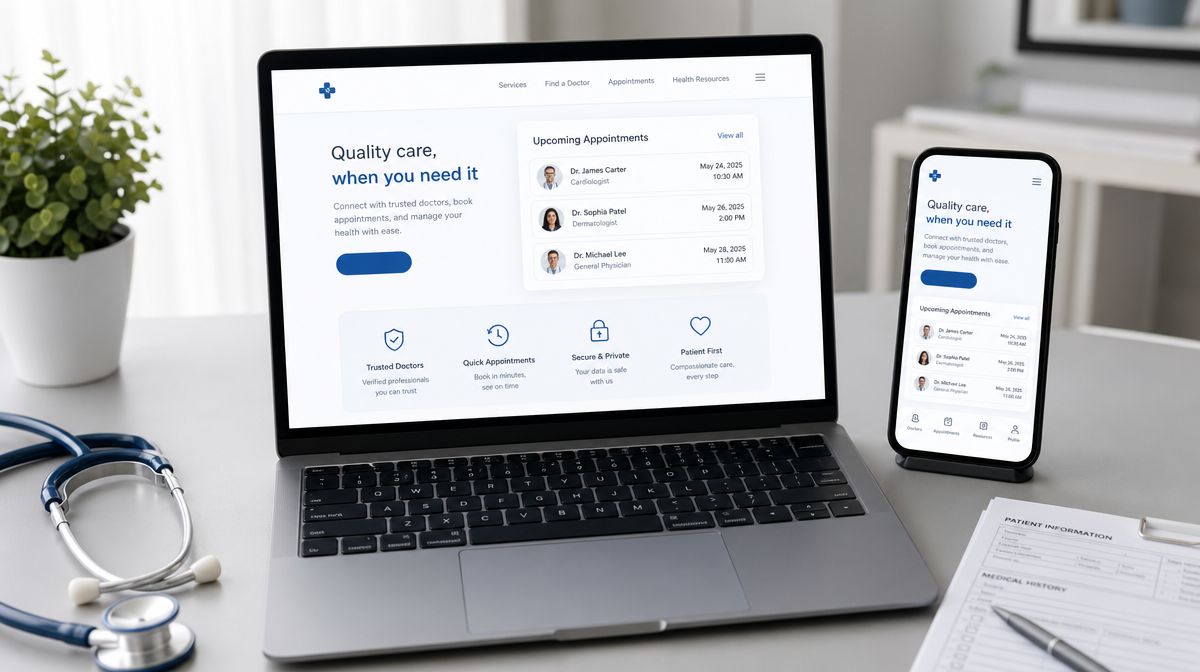
NYC patients browsing from a cab or a subway platform between stops won’t tolerate a slow, cluttered site. Mobile-first design isn’t a trend — it’s a prerequisite. Pages should load in under three seconds, navigation should work with a thumb, and a click-to-call button needs to be visible without scrolling. Every second of friction costs you a real appointment.
Three structural elements separate websites that book patients from websites that just exist:
- Frictionless scheduling: Patients who can’t book in two clicks or less will leave. Embedded online booking — shown to cut unused appointments by over half — eliminates the gap between interest and commitment.
- Procedure-specific service pages: A single services page cannot rank for multiple high-value procedures or build confidence in your specialty. Each treatment your practice offers deserves its own dedicated page targeting that specific search term.
- Visible trust signals: Board certifications, hospital affiliations, before-and-after galleries, and SSL-secured intake forms aren’t decoration — they answer the unspoken credibility questions patients are evaluating before they ever reach out.
In a healthcare marketing NYC environment where patients are choosing between dozens of comparable practices, your website is often the deciding factor — and most practices are losing that decision on page load.
In a city where a patient can choose between fifteen cardiologists within a ten-minute walk, reviews aren’t a nice-to-have — 84% of patients check them before choosing a provider. NYC patients treat Google, Healthgrades, and Zocdoc reviews the way they treat Yelp before trying a new restaurant: they read them, count them, and judge the ones you haven’t responded to just as harshly as the negative ones.
Reputation management is the active, systematic process of generating new reviews, monitoring what patients say across platforms, and responding in ways that build trust without violating privacy. Practices that treat it as passive — waiting for happy patients to voluntarily post — consistently lose ground to competitors who’ve automated the entire workflow.
Three components make up a reputation system that actually moves the needle in healthcare marketing NYC:
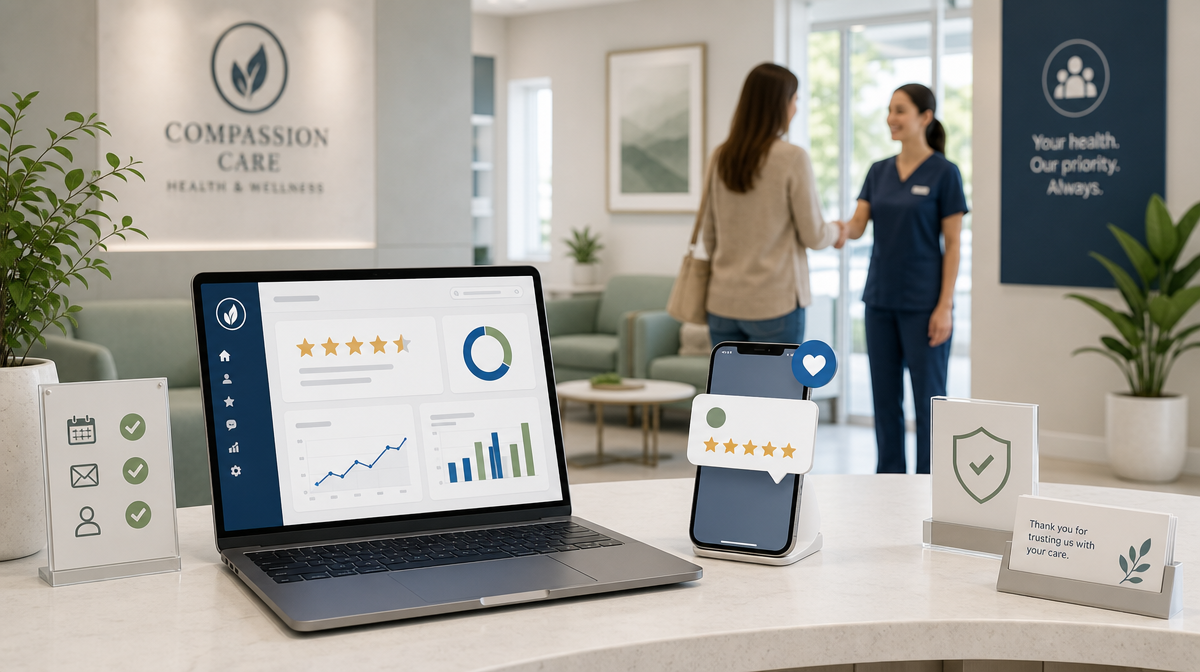
- Automated post-appointment review requests: SMS and email sequences triggered within hours of a visit capture satisfaction while it’s highest. Waiting days means the moment has passed. Target platforms include Google, Healthgrades, Zocdoc, Vitals, RateMDs, and Facebook.
- HIPAA-compliant response templates: Responses to reviews — positive or negative — cannot acknowledge the patient relationship or reference any clinical details. A well-crafted neutral response that thanks the reviewer and invites further conversation demonstrates professionalism without creating liability.
- On-site social proof integration: Embedding a filtered review widget directly on your website surfaces your strongest ratings at the exact moment a prospective patient is deciding whether to book. Video testimonials go further — a 60-second patient story outperforms a five-star rating on its own every time.
Most NYC patients decide whether to book a consultation long before they pick up the phone. They spend days — sometimes weeks — reading about their symptoms, comparing treatment options, and quietly evaluating which practice seems to actually understand their problem. If your practice isn’t producing content that shows up during that research phase, a competitor who is will own that relationship before you ever enter the picture.
Content marketing in a market as competitive as New York isn’t about publishing for publishing’s sake. It’s about positioning your practice as the most credible answer to questions your future patients are already asking. The practices winning at healthcare marketing NYC aren’t necessarily the most credentialed — they’re the most visible at the moment patients are forming opinions.
Three content categories consistently generate the highest-quality organic traffic for NYC practices:
- Procedure guides: Pages answering “what does recovery look like” or “am I a candidate for” capture patients who are close to booking but need one more layer of confidence. These aren’t general blog posts — they’re conversion assets.
- Condition explainers: Patients researching symptoms months before they’re ready to schedule are tomorrow’s appointments. Educational content that meets them early builds familiarity and trust that a paid ad never can.
- NYC-specific health content: Air quality concerns in Midtown, seasonal allergy patterns unique to the boroughs, stress-related conditions common to high-pressure urban lifestyles — tying your expertise to the city your patients actually live in signals relevance no national competitor can replicate.
Manual campaign management in a market where a single click costs $15–$40 and patient decisions happen across dozens of touchpoints is, frankly, a losing proposition. NYC’s ad environment moves too fast for weekly optimization reviews — by the time you’ve analyzed last Tuesday’s data, budget has already been misallocated. AI-powered tools change that math by processing performance signals continuously and making micro-adjustments that no human team running monthly reports can replicate.
“Cost per patient” is the number that actually matters: total marketing spend divided by new patients acquired. In NYC, where channel costs are elevated across the board, even modest efficiency gains compound quickly into meaningful savings.
- AI-driven keyword and competitor gap analysis: Machine learning tools scan thousands of search queries and competitor ad strategies simultaneously, surfacing high-opportunity terms your practice isn’t bidding on — and identifying which competitor positions are vulnerable to capture.
- Predictive budget reallocation: Instead of locking spend into a fixed channel split, AI systems monitor conversion data in real time and shift dollars toward whichever channel is producing the lowest cost per booked appointment at that moment. Our A.L.I. 360 system does exactly this across paid search, display, and social simultaneously.
- After-hours lead capture through intelligent chatbots: NYC patients research late — often after 9 PM when your front desk has been closed for hours. AI chatbots qualify leads, answer procedure questions, and initiate appointment scheduling without any staff involvement, turning overnight traffic into morning-ready appointments.
Practices using AI-optimized campaigns in competitive healthcare marketing NYC environments have documented patient acquisition cost reductions exceeding 30% compared to manually managed counterparts.
Getting a new patient through the door is a marketing win. Getting them to come back — and tell three colleagues — is where NYC practices actually build sustainable growth. In a city where people relocate boroughs, switch jobs, and discover new providers constantly, patient retention isn’t automatic. It has to be engineered.
The post-visit window is where most practices go completely silent, and that silence is expensive. A patient who leaves your office without any structured follow-up is a patient who forgets your name the moment something shinier appears in their Instagram feed. Deliberate post-visit communication closes that gap before a competitor fills it.
- Automated appointment reminders: SMS sequences sent 48 hours and the morning of an appointment consistently reduce no-show rates by 25–35% — which means fewer empty slots draining your schedule and your revenue.
- Post-visit surveys: A brief satisfaction check sent within 24 hours of a visit does two things simultaneously: it surfaces problems before they become public complaints, and it primes satisfied patients to leave a review while the experience is still fresh.
- Personalized re-engagement outreach: Birthday messages, annual wellness check-in reminders, and treatment follow-up sequences signal that your practice treats patients as individuals — not appointment slots. In a healthcare marketing NYC environment this crowded, that distinction is what separates practices patients recommend from ones they forget.
Every touchpoint after discharge is a referral opportunity waiting to be activated or abandoned. The practices that systematize these moments build word-of-mouth pipelines that no paid campaign can fully replace.
Digital channels drive volume, but in NYC’s five boroughs, the patients who stay longest and refer most often come through relationships your practice builds at street level. A dermatologist in Williamsburg who sponsors the local running club gets something no Google Ad can manufacture: familiarity before the appointment ever happens.
Physician referral networks deserve particular attention if your practice depends on insurance-based volume. PCPs and complementary specialists in your immediate geography — the internist two floors up, the endocrinologist across the block — are sitting on patient panels that match your ideal demographics exactly. A quarterly lunch, a brief educational presentation at a neighboring practice, or even a co-authored patient handout can establish a referral relationship that sends consistent monthly volume without ongoing ad spend.

Beyond physician-to-physician connections, three offline tactics consistently generate compounding returns in a healthcare marketing NYC context:
- Corporate wellness partnerships: Office buildings in Midtown, DUMBO, and Hudson Yards house thousands of employees whose employers actively seek health vendors for on-site screenings and lunch-and-learn events.
- Cross-promotions with complementary businesses: A physical therapy practice partnering with a yoga studio in the West Village, or a weight loss clinic cross-promoting with a nutritionist in Forest Hills, creates mutual patient introductions that neither party could generate alone.
- Neighborhood health events: Hosting a free blood pressure screening at a community center or co-sponsoring a borough health fair puts your practice name in front of residents who haven’t started searching yet — but will remember you when they do.
Every strategy covered above — neighborhood SEO, compliant paid ads, AI-optimized budgets, reputation systems — requires deep familiarity with how healthcare marketing actually works. A generalist agency learning HIPAA rules on your dime, or figuring out Zocdoc’s review ecosystem for the first time while billing you for it, is a liability you can’t afford in a market this expensive.
Target Patients MD works exclusively with medical practices. That specialization means compliance frameworks, specialty-specific patient behavior, and the nuances of NYC’s borough-by-borough search landscape aren’t things we research for you — they’re already built into how we operate. Across 735+ practitioners in the U.S. and Canada, the patterns of what drives booked appointments versus wasted spend are embedded in every campaign we build.
- Healthcare-only focus: Every campaign, landing page, and targeting decision is built around patient acquisition specifically — not repurposed from an e-commerce or B2B playbook.
- Real-time ROI dashboards: You see leads, cost per lead, and booked appointments updated continuously — not summarized in a monthly PDF that’s already outdated by the time it lands in your inbox.
- Accountable, outcome-based partnership: Our compensation is tied to the work that grows your practice, and our reporting connects every dollar to booked appointments and cost per patient — so you can judge us by results, not activity.
If healthcare marketing in NYC has felt like guesswork with someone else’s agency, the problem likely isn’t the channels — it’s the partner. Learn more about Target Patients MD and what a healthcare-only approach actually looks like in practice.
Straightforward questions deserve straight answers — here’s what NYC practice owners ask most often before committing to a marketing strategy.
- How much does healthcare marketing cost for NYC medical practices?
Monthly investment varies widely — a solo specialty practice might spend $3,000–$5,000 to compete locally, while a multi-location group targeting high-CPM Manhattan keywords could require $15,000 or more. Expect to budget 20–40% above what comparable campaigns cost in non-metro markets due to NYC’s elevated ad auction prices and competitive organic landscape. - What is a realistic timeline for NYC medical marketing campaigns to show results?
A well-structured paid search campaign can generate qualified appointment inquiries within 48–72 hours of going live. SEO, however, operates on a different clock — meaningful ranking movement in NYC’s saturated search environment typically requires four to six months of consistent effort before organic patient volume becomes measurable. - Are healthcare marketing campaigns in NYC automatically HIPAA compliant?
No — and assuming otherwise is one of the most common compliance gaps practices discover after the fact. HIPAA-compliant healthcare marketing NYC requires deliberate configuration: encrypted intake forms, condition-blind retargeting pixels, and proper Business Associate Agreements with any vendor that handles patient data. - Which marketing channels work best for cash-pay versus insurance-based NYC practices?
Cash-pay and elective practices typically see the strongest returns from Instagram and Facebook ads paired with aesthetic-keyword SEO, where purchase intent is visual and aspirational. Insurance-based practices generally extract more consistent volume from Google Search Ads and neighborhood-level local SEO targeting condition-specific queries.
Budget conversations make most practice owners uncomfortable, which is exactly why so many end up surprised by their first invoice from a generalist agency. Healthcare marketing NYC pricing doesn’t follow a national template — the variables that drive cost here are genuinely different from what you’d encounter in smaller markets.
Specialty matters more than most vendors will tell you upfront. A psychiatry practice competing for “therapist Upper West Side” faces a completely different auction environment than a cosmetic dermatology group targeting “filler injections Tribeca.” Keyword competitiveness, patient lifetime value, and procedure margins all influence what a realistic monthly budget looks like.
A few cost factors that are specific to the NYC healthcare environment:
- Ad auction density: More competing practices bidding on the same geographic terms drives up minimum viable spend to achieve meaningful impression share.
- Multilingual content requirements: Practices serving Spanish, Mandarin, or Russian-speaking patient populations need separate landing pages and ad sets, which increases production scope.
- Borough-level SEO complexity: Ranking across multiple neighborhoods simultaneously requires more content infrastructure than a single-location market strategy.
- Compliance overhead: HIPAA-configured tracking, encrypted forms, and proper vendor agreements add setup costs that generalist agencies typically don’t account for.
What’s consistent across specialties: underinvesting in a competitive NYC market produces worse outcomes than not marketing at all, because underfunded campaigns generate just enough data to look active while delivering no measurable patient volume.
The timeline question is one of the most honest conversations you can have before committing budget — and the answer in NYC is more nuanced than most agencies will tell you upfront.
Two fundamentally different clocks are running simultaneously when you launch a healthcare marketing NYC campaign, and confusing them is how practices end up disappointed:
- Paid search operates in days, not months: A properly built Google Ads campaign targeting procedure-specific keywords in your borough can surface appointment inquiries within 48–72 hours of activation. The caveat is that the first two to four weeks function as a calibration period — conversion data accumulates, bid strategies adjust, and cost per lead typically improves meaningfully by week three compared to day one.
- Social and display ads follow a similar rapid-launch curve for elective and aesthetic services, though audience refinement usually requires four to six weeks before you’re reaching the right ZIP codes at efficient CPMs.
- Local SEO moves on a longer horizon: Neighborhood-level rankings in a market with this much competition don’t shift in weeks. Expect four to six months before organic patient volume becomes consistently measurable — and twelve months before a full neighborhood content strategy reaches its ceiling performance.
- Reputation momentum compounds gradually: A review generation system typically produces visible star-count improvements within sixty to ninety days, but the trust signal that moves new patient decisions usually requires six months of consistent volume across multiple platforms.
The most effective approach treats paid channels as your immediate pipeline while SEO builds the long-term foundation underneath it.
Not even close — and the gap between “we’re running ads” and “our ads are HIPAA compliant” is where practices quietly accumulate regulatory exposure they don’t discover until something goes wrong.
The default settings on most advertising platforms are built for e-commerce, not healthcare. Without deliberate intervention, your campaigns may be doing things that violate patient privacy without anyone on your team realizing it:
- Standard tracking pixels can capture protected health information when a patient visits a condition-specific page or submits an intake form — information that ad platforms then store and use in ways HIPAA doesn’t permit.
- Contact forms without encryption transmit patient-submitted data over unsecured channels, which constitutes a breach regardless of whether anyone intercepts it.
- Missing Business Associate Agreements: Any third-party vendor that touches patient data — your ad platform, your CRM, your scheduling tool — legally requires a signed BAA. Most practices running healthcare marketing NYC campaigns through generalist agencies have never seen one.
- Condition-based audience targeting on Meta and Google, when improperly configured, can segment users by health-related behaviors in ways that cross compliance lines even if the intent was purely geographic.
Compliance isn’t a one-time checkbox — it requires ongoing configuration as platforms update their tracking architecture. A campaign that was compliant eighteen months ago may not be today. Working with a healthcare-specialized team means someone is watching those changes so you aren’t the practice that finds out the hard way.
The channel mix that fills a cash-pay practice’s schedule looks almost nothing like what drives consistent volume for an insurance-based one — and treating them the same way is one of the more expensive mistakes practices make when planning a healthcare marketing NYC budget.
Cash-pay and elective practices are selling a decision that patients make voluntarily, often after visual inspiration. That buying psychology favors channels where imagery and aspiration do the persuading:
- Instagram and Facebook ads reach patients who aren’t actively searching yet but respond to before-and-after content, procedure spotlights, and lifestyle-adjacent messaging targeted by ZIP code and household income.
- Aesthetic-keyword SEO captures patients already comparing providers for specific procedures — searches like “lip filler Upper East Side” or “body contouring Williamsburg” carry strong commercial intent with relatively low urgency resistance.
- Influencer and UGC partnerships within specific NYC neighborhoods give elective practices social proof that converts at a different level than clinical credentials alone.
Insurance-based practices operate on different patient psychology — people seeking care for a condition they didn’t choose and want resolved quickly. That intent pattern rewards different channels entirely:
- Google Search Ads intercept patients in active need, where speed and proximity matter more than aspirational messaging.
- Neighborhood-level local SEO positions your practice as the most trusted nearby option for condition-specific queries, which consistently drives the highest appointment-to-inquiry conversion rates for insurance-accepting providers.
- Zocdoc and Healthgrades profile optimization captures patients who specifically filter by insurance acceptance before they ever reach your website.